
What Is Trade Marketing?
A founder-first guide to turning trade spend into a strategic advantage
Trade marketing is the discipline of using your limited resources—money, inventory, time, and execution—to get your products onto more shelves and into more shoppers’ hands.
When informed by category management, trade marketing becomes a competitive advantage.
When treated as a standalone expense, it becomes one of the fastest ways to burn cash.
This page explains trade marketing in its entirety—what it is, how it works, why it fails, and how brands can use it to extend runway while strengthening their go-to-market strategy.
When done right:
- it extends your runway
- improves retailer relationships
- drives profitable growth
When done wrong:
- it drains cash
- creates chaos
- weakens your brand
Most brands don’t fail because they don’t spend enough.
They fail because they don’t spend strategically.
Table of Contents
- Why Trade Marketing Feels Broken
- Trade Marketing in Plain English
- What Trade Marketing Is (and Is NOT)
- Why Trade Marketing Fails
- The System Behind Effective Trade Marketing
- Incrementally vs. Subsidized Sales
- How Retailers Actually Evaluate Promotions
- The Hidden Cost of Trade Spend
- Trade Marketing ROI: What Actually Matters
- Promotion Strategy vs. Execution
- Retail Promotion Planning & Forecasting
- Deduction Prevention (The Missing Lever)
- Where AI Fits
- What Great Trade Marketing Looks Like
- Where to Go Next
1. Why Trade Marketing Feels Broken
Most founders say the same things:
- “Retail is pay-to-play.”
- “Everyone has their hand out.”
- “Promotions don’t really work.”
- “We’re spending, but not growing.”
They’re not wrong.
Trade spend often becomes:
- the second largest line on your P&L
- the least understood
- the hardest to control
But here’s the truth:
Trade marketing isn’t broken.
The way it’s practiced is.
Why this matters?
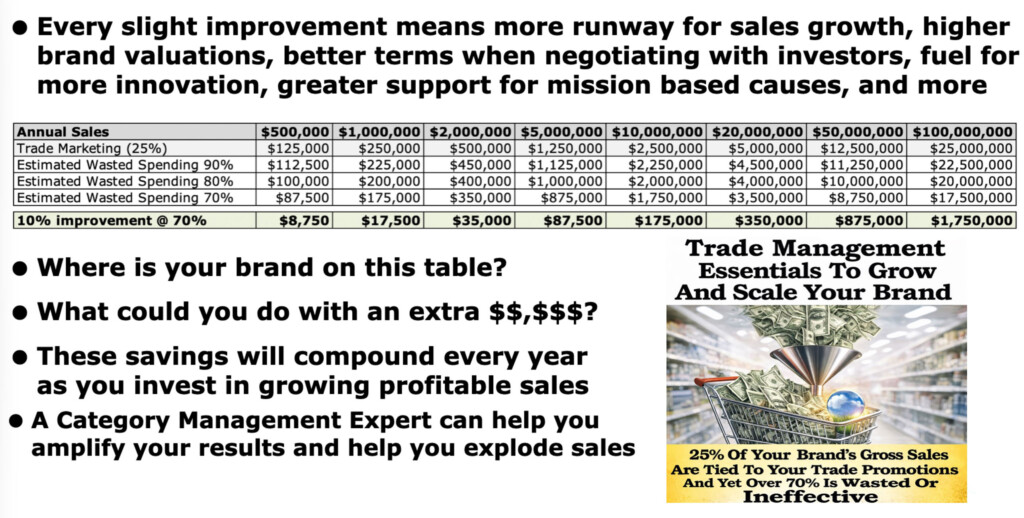
Trade Marketing represents about 25% of a companies gross sales and yet 70% or more is wasted or invective. This page will help improve your trade spending ROI.
2. Trade Marketing in Plain English
Think of trade marketing like medicine.
- Category Management = the doctor (understands the full system)
- Category management is the foundation. It explains how shoppers behave and how retailers make decisions.
- Trade Marketing = the specialist (applies targeted solutions)
- Trade marketing applies those insights to promotions, spend, timing, and execution.
Trade marketing is a specialty within category management.
Not all companies manage Trade Marketing this way, the reason they are not getting the highest ROI.
Without that foundation:
- promotions become guesswork
- spend becomes reactive
- results become inconsistent
With it:
- decisions become clear
- trade becomes strategic
- growth becomes repeatable
3. What Trade Marketing Is (and Is NOT)
❌ Myth
Trade marketing = discounts and promotions
✅ Reality
Trade marketing = a system to influence shopper behavior and retailer performance
❌ Myth
More promotions = more sales
✅ Reality
Bad promotions subsidize existing demand instead of creating growth
❌ Myth
Retailers ask, brands comply
✅ Reality
Brands that bring insight earn trust—and better outcomes
4. Why Trade Marketing Fails
Trade marketing usually fails because brands rely on tools without understanding the strategy behind them.
Trade marketing platforms are useful—just like accounting software is useful.
But software doesn’t make you an expert.
Trade marketing fails when brands:
- rely on tools without strategy
- say “yes” without thinking
- measure activity instead of impact
- operate in silos (sales vs finance vs ops)
A dashboard is not a strategy.
Without:
- shopper insight
- retailer logic
- incrementally
you’re guessing.
And guessing is expensive.
Brands end up saying “yes” to six promotions a year—without ever asking whether three smarter promotions would deliver better results for everyone involved.
Why category management gives trade marketing its edge
Here’s the uncomfortable truth:
Trade marketing without category management is why brands burn cash.
Category management provides:
- shopper context
- retailer logic
- decision frameworks
- clarity on what actually drives growth
Trade marketing applies that understanding to:
- promotion selection
- timing and cadence
- spend allocation
- execution standards
- post-event learning
This is the approach we teach at Retail Solved—and it’s why trade marketing has been a differentiator throughout my career.
5. The System Behind Effective Trade Marketing
Trade marketing only works as a system:
- Planning & forecasting
- Promotion strategy
- Spend discipline
- Retailer alignment
- Execution
- Measurement
- Shopper insight
- Learning loops
- Post-event analysis and learning loops
Miss one—and everything weakens.
Trade marketing usually fails because brands rely on tools without understanding the strategy behind them.
Trade marketing platforms are useful—just like accounting software is useful.
But software doesn’t make you an expert.
6. Incrementally vs. Subsidized Sales
This is the most important and the most misunderstood concept in trade marketing.
Subsidized Sales
- Sales that would have happened anyway—now discounted
Incremental Sales
- Sales that only happen because of the promotion
Most brands celebrate volume.
Retailers evaluate incrementally.
If your promotion:
- shifts timing
- discounts loyal buyers
- pulls demand forward
…it may look successful but actually destroy value.
Trade marketing is not about running promotions.
It’s about running incremental promotions.
Why incrementally matters so much
Incrementally determines:
- whether a promotion grows the category
- whether it improves retailer profitability
- whether it strengthens or weakens your brand
Brands that understand this stop chasing activity and start designing promotions that actually change shopper behavior.
That’s when trade spend starts working harder.
7. How Retailers Actually Evaluate Promotions
Retailers don’t ask:
“Did sales spike?”
They ask:
- Did it increase total category sales?
- Did it attract new shoppers or new occasions?
- Did it increase basket size?
- Did it improve margin dollars?
- Did this drive incremental units?
- Did it create operational complexity without payoff?
- Did it maintain margin?
Promotions that check these boxes earn trust.
Promotions that don’t quietly lose support—even if they look “successful” on paper. Ineffective promotions erode those those things.
This is the shift:
👉 From brand logic → retailer logic
When you speak retailer logic, everything changes.
What retailers really want from brands
Retailers want:
- fewer, better promotions
- clear expectations
- credible forecasts
- insight they aren’t getting elsewhere
Brands that bring this level of thinking stop being “one of many.”
They become valued partners.
8. The Hidden Cost of Trade Spend
Trade spend isn’t just what you pay.
It also includes:
- margin erosion
- inventory distortion
- operational stress
- forecasting errors
- pricing breakdowns
- lost credibility
These costs compound quietly over time.
Most brands don’t fail because sales drop.
They fail because trade spend quietly drains the business.
Why trade spend is so dangerous when unmanaged
Trade spend grows faster than revenue for many brands.
Why?
- Promotions stack year over year
- Spend decisions aren’t revisited
- Learning loops don’t exist
- “This is how it’s always been done” goes unchallenged
Without discipline, trade spend becomes a tax instead of an investment.
9. Trade Marketing ROI: What Actually Matters
The biggest mistake brands make
Most brands define ROI as:
“Did sales go up during the promotion?”
That’s not ROI.
That’s activity.
True trade marketing ROI asks:
- Were sales incremental?
- What did it cost?
- What would’ve happened anyway?
- What should change next time?
Without these answers, brands repeat the same mistakes—just with better-looking reports.
Trade marketing ROI in plain English
Trade marketing ROI is about getting more impact from every dollar you spend.
That often means:
- fewer promotions
- smarter promotions
- better timing
- tighter execution
- clearer learning loops
Saving 10–20% of trade spend frequently does more to extend runway than chasing incremental top-line sales.
Free tools to help you take control
Retail Solved offers free tools designed to help brands move from guesswork to strategy:
Promotion Efficiency Calculator
Understand how much of your revenue is going to trade—and where efficiency gains exist. It’s free! Click here to try it out.
Promotion Analysis Tool
Break down individual promotions to identify:
- base vs. incremental sales
- cost drivers
- performance levers
- opportunities to improve ROI
These tools exist to raise the bar across the industry—and help brands earn credibility with retailers.
It’s free! Click here to try it out.
10. Promotion Strategy vs. Execution
This distinction separates brands that grow from brands that stall.
Promotion strategy = WHY
- What behavior are we changing?
- Who are we targeting?
- When does this make sense?
Promotion execution = HOW
- Pricing
- displays
- placement
- support
Most brands skip strategy.
Execution without strategy = expensive motion
11. Retail Promotion Planning & Forecasting
Retail promotion planning and forecasting is the discipline of aligning resources—people, product, money, and timing—so you can reach your objectives and satisfy shoppers.
When done well, it builds trust internally and at retail.
When done poorly, it burns cash, creates out-of-stocks, frustrates retailers, and shortens runway.
This page explains how to do it correctly—and why it should become part of your regular operating rhythm, not an afterthought.
Why promotion planning and forecasting matter more than ever
Most brands treat promotion planning like a last-minute exercise.
A retailer asks for a forecast.
A number gets filled in.
Everyone hopes it works.
That approach used to be tolerated.
It isn’t anymore.
Today:
- retailers expect precision
- supply chains are tighter
- capital is more expensive
- shoppers are less forgiving
Promotion planning and forecasting is no longer optional.
It’s how strategy turns into results.
Promotion planning and forecasting in plain English
Promotion planning answers:
- What are we trying to achieve?
- Which shoppers are we targeting?
- What behavior are we trying to change?
Forecasting answers:
- What do we realistically expect to happen?
- How many units will we sell?
- What does success actually look like?
Together, they form the bridge between:
- strategy and execution
- ambition and reality
- promises and performance
Without that bridge, everything else wobbles.
Why most promotion forecasts fail
Most promotion forecasts fail because they are disconnected from the rest of the business.
Brands try to forecast promotions in isolation—without aligning:
- finance
- sales
- production
- inventory
- distribution
- execution capability
But forecasting is how you reach your objectives.
If your goal is to grow 5% over the next 12 months, promotion planning and forecasting must be fully aligned with how the business operates—end to end.
When it isn’t, brands lose runway quietly and quickly.
What brands think forecasting is vs. what it actually is
❌ What brands think they’re doing
- Plugging numbers into a spreadsheet
- Guessing based on last year
- Copying retailer expectations
- Hoping execution goes well
✅ What forecasting actually is
- Making informed assumptions
- Stress-testing scenarios
- Understanding constraints
- Communicating expectations clearly
- Creating accountability and learning
Forecasting isn’t about being perfect.
It’s about being intentional, realistic, and aligned.
Promotion planning and forecasting should be routine—not reactive
When forecasting only happens because a retailer asks for it, problems follow:
- inventory mismatches
- out-of-stocks or excess inventory
- margin surprises
- broken trust
When forecasting becomes part of your regular routine:
- teams align earlier
- risks surface sooner
- decisions improve
- execution gets cleaner
Precision compounds.
A simple, effective promotion planning & forecasting flow
This doesn’t need to be complicated.
It just needs to be disciplined.
1. Define the objective
Are you trying to:
- drive trial?
- increase repeat?
- grow basket size?
- protect distribution?
- support a new item?
No objective = no strategy.
2. Identify the target shopper behavior
Be specific:
- new shopper vs loyal buyer
- pantry load vs immediate consumption
- single item vs basket expansion
Promotions without a behavior change goal usually subsidize existing demand.
3. Select the right promotion mechanics
Examples:
- TPR
- ad support
- display
- cross-promotion
- basket-building strategies
Different mechanics drive different outcomes.
4. Forecast base vs incremental sales
This is critical.
- Base sales: what would have sold anyway
- Incremental sales: what only happens because of the promotion
Retailers care about incrementally.
Brands should too.
5. Account for real-world constraints
Your forecast must reflect:
- store count and distribution
- inventory availability
- production capacity
- execution risk
- retailer-specific expectations
Ignoring constraints doesn’t make them go away—it just creates surprises later.
6. Align internally
Before numbers go out:
- finance understands the risk
- sales understands the commitment
- operations understands the volume
- brokers understand execution standards
Forecasts are promises.
Alignment prevents broken ones.
7. Execute—and then learn
After the promotion:
- compare forecast vs actual
- identify what drove variance
- document insights
- adjust next time
No learning loop = repeated mistakes.
What retailers really want from promotion forecasts
Retailers don’t want perfection.
They want credibility.
Retailers want brands to:
- increase shopper traffic
- convert shoppers into loyal buyers
- grow baskets and category sales
Retailers lose trust when brands:
- over-promise
- under-deliver
- fail to execute
- can’t explain results
Good forecasts make retailers feel confident.
Bad forecasts make them cautious.
Planning and forecasting build trust—not risk
Many brands fear forecasting because they think it increases risk.
The opposite is true.
Forecasting:
- reduces surprises
- surfaces issues early
- improves conversations
- builds confidence internally and externally
The risk isn’t forecasting.
The risk is not forecasting.
12. Deduction Prevention (The Missing Lever)
This is where most brands lose money—and don’t even realize it.
Preventing deductions before they occurs could save you thousands each year, perhaps even in a single retailer.
Incase your thinking that you’ve got this covered because you pay someone to manage your deductions, think again. That is an expense you could avoid if the deduction never occurs. That is cash flow that you loose control of until the deduction is resolved. The people managing your deductions will also struggle same as you. This is true even if they use AI
Deductions:
- feel random
- drain cash
- disrupt forecasting
But here’s the truth:
Most deductions are 100% preventable.
WHY DEDUCTIONS HAPPEN
This is part of the Retail Operating System add link
Most deductions come from five places:
1. Sloppy or incomplete promotion agreements
2. Incorrect pricing and vague promotion and allowance dates
3. Poor forecasting and inconsistent shipments leading to out-of-stocks
4. Misaligned communication between brand, broker, distributor, and the retailer
5. Lack of documentation and preventive audits
Deductions are the result of operational drift —
not “bad luck.”
The Deduction Prevention System
1. Build Ironclad Promotion Agreements
If it’s not written clearly, it didn’t happen
This is the single greatest cause of unnecessary deductions in early-stage brands.
2. Control Pricing Integrity Across Every System
One of the silent killers of margin is pricing drift.
Promotions can make this problem worse. Build a solid pricing architecture. This will enhance your promotional effectiveness.
Forecasting is not guesswork.
Forecasting is margin protection.
3. Forecast Alignment With Precision
Most warehouse and retailer penalties come from predictable forecasting errors.
Bad forecasts create operational deductions
4. Use Scorecards to Create Accountability (And Documentation)
Incomplete agreements = deductions you cannot dispute.
Scorecards become your proof when deductions arise.
Track execution and accountability
Why This Works
Distributors and brokers behave differently when they know performance is being documented monthly. This also helps you build trust with your retailer partners.
5. Centralize All Documentation — If You Can’t Prove It, You Can’t Recover It
If you can’t prove it, you can’t recover it
Documentation is your strongest deduction prevention tool.
The most preventable deduction losses occur because the brand has no organized documentation.
Why This Matters
Trade spend is often:
- ~25% of revenue
- mostly unmanaged
- partially wasted
Reducing deductions is the fastest way to:
- improve ROI
- extend runway
- stabilize cash flow
This is not finance.
This is strategy.
13. Where AI Fits
AI is an incredible accelerator.
AI helps:
- analyze data
- model scenarios
- speed decisions
But it does NOT replace:
- judgment
- context
- creativity
- experience
Tools support thinking.
They don’t replace it.
This is why brands that understand the why behind forecasts get far more value from any system they use.
14. What Effective Trade Marketing Looks Like
When trade marketing is done correctly:
- promotions are fewer, smarter, and more profitable
- retailers receive insight, not noise
- execution improves
- margins stabilize
- runway extends
Trade marketing stops feeling like a tax.
It becomes a strategic growth lever.
It becomes your competitive advantage.
Often, it becomes the single most powerful way a brand can extend runway while strengthening its go-to-market strategy.
Trade marketing doesn’t have to be intimidating.
And it doesn’t have to be wasteful.
When fully understood, trade marketing is your secret weapon—helping you outmaneuver larger brands, earn retailer trust, and grow without sacrificing your runway.
15. Where to Go Next
If this changed how you think:
Start Here
Understand the full system: Click here to learn more about the Retail Operating System
Apply It
30 Days to Profitable CPG Growth: Its Free. Click here to start building a profitable brand
Use the Tools
Promotion analysis + efficiency tools: Its Free. Click here to check it out!
Final Thought
Trade marketing is not a cost of doing business.
It is the system that determines:
- how fast you grow
- how long you survive
- how strong your brand becomes
Used correctly, it becomes your secret weapon.