The podcast “Bulletproof Your CPG Brand” focuses on helping emerging CPG brands extend their runway and boost sales. The host, Dan Lohman, emphasizes the importance of protecting the value these brands create, rather than solely focusing on velocity. He highlights three strategies, including fixing promotion agreements and deductions, to achieve this goal.
The show outlines three strategies to help small brands succeed in retail. First, tighten up promotion agreements to prevent unnecessary deductions and maintain cash flow. Second, own your shelf strategy by proactively guiding product placement and ensuring consistent merchandising. Third, align your brand story across all platforms to create a consistent and compelling message that resonates with customers.
Listen where you get your podcast








Like what you’ve heard?
Please leave a review and comment on iTunes
Let me know your most pressing question, I’ll do my best to answer it on a future episode.
If you’re an emerging CPG brand, you’re probably feeling two things right now: 1. pressure on your cashflow, and 2. pressure to grow faster The problem is, most of the advice you’re getting will shorten your runway, not extend it. Today I’m going to show you three simple but powerful ways to extend your runway and boost sales that almost every brand overlooks – and I’ll also share why this show, and my work, have completely evolved to serve you better. Welcome back to the Bulletproof Your CPG Brand podcast. I’m your host, Dan Lohman, founder of Retail Solved. If you’ve been with me for a while, you’ll remember this show as Brand Secrets and Strategies. We published 268 episodes, interviewed the top leaders in natural and organic, and built a strong community of founders and industry pros. Then, I went quiet for a while. Not because I was done – but because I stepped deeper into the work. Let me take a brief moment and step back in time. I had just completed our second successful test pilot as a CEO and cofounder of an innovative startup. We were on a mission to dramatically reduce diabetes and obesity while making food taste good again. With our second successful test pilot under our belt it was time for me to start focusing on how to build and launch the brand. That included raising capital, developing packaging and marketing, building a sales team, and everything that else that goes into launching a successful brand. Being new at this, I realized that there was a lot I didn't know so I turned to the incubators, natural products business schools and industry networking groups. I was a sponge, trying to learn everything I possibly could in a short amount of time. While I learned a lot, the best part was I met brands in all stages of development from prelaunch to brands that were already household names. We had interested investors – but the terms were… brutal. They would have either taken control of the brand or forced us to abandon our mission. And I started hearing the same stories from other founders: great products, passionate missions, but term sheets that felt like trading your company… or your soul. Getting in the trenches was great, but I was hearing a lot of horror stories from other brands in similar positions including those who were having a lot of success at retail. They were all struggling with the same things I was struggling with. They were struggling to get funding, gaining profitable distribution, and getting meaning sales traction despite all of the advice and coaching. The general sentiment was that retailers and distributors looked at us more like ATM machines than valued partners and cherished brands. It felt like everyone had their had out and we had targets on our backs. The advice that I was getting was generic at best. I knew that if I had followed most advice that I'd been given, I would run through all our cash in a heartbeat and we'd never launch. While it was important to learn how the game was played and what to expect, none of the advice I had received was going to guarantee our success or differentiate our brand in a crowded category. That’s when I saw, from the inside, how broken a lot of the advice is that founders get – especially around funding, retail, and growth. That season made something crystal clear to me: Thinking back on those experiences is why I pressed pause. I went back into advanced strategy work, doing the kind of work big brands pay a lot of money for, so I could bring those insights back to you. While working to launch my brand I was also a regularly featured contributor to just about every industry publication writing hundreds of articles focused on answering questions founders would submit. That led to speaking, mentoring, and helping entrepreneurial brands. I’ve also worked for big brands in sales and was classically trained in mainstream CPG, as a category management expert, the first person certified at the highest level of category management proficiency – a Certified Professional Strategic Advisor (CPSA), plus grocery manager, store manager, District Sales Manager, broker liaison, etc. Big brands invest heavily in developing their talent. They sent me to multi-day trainings month after month, led by the best subject-matter experts in the industry. I learned more there than I did in college – and I want to open that playbook for you.” So this show has evolved from Brand Secrets and Strategies to Bulletproof Your CPG Brand – and my website is now RetailSolved.com. The focus is sharper: - turning retail relationships into revenue - Developing a multi-channel strategy to future proof your brand - maximizing your trade marketing ROI - improving broker performance - and converting occasional shoppers into loyal evangelists In short, extending your runway while you grow sales. The result is giving your brand the unfair competitive advantage it deserves. You’ll hear solo training episodes from me, practical playbooks you can implement right away, plus conversations with some of the brightest minds in CPG – many of whom you’ll recognize from past episodes and from your LinkedIn feed. As with all episodes, at the end of every show there is a free downloadable guide to help you go deeper into the topics we discuss so stay tuned and don’t forget to hit subscribe to be the first to know when new episodes drop. Reach out and let me know what your most pressing issues are - you know the things that keep you up at night and I will do my best to get you the answers you deserve on future episodes. The story I shared at the intro is true and it is something I had never shared publicly before. While it helped form my appreciation for what it means to be a entrepreneurial founder, this show is about you and your journey. Just know that I have walked in your shoes as a founder and by your side as a mentor for hundreds of brands. I will share more of my story on future episodes along with what happened to that venture. Stay tuned. Let’s get into today’s topic: three overlooked ways to extend your runway and boost sales – without chasing more discounts, more ad spend, or more chaos. First, Context: Why “Velocity” Is Failing You Most of the industry worships one number: velocity – units per store per week. If you’re a small natural brand, that’s usually the metric used against you. Here’s what doesn’t get talked about enough: small natural better-for-you brands often drive more profitable sales contribution and profitable category growth than the big, fast-moving brands. Without them, many categories would be flat or declining. I managed to originally prove this in a feature article I wrote for the 2016 category management handbook and I’ve proven it several times since across multiple categories. Let me explain. Shoppers today are more health conscious and as a result they carefully read labels and they pay close attention to what they put into their bodies. Food is medicine continues to be a growing trend. Therefore health conscious shoppers are less price sensitive and they will pay a premium for products that have the attributes they are looking for like less sugar, higher protein, organic, gluten-free, plant based, etc. Those brands contribute more profitable dollars to the category - their contribution. This is what the retailers take to the bank. Conversely, big brands lacking those attributes tend to drive sales with deep discounts effectively commoditizing their brands and the categories as a result. Those brands pull profitable dollars from the categories and provide no real unique value the retailer. Their customers chase price and are not loyal to any one retailer. Natural better-for-you brands often bringing in the most loyal shoppers, the biggest baskets, and the true innovation shoppers are looking for today. But if you’re only judged on velocity, you look like you’re underperforming. Let’s change that conversation. So extending your runway isn’t just about cutting costs or getting cheaper ingredients. It’s about protecting the value you already create – at retail, in your trade spend, and with your most loyal shoppers. It’s also about the contribution you provide to your retail partners. Now lets go into the three strategies. Strategy #1: Fix Your Promotion Agreements Let’s start with something painfully unsexy… that quietly bleeds a ton of your cash: retail promotion agreements and deductions. Most brands treat these forms as admin paperwork. In reality, they’re the legal backbone of how your discounts get taken – and how you challenge deductions. So why does this matter, consider this. In episode 197, Eric Skae shares a story where he received a check for $12.31 on a $16,000 sale. Deductions can derail or even bankrupt a brand, especially small brands. Go back and listen to the episode for the specifics and how Eric handled it. Here are some Key points to consider: Vague, sloppy, or incomplete forms = deductions you can’t dispute. Many brands then pay a third party to reconcile deductions that should never have happened. Remember that even if your paying someone to managing your deductions, that is an expense - money you might not need to spend in the first place. To make matters worse, you are tying up your cashflow while you settle your deductions. Can you afford to do with out your your receivables for months at a time? Retailers do appreciate clean, accurate paperwork – it makes their lives easier. Keeping your cash ready and available gives you more runway to grow and scale your brand Simple strategies to fix this include: 1. Slow down and complete every field on every form clearly. Each sales deal sheet is a contract. Treat it with the respect and attention to detail you would treat any other contract. 2. Include detailed specifics. Specify the deal start and end dates, specific items to be promoted by UPC, discount amounts by each item UPC, specify where the items will be displayed and who will be responsible for maintaining the display. Don’t leave anything to chance. You should also include how much product you recommend each store needs to have in their back room to support each promotion - we’ll discuss why this is important in future episodes. 3. Keep a clean digital record organized by retailer and date. 4. Retailers will appreciate your attention to detail. This will set you apart from your completion. You don’t need a fancy system to start – you just need discipline. Think of your promotion agreement as your first line of defense against unnecessary deductions. Every deduction you prevent is real cash you keep. That’s runway to help you grow and scale. Strategy #2: Own Your Shelf Strategy Episode 104 is a real life story where a podcast fan shared their frustrations when trying to to support a friend who just launched their brand. They went into a retailer to purchase their friends product, but the product wasn’t where they expected to find it. They searched for a long time and finally involved a store clerk. They still couldn’t find it. Finally they found it in the wrong category far away from where her friend told her to look for it. This is a colossal mistake that many brands make. Let me explain. The brand spent a lot of money to promote the product, that was wasted. The retailer expected new excited shoppers in their store and instead got frustrated customers - not a good first impression. Now the brand needs to spend a lot of money to have the product re-merchandised and that could take several weeks. Think of all the additional lost sales between now and then. A simple mistake like this could potentially bankrupt the brand. Unfortunately, I hear these stories like this a lot. Go back and listen to that episode to learn more and how to avoid making those critical mistakes yourself. The key takeaways are: Shoppers can’t buy your brand if they can’t find it, that includes poor or inconsistent merchandising in the correct category even across multiple stores within a retail chain. Few if any shoppers will go on a scavengers hunt to find your brand, especially time starved shoppers. When a product is placed in the wrong category or section, it hurts your velocity and retailers quickly loose faith in your brand making it ripe for being discontinued. Key points: Your packaging and shelf placement are your brands first impression - make it a good one! Retailers are not experts in every single category and subcategory - they need your guidance. If you don’t proactively guide your product placement, you’re leaving it to chance. Retailers rely on others who do not have a vested interest in your success. Frequently the resources they use don’t rely on tested merchandising strategies. To fix this: 1. Always include a recommended schematics when presenting new items - I have offer a creative solution in the guide at the end of this episode. 2. Show where the shopper expects to find your items, with fact-based reasoning. 3. Tie your product placement to how your core customer shops the store (e.g., “When she buys X, she also looks for Y”). Remember: If customers can’t find you brand, they can’t buy you brand. And if they can’t buy your brand, nothing else matters – not your social media, not your beautiful packaging, not your mission. I go into this deeper in the New Item Essentials Guide available at the end of this episode. Strategy #3: Align Your Brand Story Everywhere Now I am going to share with you the simplest and yet most consequential mistake that every brand makes. Its inconsistent messaging. I’ve had the privilege of working with brands from pre-revenue to multi-billion dollars in sales and they all have this problem. Consideration this. If you asked 100 people from all over the country to tell you what came to mind when they thought of your brand, you would probably get dozens of different answers. This is why your marketing does not resonate and this is why your trade spending is ineffective. This is also why your brand does not stand out on a crowded retail shelf and why shoppers frequently chose your competitors over you. Now play the game with an established big brand. You will get the same results. Why, because brand marketing and messaging is inconsistent at best. That confusion is expensive. A confused mind always says no. Always! A consistent, compelling story is one of the cheapest, highest-ROI ways to grow sales and extend runway. Teach the basics throughout your entire organization: 1. Founder-level story: why your brand exists and who it’s for. 2. Translate that into a simple, repeatable “turnkey sales story” for your team. 3. Make sure it shows up everywhere: sales decks, promotions, packaging, social media, retailer conversations. Everywhere! The reason this matters is because when you bake that messaging into your brands DNA, then it shows up in everything you do and it then gets transferred to your ideal customers. Don’t believe me. Consider Patagonia? Its just about the only brand I can think of that does this and does this well. Their clothes are iconic and they are symbol for what the brand stands for. Their products, their marketing, their policies – they all tell the same story. That’s what you’re aiming for in your own way. This was foundation of why I created the free Turnkey Sales Story Strategies course and how it helps teams communicate with the same passion and enthusiasm as the founder - the primary building block missing from every brand I’ve every worked with. Recap: I just gave you 3 free simple easy to follow strategies you can implement today to start saving money and increase your runway 1. Tighten up your promotion agreements to stop unnecessary deductions. 2. Own your shelf strategy so shoppers can easily find and buy your products. 3. Align your brand message so everyone tells the same compelling story. None of these require a giant budget or a huge team. They require attention, intention, and a commitment to being just a little better than the brand next to you on the shelf. Over the next several episodes, I’m going to go deeper into each of these, plus topics like: - Subscribe and follow the show. - Connect with me LinkedIn. - Download the New Item Essentials Guide at the end of this episode and check out the Turnkey Sales Story strategy course. You don’t have to play the same game big brands play to win at retail. You just need to know how the game works for you – and how to stack the odds in your favor. I’m here to help you do exactly that.
Enter your name and email address below and I'll send you periodic brand building advice, tips and strategies.
**emerging brands don’t just need more advice – they need better strategy, from people who’ve actually sat in the founder seat and across the table from retailers.”
I’m Dan Lohman, and this is the Bulletproof Your CPG Brand podcast.
Sign up to receive email updates
FREE Trade Promotion ROI Calculator:
Click Here To Maximize Sales And Profits
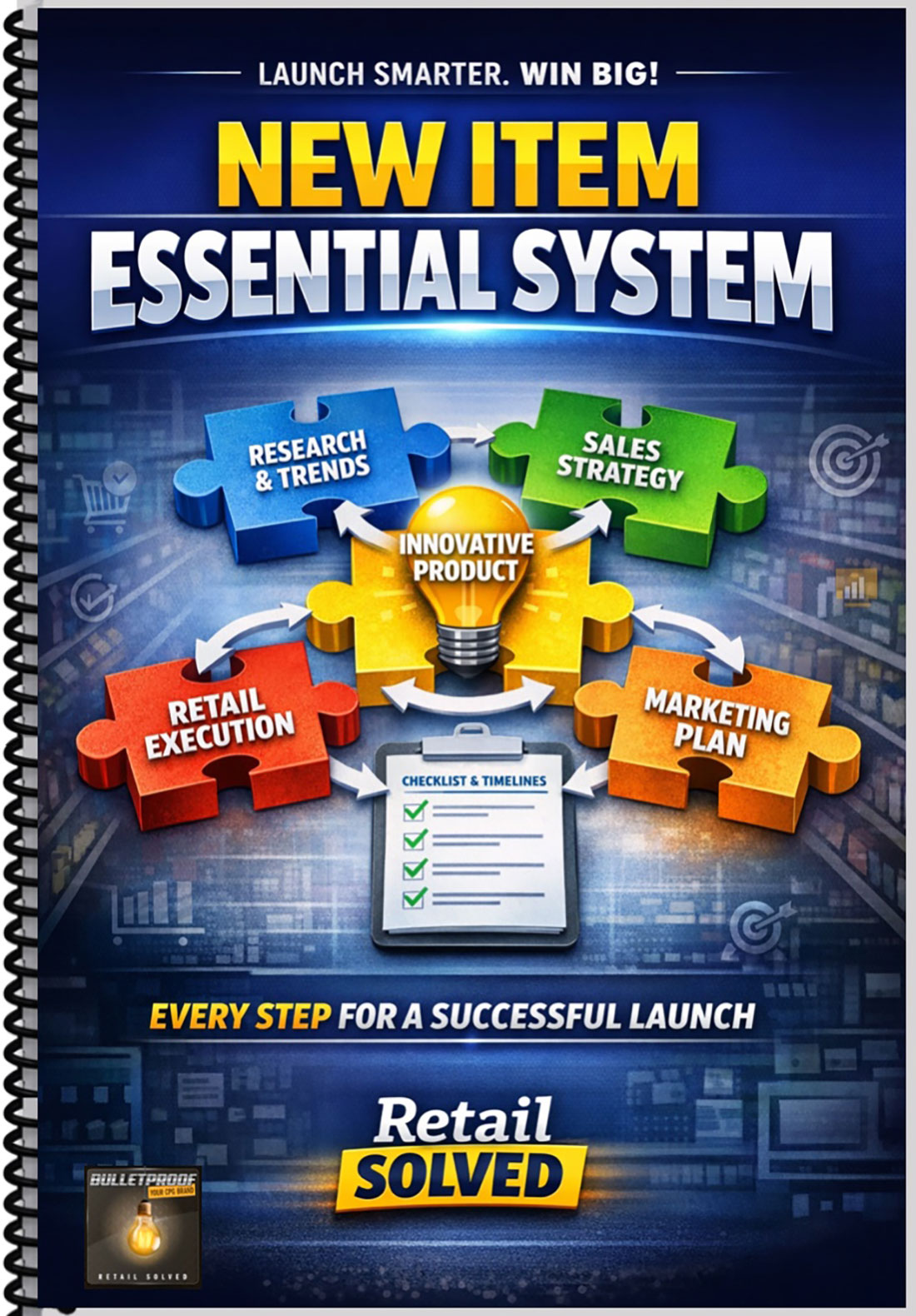
Most new items do not fail. They never had a real chance.
Pressure-test the shopper, placement, retailer value, execution, economics, and support behind the launch.
Image is the property of CMS4CPG LLC, distribution or reproduction is expressively prohibited.