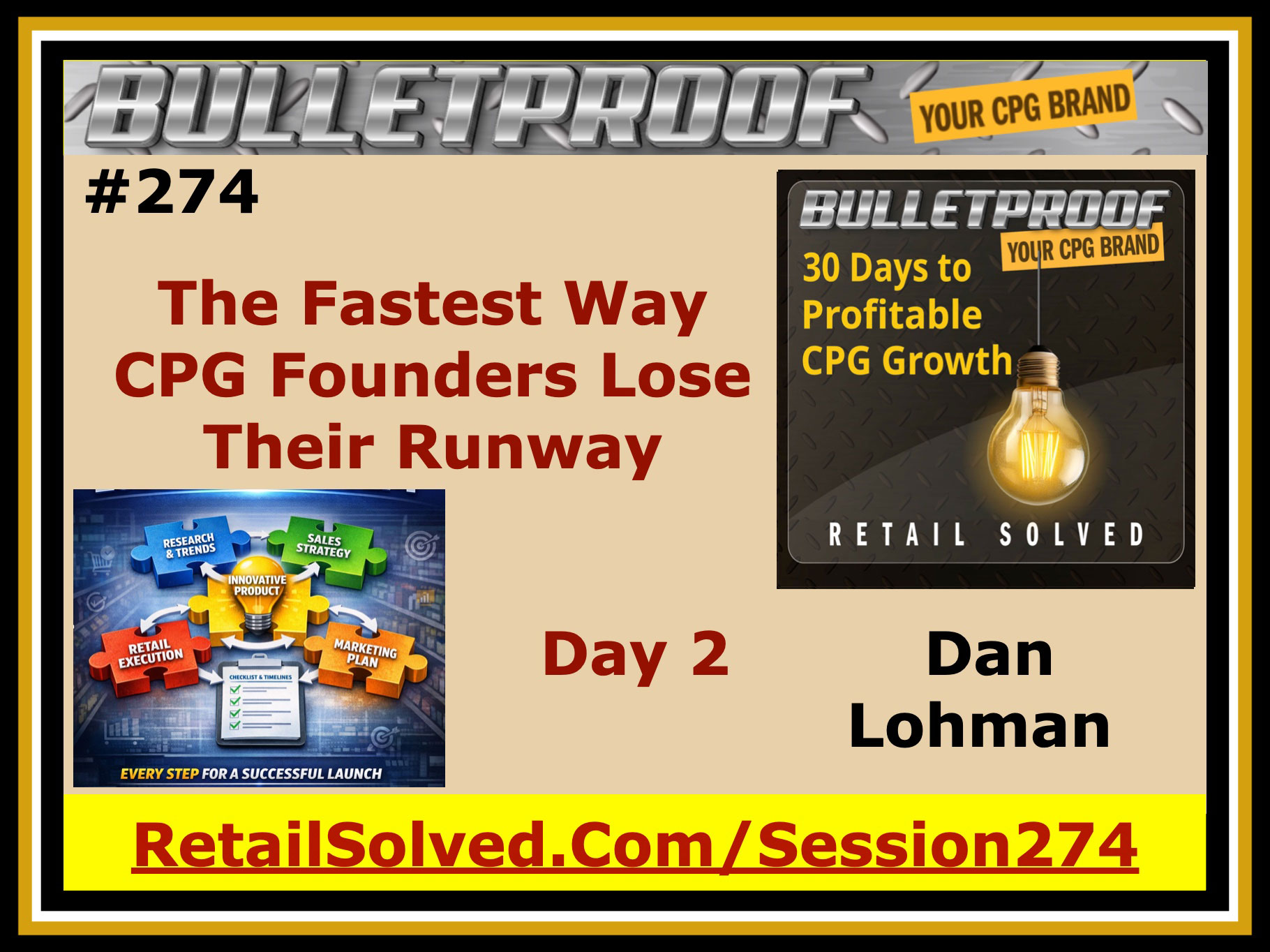
The fastest way to lose runway isn’t bad product—it’s not understanding how your business actually works. In Day 2 of 30 Days to Profitable CPG Growth, I break down why founders avoid the financials, operations, and retail mechanics that determine success. You’ll learn how misunderstanding sales, velocity, and execution caps growth, why guessing kills confidence, and how Category Management gives you control. This episode helps you move from reactive to strategic—so you can lead with clarity and scale with confidence.
Understanding how your business works, particularly your sales engine, is crucial for scaling and achieving growth. This involves knowing the rules of the game, simplifying your business to its core functions (making and selling), and learning from both successes and failures. By mastering these aspects, you can gain a competitive advantage, build trust with retailers and investors, and align your team for success.
For additional inspiration listen to the following Bulletproof Your CPG Brand podcast episodes:
🎙️ 42 How We Need To Inspire & Educate Shoppers About Brands, Gary Hirshberg with Stonyfield
🎙️ 136 The Retail Game – What You Need To Know to Win, Bob Burke with Natural Products Consulting
🎙️5 Using Advanced Strategies to Boost Retail Sales, Adam Lowry with Ripple Foods and Method
🎙️ 126 Well Defined Business Strategy for Lasting Success, Dustin Finkel with KAPOP
Day 2 of the Free 30 Days to Profitable CPG Growth
Tip of the day: Commit to learn and appreciate the different roles in your business. This will keep you grounded and help you better understand how your business works.
Listen where you get your podcast








Like what you’ve heard?
Please leave a review and comment on iTunes
Let me know your most pressing question, I’ll do my best to answer it on a future episode.
Welcome to day 2: Episode 274 — Understand How Your Business Works with Confidence
If you’re honest, there are probably parts of your business you avoid. You’re not alone. But here’s the truth you can’t afford to ignore: If you don’t deeply understand how your business works—especially how your sales engine works at retail and online—you’ll always feel like you’re guessing. You’ll be reactive instead of strategic. And that uncertainty will put a hard cap on your growth. Let me explain. Because no sales… no business.
And not understanding how sales really work at retail is one of the fastest ways to sabotage your own runway. Step 1: Know the Game You’re Playing On Episode 136, Bob Burke laid this out in very stark terms—what’s expected of you if you want to launch or scale a brand in natural. The costs. The timelines. The support requirements. The reality behind the romantic story. Those aren’t “nice to know” details. Those are the rules of the game. If you follow the same traditional strategies everyone else is taught—overspending on trade, accepting every promotion, chasing distribution at all costs—you’ll struggle. Your margins will suffer. Your cashflow will be strained. And you’ll never get the competitive edge you need to level the playing field with the most sophisticated brands. Step 2: Strip Business Down to Its Core Consider this. Once you identify what’s required to hit your goals, you can work backward and make sure every piece is in place: This is how you eliminate out-of-stocks, maximize every selling opportunity at shelf, and execute cleanly across your entire sales funnel. Step 3: Learn the Story Behind “Overnight Success” In Episode 42, Gary Hirshberg talked about the “overnight success” of Stonyfield that was many years in the making. The reality: constant problem-solving, constant adaptation, constant learning. The brands that last are not the ones that never fail. They’re the ones who treat failure like data. So be willing to fail—as long as you’re equally willing to learn from it. Step 4: Why Category Management Exists (and Why You Need It) If you look back in time, big brands used to approach retail the way a lot of natural brands still do today: It was inefficient and, frankly, destructive. It trained shoppers to focus on price at the expense of quality. It drove us toward a throwaway culture—cheaper ingredients, lower durability, constant discounting. In the early ’90s, when Walmart exploded and independents started consolidating, brands and retailers needed a better way. They needed: That’s when Category Management was born. The problem?
In natural, these skills are often ignored or watered down into what I call “push-button category management.” You’re handed canned topline reports and told that’s enough. To win, you need to go deeper. You need to bring actionable insights to the retailer—insights they can’t get from anyone else. Throughout this series, I’ll show you how. Step 5: Learn Every Role in Your Business Don’t make that mistake. I believe an effective leader needs to: When you do this, your team becomes your early warning system. They help you spot bottlenecks, avoid landmines, and fix problems before they show up on a retailer scorecard or in your P&L. Let me take you behind the curtain for a moment… But the marketing team had a completely different strategy. Sales wasn’t aligned. Promotions didn’t support the launch timing. Merchandising was inconsistent. Shoppers were confused. The result? The product failed—not because it was bad, but because the company was siloed they were incapable to working together as a cohesive unit. That’s the Achilles heel of big brands. You can turn that into your advantage. When your team is aligned, communicating, and focused on the same shopper and retailer objectives, you become far more effective—and far more attractive to your retail partners. Step 6: Your Customer Is Your Ultimate Advantage Years ago at Unilever, we launched a groundbreaking stain treater. Consumers loved it. The marketing splash was huge. The product should have dominated. That’s what happens when you don’t understand how the business works at the shelf. Your shopper is unique. They understand the value of your clean-label, better-for-you product. They build specific baskets around it. If you can understand how they shop and what else they buy when your product is in their cart—and then bring those insights to your retailers—you gain a sustainable, unfair competitive advantage. Day 2 Action Item: Map How Your Business Really Works Closing: You Can Learn This. You Can Master This. Tomorrow, in Episode 275, we’re going to build on this by talking about the specific numbers and KPIs you need to track so you can manage your business like a pro and extend your runway. Make sure you’re subscribed so you don’t miss it.
Share this with a founder who feels overwhelmed by the “business side” of their brand.
And download the free guide for this episode For additional inspiration listen to the following podcast episodes: Next listen to Episode 85 Using Advanced Strategies to Boost Retail Sales, Adam Lowry with Ripple Foods and Method Then listen to Episode 126 Well Defined Business Strategy for Lasting Success, Dustin Finkel with KAPOP And more importantly, it’s that strategy that can help remove a lot of the obstacles that derail’s other brands. This is one of my favorite episodes because, in this episode, we talk about how to leverage the best of the advanced strategies used in mainstream while keeping natural natural. Tip of the day: Commit to learn and appreciate the different roles in your business. This will keep you grounded and help you better understand how your business works. Thank you for listening. This episode has an accompanying video with illustrations and additional information I can’t share on an audio podcast. You can watch it at retailsolved.com/30daychallenge. You can get the show notes for this episode by going to RetailSolved.com/Session274. Tomorrows episode is Surround Yourself With Trusted Advisors and Experts. This episode will build on today’s conversation. Thank you for listening. I look forward to seeing you in the next episode.
Enter your name and email address below and I'll send you periodic brand building advice, tips and strategies.
Day 2 of 30 Days to Prosperity
The financials. The ugly back-office stuff. The operational details that don’t feel as exciting as product innovation, branding, or being the face of your company.
Most founders struggle with the day-to-day mechanics of running a business. It’s normal. You didn’t launch your brand because you love debits and credits or because you dreamed of managing deductions and reconciliations.
You cannot scale what you don’t understand.
In Episode 273 we talked about your foundation—your business plan, your goals, and your ability to think ahead instead of constantly reacting. Today we’re going to build on that by helping you truly understand how your business works so you can lead with confidence.
Before you can have any success launching or growing your brand, you need to know:
What game you’re playing
What the objective is
What the rules are
And how to leverage those rules to your advantage
The good news?
Once you understand those rules, you can stop playing defense. You can start using the advanced strategies we’re talking about in this series, my podcast, my webinars, and my guides to maximize every opportunity instead of constantly feeling like you’re behind.
This series exists to change that.
Let’s simplify.
Your business is about two things:
Making things
Selling things
That’s it.
The founders who win are the ones who:
Truly understand the “make” side (capacity, ingredients, packaging, lead times, costs)
Truly understand the “sell” side (distribution, velocity, shopper behavior, promotions, retail expectations)
If you want to grow 20%, what does that actually mean?
How many more units need to leave your warehouse?
How many more stores or SKUs do you need?
What velocity do you need in each account?
How many promotions will it take—and can you support them?
How much incremental inventory do you need on hand?
The production capacity
The packaging
The logistics
The data and reporting
The retail execution
This is how you start thinking like a category leader, not just a product supplier.
None of us are born knowing how to do this.
We love to tell the “overnight success” story, but we skip the years of grinding, testing, failing, and adjusting.
When you understand how your business works, failure becomes feedback, not a verdict. You can see why something didn’t work and fix it, instead of telling yourself the story that “retail is broken” or “we just need more money.”
Yesterday I talked about strategy and why your business plan needs to be robust and alive. Today I want to connect that to how big brands operate—and how that can give you an advantage.
Buy your way onto the shelf
Use relationships and influence
Compete on price
Rely on generic promotions
Less excess inventory
Fewer out-of-stocks
More effective promotions
Better assortments
Smarter innovation
Category Management is the advanced strategy toolkit big brands still rely on today to drive profitable growth. It’s how they plan, forecast, optimize assortments, and align promotions with shopper behavior and retailer goals.
It’s not.
Those same reports are available to your competitors. They won’t differentiate you. They won’t tell your unique shopper story. And they won’t give the retailer anything they don’t already know.
Have you ever watched Undercover Boss?
I love that show because it perfectly illustrates how disconnected leadership can become from the day-to-day realities of their own company. Senior executives are often shocked by what they see when they walk in their employees’ shoes.
When I was the grocery manager at Price Club (now Costco), we were encouraged to constantly find better, more efficient ways to do our jobs. Something as simple as “how many cuts does it take to open this box?” mattered. Most people made four cuts. We figured out how to do it with two—and that mindset applied to everything.
Understand every major role
Respect the people doing the work
Keep communication clear and open
Encourage cross-training and shadowing
I once worked on a project for a large CPG company I’d always admired. They brought me in to help launch a healthy snack. I built a full path-to-market plan: clear merchandising strategy, a robust category overview, everything.
Traditional focus groups and generic research often miss the point. They pull in people who don’t understand your category, don’t shop natural, and don’t value what you bring to the shelf.
But the refill—the backbone of our strategy—didn’t fit on most store shelves.
No one had asked the sales or category management teams how the category was actually merchandised. Fixing it would have meant either re-merchandising every store or redoing the packaging at enormous cost.
So they killed the product.
That’s what this entire series is about.
Today, I want you to:
List the core functions in your business
Making (operations, sourcing, production, logistics)
Selling (sales, trade, eCommerce, marketing, category)
Write down what you know—and don’t know—about each.
Where are you confident? Where are you guessing?
Identify one role you need to understand better.
Commit to shadowing, interviewing, or working alongside that function in the next 30 days.
Capture one question you’ll start asking in every internal and retailer conversation:
“How does this decision impact the shopper, the retailer, and our ability to execute?”
What gets written down gets done. This is how you shift from guessing to leading with confidence.
You were not born knowing how to launch and scale a brand. No one is. But you can learn how your business works at a deep level. And when you do, everything changes:
Retailers trust you more.
Investors see you as less risky.
Your team feels more aligned.
You gain control over your growth instead of feeling dragged by it.
My mission is to help you get more runway from your available resources, get on more store shelves, and into the hands of more shoppers—while converting occasional customers into loyal evangelists and earning an equal seat at the table.
You can do this. I’m here to help you prove it.
Episode 136 The Retail Game – What You Need To Know to Win, Bob Burke with Natural Products Consulting
I already talked a little bit about this podcast and why this matters. Bob does a phenomenal job painting a stark reality of what's expected of you as a new brand or as an existing brand that wants to grow and scale. You need to know how the rules and how the game is played.
Learn how using advanced strategies can give your brand a competitive edge and boost sales with retailers. Adam, co-founded Ripple Foods and Method Products, a green cleaning company, to influence consumer behavior towards sustainability. Ripple Foods, a plant-based milk brand, focuses on strategic partnerships and product innovation to provide value to retailers and consumers.
In this episode, we have a great conversation about the importance of having a solid business strategy and how that strategy is going to give you the bandwidth that you need to succeed and how that strategy is going to give you the additional bandwidth that you need to grow and scale your brand.
Sign up to receive email updates
FREE Trade Promotion ROI Calculator:
Click Here To Maximize Sales And Profits
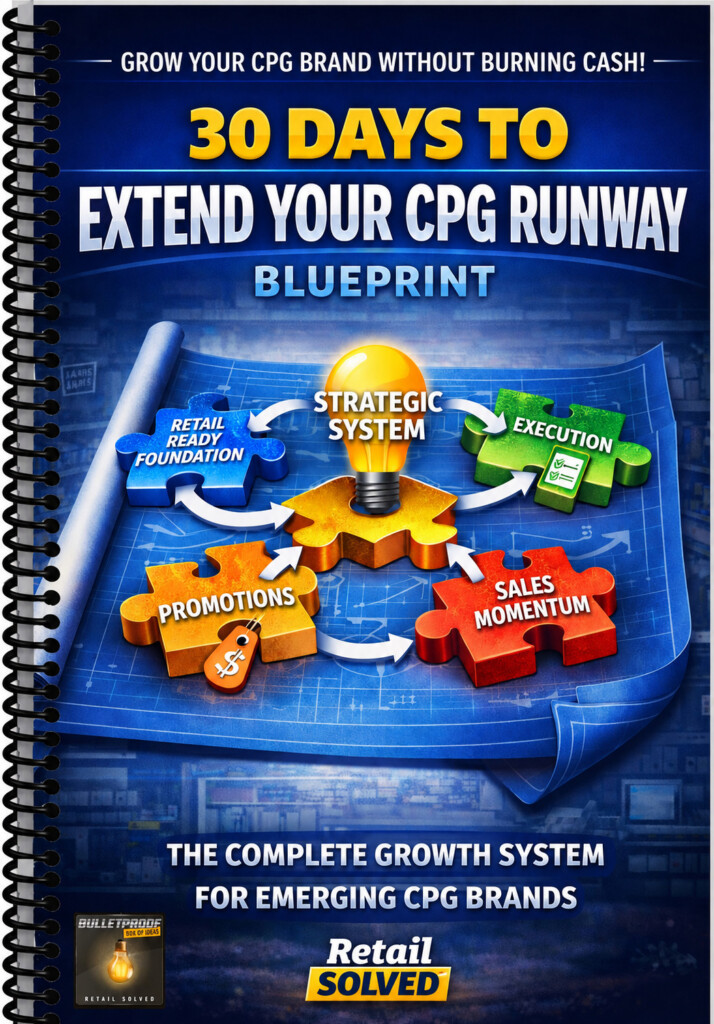
Extend your runway one focused day at a time.
Build the retail fundamentals behind profitable growth with one practical skill, one action, and one better decision each day.
Image is the property of CMS4CPG LLC, distribution or reproduction is expressively prohibited.