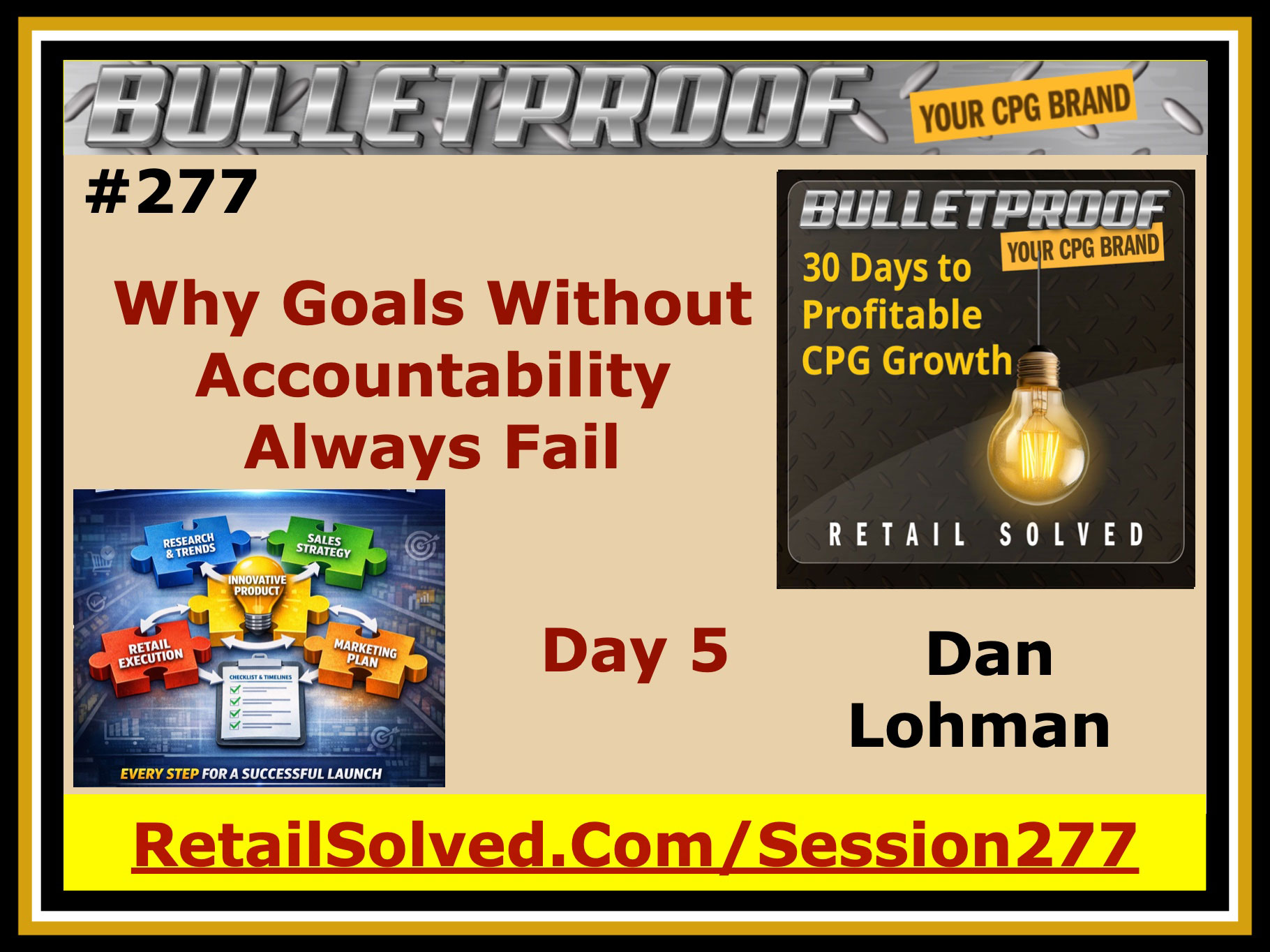
Big goals mean nothing without structure and accountability. In Day 5 of 30 Days to Profitable CPG Growth, I explain why most founders set goals that sound inspiring—but never move the business forward. You’ll learn how to turn ambition into execution using SMART goals, scorecards, and measurable benchmarks that guide decisions, align teams, and protect your runway. This episode shows you how disciplined goal-setting becomes strategy—and why accountability is the difference between wishing and scaling.
Traditional goal-setting often fails because it lacks specificity, measurability, and accountability. To achieve ambitious goals, founders should use the SMART framework (Specific, Measurable, Attainable, Realistic, Timely) to break down goals into actionable steps. A business plan and scorecard are essential tools for tracking progress, maintaining accountability, and ensuring alignment across the team.
Action step: pick one goal, assign an owner, a number, and a weekly checkpoint.
What goal are you committing to this quarter?
For additional inspiration listen to the following Bulletproof Your CPG Brand podcast episodes:
🎙️ 91 Disrupting The Category with Innovation in Products, Justin Gold with Justin’s
🎙️117 Maximize Broker Effectiveness for Sales Success
🎙️ 202 11 Proven Strategies To Increase Your Market Basket Size And Grow Sales
Day 5 of the Free 30 Days to Profitable CPG Growth
Tip of the day: Don’t Be Afraid To Have Audacious Big Dreams. Disruptive Brands Are Leading Key Growth Trends. Use SMART Goals To Remain Focused And On Track
Listen where you get your podcast








Like what you’ve heard?
Please leave a review and comment on iTunes
Let me know your most pressing question, I’ll do my best to answer it on a future episode.
Welcome to day 5: Episode 277 — How To Develop Strategic Goals With Accountability Strategies Don’t be afraid to dream big.
Don’t be afraid to set audacious, disruptive, ambitious goals.
The most successful brands in natural—the true category leaders—started with a bold vision and the clarity to pursue it with intention. Why Traditional Goal-Setting Fails Most Founders Learn From People Who’ve Already Reached the Summit Big Goals Require Small, Consistent Steps Your Mind Focuses on Whatever You Aim At SMART Goals: Your Framework for Clarity & Execution 1. Specific 2. Measurable 3. Attainable 4. Realistic 5. Timely Your Business Plan Must Absorb Your Goals Scorecards: The Most Underrated Accountability Tool What’s Holding You Back? Day 5 Action Item: Build Your First SMART Goal Closing: Your Goals Are the Lighthouse for Your Business For additional inspiration listen to the following podcast episodes: Episode 117 Maximize Broker Effectiveness for Sales Success The reason this matters is because I believe that you develop and manage the strategy within your brand, and then hold your broker partners accountable. In this podcast episode, I talk about the importance of having goals and having strategies and then how to leverage your internal and your external sales team to execute on your behalf. Episode 202 11 Proven Strategies To Increase Your Market Basket Size And Grow Sales Tip of the day: Don’t Be Afraid To Have Audacious Big Dreams. Disruptive Brands Are Leading Key Growth Trends. Use SMART Goals To Remain Focused And On Track Thank you for listening. This episode has an accompanying video with illustrations and additional information I can’t share on an audio podcast. You can watch it at retailsolved.com/30daychallenge. You can get the show notes for this episode by going to RetailSolved.com/Session277. Tomorrows episode is How To Hire Wisely To Fill Strategic Skill Gaps. This episode will build on today’s conversation. Thank you for listening. I look forward to seeing you in the next episode.
Enter your name and email address below and I'll send you periodic brand building advice, tips and strategies.
Day 5 of 30 Days to Prosperity
But here’s the part most founders miss:
Your biggest dreams only matter when they’re connected to clear, strategic, and measurable goals… supported by accountability.
Today’s episode is about helping you build those goals—with precision and confidence—so you stay focused, aligned, and on track no matter what distractions show up along the way.
Let’s get into it.
Most of us were taught to set goals when we were kids:
“I want to be a firefighter.”
“I want to be a teacher.”
“I want to be an entrepreneur.”
Those goals are inspiring, but they’re not actionable. They don’t tell you how to get there. They don’t provide milestones, measurable progress markers, or clear direction.
The same thing happens in business.
A founder will say:
“My goal is to raise more money.”
Great—here’s a dollar. You achieved your goal. Now what?
Or…
“My goal is to grow sales.”
Okay—but by how much?
In which accounts?
On which SKUs?
By what date?
With what support?
Generic goals cannot guide your business.
Generic goals distract your business.
This is why you need a better framework—and a better mindset.
Consider this.
If you want to be a millionaire, you don’t ask someone earning minimum wage how to do it. If you want to win an Olympic medal, you don’t hire a coach who has never competed. Professionals who excel—whether in athletics, business, or life—seek out mentors who have already done the thing they’re trying to achieve.
That’s why I often use the “mountain guide” analogy.
If you’re climbing Everest for the first time, you need someone who has already summited the mountain and returned safely.
Let me be your Sherpa.
My job is to help you reach the summit—and get back safely—using the frameworks, strategies, and accountability systems that have already been proven to work.
And goal-setting is the rope that keeps you secure on the climb.
If you’ve ever run a marathon, you know you can’t just show up on race day and hope for the best.
Running 26.2 miles without training is reckless. You’d get hurt. You’d burn out. You’d fail.
Instead:
You get proper equipment
You start with shorter runs
You build endurance
You add mileage over time
You track your progress
That’s the same skill set required to reach any serious business goal.
The same applies to losing weight.
The same applies to gaining distribution.
The same applies to improving velocity.
The same applies to reaching profitability.
Break your goals into digestible, practical chunks.
Then build momentum through consistent action.
Let’s talk about mindset.
Have you ever hit ice while driving and your car began to skid?
Your instinct might be to stare at the telephone pole you’re trying to avoid. But the rule is simple:
You must steer into the skid. Your car goes where your eyes go.
If your attention is on the telephone pole, guess what you’re headed toward?
The same thing happens in business.
If you focus on distractions, anxieties, or fears… your business veers toward them.
If you focus on your goals, your actions align with what matters.
Strategic goal-setting keeps your eyes—and your decisions—centered on the future you want.
SMART goals help transform bold dreams into actionable roadmaps.
SMART stands for:
Specific
Measurable
Attainable
Realistic
Timely
Let’s unpack how this applies to your brand.
Define the exact goal, in unambiguous language.
“Grow 5%” is not specific.
“Grow 5% by gaining distribution on SKUs A, B, and C in 352 stores across Region X by September 30, supported by a Q3 TPR strategy and incremental backroom inventory” is specific.
Specificity removes confusion.
Specificity eliminates assumptions.
Specificity provides a “recipe” that anyone can follow.
Think about baking an award-winning chocolate cake.
Same ingredients, same order, same quantities.
If you deviate—even slightly—you get a different outcome.
Goals work the same way.
How do you know if you’re on track?
What metrics matter?
How often will you measure them?
What thresholds define success?
If your goal is to grow 5% this year, what does weekly or monthly progress look like?
If you want to lose 30 pounds, the benchmark might be one pound per week.
If you want distribution in 352 stores, you might target 117 per month.
Measurement gives you feedback.
Feedback gives you control.
Control gives you confidence.
Is the goal actually achievable with the resources, relationships, and capacity you have?
If you can realistically secure distribution for two SKUs across 352 stores but only half that for your third SKU, then you need to account for that.
Can you fill the gap another way?
Do you need additional promotional support?
Do you need a new channel strategy?
Do you need to shift timing?
This is where smart founders adapt instead of giving up.
A realistic goal stretches you without breaking you.
Can your team execute?
Can your copacker fulfill?
Can your distributor deliver?
Can you keep shelves full during promotions?
Realistic doesn’t mean “easy.”
Realistic means “possible with effort and discipline.”
You never want to overpromise and underdeliver—especially with retailers.
Your valuation, credibility, and long-term relationships depend on your reliability.
Every goal needs a deadline.
Deadlines sharpen focus.
Deadlines build accountability.
Deadlines give your team a sense of urgency.
Ask yourself:
When will each milestone be complete?
What happens if you fall behind?
How will you pivot?
When you combine these five attributes, your goals transform into strategy.
A goal without a plan is a wish.
A plan without accountability is hope.
Your business plan—the same robust, living document we discussed on Day 1—should hold:
Your strategic goals
Your benchmarks
Your responsibilities
Your timelines
Your resource requirements
Review it regularly.
Update it proactively.
Adapt it as conditions change.
This is how you stay ahead of competitors.
This is how you get on more shelves—and stay there.
This is how you build discipline into your culture.
One of the most important tools in goal-setting is a scorecard.
A scorecard:
Breaks goals into tasks
Assigns ownership
Tracks progress
Highlights gaps
Drives accountability
Keeps everyone aligned
Everyone on your team—including brokers, distributors, and agencies—should understand the scorecard and their role in delivering it.
Think of it as your business GPS.
If you drift off course, the scorecard tells you immediately.
Most brands don’t use scorecards.
The best brands rely on them daily.
Disruptive brands don’t play small.
They don’t hide from big dreams.
They don’t wait for permission.
They commit.
They stretch.
They step forward.
They burn the ships.
Cortez’s story resonates because once he burned the ships, retreat wasn’t an option. The team had to move forward. They had to innovate. They had to commit fully.
Draw your line in the sand.
Burn your “maybe later.”
Move boldly toward your goals.
You have everything you need to begin.
Today, choose one business objective and turn it into a SMART goal.
Specific: Define exactly what you want
Measurable: Identify how you'll track progress
Attainable: Confirm your capacity
Realistic: Validate timelines and constraints
Timely: Assign a clear deadline
Then:
Add it to your business plan
Build a simple scorecard
Assign roles
Identify weekly benchmarks
Review progress every Friday
This is how founders gain clarity.
This is how leaders build discipline.
This is how brands scale.
Strategic goal-setting gives you direction.
Accountability keeps you committed.
Consistency turns goals into outcomes.
Tomorrow, in Episode 278, we’ll dive into How to Build a Strategic Growth Roadmap—a step-by-step path for aligning your goals with execution across your entire organization.
Make sure you’re subscribed so you never miss a lesson.
Share today’s episode with another founder who’s ready for clarity and confidence.
And download the episodes guide
Draw your line in the sand.
Now let’s climb the mountain—together.
Episode 91 Disrupting The Category with Innovation in Products, Justin Gold with Justin’s
In this episode, we talk a lot about the need for having strategic goals and how having strategic goals helped Justin become a big player in a highly competitive category and against big brands. How he disrupted the category because they had strategic goals and a vision to achieve them.
In this podcast episode, I talk about how leveraging the strength of your broker and holding him accountable to maximize sales.
Discover 11 proven strategies to increase your market basket size and boost sales effectively for your brand. Retail is broken, focusing more on profit than customer needs. The key to fixing retail is educating retailers on the value of the your customers and what’s in their shopping basket when they buy your brand, especially for health-conscious shoppers who spend more. Understanding your ideal consumer and their buying habits is crucial for brands to increase market basket growth and helping your retail partner sell more.
Sign up to receive email updates
FREE Trade Promotion ROI Calculator:
Click Here To Maximize Sales And Profits
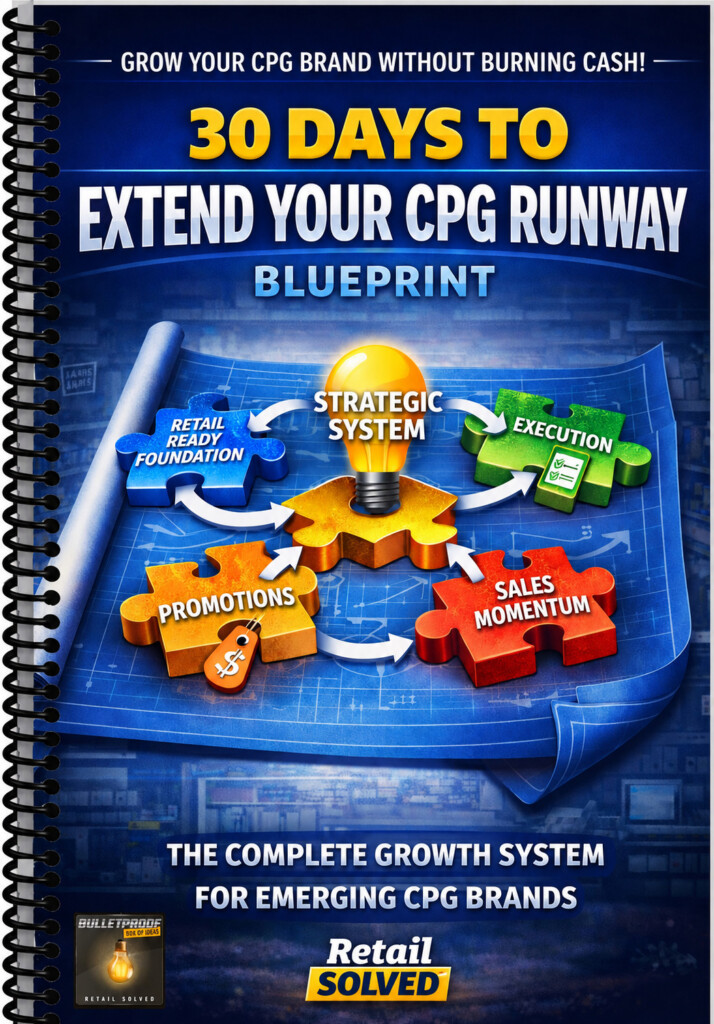
Extend your runway one focused day at a time.
Build the retail fundamentals behind profitable growth with one practical skill, one action, and one better decision each day.
Image is the property of CMS4CPG LLC, distribution or reproduction is expressively prohibited.