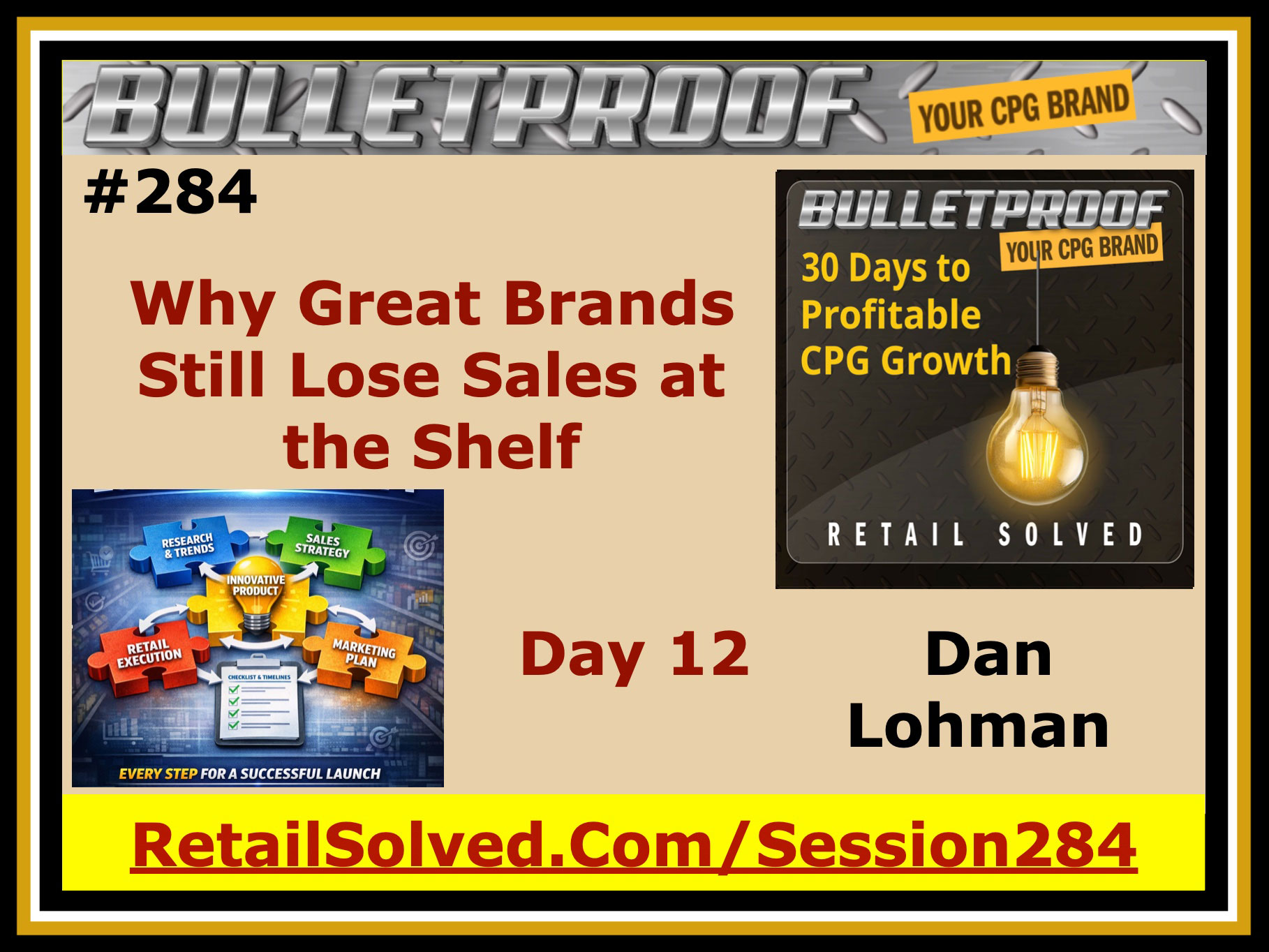
If shoppers can’t find your product, they can’t buy it—no matter how strong your story is. In Day 12 of 30 Days to Profitable CPG Growth, I explain why friction at shelf quietly kills velocity and how to remove it. You’ll learn how to map the shopper journey, use market-basket insights to guide merchandising, and translate storytelling into shelf clarity retailers care about. This episode shows how making your brand easy to find and easy to buy drives trust, loyalty, and repeat sales.
To increase sales and build customer loyalty, brands must make their products easy to find and purchase. This involves understanding the shopper’s buying journey, identifying complementary products, and strategically placing products in stores. By removing friction and confusion from the shopping experience, brands can create a seamless journey that encourages repeat purchases and strengthens retailer relationships.
Availability beats awareness.
Action step: audit friction: search, shelf placement, OOS, PDP quality.
Where is it hardest to buy your brand?
For additional inspiration listen to the following Bulletproof Your CPG Brand podcast episodes:
🎙️ 68 Proven Strategies to 2x Your Loyal Shoppers Easily
🎙️ 104 Essential New Item Checklist for Launching Products
🎙️ 144 Creative Disruptive Retail Strategies to Win Customers, Mike Fogarty with Choice Market
Day 12 of the Free 30 Days to Profitable CPG Growth
Tip of the day: Confusion pushes shoppers away. The customer journey needs to be simple and straight forward. Help lead shoppers to the resolution of their problem and you will win them for life.
Listen where you get your podcast








Like what you’ve heard?
Please leave a review and comment on iTunes
Let me know your most pressing question, I’ll do my best to answer it on a future episode.
Welcome to day 12: Episode 284 — How To Make It Easy For Shoppers To Buy Your Brand If a shopper can’t find your product, they can’t buy your product.
Today we’re going to talk about how to remove friction from the buying journey, how to help your customer succeed at shelf, and how to help retailers deliver the seamless and frictionless shopping experience their customers crave. Because when you make it easy for shoppers to find your brand, you don’t just increase sales—you build trust, loyalty, and repeat purchases. Why Storytelling Must Lead to Shelf Clarity Storytelling must guide your merchandising and your go-to-market strategy. Think of your storytelling as the emotional connection.
Think of your merchandising as the practical application. Start With the Market Basket — Then Work Backward Ask yourself: Once you understand your customer’s shopping ecosystem, you can work backward to map out exactly how to support that journey at retail. For example: Now your merchandising story becomes clear. This is how you transform your brand from a “nice to have” into an essential part of your customer’s shopping mission. Identify the Shopper’s Need State When you understand the need state, you can: Retailers Don’t Sell Products—They Sell Real Estate When your brand: This is how you earn better placement, more facings, stronger support, and increased distribution. Turn Insights Into a Story Retailers Care About That’s a story retailers understand.
That’s a story retailers lean into.
That’s a story retailers can act on. Trail of Breadcrumbs: How to Make Your Brand Easy to Find Your job is to remove confusion at every point. This includes their search on the retailers apps and their online store. Most brands skip this. Take the shoppers journey everywhere your products are sold. I’ll bet that you find a lot of opportunities to make that journey easer for them. Never Force Shoppers to Work Hard Your job is to: When shoppers feel supported, they buy.
When shoppers feel confident, they return.
When shoppers feel seen, they evangelize. Day 12 Action Item: Map Your Shopper’s Buying Journey This is how you help retailers win.
This is how you make your brand easy to buy.
This is how you increase velocity and loyalty at the same time. In Closing: Make your brand Easy to Buy, Easy to Love Build this into a story that resonates with retailers. Include insights that set you apart from other brands. Tell a story that speaks their language and aligns with their objectives. Tomorrow, in Episode 285, we’ll talk about How to Merchandise Your Brand Like a Category Leader, including how to build schematics, optimize resets, and influence buyer decisions. Subscribe so you never miss an episode.
Share this with a founder who’s stuck focusing solely on velocity.
And download the episodes free guide to go deeper into these strategies For additional inspiration listen to the following podcast episodes: Episode 104 Essential New Item Checklist for Launching Products In this episode, I share a story about how someone was looking to help a friend grow their brand, looking to buy their friend's brand. The product was mis-merchandised. Because it was mis-merchandised, all the work that the brand had done to drive traffic in the store, that was a waste. First impressions matter. Shoppers were left frustrated - they could not find the brand. The retailer was frustrated - they lost sales and new shoppers. The brand was frustrated - they now needed to re-merchandise the item - they lost a lot of sales waiting for this to happen. Episode 144 Creative Disruptive Retail Strategies to Win Customers, Mike Fogarty with Choice Market Shoppers want what they want and any retailer can make that their primary focus will win the retail game. Now layer on local, organic, fast casual dining, etc. Tip of the day: Confusion pushes shoppers away. The customer journey needs to be simple and straight forward. Help lead shoppers to the resolution of their problem and you will win them for life. Thank you for listening. This episode has an accompanying video with illustrations and additional information I can’t share on an audio podcast. You can watch it at retailsolved.com/30daychallenge. You can get the show notes for this episode by going to retailsolved.com/session284. Tomorrows episode is Use Clarity and Consistency to Amplify Your Brand This episode will build on today’s conversation. Thank you for listening. I look forward to seeing you in the next episode.
Enter your name and email address below and I'll send you periodic brand building advice, tips and strategies.
Day 12 of 30 Days to Prosperity
It doesn’t matter how powerful your story is, how compelling your WHY is, or how aligned your mission is with your customer’s values—if your product isn’t easy to find, understand, and purchase, everything else falls apart.
You’ve spent the last several episodes learning how to communicate your WHY, understand your customer, and tell a story that resonates. Now we take the next step:
Emotion gives shoppers a reason to care.
Clarity gives them a reason to buy.
Your job is to connect the two.
Let’s start with the most powerful tool you have.
Everything begins with the market basket - the sum total of what they purchase on each retail visit.
What does my shopper buy alongside my product?
What complementary products appear in the same basket?
What does that reveal about their buying mission?
What does that tell me about how they shop?
If your product is gluten-free granola, the market basket might include:
Plant-based yogurt
Fresh berries
Organic dairy
Functional beverages
Clean-label snacks
You want to:
Be near complementary products
Be merchandised at eye level
Show up in secondary placements
Be cross-promoted with adjacent categories
Help shoppers build a bundle that solves their need state
Understanding the need state is critical.
A need state answers:
“What problem is the shopper trying to solve right now?”
Examples are:
Cold & flu → wellness products, broths, teas, soups
Holiday meal → proteins, sides, sauces, snacks
Post-workout → hydration, protein, recovery
Plant-based lifestyle → dairy alternatives, meat alternatives, grains
Position your product correctly
Suggest complementary items
Educate retailers on optimal merchandising
Help shoppers complete their mission easily
Retailers love brands that help them simplify the shopping journey.
This is one of the most important lessons you’ll ever learn about retail.
Retailers don’t sell food.
Retailers sell space.
A tiny sliver of shelf—just a few inches wide—represents:
Rentable real estate
Revenue potential
Shopper value
Opportunity cost
Retailers want to maximize the return on every inch.
Drives bigger baskets
Attracts high-value shoppers
Encourages cross-category sales
Brings people back to the store
Reduces shopper friction
You become far more valuable to the retailer.
When presenting your brand to a retailer, shift from product-focused selling to shopper-focused storytelling.
For example:
Instead of saying:
“We’re gluten-free granola made with clean ingredients.”
Say:
“Our shopper spends twice as much per trip, buys premium dairy alternatives, shops produce more frequently, and chooses stores that support her lifestyle. When she buys our granola, her basket size increases by 27%. We help you attract and retain high-value shoppers.”
Think of your customer’s path through the store.
Now imagine leaving breadcrumbs that guide them directly to your product.
Here’s how:
1. Begin at the checkout line and reverse engineer the journey.
What brought them into the store?
What else will they buy?
What aisles will they travel through?
2. Identify exact merchandising placement.
Eye-level?
Endcap?
With complementary products?
Secondary location in a high-traffic zone?
3. Build KPIs that define perfect execution.
Your broker, distributor, or sales rep should have a bulletproof checklist, including:
Facing expectations
Shelf position
Adjacent products
Secondary placement opportunities
Pricing and promo alignment
Instore education elements (signage, tags, recipe cards)
4. Optimize packaging and messaging for quick recognition.
Your packaging should act like a billboard at shelf.
5. Make omnichannel seamless.
If shoppers look for your brand online:
Can they find you quickly?
Are you easy to order?
Do you appear in related product recommendations?
Your brand should be impossible to miss—anywhere customers shop.
A brand I recently did a project for has a health and wellness item. It was merchandised correctly in the store but when you did a search for health and wellness items, dod food appeared.
Confusion kills brands.
Friction kills sales.
Poor merchandising kills momentum.
Remove confusion
Reduce friction
Increase clarity
Simplify the shopping journey
Help retailers merchandise your brand correctly
Today, complete the following exercise:
1. Identify your top 5 complementary products.
What else is in your customer’s basket?
2. Map the path your shopper takes through a store.
Where do they start?
Where do they end?
What detours do they take?
3. Define ideal merchandising locations.
Primary location.
Secondary placements.
Cross-merch opportunities.
4. Write 3 KPIs that define perfect shelf execution.
These become your non-negotiable guardrails.
5. Turn this into a 1-page merchandising story for retailers.
When you eliminate confusion and friction:
Customers find your products faster
They buy more of them
They build bigger baskets
They develop deeper loyalty
Retailers support you more strategically
Make your brand easy to find.
Make it easy to buy.
Make it impossible to overlook.
Episode 68 Proven Strategies to 2x Your Loyal Shoppers Easily
Sustainable sales growth requires a thoughtful strategy and a commitment to be better than other brands. Like the tortoise and the hare, small strategic incremental steps can add up to a huge win.
New product innovation is the lifeblood of every brand. New products fuel sustainable growth, attract shoppers, and increase brand awareness. Know the critical steps to get your product on more store shelves and into the hands of more shoppers.
Explore innovative and creative disruptive retail strategies that put shoppers' desires at the forefront of retail success. Choice Markets, a hybrid grocery, convenience, and fast-casual store, was founded by Mike, inspired by his experiences in Barcelona and his desire to innovate in the convenience store industry. The store, designed to cater to urban consumers seeking healthy, high-quality products, aims to fill the gap left by traditional convenience stores that lack innovation.
Sign up to receive email updates
FREE Trade Promotion ROI Calculator:
Click Here To Maximize Sales And Profits
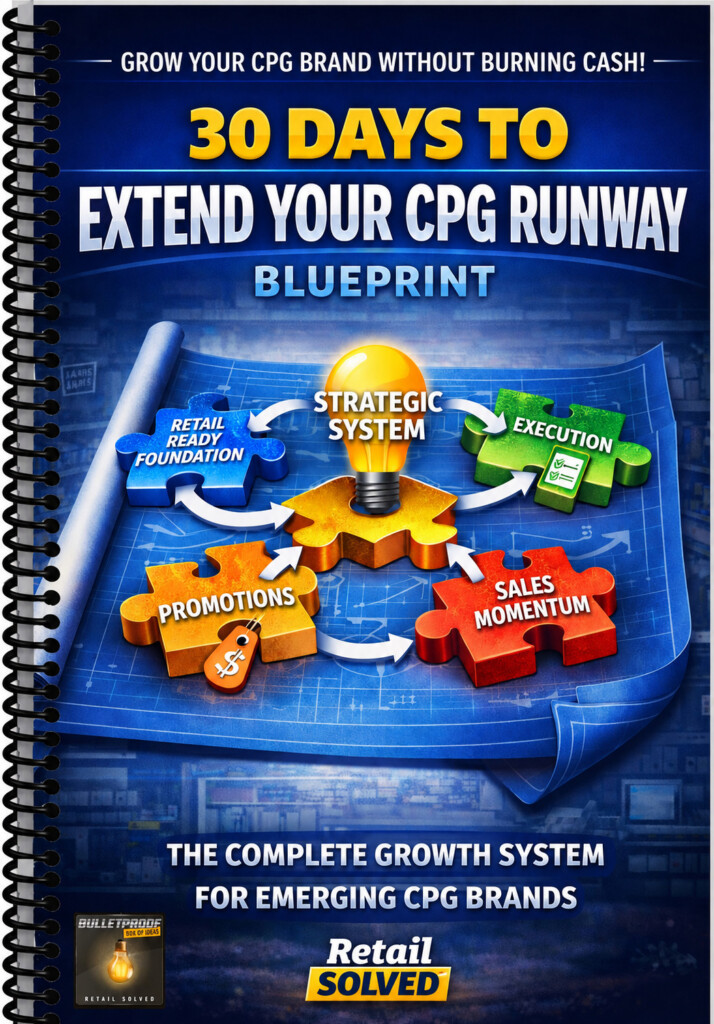
Extend your runway one focused day at a time.
Build the retail fundamentals behind profitable growth with one practical skill, one action, and one better decision each day.
Image is the property of CMS4CPG LLC, distribution or reproduction is expressively prohibited.