Confused shoppers don’t ask questions—they choose your competitor. In Day 13 of 30 Days to Profitable CPG Growth, I break down why clarity and consistency are the hidden multipliers behind trust, conversion, and repeat purchase. You’ll learn how inconsistent messaging, placement, and execution quietly erode value—and how clear, repeatable brand signals help shoppers buy with confidence. This episode shows how to simplify the customer journey, amplify perceived value, and turn clarity into a competitive weapon.
Clarity and consistency are crucial for building a successful brand. When customers are confused or unsure about a product, they are more likely to choose a familiar or cheaper option. By providing a straightforward and predictable customer journey, brands can increase confidence, leading to more sales and customer loyalty.
Consistency is a growth lever.
Action step: choose 3 brand truths and repeat them everywhere for 90 days.
What are your 3 non-negotiables?
For additional inspiration listen to the following Bulletproof Your CPG Brand podcast episodes:
🎙️ 26 Story Telling Secrets to Boost Your Brand, Bobby Umar with Raeallan
🎙️ 34 Plant Based Strategies to Drive Consumer Engagement, Mike Cooke with Daiya
🎙️ 64 Heart Of Successful Brands Building Community, Neil Grimmer with Habit and Plum Organics
Day 13 of the Free 30 Days to Profitable CPG Growth
Tip of the day: Confusion pushes shoppers away. The customer journey needs to be simple and straight forward. Help lead shoppers to the resolution of their problem and you will win them for life.
Listen where you get your podcast








Like what you’ve heard?
Please leave a review and comment on iTunes
Let me know your most pressing question, I’ll do my best to answer it on a future episode.
Welcome to Day 13: Episode 285 — Use Clarity and Consistency to Amplify Your Brand
Confusion pushes shoppers away. Your job is simple: Let me explain. Up to this point in the series, we’ve talked about: Now we’re going to layer in something that multiplies the impact of all of those: When those two are in place, shoppers feel confident.
Confident shoppers buy more.
Confident shoppers come back.
Confident shoppers become evangelists. Consider this. The Hidden Cost of Inconsistency No consistent signing.
No consistent placement.
No predictable experience for shoppers. This is the Achilles heel of most brands. I want you to ask: Clarity and consistency are also important online. This Is Your Moment to Lead A lot of brands—big and small—are still trying to regain their footing. They’re reacting, not leading. They’re unsure what the next 6–12 months will look like. This is your opportunity. Perceived Value Comes From Clear Differentiation I’ve talked throughout this series about the bread example: Same category, Completely different value proposition. If everything is lumped together—if bread is just “bread”—then retailers and shoppers never see the difference. That’s what commoditization does. It erases perceived value. Your job is to create massive perceived value by making your difference crystal clear: Clarity creates perceived value.
Consistency cements it. Live in the Hero’s Journey — As the Guide If your instructions are vague, scattered, or inconsistent, they’ll give up.
If your steps are clear and predictable, they’ll follow you—and they’ll thank you for it. Use Your Tribe to Clarify Your Language When you have your own tribe: Personalization: Simple, Human, and Repeatable Think about Starbucks. You can borrow that mindset: Shoppers Want You to Tell Them What to Do Online, a confusing checkout process leads to cart abandonment.
In-store, confusing layout leads to basket abandonment. Online, if they can’t find: In-store, if they can’t: Your job is to create a trail of breadcrumbs: Day 13 Action Item: Audit Your Clarity and Consistency Compare their websites and your website, social, and packaging. Ask 3 customers from your tribe to describe your brand in one sentence. Write down 3 clarity improvements you can implement in the next 30 days. In Closing: Clarity and Consistency Are Your Multipliers Together, they: Tomorrow, in Episode 286, we’re going to build on this by talking about How to Design a Simple, Repeatable Retail Execution System—so that brokers, distributors, and internal teams can deliver your standard flawlessly in every store. Make sure you’re subscribed so you don’t miss it.
Share this episode with a founder who’s stuck in “random acts of marketing” and needs a path to clarity. For additional inspiration listen to the following podcast episodes: Episode 34 Plant Based Strategies to Drive Consumer Engagement, Mike Cooke with Daiya Episode 64 Heart Of Successful Brands Building Community, Neil Grimmer with Habit and Plum Organics Tip of the day: Confusion pushes shoppers away. The customer journey needs to be simple and straight forward. Help lead shoppers to the resolution of their problem and you will win them for life. Thank you for listening. This episode has an accompanying video with illustrations and additional information I can’t share on an audio podcast. You can watch it at retailsolved.com/30daychallenge. You can get the show notes for this episode by going to RetailSolved.com/Session285. Tomorrows episode is Identify Your Ideal Retail Partner Including On-Line. This episode will build on today’s conversation. Thank you for listening. I look forward to seeing you in the next episode.
Enter your name and email address below and I'll send you periodic brand building advice, tips and strategies.
Day 13 of 30 Days to Prosperity
When a customer is overwhelmed, unsure, or can’t quickly understand what your product is, who it’s for, or why it matters, they default to the easiest option:
They walk away.
Or they grab whatever’s familiar.
Or they choose the cheapest thing on the shelf.
Make the customer’s journey straightforward, predictable, and consistent—everywhere they encounter your brand.
Do that well, and you become the easy “yes.”
Do it poorly, and you unintentionally push shoppers toward your competitors.
Clarity + Consistency = Confidence
Your foundation and business plan
Your WHY
Your ideal customer
Your community
Your storytelling
Your merchandising
Clarity and consistency.
Clarity answers:
“What do you stand for, what problem do you solve, and what should I do next?”
Consistency answers:
“Can I trust that I’ll get the same experience every time I interact with you?”
If you’re merchandised one way in one store and completely differently in another…
If your packaging changes constantly…
If your messaging is different on your website, social channels, and shelf…
You’re asking your shopper to work harder than they should have to.
And shoppers don’t want to work.
They want to be led.
I see this all the time.
A brand celebrates getting into a new retailer and then discovers:
In one store, they’re at eye level.
In another, they’re down by the floor.
In another, they’re in a completely different aisle.
In another, they’re merchandised like a commodity.
From now on, when you think about retail execution, I don’t want you to only ask:
“Is the product on the shelf?”
“Do I have tags or signs up?”
“Is the shopper journey clear?”
“Is the experience consistent across stores?”
“Is it easy for customers to find and buy my product?”
Clarity and consistency at shelf are not “nice to have.”
They’re competitive weapons.
I frequently find different product images of a brand in different places at the same time. In fact, I was once on the board of a company working to solve this very issue. I was surprised how widespread this issue is and it also impacts the copy that describes your brand.
That added confusion is expensive and it compromises your brand.
Remember the adage, you never get a second change at a first impression?
My version of this is, you never get a second chance to disappoint a customer?
I recently had a conversation with Doug Brown on the podcast where he said something I loved:
“This is a perfect time for massive prospecting.”
What he meant was:
Now is the moment for smart brands to step up, lean into clarity, and claim a leadership position in their category.
This is your moment to:
Show up as the category’s strategic leader
Bring shopper insights others ignore
Help retailers simplify the customer journey
Make your brand the easiest to shop, understand, and support
Clarity and consistency are how you signal that leadership.
Let’s connect this to value.
Generic bread: cheap, minimal nourishment, you’re hungry almost immediately.
Best mainstream bread: better, more filling, you stay full longer.
Organic nutrient-dense bread: higher cost per loaf, lower cost per use because it satisfies you longer and fuels your body better.
Who you’re for
What problem you solve
How you’re better
Why you’re worth more
What unique shopper do you attract
And then repeat that message everywhere—in your packaging, on your website, in your social, in your pitches, in your demos, in your training, and at every shelf in every store.
Think of your customer’s experience like a hero’s journey.
They’re standing at the base of a mountain—confused, overwhelmed, unsure what to do next.
You’ve already climbed that mountain.
You solved the problem.
You created the product.
You’ve done the work.
Your job now is to be their Sherpa:
Show them the path.
Warn them about landmines.
Give them the right tools.
Tell them what to bring and what to leave behind.
Walk them step-by-step toward their desired outcome.
And most importantly: make the path obvious.
One of the reasons I keep coming back to the idea of building your own community—your tribe—is because it becomes your clarity laboratory.
You can ask what they love about your product.
You can learn which phrases resonate.
You can hear, in their words, what problem you solve.
You can test messaging.
You can refine your story.
Then you take their language and use it in:
Your packaging
Your website
Your pitch decks
Your shelf talkers
Your digital ads
Your presentations to retailers
This eliminates guesswork and makes your messaging feel natural and personal.
Now, I know you can’t personalize everything at scale in every single store. That’s not realistic.
But you can personalize:
Your tone
Your story
Your onboarding experience
Your follow-up
They don’t just pour a generic cup of coffee.
They ask how you want it.
They write your name on the cup.
They remember your preferences.
That’s part of why they can charge $5 (or more) for a coffee. It’s not just caffeine. It’s identity. It’s community. It’s perceived value.
Or think back to Burger King’s old “Have it your way” campaign. They weren’t selling burgers—they were selling customization and control.
How can you make your customer feel seen?
How can you make them feel like this product was made for them?
How can you follow up personally and thank them for choosing you?
One tool I’ve used is video messaging—sending a quick personalized thank-you or welcome message when someone joins a course or grabs a resource. It’s simple, human, and incredibly powerful.
You can apply the same thinking to your brand.
This may sound overly simplistic, but it’s true:
Shoppers want you to tell them what to do—and in what order.
The price
The benefits
The ingredients
The size
The path to “Add to Cart”
…they leave.
Find your product
Understand what it is
See how to use it
Connect it to their need state
…they move on.
Clear navigation online
Clear signage in-store
Clear packaging hierarchy (who it’s for, what it does, why it’s better)
Clear call to action (“Great for…”, “Perfect when…”, “Best used with…”)
The more you simplify the journey, the more you amplify your brand.
Today, I want you to do a quick but powerful audit:
Pick two retailers that sell your product.
Visit or have someone send photos.
Is your brand merchandised similarly?
Is your message clear and consistent?
Do they all tell the same story?
Do they use the same core language?
Is your WHY obvious everywhere?
Does it match what you want them to say?
If not, what needs to change?
Shelf standards (KPI checklist)
Messaging updates
Simple “breadcrumb” improvements online
What gets written down gets done.
What gets done consistently builds brands.
Clarity makes your brand understandable.
Consistency makes your brand unforgettable.
Reduce shopper confusion
Increase trust
Improve conversion
Strengthen retailer relationships
Amplify your story
Extend your runway
And download the episodes free guide to go deeper into these strategies
Remember: When you lead shoppers clearly and consistently to the resolution of their problem,
you don’t just earn a sale—
you earn a customer for life.
Episode 26 Story Telling Secrets to Boost Your Brand, Bobby Umar with Raeallan
Explore innovative and creative disruptive retail strategies that put shoppers' desires at the forefront of retail success. In this episode, we talk about how big brands communicate the value of their brand to their customers, how they use storytelling that resonates with customers, and how you can learn from the strategies, from the techniques and the tactics that the big brands use to tell your story. And then leverage those strategies so you can differentiate them when you're talking about what's unique, the products, etc.
Explore plant based strategies that fulfill consumer needs and drive sales across all categories in the marketplace. Daiya Foods, a plant-based brand, creates dairy-free, soy-free, and gluten-free products that mimic traditional dairy. Plant-based products are gaining popularity due to health and environmental concerns, leading to increased demand for transparency and clean labels. Brand story telling is a big reason for their success.
Discover the key elements behind the heart of successful brands: personal storytelling, mission-driven goals, and service.
Sign up to receive email updates
FREE Trade Promotion ROI Calculator:
Click Here To Maximize Sales And Profits
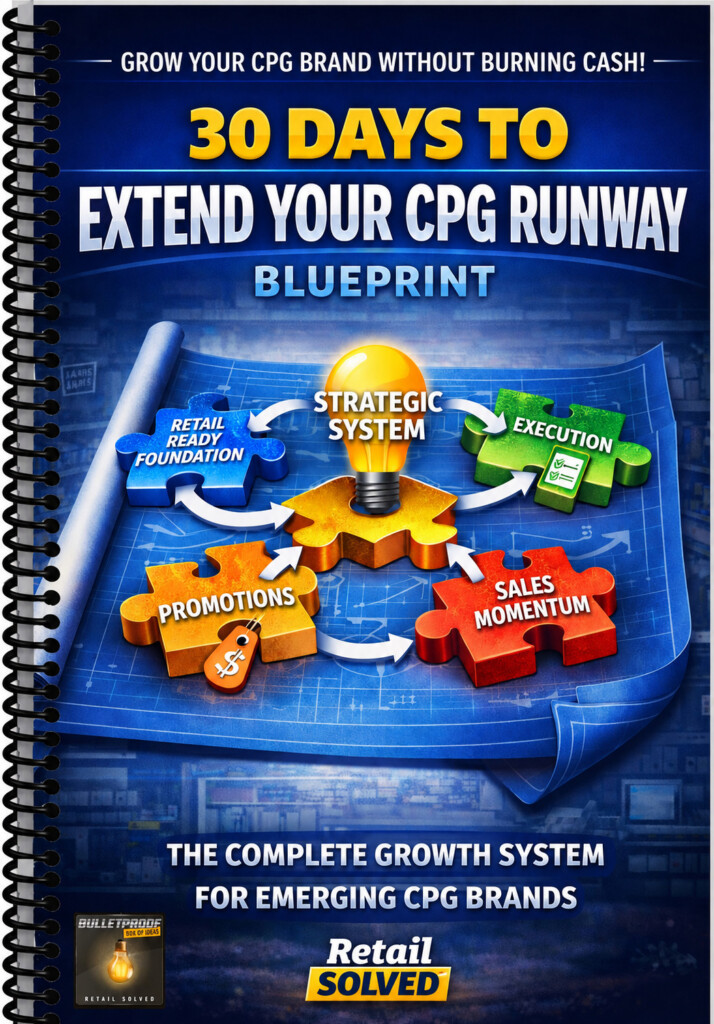
Extend your runway one focused day at a time.
Build the retail fundamentals behind profitable growth with one practical skill, one action, and one better decision each day.
Image is the property of CMS4CPG LLC, distribution or reproduction is expressively prohibited.