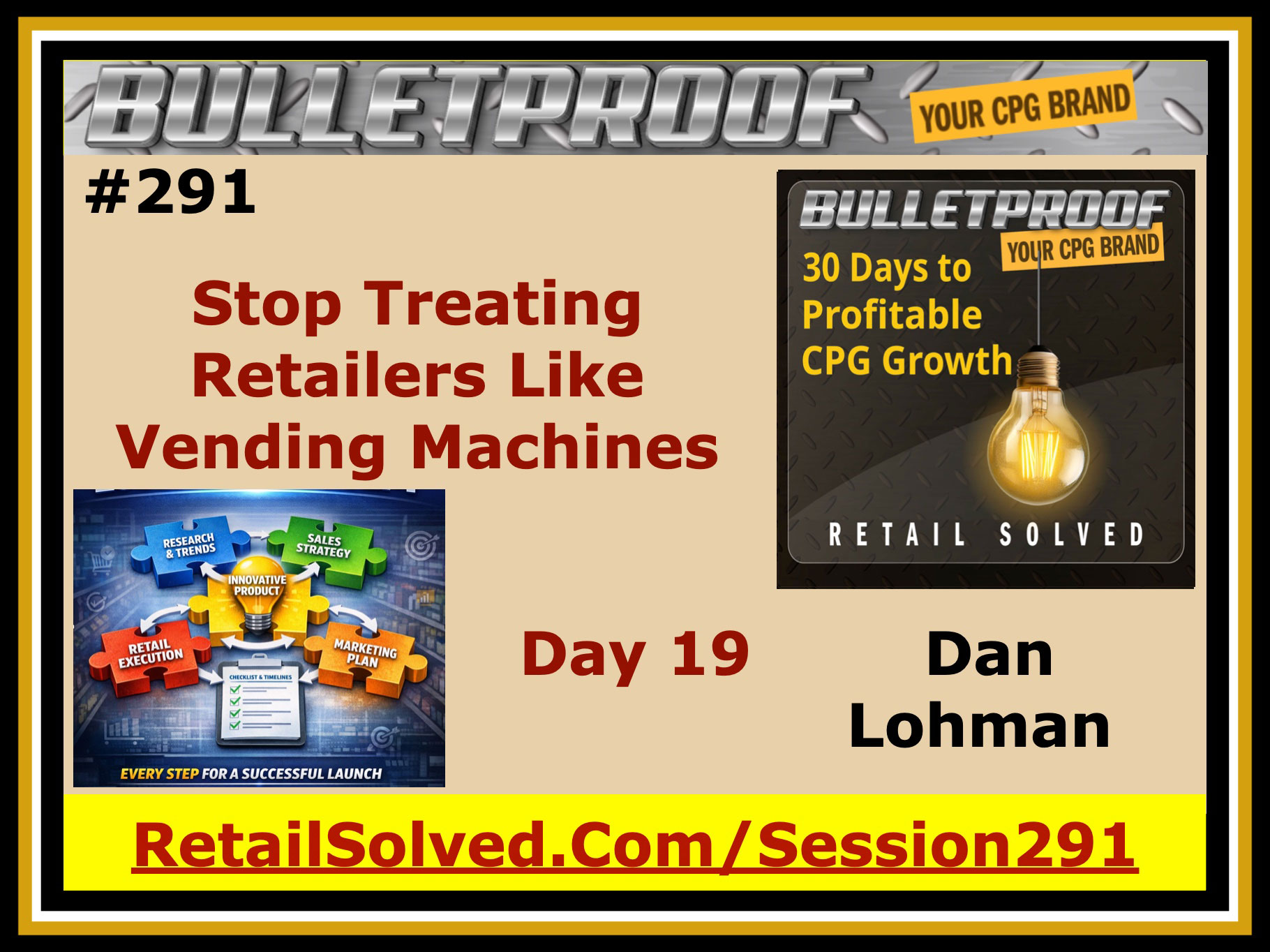
Most brands approach retailers asking for space, promotions, and favors—and wonder why buyers tune them out. In Day 19 of 30 Days to Profitable CPG Growth, I show how to flip that dynamic by becoming an expert in your retail partner. You’ll learn how understanding a retailer’s business model, shopper, people, and priorities turns you from a vendor into a trusted category leader. This episode explains how respect, insight, and value creation earn influence, access, and long-term growth.
Brands should view retailers as partners, not vending machines, by understanding their business models, priorities, and challenges. By providing value and insights, brands can build trust and become indispensable category leaders, gaining preferential treatment and opportunities. This approach, based on the law of reciprocity, fosters long-term success for both the brand and the retailer.
Action step: write one page: strategy, shopper, margin drivers, risks, goals.
Which retailer do you need to study next?
For additional inspiration listen to the following Bulletproof Your CPG Brand podcast episodes:
🎙️62 Proven Strategies To Level The Playing Field Effectively, Todd Kluger with Lundberg Family Farms
🎙️ 99 Sales Management Success Strategies that Build Brands, Bob Burke with Natural Products Consulting
🎙️ 123 In-Store Marketing Strategies Every Brand Should Use, Andrew Therrien with Sampler
Day 19 of the Free 30 Days to Profitable CPG Growth
Tip of the day: No two retailers are the same. They deserve to be respected and valued. Their success is your success. Personalizing your relationship will pay huge dividends and give you the edge you deserve.
Listen where you get your podcast








Like what you’ve heard?
Please leave a review and comment on iTunes
Let me know your most pressing question, I’ll do my best to answer it on a future episode.
Welcome to Day 19: Episode 291 — How To Become An Expert In Your Retail Partner
Day 19 of 30 Days to Prosperity If we’re honest, most brands treat retailers like vending machines: Let me flip that for you: This is how you stop being “just another brand” asking for favors… What It Felt Like On the Other Side of the Desk Here’s why that matters. If you want retailers to care about your brand, start by caring deeply about their business. From “Vendor” to “Trusted Partner” Every recommendation, every program, every new item was positioned as: They eventually asked me to validate my competitors decks and assortment recommendations. Imagine having that level of influence. The rewards were great. I was given preferential merchandising, promotion support plus a lot more. The Law of Reciprocity (Retail Version) When you: Here’s why that matters. And here’s the irony: Category Captain vs. Category Leader (Revisited) When you become a category leader, savvy retailers will: Account Penetration: Get To Know the Whole Team Let me share a story. How To Start Becoming an Expert in Each Retailer Day 19 Action Item: Choose One Retailer and Go Deep In Closing: Their Success Is Your Success This is how you launch new innovation with precision and how you ensure your next innovation succeeds on-shelf and online. Tomorrow, in Episode 292, we’re going to build on this and talk about How To Turn Retailer Meetings Into Strategic Work Sessions Instead of “Check-the-Box” Updates—so you never walk out of a review wondering if anything actually changed. For additional inspiration listen to the following podcast episodes: More importantly, as a small natural brand, small meaning compared to the bigger brands, they were leveraging insights at retail that most brands overlook. We talk about strategies that you can use today to level the playing field, even with your most sophisticated counterparts. This is how you win at retail. Episode 99 Sales Management Success Strategies that Build Brands, Bob Burke with Natural Products Consulting In this podcast episode, Bob shares in stark terms exactly what's expected of every brand out there, the things that we've been talking about. Then when you overlay that with the strategies highlighted in this series. Remember, you've got to know how the game is played and you've got to understand exactly what's expected of you before you can get creative. More importantly, if you understand exactly what your retail partner is looking for, then you can help deliver at an extremely high level. This is how you become a category leader. Episode 123 In-Store Marketing Strategies Every Brand Should Use, Andrew Therrien with Sampler Andrew is a master salesman. And what's great about Andrew's insights is he talks about how you can leverage your in-store marketing strategy to gain a significant and sustainable competitive advantage for both you and your retail partner. Tip of the day: No two retailers are the same. They deserve to be respected and valued. Their success is your success. Personalizing your relationship will pay huge dividends and give you the edge you deserve. Thank you for listening. This episode has an accompanying video with illustrations and additional information I can’t share on an audio podcast. You can watch it at retailsolved.com/30daychallenge. You can get the show notes for this episode by going to RetailSolved.com/Session291. Tomorrows episode is Knowledge Is Power How To Win At Retail Effectively. This episode will build on today’s conversation. Thank you for listening. I look forward to seeing you in the next episode.
Enter your name and email address below and I'll send you periodic brand building advice, tips and strategies.
“I want this.”
“I need that.”
“Put me on an endcap.”
“Run this promotion.”
Everything is framed as, “Here’s what I need from you.”
And then we wonder why buyers dodge our emails, cut meetings short, and default to the biggest brands with the deepest pockets.
No two retailers are the same. They deserve to be respected and valued.
Their success is your success.
When you become an expert in your retail partners—how they operate, what they care about, how they win in their markets—you gain a real, durable edge.
…and start becoming a trusted, respected, indispensable category leader.
Let me explain.
Let me take you behind the curtain for a moment.
Back when I was the grocery manager at Price Club (now Costco), I had an unusual amount of autonomy. This was before centralized schematics and corporate planograms and even corporate managed product assortments. I was responsible for:
What items we carried
How much we carried
Where they were merchandised
How they were merchandised
Choosing new items
Every day, brands would come in and say some version of:
“I need an endcap.”
“You should bring in my new SKU.”
“I need more space.”
Me. Me. Me.
Very few walked in asking:
“What’s working for your shoppers?”
“What gaps are you seeing in this category?”
“Where do you need help beating your competition?”
When you have a parade of brands focused only on their own objectives, you quickly get conditioned to tune them out.
You become skeptical. You protect your time.
So when someone does show up different—focused on your shopper, your store, your challenges—that person stands out immediately.
That was my first big lesson:
This is the advice I used to dominate my competitors throughout my career and with my clients.
Fast-forward to when I moved over to the manufacturer side.
Knowing how it felt to sit in the retailer’s chair, I decided to try something different. Instead of showing up with:
“Here’s our deck.”
“Here’s our promotion calendar.”
“Here’s what corporate wants.”
…I started with:
“Help me understand your goals this quarter.”
“Where are you underperforming?”
“What does a big win look like for you in this category?”
Then I framed everything around the three things retailers really want:
More traffic in their store
A competitive advantage in their market
A reasonable profit
“Here’s how we can help you get more of those three things by leveraging the strength of our unique shopper.”
This is the opportunity.
When you consistently show up that way, retailers begin to:
Trust your motives
Value your insights
Invite you into more strategic conversations
I even got to the point where retailers would call me first when they needed:
Last-minute displays
Extra support on a key week
A quick read on what was happening in the category
That’s not because my brands were the biggest.
It’s because I’d proven I was there to help them win.
You’ve probably heard of the law of reciprocity:
If I do something genuinely helpful for you, you’re naturally inclined to want to do something helpful for me.
This applies to retailers too.
Bring them insights no one else is sharing
Help fix problems that aren’t “your fault”
Show them opportunities that go beyond your brand
Are willing to sacrifice a weak SKU for the good of the category
…you earn a different level of respect.
Category management, done right, is about being an unpaid consultant for the retailer. A true category leader:
Advocates for what’s best for the category
Thinks beyond their own brand
Is willing to recommend cutting their own underperformers if it grows the retailer’s business long-term
When you’re willing to recommend cutting one of your own items to improve category performance, retailers often reward you by protecting other items or bringing in your innovations quicker.
You prove that you’re in it for the long game—not just a quick win.
We talked earlier in the series about the difference between a category captain and a category leader.
Category captain = big brands, expensive role, lots of tools and formal obligations, very expensive.
Category leader = any brand, of any size, willing to lead with insight, integrity, and category-first thinking.
Ask you to validate recommendations from other brands
Bring you into category reset discussions
Give you early visibility into upcoming opportunities
Offer incremental placements others never see
That’s not theory—I’ve lived it.
I’ve been invited to “fact-check” the recommendations of much bigger brands simply because the retailer trusted my objectivity along with the depth and breath of my experience.
That’s the power of becoming an expert in your retail partner.
Let’s get practical.
Most brands only know one person at a retailer: the buyer or category manager. That’s it.
That’s a huge missed opportunity.
Consider this:
People prefer doing business with people they know, like and trust.
Inside a retailer, decisions and influence aren’t limited to one person.
So you want to build broad, authentic relationships across the account:
Category manager / buyer
Assistant buyer or analyst
Space planning / schematics
Marketing or promotions team
Store operations or regional merchandising leads
Even office staff and coordinators
When I joined a new manufacturer, we were struggling with the largest retailer in the country. Our relationship was weak. Our influence was almost zero.
So I made a point of:
Learning birthdays
Remembering small details
Spending time with the #2 person and support staff
Asking their opinions on my ideas before presenting to the main decision-maker
Over time, something powerful happened:
The #2 person started helping me shape my presentations.
They gave me feedback on what would resonate and what wouldn’t.
They effectively “pre-sold” my recommendations internally.
By the time I walked into the big meeting with the actual decision-maker, the hardest part of the work was already done.
I even brought the recommended schematic on a floppy disk (yes, I’m dating myself) so all they had to do was plug it in and go.
That’s account penetration.
That’s personalization.
That’s what it looks like to become an expert in your retail partner.
Here’s a simple framework you can start using today.
1. Learn Their Business Model
Ask yourself:
Are they competing primarily on price, service, experience, or assortment?
Who is their core shopper?
How are they positioned against nearby competitors?
Now back to the retailer’s perspective:
How does your brand help them win that game more effectively?
2. Learn Their Language
Every retailer has their own terms, KPIs, and priorities.
What do they call their key programs?
How do they measure success in your category?
What internal initiatives are they focused on this year?
Use their language in your presentations. It shows you’ve done your homework and that you are making THEM the priority.
3. Learn Their People
Make a contact map:
Who are the decision-makers?
Who influences them behind the scenes?
Who’s handling data?
Who runs resets?
Build relationships at all levels. Be genuine. Be respectful. Be consistent.
4. Use Every Touchpoint to Add Value
Every time you interact, ask yourself:
“What can I teach them or show them today that will help them grow their business?”
That might be:
A quick shopper insight
A small data nugget
A trend they haven’t seen yet
A success story from another account
A missed opportunity in the market
Over time, this positions you as a go-to resource, not just another vendor.
Pick one key retail partner and:
Make a list of everything you know about their business model, shopper, and priorities.
Highlight the gaps—what you don’t know yet.
Plan at least one conversation or piece of outreach where your only goal is to learn and add value, not to “get something.”
This is how you start shifting from transactional to strategic.
When you become an expert in your retail partners:
You stop begging for space
You start being invited into bigger conversations
You earn trust, influence, and opportunity
Retailers remember the brands that help them win.
And when they win more often with you at their side, your brand wins too—
with more runway, better placement, and a real equal seat at the table.
Make sure you’re subscribed, share this episode with a founder who’s frustrated with retail
Grab the free new items essentials system I created to help you implement what we’re talking about at a much deeper level. Its a free downloadable guide.
Downloads the free series guide to go deeper into these strategies
You don’t have to be the biggest brand to be the most valuable partner.
You just have to care enough to become an expert in the people you’re asking to bet on you.
Episode 62 Proven Strategies To Level The Playing Field Effectively, Todd Kluger with Lundberg Family Farms
Explore proven strategies to level the playing field and win at retail. Learn how small brands can compete with industry giants. Lundberg Farms, a family-owned organic rice and quinoa company, prioritizes community involvement, sustainable practices, and employee well-being. They utilize data analysis to inform business planning, product creation, and consumer communication, ensuring product availability and meeting promotional demand.
I had the privilege of doing a project for Lundberg Family Farms years ago, and what was unique about them is that they used fact-based insights to grow and scale their brand.
Unlock your potential with Sales Management Success Strategies. Learn how expert guidance can drive your brand's growth. Bob Burke, a natural products consultant, shares his journey from Stonyfield Farm to founding Natural Products Consulting. He emphasizes the importance of a direct sales force, brand-retailer relationships, and his field manual, a comprehensive resource for the natural products industry.
Unlock the potential of your brand with effective in-store marketing strategies that boost sales and gain new customers. In-store product sampling is a highly effective strategy for introducing new products to potential customers. Brands should prioritize retailers as strategic partners, invest in in-store marketing, and collaborate with retailers on cross-selling opportunities. Proper planning and execution are crucial to maximize results and ensure profitability.
Sign up to receive email updates
FREE Trade Promotion ROI Calculator:
Click Here To Maximize Sales And Profits
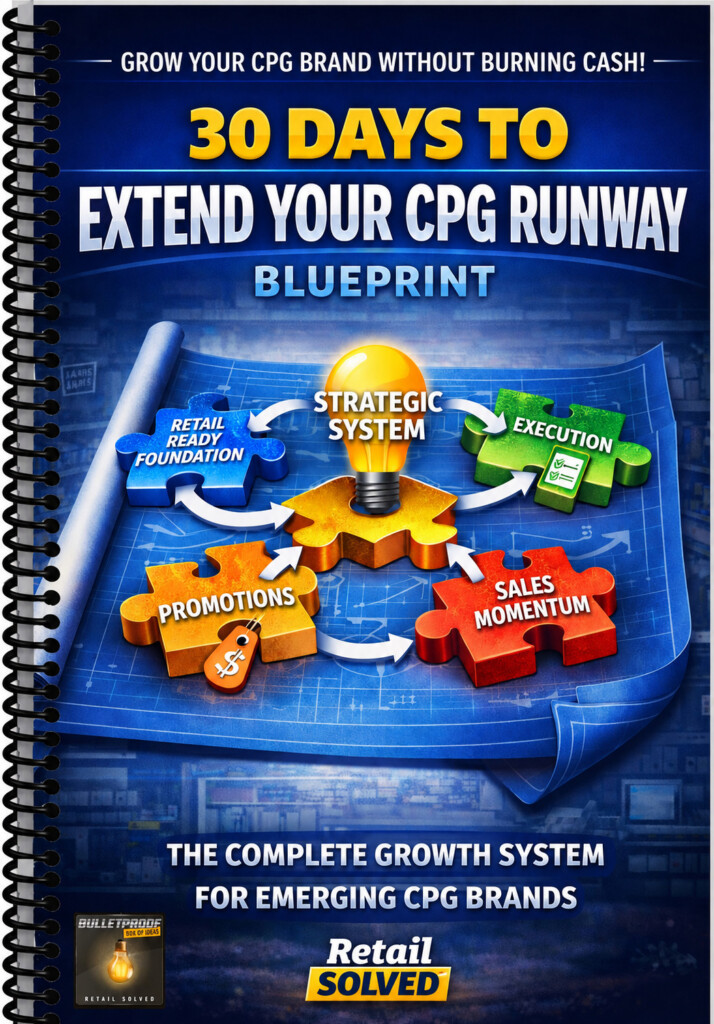
Extend your runway one focused day at a time.
Build the retail fundamentals behind profitable growth with one practical skill, one action, and one better decision each day.
Image is the property of CMS4CPG LLC, distribution or reproduction is expressively prohibited.