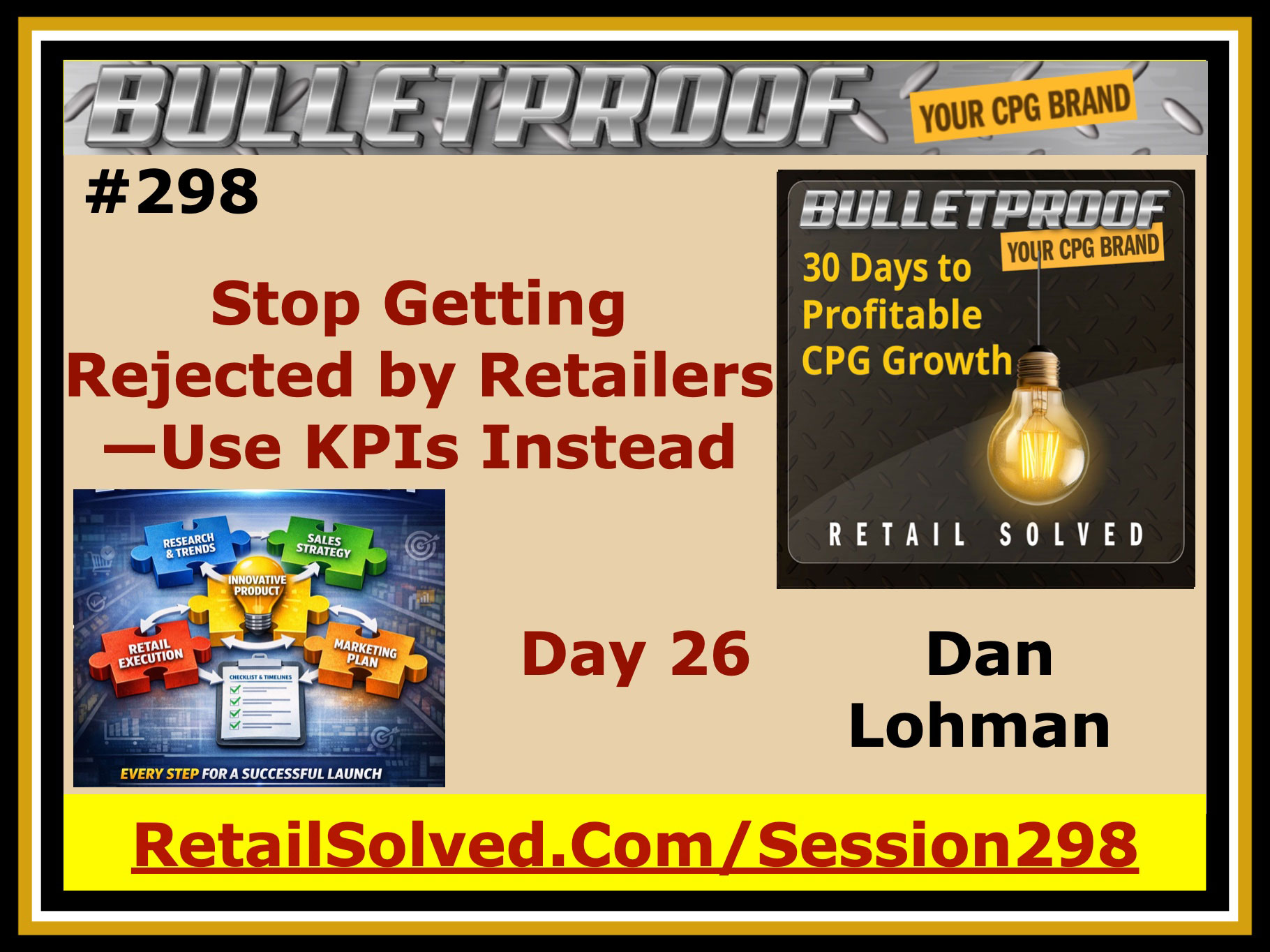
Retailers don’t reject great products—they reject poor execution. In Day 26 of 30 Days to Prosperity, I break down how KPIs act as guardrails that prevent mistakes, eliminate guesswork, and ensure flawless execution at retail. You’ll learn which performance indicators actually matter, how to set clear expectations for brokers and teams, and why brands that measure execution outperform competitors with bigger budgets. If you want consistency, trust, and momentum at shelf, this is your playbook.
KPIs are crucial for ensuring flawless retail execution and driving brand growth. They provide clarity, accountability, and eliminate guesswork, helping brands avoid costly mistakes and maintain consistency across all customer-facing elements. By implementing clear and measurable KPIs, brands can gain a competitive advantage, improve retailer relationships, and deliver a predictable and scalable brand experience.Which KPI do you track that doesn’t actually help?
For additional inspiration listen to the following Bulletproof Your CPG Brand podcast episodes:
🎙️ 160 Reach Your Goals Tomorrow and Beyond, Top Strategies Revealed
🎙️ 84 Perseverance & Overcoming Obstacles in Retail Strategy, David Perkins with Beetnik Foods
🎙️ 218 Retail Horror Stories – How To Avoid Failures
Day 26 of the Free 30 Days to Profitable CPG Growth
Tip of the day: KPI’s act as the guard rails that keep everyone on track. They help to ensure flawless retail execution.
Listen where you get your podcast








Like what you’ve heard?
Please leave a review and comment on iTunes
Let me know your most pressing question, I’ll do my best to answer it on a future episode.
Welcome to Day 26: Episode 298 — How To Develop Performance Indicators for Success (KPIs) If you’ve been following along in this series, then you already know: But none of those tools will reach their full potential without one more piece: Why KPIs Matter So Much in CPG Let me take you behind the curtain: A Painful Real-World Example KPIs Are Your Guardrails Examples of Essential Retail KPIs 2. Merchandising Standards 3. Pricing Guidelines 4. Promotional KPIs 5. Retail Execution KPIs Why KPIs Give You an Unfair Advantage This Is Where Everything in the Series Starts Coming Together A Closing Thought Next up in Episode 299, we’ll talk about how to build systemic operational discipline across your entire organization—so excellence becomes your default setting. Subscribe and share this with another founder wanting flawless retail execution For additional inspiration listen to the following podcast episodes: Episode 84 Perseverance & Overcoming Obstacles in Retail Strategy, David Perkins with Beetnik Foods Episode 218 Retail Horror Stories – How To Avoid Failures Tip of the day: KPI’s act as the guard rails that keep everyone on track. They help to ensure flawless retail execution. Thank you for listening. This episode has an accompanying video with illustrations and additional information I can’t share on an audio podcast. You can watch it at retailsolved.com/30daychallenge. You can get the show notes for this episode by going to RetailSolved.com/Session298. Tomorrows episode is Master Story Telling The Power Of A Unified Voice This episode will build on today’s conversation. Thank you for listening. I look forward to seeing you in the next episode.
Enter your name and email address below and I'll send you periodic brand building advice, tips and strategies.
Day 26 of 30 Days to Prosperity
KPIs act as the guardrails that keep your brand on track. They ensure flawless execution at retail—and flawless execution is where real growth happens.
Strategy matters.
Story matters.
Community matters.
Retail partnerships matter.
Team alignment matters.
Scorecards matter.
Clear, measurable, actionable KPIs—Key Performance Indicators.
These are the guardrails that keep your brand from drifting off course.
This is one of the most overlooked areas in natural CPG and one of the simplest ways to immediately out-execute your competitors—even those with deeper pockets and larger teams.
And if you’re truly ready to level the playing field, KPIs are how you do it.
There’s a predictable pattern I see with nearly every struggling brand:
They believe they’re executing well…
but they don’t actually measure execution.
They assume their brokers are following instructions…
but they don’t verify.
They think their merchandising is consistent in every store…
but it’s not.
They believe their new item launch went smoothly…
but shoppers can’t find the item on shelf.
I see this in big brands as well
You cannot scale what you cannot measure.
And you cannot fix what you do not track.
This is where KPIs become your greatest asset.
They remove assumptions.
They create clarity.
They drive accountability.
They eliminate guesswork.
They prevent costly mistakes.
And most importantly:
KPIs ensure shoppers can find and buy your product EVERY time they walk into a store.
This is the cornerstone of retail excellence—and the advantage almost every competitor overlooks.
In Episode 104 of the podcast, I shared a story about a brand that launched an incredible new item.
They were ecstatic.
Their brokers sold it in widely.
Their internal team celebrated the win.
And then…
The consumer complaints started rolling in.
Shoppers couldn’t find the product.
It wasn’t merchandised consistently.
It was placed in the wrong department in dozens of stores.
Some stores never put it out.
Others placed it on the bottom shelf, far away from the parent brand.
The item looked like it was failing—but the problem wasn’t the product.
The problem was execution.
And by the time the brand realized what happened?
They had already:
lost velocity
lost distribution
lost customer trust
lost retailer support
lost their promotional window
lost their chance to impress shoppers on the first try
All because there were no guardrails.
No KPIs.
No structure.
No expectations communicated.
No verification.
This is completely avoidable.
Think of KPIs as the instructions you’d hand to someone climbing a mountain with you.
They should be:
clear
specific
measurable
non-negotiable
aligned with your strategy
And they should cover every customer-facing element of your business.
Here’s what that looks like in practice.
1. Distribution
You might define:
Tier 1 retailers = 100% ACV
Tier 2 retailers = 70% ACV
Tier 3 retailers = 30% ACV
If a broker or sales rep knows the exact target, there's no ambiguity.
Be precise:
“Item must be merchandised to the right of Brand X.”
“Middle shelf placement, no lower than knee level.”
“Parent brand block must remain intact.”
Retailers and brokers LOVE this clarity.
Examples:
“Always priced 10% below Brand X.”
“Target shelf price: $4.99 with allowable range of ±$0.20.”
Pricing consistency builds trust with shoppers and retailers.
Instead of vague goals like “promote quarterly,” set:
“Four TPRs per year, each at 20% discount.”
“Feature ads aligned with seasonal usage.”
“Required secondary displays during national promotion windows.”
This ensures the promotion actually drives incremental growth—not chaos.
These can include:
Shelf tags posted correctly
Displays built within 24 hours of delivery
Out-of-stocks resolved within 48 hours
Planogram compliance above 90%
These are critical because:
Execution is the #1 driver of sales you can fully control.
And very few brands truly measure it.
KPIs:
remove confusion
eliminate sloppy execution
empower brokers and sales teams
help you hold partners accountable
simplify communication
minimize retailer complaints
ensure consistency across regions, stores, and teams
And here’s the big one:
KPIs help you deliver a predictable, repeatable, scalable brand experience.
This is what retailers reward.
This is what shoppers respond to.
This is what builds momentum.
And momentum, as you’ve heard me say, becomes rocket fuel the moment you start stacking wins.
Because when you combine:
strategic goals
MBOs
scorecards
KPIs
flawless retail execution
clean messaging
deep customer understanding
data-driven insights
You become unstoppable.
You become the category leader retailers proactively reach out to.
And this isn’t theory.
These are the exact strategies I’ve used to push around some of the most iconic brands on the planet—and help emerging brands earn an equal seat at the table.
If you take only one thing from this episode, let it be this:
Execution without KPIs is luck.
Execution with KPIs is leadership.
And leaders get rewarded—with displays, with distribution, with trust, and with the opportunities other brands never see.
We’re getting close to the finish line of this series, and this is where the real transformation begins.
Let’s keep going.
Downloads the free series guide to go deeper into these strategies
Episode 160 Reach Your Goals Tomorrow and Beyond, Top Strategies Revealed
In that podcast episode, I talk about how to set a vision for your brand, how to set your goals. KPI's are ideal for this because they help set up the guardrails so that you stay on track so that you can reach your goals.
Explore ways of Perseverance & Overcoming Obstacles in disruptive branding and product distribution for better sales.
Explore Retail Horror Stories - How To Avoid Problems That Derail Brands and learn from real-life marketing failures. Distributors should be strategically chosen to ensure products are placed in stores where the target customers shop. Brands should own their go-to-market strategy and have a robust business plan to guide growth and distribution.
All brands struggle and go through growing pains.
Sign up to receive email updates
FREE Trade Promotion ROI Calculator:
Click Here To Maximize Sales And Profits
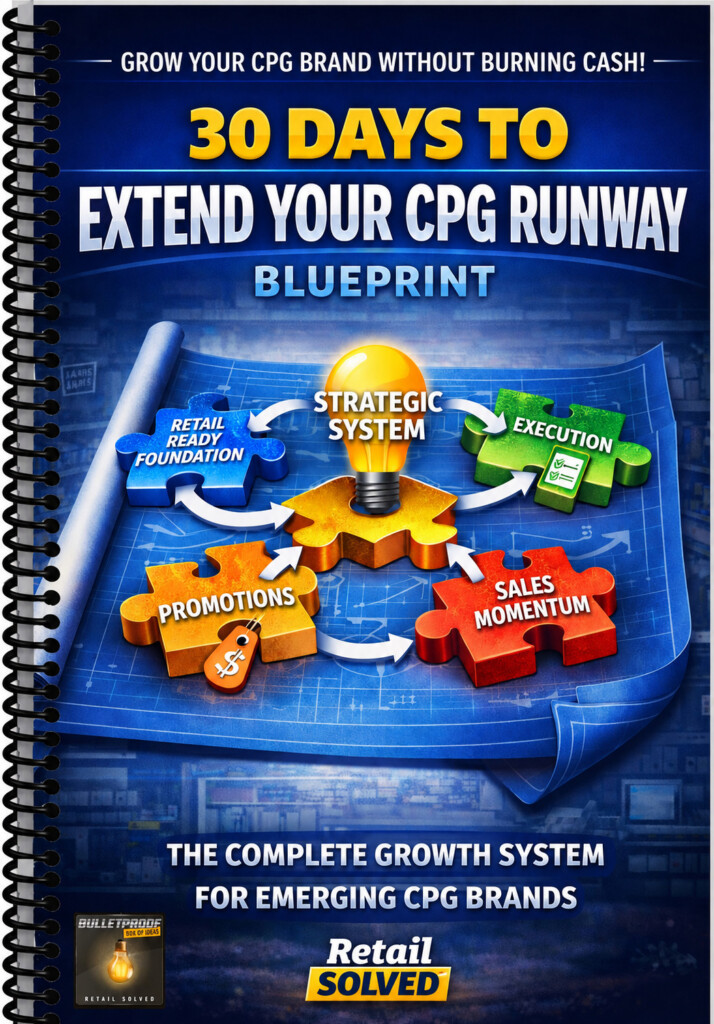
Extend your runway one focused day at a time.
Build the retail fundamentals behind profitable growth with one practical skill, one action, and one better decision each day.
Image is the property of CMS4CPG LLC, distribution or reproduction is expressively prohibited.