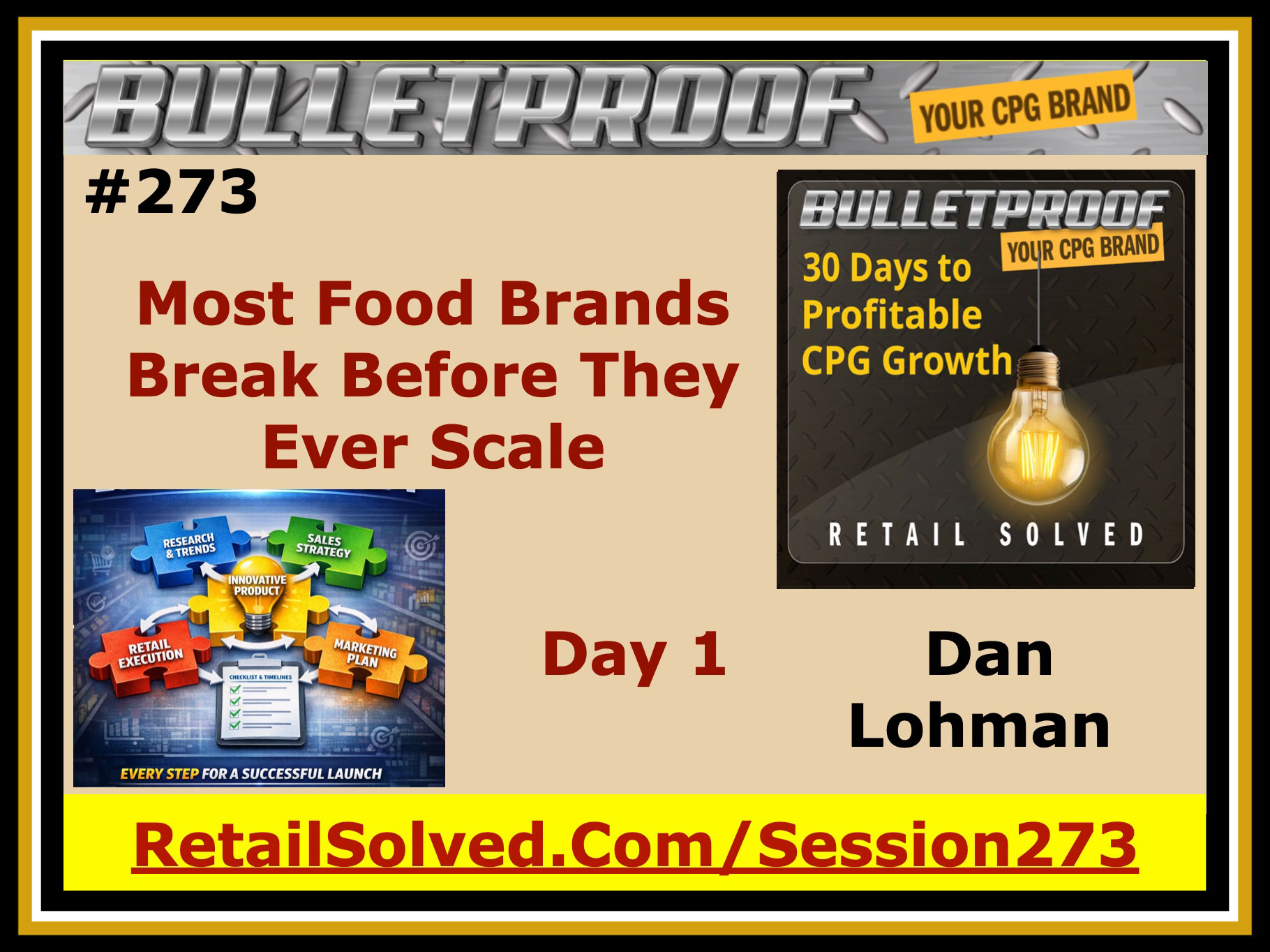
Most food brands don’t fail because of product—they fail because the foundation cracks under growth. In Day 1 of 30 Days to Profitable CPG Growth, I explain why scaling without strong fundamentals quietly destroys margins, forecasts, and retailer trust. You’ll learn how distraction hides the real growth drivers, why foundations must be revisited continuously, and what systems retailers and investors expect before saying yes. This episode resets how you think about scale—and why strong foundations accelerate profit instead of slowing it down.
The 30 Days to Profitable CPG Growth is relaunched as a masterclass to help emerging CPG founders scale profitably. The series focuses on building systems, discipline, and retail execution for sustainable growth, rather than simply increasing distribution. It provides actionable strategies, retail insights, and tools to help founders align their brands with retailer goals and convert shoppers into loyal customers.
If you’re trying to scale a food brand, stop improvising. Growth isn’t luck. It’s sequence:
strategy → execution → retail trust → repeatable demand.
Action step: write your next 90 days as 3 phases: build / prove / scale.
What phase are you in right now?
For additional inspiration listen to the following Bulletproof Your CPG Brand podcast episodes:
🎙️ 142 Maximize Sales With A Solid Business Plan Today, Michael J. O’Donnell
🎙️ 4 Strategies To Grow Sales And Profits Effectively
🎙️ 115 Success = Brand Strategy + Execution Essentials, Michael J. O’Donnell
Day 1 of the Free 30 Days to Profitable CPG Growth
Tip of the day: You put your whole heart and soul into creating a product to revolutionize the category, shouldn’t your go-to-market strategy be as innovative as the ingredients in your package. Building a solid foundation today will support explosive growth tomorrow and beyond.
What do you plan to do to strengthen your brands foundation?
Listen where you get your podcast








Like what you’ve heard?
Please leave a review and comment on iTunes
Let me know your most pressing question, I’ll do my best to answer it on a future episode.
Welcome to day 1, Episode 273 — How To Launch & Scale a Profitable Food Business Step-by-Step If you’re building a food brand right now, you’re probably feeling the weight of a thousand decisions—distribution, cashflow, supply chain, retail expectations, investor pressure, and the constant push to “scale faster.” But here’s the hard truth most founders don’t hear until it’s too late: Let me explain. But here’s the good news:
A sturdy foundation doesn’t just prevent collapse—it accelerates profitable growth. A strong foundation is rocket fuel. It gives you clarity, stability, and the confidence to scale without losing control. Today marks Day 1 of this revitalized 30-day masterclass. And we’re starting exactly where every successful brand begins: with the foundation that supports everything else. Why the Foundation Matters More Than Anything Else Consider this. Your brand is no different. And this is where most brands—big and small—get into trouble. They confuse activity with progress. They confuse momentum with direction. They forget what matters most to retailers, and they forget why shoppers choose their products in the first place. This is the Achilles heel I talked about in Episode 272 and the same one I’ve seen repeatedly throughout my career. Even billion-dollar brands fall into this trap because they get so consumed with the daily fire drills that they stop checking the foundation. But your brand doesn’t have to make that mistake. A Personal Lesson From My Early Days We could talk about our mission and our product benefits—but when buyers asked about forecasts, pricing architecture, margin impact, or supply chain continuity, our answers were vague. We were building the plane while flying it. It wasn’t about intelligence or effort. It was that we didn’t yet have the systems, discipline, and clarity to grow sustainably. That experience shaped how I now mentor brands and why this series begins with the foundation. Your foundation is not something you set once and forget. It’s something you build, maintain, reassess, and strengthen continuously. It’s the baseline that lets you earn an equal seat at the retail table. The Biggest Growth Blocker: Distraction You get blinders on.
The small details blur.
You start reacting instead of leading. Resetting your foundation keeps you grounded. It protects you from distraction. It keeps termites—bad assumptions, poor decisions, and hidden inefficiencies—from quietly eating away at your business. Your First Job: Strengthen Your Business Foundation Here’s what that looks like. It includes: Let me explain why this matters. This is how professionals operate. They don’t leave anything to chance. 2. Goals That Guide Your Decisions Most founders set goals based on hope. Professionals set goals based on capability, capacity, and strategy. 3. Annual (and Ongoing) Foundation Audits At least once a year—and ideally quarterly—step back and evaluate: True Category Management teaches us to anticipate, not react. That begins with knowing the health of your own business. 4. Investor Readiness Is Retail Readiness Founders spend endless hours polishing pitch decks while ignoring the core elements investors care about most: Risk Think about Shark Tank. They don’t know their business deeply enough. Day 1 Action Item: Strengthen Your Foundation Closing: This Is Where Your Transformation Begins Remember: A solid foundation amplifies every decision you make. Make sure you subscribe so you don’t miss any of these daily episodes. Share this series with another founder who needs clarity and encouragement right now. And download the free guide that accompanies this lesson—it includes today’s audit worksheet and a blueprint for building a robust business plan. You’re not alone in this.
We rise by helping each other.
And together, we are going to build a bulletproof brand—one that earns an equal seat at the table and gets into the hands of more shoppers. For additional inspiration listen to the following podcast episodes: Michael does the best job I've ever seen in this industry of structuring a business plan for a brand. We're on the same page in terms of what's required and what should be included in your business plan. And remember, your business plan should be so robust and so complete that someone else could step into your brand and run your business for you on your behalf and in your absence. That's the goal you're shooting for. Episode 4 Strategies To Grow Sales And Profits Effectively Episode 115 Success = Brand Strategy + Execution Essentials, Michael J. O’Donnell We talk about having those strategies in place and then being able to implement them and execute them across your entire business. A lot of brands talk about how great their strategies are, but their execution is usually pathetic. That's the difference between you being a legacy brand and being a brand that's here today and gone tomorrow. Your execution needs to be backed up by a solid brand strategy. Tip of the day: You put your whole heart and soul into creating a product to revolutionize the category, shouldn’t your go-to-market strategy be as innovative as the ingredients in your package. Building a solid foundation today will support explosive growth tomorrow and beyond. Thank you for listening. This episode has an accompanying video with illustrations and additional information I can’t share on an audio podcast. You can watch it at retailsolved.com/30daychallenge. You can get the show notes for this episode by going to RetailSolved.com/Session273. Thanks for listening and I look forward to seeing you in the next show. Tomorrows episode is Understand How Your Business Works with Confidence. This episode will build on today’s conversation. Thank you for listening. I look forward to seeing you in the next episode.
Enter your name and email address below and I'll send you periodic brand building advice, tips and strategies.
Day 1 of 30 Days to Prosperity
Your brand will only grow as strong as the foundation beneath it.
And most brands don’t realize their foundation is cracked until the damage is already showing up on the shelf.
Every week I talk to founders who are overwhelmed, distracted, and juggling too many urgent tasks. The day-to-day noise gets so loud that the basics—the true drivers of growth—become invisible. And when you ignore the basics, those small cracks quietly widen. Eventually they show up as plateauing velocity, shrinking margins, missed forecasts, and retailer frustration.
Think about the brands you admire—the ones that make growth look effortless. What you don’t see is the years of disciplined fundamentals they protect at all costs. This is true whether you’re talking about elite athletes, world-class musicians, or thriving CPG companies.
Legendary football coach Vince Lombardi began every season—every single season—with a room full of elite athletes and said, “Gentlemen, this is a football.” He understood a truth most brands miss: mastery isn’t about advanced tactics. It’s about perfecting the fundamentals over and over again.
You might have great packaging, a great product, or enthusiastic fans... but if the foundation is weak, nothing above it can scale. Everything becomes harder than it needs to be.
Early in my career as a cofounder, I was convinced we were ready to scale. We had the product. We had fans. We had passion. But when we began pitching retailers, something became painfully obvious: our business plan wasn’t deep enough to support our growth goals.
And retailers noticed.
Let’s be honest—life gets in the way. Emails, meetings, production issues, trade spend decisions, Expo deadlines, investor conversations… it’s a lot. And the busier you get, the easier it is to drift away from your long-term strategy.
And before you know it, you’re winging retailer pitches or winging your forecasts or winging your promotional plan. That might get you through today, but it won’t get you to profitability.
So today, we go back to the beginning.
Every brand—whether pre-revenue or $200M—needs to ask one simple question:
“Is my foundation strong enough to support the growth I’m pursuing?”
1. A Robust, Living Business Plan
Not a pitch deck. Not a one-page summary. A true business plan is a complete operating blueprint—so clear and detailed that someone else could run your business if you weren’t in the room.
Your long-term vision
Distribution strategy
Velocity targets
Retail execution plan
Trade spend strategy
Ingredient and packaging forecasting
Revenue goals and SKU-level expectations
Staffing and training requirements
Contingency plans for supply chain disruptions
Your capital needs and how that capital will be deployed
If you tell yourself you want to grow 5% next year, that’s not a goal—it’s a wish. A real plan answers:
How many stores does that require?
How many SKUs per store?
What velocity must each SKU maintain?
How many promotions will it take?
What will it cost?
Do you have the inventory to support it?
Can your team execute it?
I once saw Damon John story give an amazing keynote? It was identical to when I first saw it. Every pause. Every gesture. Every line—perfected. That’s what your planning should resemble: disciplined, intentional, rehearsed and professional.
Your goals must be:
Reasonable
Actionable
Measurable
Tied to your long-term success
We’ll go deep into goal-setting later in the series, but for today, I want you to ask:
“Are my goals grounded in a clear, fact-based roadmap?”
This is something big brands rarely do well, and it’s a massive opportunity for you.
What has changed in the economy?
What has changed in your ingredient sourcing?
What unexpected costs have emerged?
What does your retailer need today that wasn’t true last year?
Are your systems still supporting your goals?
One of the biggest misconceptions in this industry is that raising money proves you’re ready to scale. It doesn’t.
Clarity
Predictability
Execution discipline
Most founders talk passionately about their product… and then freeze when asked about cost of goods, margins, forecasts, or customer acquisition.
Your business plan removes that risk—for investors and retailers. It shows them you understand your numbers, your risks, your opportunities, and your path to scale.
And that makes it easier for them to say yes.
Today, I want you to audit your foundation.
Ask yourself:
Do I have a complete, written, up-to-date business plan?
Is it detailed enough that someone else could run my brand?
Are my goals specific, measurable, and tied to strategy?
What cracks have emerged that I’ve been ignoring?
What distractions have crept in that need to be cleared out?
Write down your answers. What gets written down gets done.
This is how you future-proof your brand. This is how you extend your runway. This is how you build toward profitable scale.
Today marks the first step in a 30-day journey that will change the way you run, lead, and scale your business. The foundation we covered today is not glamorous, but it’s the single most important factor in whether your brand thrives or struggles.
Strong brands aren’t built on luck—they’re built on discipline.
You now have clarity around what needs to be strengthened and why it matters.
Tomorrow, in Episode 274, we’re going to dive into how to set goals that actually move your business forward—goals rooted in fact-based strategy, not wishful thinking.
Episode 142 Maximize Sales With A Solid Business Plan Today, Michael J. O’Donnell
Michael and I spend a lot of time talking about the importance of a business plan, why it matters, and how to structure one. How to set one up.
Unlock new growth with effective strategies to grow sales and profits for your brand in today's competitive market. Consumers can't buy what they can't find! Learn how to fix our broken food system, improve product awareness, level the playing field between small & big brands, & make healthy products more accessible and affordable with loyal committed shoppers.
In this podcast episode, we talk about what's possible. We talk about what you can achieve if you use the right strategies. And, those strategies, remember, need to be baked into your business plan.
Sign up to receive email updates
FREE Trade Promotion ROI Calculator:
Click Here To Maximize Sales And Profits
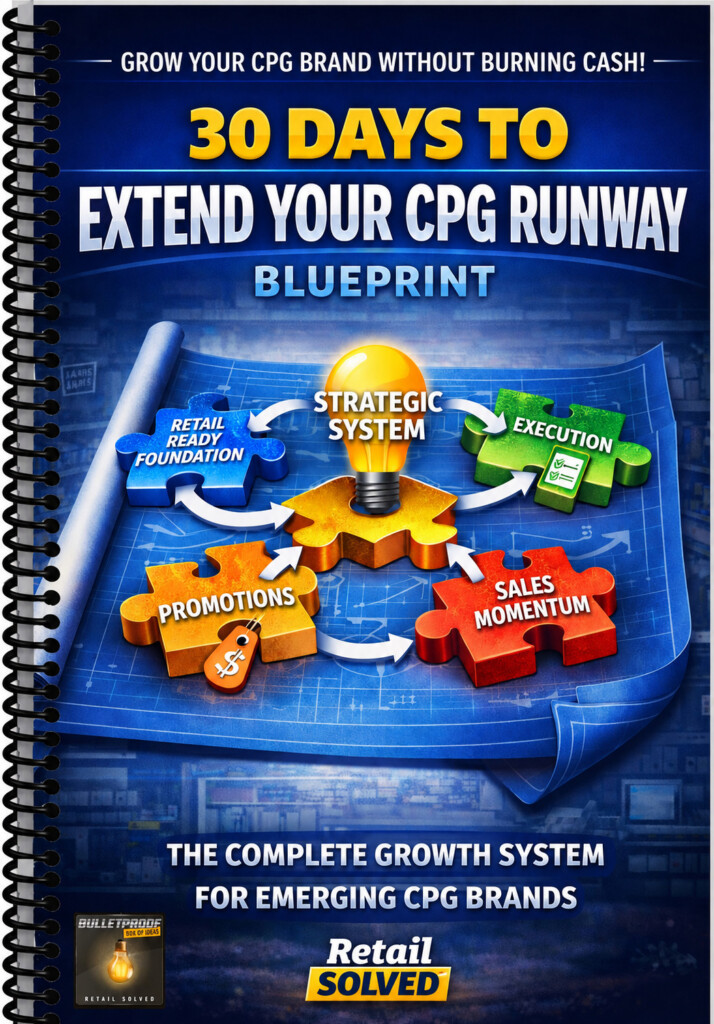
Extend your runway one focused day at a time.
Build the retail fundamentals behind profitable growth with one practical skill, one action, and one better decision each day.
Image is the property of CMS4CPG LLC, distribution or reproduction is expressively prohibited.