Great strategy fails without flawless execution. In Day 25 of 30 Days to Prosperity, I break down how scorecards turn goals, MBOs, and plans into predictable results retailers trust. Learn how top CPG brands use scorecards to eliminate chaos, assign clear ownership, prevent execution breakdowns, and scale with confidence. This is the framework retailers respect—and the discipline that separates reactive brands from true category leaders.
Scorecards map out objectives in bite-size, manageable pieces that keep you focused, aligned, and on track. They can be the difference between success and failure. Scorecards are the most underutilized project-management tool in the CPG industry. And that’s a problem—because scorecards are also one of the most effective tools to keep the business moving forward predictably.
Action step: create a weekly scorecard for distribution, OOS, promo, deductions.
What would you measure weekly if you had to pick 5 things?
For additional inspiration listen to the following Bulletproof Your CPG Brand podcast episodes:
🎙️ 124 Celebrating Real Food The Farmer’s Essential Role, Phil Lempert with Supermarket Guru
🎙️ 134 Category Review Strategies to Maximize Sales
🎙️ 157 Tools To Ensure Sales Success with Scorecards
🎙️190, Promotion Analysis Growth Strategies to Maximize Your Trade Marketing ROI
Day 25 of the Free 30 Days to Profitable CPG Growth
Tip of the day: Scorecards map out objectives in bitesize manageable chunks that keep you on-track and focused. They help you achieve your goals – they can be the difference between success and failure
You can get the episodes free guide and todays show notes at: RetailSolved.com/session297
Listen where you get your podcast








Welcome to day 25: Episode 297 — How To Ensure Flawless Execution Using Scorecards If you’ve been following along in this 30 Days To Prosperity series, then you’ve already heard me say: Why Scorecards Matter More Today Than Ever Here’s why: A Simple Example: Planning an In-Store Demo This happens all the time because brands rely on good intentions instead of structured planning. What a Demo Scorecard Actually Looks Like Once these tasks are mapped: The Impact: What Happens When You Do This Right Scorecards Aren’t Just for Demos Why Most Brands Don’t Use Scorecards (And Why You Must) A Final Word of Encouragement Next up we’ll talk about how to systematize flawless execution across your entire organization—so excellence becomes your standard, not your exception. Subscribe and share this with another founder looking for an edge For additional inspiration listen to the following podcast episodes: Episode 157 Tools To Ensure Sales Success with Scorecards Secrets 190, Promotion Analysis Growth Strategies to Maximize Your Trade Marketing ROI. Scorecards are one of the best ways to manage your trade marketing. Learn how to leverage a scorecard to maximize every aspect of your trade marketing. It's an area that's overlooked by just about everyone. The reason this matters is because if you can get more runway to grow and scale your brand, that's going to differentiate you. It's going to help you make a big difference on the shelf and it's going to help you fuel your brand and help you fuel new innovation. Tip of the day: Scorecards map out objectives in bitesize manageable chunks that keep you on-track and focused. They help you achieve your goals - they can be the difference between success and failure Thank you for listening. This episode has an accompanying video with illustrations and additional information I can’t share on an audio podcast. You can watch it at retailsolved.com/30daychallenge. You can get the show notes for this episode by going to RetailSolved.com/Session297. Tomorrows episode is How To Develop Performance Indicators for Success - KPI’s. This episode will build on today’s conversation. Thank you for listening. I look forward to seeing you in the next episode.
Enter your name and email address below and I'll send you periodic brand building advice, tips and strategies.
Day 25 of 30 Days to Prosperity
Scorecards map out objectives in bite-size, manageable pieces that keep you focused, aligned, and on track. They can be the difference between success and failure.
What gets measured gets done.
And you can’t hit a target you’re not aiming at.
Today we’re taking that a step deeper.
Because now that you’ve learned how to set SMART goals…
how to create MBOs for your team…
and how to align your organization around strategic objectives…
It’s time for the tool that actually brings all of that to life.
A tool that eliminates chaos.
A tool that keeps everyone accountable.
A tool that removes guesswork and replaces it with clarity.
That tool is the scorecard.
I’ll say it plainly:
Scorecards are the most underutilized project-management tool in the CPG industry.
And that’s a problem—because scorecards are also one of the most effective tools to keep the business moving forward predictably.
They break big goals into small, doable action steps.
They clarify exactly who is responsible for what.
They eliminate assumptions that lead to mistakes.
They create cross-functional alignment.
They build accountability without micromanagement.
If the MBO is the strategic what,
the scorecard is the tactical how.
And you need both to scale with confidence.
Let’s walk through a scenario to ground this in real-world experience.
Picture this:
Your brand has secured an in-store demo—a huge opportunity to lift sales, acquire new customers, and deepen your retailer relationship.
Great!
But here’s the truth:
A demo without a scorecard is a disaster waiting to happen.
Backroom out-of-stocks…
no signage…
no samples…
unprepared staff…
frustrated shoppers…
angry retailers…
Let’s fix that.
Start by listing every task required for flawless execution.
Here’s a simplified version:
1. Retailer Commitment
Confirm demo date, time, and location
Get any approvals the retailer requires
Follow up one week prior
2. Inventory Planning
Analyze past sales to forecast incremental volume
Factor in promotional causals (price drops, signage, displays)
Communicate store-by-store allocation
Confirm DC or distributor inventory
Accuracy is everything here.
No out-of-stocks. No surprises.
3. Store-Level Coordination
Align pricing and promotional tags
Confirm displays and who will build/remove them
Ensure sufficient backroom space
4. Demo Execution
Schedule an experienced, well-trained demo specialist who understands your product and knows who your ideal customer is
Confirm supplies: gloves, aprons, sample cups, utensils, microwave, trash bags, etc.
Provide clear talking points rooted in your selling story
5. Signage & Creative
Get signage approved
Print and ship materials early
Confirm receipt with each store
Assign ownership.
Who is responsible for each line item?
Assign deadlines.
When is each step due?
Assign order of operations.
Which steps depend on earlier steps?
Duplicate for every store in the chain.
Scalable. Repeatable. Predictable.
This is how you ensure flawless execution.
When I was the grocery manager at Price Club—now Costco—I coordinated countless demos.
And the sales lift from a well-executed event?
Several hundred percent.
Not just during the demo…
but afterwards.
Base sales grew steadily because customers fell in love with the product.
That is the goal.
That is the opportunity.
And that is why scorecards matter.
Retailers love when a brand makes their life easier.
They reward brands who execute with excellence.
They ask those brands back again and again.
In fact, the most successful brands use scorecards for:
Line reviews
Planogram resets
New item launches
Broker management
Sales meetings
Marketing calendars
Production planning
Trade promotion execution
Project launches of any kind
Anything that has multiple steps, multiple people, or multiple deadlines belongs in a scorecard.
This is how you avoid fire drills.
This is how you reduce stress on your team.
This is how you create a culture of calm execution instead of frantic reaction.
Simple? Yes.
Overlooked? Constantly.
Powerful? Absolutely.
Most brands run fast.
So fast that they never slow down long enough to set up structure.
But here’s the secret:
Structure doesn’t slow you down.
Structure makes you faster, more confident, and more predictable.
And predictability is the ultimate competitive advantage.
It helps you:
hit deadlines
hit sales targets
manage risk
reduce out-of-stocks
improve retailer trust
boost employee performance
increase investor confidence
In short, structure creates the discipline required to scale.
There are thousands of small things your competition overlooks.
Scorecards are one of them.
If you adopt this tool—not as a one-off—but as part of your brand DNA, you instantly rise above the noise.
You become the brand retailers trust.
The brand teams love working for.
The brand investors want to support.
The brand customers can rely on.
This is how you become bulletproof.
Let’s keep building your competitive edge.
Downloads the free series guide to go deeper into these strategies
Episode 124 Celebrating Real Food The Farmer’s Essential Role, Phil Lempert with Supermarket Guru
Join us in celebrating real food and the vital role farmers play in our food system and product availability. Phil Lempert discusses the importance of farmers in the natural food industry and the need to support them. He emphasizes the role of retailers in educating consumers about food sources and dietary trends, highlighting the need for personalized shopping experiences and accurate product information.
Nothing happens until customers buy your products. They can’t buy what they can’t find. Your retail execution needs to be flawless. Scorecards and KPI’s are the best tools to insure flawless merchandising, distribution, promotions, and sales excellence.
Sign up to receive email updates
FREE Trade Promotion ROI Calculator:
Click Here To Maximize Sales And Profits
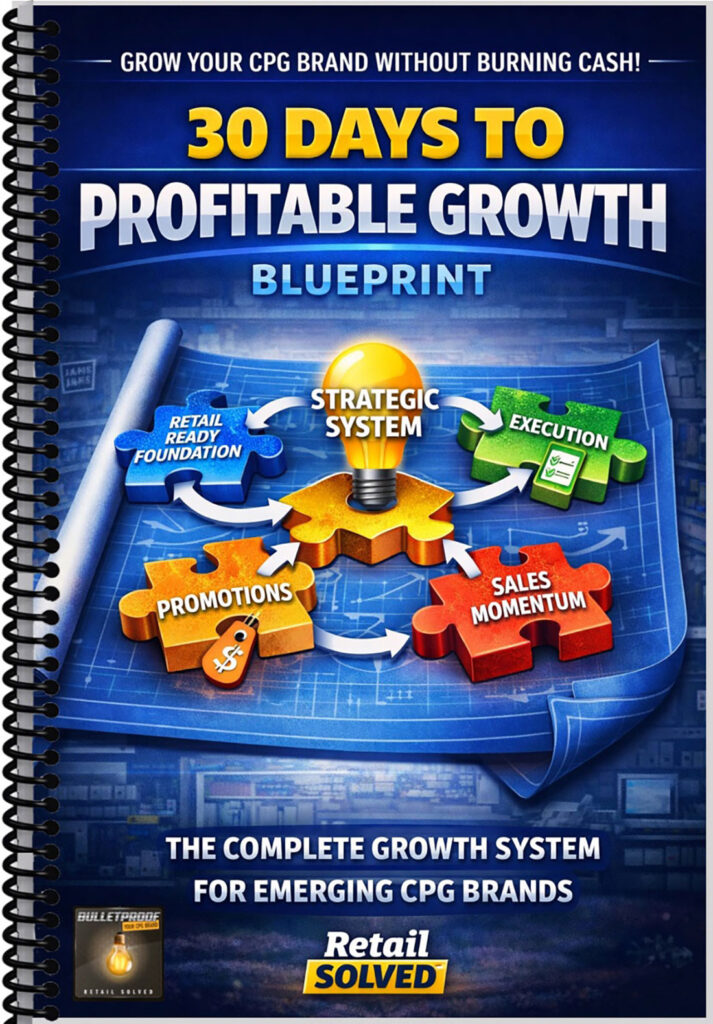
Image is the property of CMS4CPG LLC, distribution or reproduction is expressively prohibited.