Retailers don’t choose brands with the best charts—they choose brands with the clearest story. In Day 17 of 30 Days to Profitable CPG Growth, I break down fact-based selling: how to combine POS data, real shopper insight, and clear recommendations into a story retailers act on. You’ll learn why push-button reports fail, how to stand out in line reviews, and how emerging brands earn influence, space, and growth without buying it through trade spend.
Fact-based selling, a crucial skill for competing with big brands, involves using data, shopper insights, and clear recommendations to tell a compelling story. This approach goes beyond traditional category management by providing retailers with actionable insights and solutions, rather than just data points. By combining POS data with shopper insights and community feedback, brands can create personalized, impactful stories that resonate with retailers and drive growth.
For additional inspiration listen to the following Bulletproof Your CPG Brand podcast episodes:
🎙️ 45 The Importance Of A Solid Business Strategy Today, TJ McIntyre with BOBO’S
🎙️ 59 Fact-Based Selling Stories Transform Your Sales Strategy, Steve Hughes with Sunrise Strategic Partners and Boulder Brands
🎙️ 88 Category Leaders Open Doors & Grow Profitable Sales Effectively, Russ Forester with Hain Celestial
Day 17 of the Free 30 Days to Profitable CPG Growth
Tip of the day: Fact-based selling is advanced story telling – what I call true category management. Fact-based story telling includes actionable recommendations with measurable results to give you the edge you deserve.
Listen where you get your podcast








Welcome to 17: Episode 289 — How To Use Fact-Based Selling For a Competitive Edge
Day 17 of 30 Days to Prosperity If you want an equal seat at the table with big brands, this is one of the most important skills you can learn: I’m talking about advanced storytelling using facts, shopper insights, and clear recommendations.
This is what I call true category management. Why Fact-Based Selling Is Your Secret Weapon Traditional category management in natural has become what I call push-button category management: Before Category Management Became a Buzzword… That was my first real lesson in the power of fact-based storytelling. The Problem With Push-Button Reports On its own, it doesn’t tell you: Consider this. Your Community Is the Missing Piece Big Brands Can’t Fake Those answers—combined with POS data—are pure gold. Consider this. Contrast that with your brand, designed to solve a very specific need for a very specific consumer. Fact-Based Selling = POS Data + Shopper Insight + Clear Recommendation Let me share a real example. We built a story: Don’t Just Buy Data. Buy the Right Data for the Right Question. You’ll start with: Day 17 Action Item: Draft a Simple Fact-Based Story In Closing: This Is How You Get the Edge You Deserve In upcoming episodes in this challenge, we’ll go even deeper into trade promotion, shopper marketing, and how to measure what actually moves the needle, so you can protect your runway and grow with confidence. For additional inspiration listen to the following podcast episodes: Episode 59 Fact-Based Selling Stories Transform Your Sales Strategy, Steve Hughes with Sunrise Strategic Partners and Boulder Brands Episode 88 Category Leaders Open Doors & Grow Profitable Sales Effectively, Russ Forester with Hain Celestial Tip of the day: Fact-based selling is advanced story telling - what I call true category management. Fact-based story telling includes actionable recommendations with measurable results to give you the edge you deserve. Thank you for listening. This episode has an accompanying video with illustrations and additional information I can’t share on an audio podcast. You can watch it at retailsolved.com/30daychallenge. You can get the show notes for this episode by going to RetailSolved.com/Session289. Tomorrows episode is How To Make And Sell Products Your Customers Want. This episode will build on today’s conversation. Thank you for listening. I look forward to seeing you in the next episode.
Enter your name and email address below and I'll send you periodic brand building advice, tips and strategies.
Fact-based selling.
Not “pretty charts.”
Not generic ranking reports.
Not whatever falls out of the canned template your data provider gives you.
When you master it, you stop sounding like every other brand in the line review…
…and you become the founder retailers look to for leadership, clarity, and direction.
Let me explain.
In the last episode, we talked about using data analytics as the roadmap to future sales and profits. Today we’re going to turn that roadmap into a sales vehicle—your fact-based story.
Hit a button
Print a topline ranking report
Circle your brand
Ask for more space or a promotion
You’ve probably been told that’s all you need.
It’s not.
Retailers are drowning in those reports.
They don’t need another brand telling them, “We’re #7 and our velocity is growing 3.2%.”
They need something very different:
They need you to tell them what’s really going on in their category and what to do about it.
That’s where fact-based selling comes in.
Let me take you behind the curtain for a moment.
Before category management was formalized, I was already experimenting with what we now call fact-based selling. I was selling potato chips for a small regional company and I started bringing simple charts into retailer appointments.
Nothing fancy—no syndicated POS back then. I used my shipment data. But I took the extra step of visualizing it.
I’d stack little potato chip images over the bars on the graph to show:
How our brand was growing
How we performed vs. the national brand
What happened when retailers gave us an endcap
It was crude by today’s standards—but retailers loved it.
Why?
Because I wasn’t just saying, “We’re great, give us more space.”
I was showing:
What changed when they supported us
Where the opportunity was
How we could help them grow the category
Today, everyone has graphs and charts.
So the question becomes:
How do you stand out from the noise?
You do it by telling a story no one else can tell.
Most syndicated POS data—Nielsen, IRI, SPINS—tells you what happened:
Sales up or down
Units up or down
Share gains or losses
It’s historical. It’s useful. But it’s incomplete.
Why the change happened
What’s driving it
Whether it’s sustainable
How your shopper is behaving
What the retailer should actually do next
That’s where shopper and consumer insights come in.
If you run a generic consumer survey with people who don’t even buy your category, you’ll get surface-level feedback. It’s not wrong, but it’s not helpful.
But if you ask actual diaper buyers how they shop the diaper category:
They’ll tell you which brands they trust and why
They’ll tell you what else they put in the basket
They’ll tell you what packaging works and what confuses them
They’ll tell you how they trade up, down, or out of the category
Now you’re not just showing diaper sales trends.
You’re explaining why those trends exist and how to grow them.
Here’s why that matters.
Remember earlier in this series when we talked about building your own thriving community?
That community is where you get your best data:
Real customers
Real experiences
Real buying behavior
You don’t have to guess.
You don’t have to pay for random focus groups.
You don’t have to settle for generic “health-conscious consumer” profiles.
You can ask:
“How do you use our product?”
“Where do you expect to find it in the store?”
“What do you buy with it?”
“What problem does it solve for you?”
Big brands often don’t have this level of intimacy with their shopper.
Their innovation pipeline is frequently built around manufacturing efficiency, not real-life needs.
One big brand I worked with “innovated” a whole line by:
Taking the same liquid product
Slapping a breakfast label on it
Slapping an energy label on it
Slapping a meal replacement label on it
Five “new” items.
One actual product.
Their strategy was:
Push it hard
Coupon heavily
Promote aggressively
It was all about squeezing more out of the manufacturing line—not solving a unique shopper problem.
This is the opportunity.
Let’s make this practical.
Here’s the formula I want you to think about:
Fact-Based Story = What Happened (POS) + Why It Happened (Shopper Insight) + What To Do Next (Recommendation)
I worked with a young brand that had:
Limited budget
Scattered distribution in a large chain
Inconsistent merchandising (different aisles in different stores)
No control over where they were placed
Like most brands, they assumed the retailer would “figure it out.”
Spoiler: they didn’t.
Here’s what we did instead:
We ran a simple Facebook survey with their true fans.
Where do you look for us?
Where do you think we should be in the store?
What else is in your basket when you buy us?
We bought a targeted snapshot of data from the right source.
Not the big, expensive data set they were about to waste money on
Just enough to see how their brand was performing by department and placement
Their customers expected to find them in produce
When they were merchandised there, velocity and margins were much stronger
When placed elsewhere, both the brand and the category underperformed
We paired the shopper insight with POS proof and a simple recommendation:
“Consolidate all SKUs into produce chain-wide. Here’s the upside for your category and your profit.”
Result?
They went from ~$200,000 in annual sales
To placement in 1,600 stores, all in produce
Their product became an impulse buy
Within a year, sales grew to over $3 million
All without massive trade spend.
All without deep discounting.
All because they told a fact-based, shopper-led story.
That’s the power of this approach.
A quick but critical point:
It’s not enough to have access to data if it doesn’t help you answer the question you’re actually trying to solve.
Most brands:
Buy the wrong data
Don’t pair it with shopper insights
Dump screenshots into a deck
Hope the charts do the selling
You’re going to be different.
What is the key problem we’re solving for the retailer?
What does the shopper need that they’re not getting today?
What proof do we need to show?
Then you choose the data.
Then you build the story.
Then you make a clear recommendation.
That’s fact-based selling.
Grab a pen and paper and outline this for one retailer:
What’s happening in the category?
(Use whatever POS data you have.)
Why is it happening?
(What do you know from your community, your shopper, your tribe?)
What single recommendation would help the retailer grow both your brand and the category?
(Placement, pricing, assortment, promotion, education, etc.)
What’s the expected outcome?
(Incremental dollars, improved basket, new shopper, reduced churn, etc.)
That’s your first fact-based selling story.
Now imagine multiplying that across every SKU and every retailer.
Fact-based selling is not about being a “data person.”
It’s about being a story person who uses data well.
When you combine:
Your WHY
Your unique shopper
Your thriving community
Your data
Your strategic brain
…you become the founder who walks into a category review with something no one else has:
Clarity.
Insight.
A plan.
Retailers notice that.
Retailers reward that.
Make sure you’re subscribed.
Share this episode with a founder who’s stuck in “template-land” and needs to hear there’s a better way.
Downloads the free series guide to go deeper into these strategies and mini-courses I’ve created to help you master this skill step-by-step—so you can earn that equal seat at the table and the competitive edge your brand deserves.
Episode 45 The Importance Of A Solid Business Strategy Today, TJ McIntyre with BOBO’S
The Importance Of A Solid Business Strategy. TJ used to work with Steve at Boulder brands and on this episode TJ sure how he's been able to get explosive growth for bobos by using fact they selling and these advance strategies. What makes this even more more remarkable is that bobos oat bars are sold in the energy bar category. Energy bars are the most hyper competitive category in every store. Think of all the different brands trying to compete for shoppers attention. On top of that some of the bigger brands with deep pockets rely on deep discounting strategies for growth. This makes it even more difficult for small brands compete. TJ and I discuss event strategies he uses and how they've giving him a significant comparable advantage while making the brand more attractive to investors.
Add Rocket Fuel To Your Growth. In this podcast episode Steve shares how he used advanced fact based selling strategies to gain explosive growth for Boulder brands another brands throughout his career. Steve shares and examples of how fact based sales and how they give him is a significant stainable competitive advantage.
Proof That Becoming A Category Leader Opens Doors & Grows Sales. Hain Celestial it's one of the largest companies in the natural channel. Russ shares how his team relies heavily on Advanced strategies and fact-based selling. In this episode Russ shares a challenge that he has competing against big brands. I share with him several strategies to help him take a leadership role in the category and level the field against the most sophisticated competitors. In most episodes I asked my guest what are most challenging bottleneck is and I help to solve it Live on the podcast. These are most likely your most pressing bottlenecks as well. Listen to the advice that I gave Russ and how he uses it to extend his leader ship role in the category.
Sign up to receive email updates
FREE Trade Promotion ROI Calculator:
Click Here To Maximize Sales And Profits
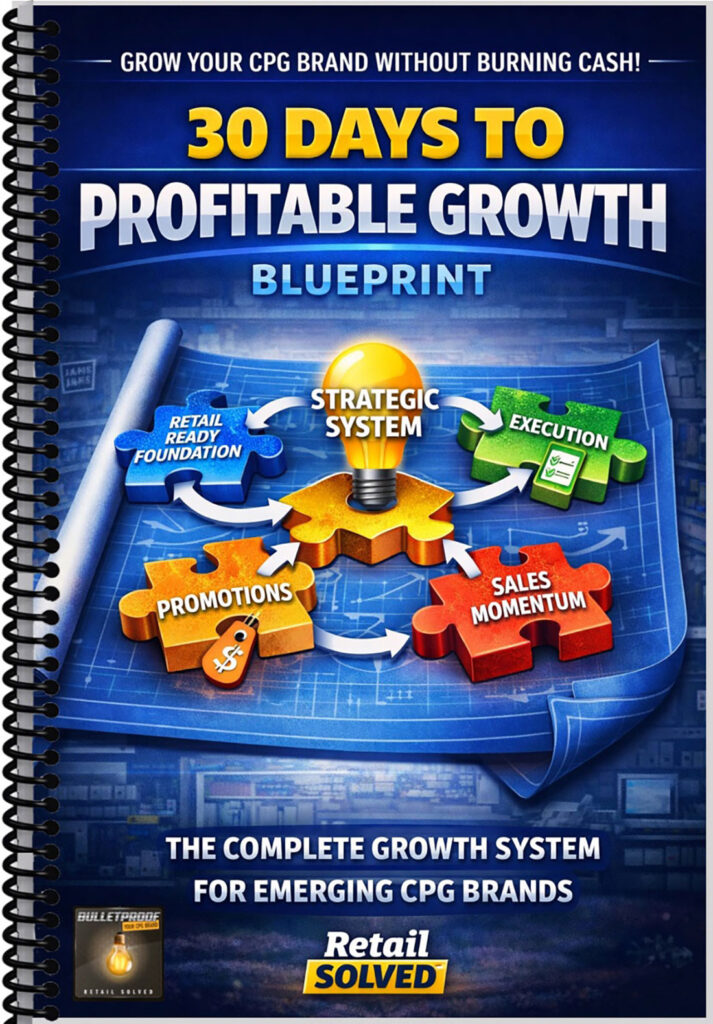
Image is the property of CMS4CPG LLC, distribution or reproduction is expressively prohibited.