Margins are tighter. Costs are rising. Retailers still expect performance. And most founders are working harder just to maintain momentum.
But here’s the uncomfortable truth:
Most brands do not have a spend problem.
They have a clarity problem.
In this episode, I break down why so many CPG brands are quietly leaking:
- cash
- margin
- execution
- retailer trust
- visibility
- and decision quality
We discuss:
- why dashboards alone do not create clarity
- how hidden operational leaks compound over time
- why many promotions subsidize sales instead of creating demand
- how retailers actually evaluate your brand
- the 7 hidden leaks draining runway
- and how the Retail Clarity Framework™ helps founders compete smarter
This is one of the most important strategic episodes I’ve recorded because it changes how founders think about growth, trade spend, execution, and profitability.
12:31 Here is a strategic reframe
13:56 Here are some actionable takeaways
15:02 Here’s something that will help
Listen where you get your podcast








Like what you’ve heard?
Please leave a review and comment on iTunes
Let me know your most pressing question, I’ll do my best to answer it on a future episode.
Every founder I speak with now is working to And if you’re like many founders I speak with… The answer was: But not in the way most brands think. Episode 320 — Margin Pressure Isn’t the Real Problem And right now, most brands are trying to grow while quietly leaking runway. The real problem is that most founders cannot clearly see where the business is leaking: And when you cannot clearly see the leak… Let me explain. He was talking about how margins had eroded as the company expanded. At the same time, shoppers became more cautious and more promotion sensitive. Now consider this. And all of this is happening while cash flow gets tighter and decision-making gets harder. So naturally, most brands start trying to identify “the problem.” Because they start treating symptoms instead of identifying root causes. Let me give you some context Most founders begin blaming: And to be fair… But here’s the problem. They see the financial pressure. Everything gets lumped together into one giant category called “margin pressure.” But margin pressure is usually the output of multiple hidden operational leaks happening simultaneously. This is the key. And when founders lack clarity, they start reacting emotionally instead of strategically. That confusion compounds. THE BIG MISUNDERSTANDING This is one of the biggest blind spots in CPG right now. Most brands are drowning in data. But data alone does not create clarity. That distinction matters more than ever right now. But this is not a stable environment. Shopper behavior is changing. So if founders only rely on historical reporting… CONSIDER THIS A founder sees velocity slowing. But maybe: Maybe the issue was never price to begin with. This is why canned reports are not strategy. RETAILERS SEE THIS DIFFERENTLY Now let’s look at this from the retailer’s perspective. Savvy retailers know the difference between: This is important. But retailers often evaluate: That changes the conversation entirely. Retailers do not reward activity. This is the opportunity for smaller brands. THE RETAIL CLARITY FRAMEWORK™ Not more dashboards. 1. Internal — What happened? This matters. 2. Shopper — Why did it happen? This is where clarity starts getting powerful. This matters because shoppers are changing right now. That changes: If brands do not understand the shopper shift… 3. Competitive — What influenced it? Most brands evaluate themselves in isolation. What else was happening around your product? Did the retailer reset the shelf? This matters because performance is contextual. 4. Predictive — What should we do next? This is where clarity becomes strategy. Not reactive strategy. Because once founders understand: They can make dramatically better decisions. THE 7 HIDDEN LEAKS 1. Promotions 2. Timing 3. Placement 4. Deductions 5. Execution Execution gaps quietly destroy runway. 6. Visibility Gaps If shoppers do not notice you… 7. Decision Quality This may be the biggest leak of all. This is even true in uncertain economic times like we are all living in today. Here is a strategic reframe Now here’s the important shift. Because when founders gain clarity: And confidence matters in difficult environments. Founders are not powerless. In fact, smaller brands often have advantages larger companies do not: But those advantages only matter when paired with clarity. And by the way—if this conversation resonates with you, make sure we connect on LinkedIn. I also publish a weekly LinkedIn newsletter where I go much deeper into many of these topics and break down real-world examples founders can apply immediately. Because the goal here is not theory. Here are some actionable takeaways So what should founders do next? Second: Third: Visibility gaps destroy sales quietly. Fourth: Poor execution distorts everything downstream. Fifth: Here’s something that will help That’s exactly why I created the free 15-Minute CPG Runway Leak Finder™. No friction. And if you want to go deeper after that, I also invite you to join the free Retail Clarity Workshop, where we walk through how to prioritize and fix hidden profit leaks step-by-step. Before I go, When you understand: Everything changes. If you know a founder struggling with margin pressure, retail execution, or growth confusion, please share this episode with them. With all the uncertainty in our economy at the moment, many brands now are focused on survival, margin erosion, growth, and getting an equal seat at the table.
Enter your name and email address below and I'll send you periodic brand building advice, tips and strategies.
• justify every dollar
• stretch already limited resources
• claw back promotions
• better control cash
• scale back innovation
You’re probably asking yourself some version of this question:
“Why does it feel like we’re working harder just to maintain momentum?”
Let me explain.
I recently spoke with the founder of a growing brand that was dealing with exactly this challenge.
On paper, the business looked healthy.
Distribution had expanded.
Sales were growing.
Retail relationships were improving.
The team was working hard.
The brand was gaining traction.
But underneath the surface…
Margin kept eroding.
And the more the business grew, the more difficult it became to identify where the pressure was actually coming from.
Was it promotions?
Rising costs?
Operational inefficiencies?
Retail execution?
Forecasting?
Deductions?
Yes.
All of it.
Add intro here
Margins are tighter.
Costs are higher.
Shoppers are more cautious.
Retailers still expect performance.
That’s the real issue.
Not just inflation.
Not just tariffs.
Not just retailer pressure.
Not just promotions.
• cash
• margin
• execution
• sales
• retailer trust
• and decision quality
Every decision starts becoming reactive.
That confusion gets expensive.
I recently had a conversation with a consulting client that really reinforced this for me.
Trade spend kept increasing.
Distributor expectations kept increasing.
Retailer demands kept increasing.
Costs kept increasing.
And the question he was wrestling with was simple:
“Can this business still scale profitably?”
That conversation is not unique anymore.
I am hearing versions of this across the industry.
Founders are under pressure from every direction:
• ingredient costs
• freight
• packaging
• retailer fees
• deductions
• inventory pressure
• labor
• promotions
• broker costs
• distributor costs
• retailer expectations
And this is where many founders unintentionally make things worse.
• trade spend
• deductions
• brokers
• distributors
• promotions
• retailer fees
• slowing demand
• rising costs
Those things absolutely matter.
Most brands are diagnosing margin pressure too narrowly.
But they cannot clearly see:
• where profit is leaking
• which investments are actually working
• where execution is breaking down
• which promotions are incremental
• which promotions are subsidizing sales
• whether shoppers are confused
• whether the product is visible
• whether timing is wrong
• whether assortment is wrong
• whether retailer expectations were misaligned from the beginning
Most brands do not have a simple spend problem.
They have a clarity problem.
They:
• throw more money into promotions
• pressure brokers harder
• cut important investments blindly
• chase velocity without understanding profitability
• fund activity instead of outcomes
And over time, it quietly drains runway.
Dashboards.
Reports.
Retail portals.
Trade systems.
Velocity metrics.
Shipment reports.
Forecasting tools.
Data tells you what happened.
Retail Clarity tells you:
• why it happened
• what influenced it
• what the shopper was responding to
• what competitors were doing
• where execution broke down
• and what to do next
Because in stable environments, historical data can often guide future decisions reasonably well.
Retailer priorities are changing.
Competition is changing.
Promotion effectiveness is changing.
Private label pressure is changing.
Category economics are changing.
They start making decisions with incomplete context.
And incomplete context creates expensive decisions.
So they increase promotions.
The promotion temporarily lifts sales.
Then sales collapse afterward.
Now the founder thinks:
“We need more promotions.”
• shoppers simply stocked up
• the promotion pulled demand forward
• the retailer moved the product
• the timing was wrong
• competitors were promoting deeper
• shoppers did not understand the value proposition
• the product was hard to find
• the display execution failed
• the wrong SKU was featured
And this is why many brands accidentally fund the wrong activities.
Because they cannot clearly see what is actually driving the result.
Retailers are not simply evaluating your product.
They are evaluating:
• category productivity
• shopper response
• profitability
• inventory flow
• execution reliability
• promotional effectiveness
• shelf productivity
• operational simplicity
• true demand
• and subsidized demand
Because many brands believe they are “winning” when sales spike during promotions.
• what happened after the promotion
• whether category growth sustained
• whether margin improved
• whether shoppers repeated
• whether inventory flowed properly
• whether the brand created operational headaches
Retailers reward clarity.
They reward brands that:
• understand the shopper
• improve the category
• create retailer confidence
• execute consistently
• and solve problems proactively
You do not need to outspend larger competitors.
You need to outmaneuver them.
This is exactly why I built the Retail Clarity Framework™.
Because founders need a better operating lens for environments like this.
Not more noise.
Clarity.
Let me walk you through it.
This is your operational reality.
Sales.
Margins.
Velocity.
Trade spend.
Inventory.
Forecasting.
Shipments.
Deductions.
Scorecards.
Retail execution metrics.
But this is only the starting point.
Because many brands stop here.
And when you stop here, you only see symptoms.
Why did shoppers buy?
Why did they ignore the product?
What were they trying to solve?
What mattered most in that moment?
Price?
Convenience?
Trust?
Visibility?
Taste?
Health?
Availability?
Many shoppers are becoming:
• more intentional
• more selective
• more price aware
• more promotion sensitive
• promotion effectiveness
• assortment performance
• merchandising impact
• packaging communication
• retailer expectations
They start optimizing for outdated behavior.
Retail does not work that way.
Were competitors:
• promoting deeper?
• better placed?
• easier to find?
• running displays?
• gaining distribution?
• simplifying their message?
• leveraging private label pricing pressure?
Did assortment change?
Did another product steal visibility?
Did category conditions shift?
And context changes interpretation.
Intentional strategy.
• what happened
• why it happened
• and what influenced it
That’s the goal.
Not perfection.
Clarity.
Because clarity creates leverage.
Now let’s make this practical.
Over time, I’ve noticed that most brands quietly leak runway in seven common areas. I see these leaks in brands of all sizes. The difference is that larger brands have more runway.
And what makes these leaks dangerous is that they often remain hidden until the financial pressure becomes severe. Left unchecked they compound over time.
Question:
Are your promotions creating incremental demand—or subsidizing existing demand?
A lift during a promotion does not automatically mean success.
This is one of the biggest mistakes brands make.
They measure activity instead of profitability.
Question:
Are you promoting at the right moment for the shopper, retailer, and category?
Even strong programs fail when timing is wrong.
A great strategy at the wrong time still fails.
Question:
Can shoppers actually find your product? In ever store?
You can have strong distribution and still lose because visibility is weak.
Shoppers cannot buy what they cannot find. This includes when you are out-of-stock.
Question:
Are you validating deductions—or automatically paying them?
Many brands quietly lose enormous amounts of margin here.
Especially fast-growing brands without strong operational discipline.
Paying someone to manage your deductions is an expense if the deduction is invalid. The best strategy is to eliminate deductions BEFORE they occur. And remember that your cashflow is disrupted until the deduction is resolved.
Question:
Is your strategy consistently showing up at shelf?
A brilliant strategy fails when execution breaks down:
• out-of-stocks - including during a promotion
• missing displays
• poor replenishment
• weak merchandising
• disconnected brokers
• distributor failures
Question:
Do shoppers immediately understand why your product matters?
They cannot choose you.
This is why visibility matters more than dashboards.
Question:
Are decisions being made with full context—or partial information?
Because poor decisions compound over time.
And many founders are making critical decisions:
• too quickly
• reactively
• under pressure
without enough clarity
The goal is not to blindly spend less.
The goal is not to panic every time margins tighten.
The goal is to spend with greater clarity.
• promotions improve
• retailer conversations improve
• forecasting improves
• execution improves
• inventory planning improves
• assortment decisions improve
• margin improves
• confidence improves
Smaller brands can absolutely compete smarter.
• speed
• adaptability
• agility
• authenticity
• closer shopper connection
• faster decision-making
• stronger founder passion
That’s where I continue many of these deeper founder conversations:
• margin pressure
• retailer expectations
• hidden profit leaks
• category strategy
• retail execution
• shopper behavior
The goal is helping founders protect runway and compete smarter in real-world retail environments.
Let’s make this practical.
First:
Stop treating every problem as a trade spend problem.
Trade spend is often where the leak becomes visible.
But it is not always where the leak starts.
Evaluate promotions differently.
Ask:
• Was growth incremental?
• Did margin improve?
• Did shoppers repeat?
• Did retailer confidence improve?
• Did category productivity improve?
Audit visibility.
Can shoppers:
• find the product? In every store?
• understand the value quickly?
• locate it where they expect it?
• recognize why it matters?
Evaluate execution honestly.
Are:
• displays maintained?
• out-of-stocks minimized?
• brokers accountable?
• distributors aligned?
• replenishment flowing properly?
Slow down critical decisions.
Founders under pressure often make reactive decisions too quickly.
This is why clarity matters.
You cannot fix what you cannot clearly see.
It’s designed to help founders quickly identify where their brand may be quietly leaking:
• cash
• margin
• execution
• visibility
• retailer trust
• and runway
No complicated system.
No email required.
Just download it and use it.
Go to RetailSolved.com and download the free 15-Minute CPG Runway Leak Finder™.
You can also get it in the show note and on the podcast webpage.
Because the goal is not simply to identify problems.
The goal is to help founders protect runway, improve execution, and compete smarter with the resources they already have.
And let me leave you with this.
Founders are not powerless.
You do not need to guess your way through retail.
You do not need to react emotionally every time conditions shift.
And you do not need to outspend billion-dollar competitors to compete effectively.
• where the leaks are
• what shoppers are actually telling you
• what retailers actually value
• where execution is breaking down
• and what is truly influencing performance
You gain leverage.
You improve decision quality.
You protect runway.
You strengthen retailer trust.
You compete smarter.
And you build a stronger business.
Make sure you subscribe to the podcast.
Connect with me on LinkedIn.
And continue building clarity into every decision you make.
Because the brands that win moving forward will not necessarily be the brands that spend the most.
They will be the brands that see more clearly.
I’m Dan Lohman and this is the Bulletproof Your CPG Brand podcast.
Here’s the reality check.
Big brands are not going to give up shelf space because your product is better.
Private label is not going to step aside because your mission is stronger.
Retailers are not going to do the work for you.
Traditional category management often optimizes what already exists instead of identifying what the current shelf is missing.
That blind spot drains runway through weak promotions, poor execution, missed distribution, bad assumptions, and retailer stories that fail to land.
Start with the 15-Minute CPG Runway Leak Finder. It helps you see where your brand is quietly losing cash, margin, execution, and decision quality — before bigger competitors exploit those gaps.
It can help you see what others miss, make better decisions, protect margin, and compete above their weight.
Get it instantly. No friction, no email required. Go to https://RetailSolved.com/guide30 or get it in the show notes or on my home page at RetailSolved.com
You need a sharper way to show the retailer why your brand grows the category, serves the shopper, protects margin, and deserves space.
Sign up to receive email updates
FREE Trade Promotion ROI Calculator:
Click Here To Maximize Sales And Profits
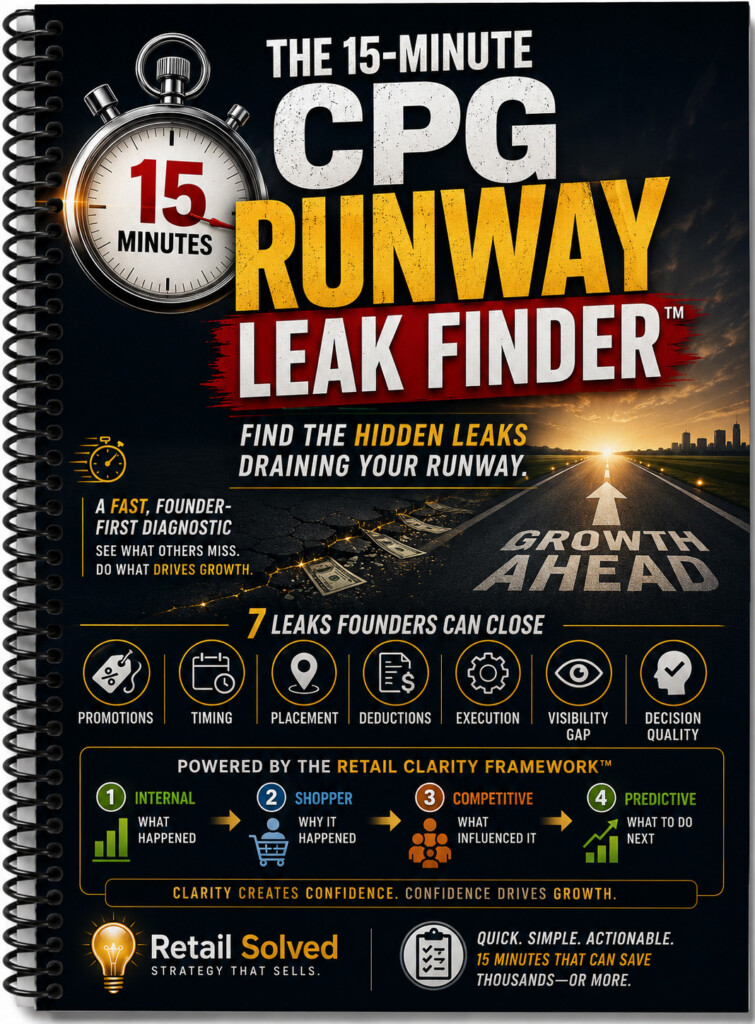
Start here: Find where your CPG brand is losing cash, margin, and runway.
In about 15 minutes, identify the leak creating the most pressure so you know where to look first.
No friction, no email required.
Retail Operating System™
The complete 11-module framework for protecting margin, optimizing trade spend, and scaling distribution with confidence.
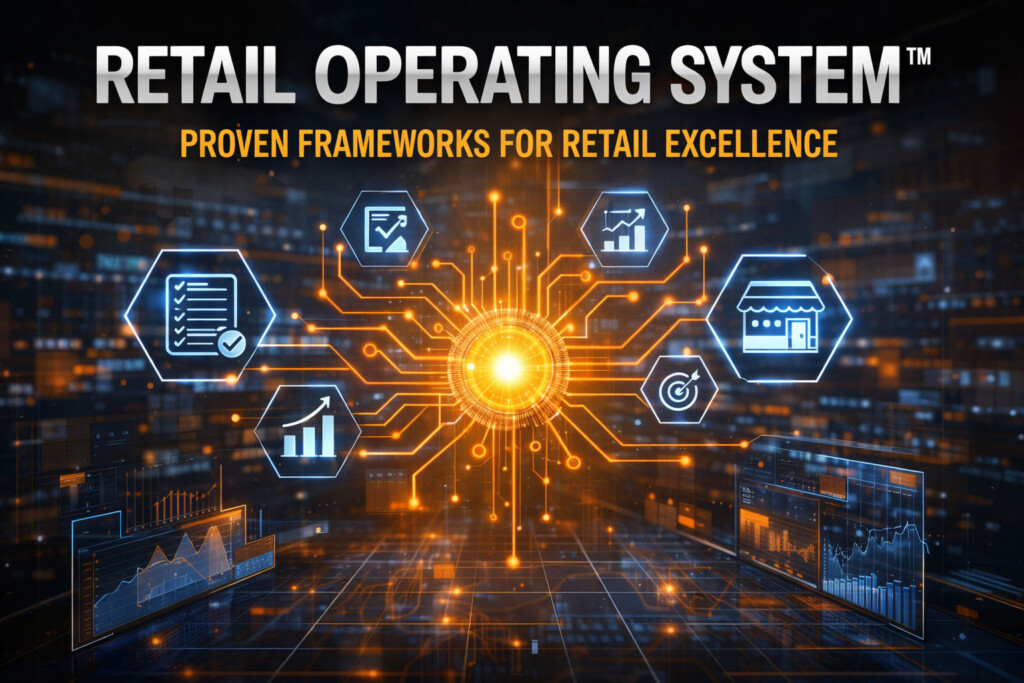
Retailers run on systems.
Most brands run on hustle.
That gap is expensive.
The Retail Operating System™ is the only structured, data-driven retail growth framework built by a Certified Professional Strategic Advisor who has sat both in the founder seat and across the table from retailers.
It gives emerging CPG brands the same operational discipline, trade strategy, and category leverage that big brands use — simplified and systemized to protect margin, optimize trade spend, and extend runway while scaling distribution.
This is not education.
It’s infrastructure.
Image is the property of CMS4CPG LLC, distribution or reproduction is expressively prohibited.