You can be “profitable” on paper and still go bankrupt. If you don’t understand cash flow, margin, and focus, your CPG brand is at risk — and that matters because running out of cash is the #1 reason businesses fail.
In this episode, I sit down with Nate from Future Ready CFO to simplify finance for founders. We break down the real difference between profit and cash, why cash is the lifeblood of your business, and how shiny-object syndrome destroys ROI. You’ll learn how to prioritize using ROI frameworks, bottleneck analysis, and skills alignment so you stop wasting time and start allocating capital strategically.
Finance isn’t just accounting. It’s clarity. It’s focus. It’s leverage.
If you want to extend your runway, reduce risk, and make smarter decisions with your capital, this conversation matters. Download the free guide at RetailSolved.com/session307 and listen to related episodes on cash conversion cycles, deduction prevention, and trade marketing ROI to go deeper.
Connect with Nate at:
linkedin.com/in/nathanlittlewood
FutureReadyCFO.com
futurereadycfo.com/hidden-profit-audit-free-template
Listen where you get your podcast








Like what you’ve heard?
Please leave a review and comment on iTunes
Let me know your most pressing question, I’ll do my best to answer it on a future episode.
🎙 Dan
Enter your name and email address below and I'll send you periodic brand building advice, tips and strategies.
Nate, thank you for joining me today.
Can you please start out by telling us a little bit about yourself and how you
got to where you're at and what you do?
Nate
Yeah, absolutely.
Well, 1st and foremost, thanks for having me on the show, Dan.
Great to be here.
So I am a fractional CFO
and I run a company called Future ready CFO,
where I basically support early stage
CPG and e-commerce
founders in all things kind of business and
finance related.
I like to say that I help people get from a state of chaos
and confusion when it comes to their finances to one of clarity
and confidence and really help them understand
how to better utilize their finances
and, you know, various other forms of data to
help, uh, you know, set more profitable growth
strategies, make better decisions.
And at the end of the day, Dan, ultimately, this is about
helping founders sleep better at night.
stressed about running their businesses.
I guess what's a little bit different to me compared to
some of the other CFOs in this space is that
I've kind of walked the walk.
I spent about 6 or 7 years before this, building
and running my own e-com business.
So, you know, I've been in the founder's satellite.
I know what it's like to be stressed about payroll.
I know what it's like to, you know, have to figure out how to finance a purchase order.
I live that for many years.
Along the way, I also served
as the lead mentor for a startup
accelerator program based out here in New York.
And I guess before all
that, I spent maybe the 1st decade or so of my career working
on Wall Street as an investment bank.
So that was kind of where I learned about the world of
finance in the last decade or so.
I've been in the world of startups.
Interesting.
Oh, I appreciate your sharing that.
And I like the idea that we're going to teach people how to get a good night's
sleep because that's critically important.
So, if I can, starting on Wall Street
and going to this, how did you make that transition?
What made you want to get into this line
of work as opposed to staying as an investment banker?
Yeah, interesting question.
Well, I, um, I mean, I, I kind of
fell into the world of finance when I was in my,
you know, early 20s and at that stage,
you know, really didn't know a lot about the world in life,
but I had big dreams and starry eyes and I thought, hey, why not?
Let's go for it.
And commenced a pretty well-wind
career and got sent all over the world and, you
know, was getting paid pretty well to do it, if I can be honest.
The truth is that for
a very large chunk of that time, I had this kind of
ningling voice in the back of my head.
It's like, this isn't you.
You don't really belong here.
And this, you know, is not where you should be.
Um, this voice, you know,
over the years started to get louder and louder, um, by,
by about 2015 or so, it was kind of yelling in the back of my head.
And I was starting to ask myself questions
about, you know, legacy, purpose,
impact, the stories that I might one day tell my,
my kids, and my grandkids about, you know, what I've done with my life
and what I achieved.
And long story short, I just wasn't
happy with the narrative that I had up until that
Um, you know, it was, I learned a lot doing
it and I got to see, you know, a large part of the world through that job.
But when you boil it down at the end of the day.
I mean, my job was to basically help make rich people richer.
And I didn't really want that on my tombstone, so to speak.
So I decided to leave.
Um, went back to school, did an NBA,
and basically used that as a platform to kind of reinvent
myself as an entrepreneur, which,
um, is not something I thought a lot about up
until that point in time.
It really wasn't until I'd been living in New York for
a couple of years that I'd really had my eyes and
mind open to the world of entrepreneurship.
But when I discovered it, I was like, oh, hang on a sec.
You mean there's a line of work where I can get to build things all the
time and I can be creative and I can design things and I can solve interesting
problems like for a job.
I was like, hell yeah.
I should have been doing this all along.
Sounds awesome.
So I kind of dove into the world of entrepreneurship,
and I guess, you know, a lot of people, when they're for 1st
drawn to that world, they kind of gravitate
towards like the founder, CEO role, right?
Like they want to do their own thing.
They want the autonomy to kind of create their own masterpiece.
I did that for a bunch of years.
But with the benefit of hindsight,
I have come to realize that my ideal
role within that ecosystem is not the founder
and CEO, right?
There were parts of that function, parts of that role that I enjoyed.
Um, the risk of stating, obviously, it was a lot of the more analytical
finance operations sort of stuff.
I excelled at that.
I did really well at that and um, you know, I enjoyed it.
But then there's this whole other side to being
a founder, you know, around customer acquisition,
branding, marketing, meta, Google, blah, blah, blah, which,
frankly, I just didn't care that much for.
And because I was never really that interested in it,
I, you know, never had the drive to get good at it.
And for a consumer products founder,
not really caring about, you know, marketing, branding, and
customer acquisition is a pretty damn big problem, right?
And I guess what I now realize is
I have a lot more to give this ecosystem, and
I can really amplify my impact
by instead of being the guy in the founder
seat, act as the guy who sits next to the
founder, and kind of servers his, you know, financial
numbers copilot, so to speak.
So rather than work on one brand, I now have
the ability to work across multiple brands and,
you know, solve a blind spot problem for a lot of founders
by and and do it, you know, while I'm saying in my own personal
zone of genius.
You know, the stuff that I'm better at.
Dan
I appreciate you saying that.
That's actually, I'm really glad you said that because one of
the things that I find when I'm working with brands
is that they think that they can do everything and should do everything on their own.
And the fact that you were able to identify that this is not
my zone of genius.
Here's where I'm better suited.
Good lesson for everyone to understand and appreciate
because a lot of people didn't
start a business, because they love spreadsheets and they love
accounting and they love tax.
They love creating stuff.
Nate
So thank you for sharing that.
Can you share some of the stories that you've
had, and where I'm going with this name, is,
because you switched, how have
you been able to better laser focus your efforts to
make a bigger difference, a more transformative
difference in the brands you've supported?
So I like to think about impact
in terms of an equation, which is kind of
breadth times depth.
What I
was doing before was fairly skinny
in terms of breadth.
In other words, it was really only one company that I
was involved with, i.e. my own, but
I could obviously go very, very deep in that company.
And, you know, I had, I was touching literally every,
every function, whether it was HR, finance accounting, you
know, product, marketing, like I, I had my finger in all of it.
So I could go very, very deep,
but my breadth was limited to the single company that
I was involved in.
So the formula or equation
that I have to think about impact or, you know, the footprint
you have is really those 2, you know, the X
times wide, the brat times of depth.
So you got kind of a rectangle here.
And what we're talking about with my 1st company is a really tall
skinny rectangle, if you will.
The way I think about it now is
a much wider, but admittedly shallower,
um, you know, rectangle.
So rather than working with one company, I can
now work with a lot of companies or a lot of founders, and sure,
I may not have my hand in every single part of their business, like I did before.
But the, the, the, parts of
the business that I can touch, I can have a lot more influence on
it and a lot more impact on.
I mean, when you think about it downlight, the
number one bit reason that these businesses fail is
they run out of cash or they don't understand
some aspect of finance, right?
Like look at the stats.
That is the top reason that.
businesses fail.
So really what I'm trying to do here
is eliminate or reduce that number
one risk of failure.
My, my, my dream, my aspiration is to have no
well-intentioned purpose led founder fail because I
don't understand finance.
If that happens, then I've kind of achieved my mission or my goal here.
And if I can help
other founders reduce this risk of failure
and they can then go on to achieve
whatever it is that they want to achieve with their mission, purpose, business
and have the change that they want to have, then I'm,
you know, I've had a hand in all of these different companies in a
way and, you know, supported all of them.
So that's kind of how I, how I think about, you know, supporting these people.
Does that, uh,
No, it's that's beautiful.
Dan
I mean, appreciate it.
And I guess when we tax something on there, and that is that if
I'm distracted by something that I'm not passionate
about, that takes away my creative energy and
it actually sabotages my ability to do what I'm good at.
So thank you for sharing that.
And I love the way you position that, because
I think a lot of people, kind of like I was saying, they think
that, well, I'm the founder, I need to do everything.
I took an accounting class so I can do accounting, right?
No, they need to focus on what they need
to focus, and then they need to surround themselves by quality people who
can fill those gaps, and more importantly, accentuate
that, that piece of the business, amplify and
be able to help that piece of the business grow and,
and thrive on its own without me having to micromanage
it or even do it myself.
So thank you for sharing that.
I will just add to that thought, Dan.
I think one of the most under underappreciated
and undertalked about phenomenons amongst founder
communities is dopamine addiction.
And founders get.
dopamine hits from solving problems.
I mean, one of the good things and the terrible things about founders is that we love
learning, and we love acquiring new skills.
And I, uh, I kind of think back to
my 1st year or 2 as a founder.
And, you know, everyone's got a friend who works at a
digital marketing agency or some freaking Instagram ad of
a product that looks like the one that you wanted to build or that you told them
about at the party on Friday night.
Like everyone wants to help.
And you get thrown all these little shiny objects.
And when you're the sort of person that gets a dopamine
hit and you get a rush from learning something new and figuring something
out, you can spend an insane amount of
time just running around picking up and playing with all of these shiny
objects, I know, Dan, because I did it.
I wasted nearly 2 years of my life doing that.
And, you know, it wasn't until I learned about
focus and I learned some frameworks for getting focused and staying
focused that I was actually able to start making
meaningful progress on my own business.
So you're absolutely right.
And yeah, I think this dopamine addiction problem
is an issue that more founders and more founded communities need to be talking about.
Dan
Well, I appreciate you saying that.
I think that is key.
So one of the things I've been focused on laser focused on is
helping founders identify those gaps and
fill those gaps strategically, because if they
take their eye off the road, so to speak, then they're
going to crash, et cetera.
But thank you for sharing that.
So, one of the things I talked to you about previously, a
lot of people in this industry are of the mindset that,
or at least we teach us and teach founders that you need to go raise money.
You need to go raise more money.
Okay, now you need to go raise more money.
Okay, now you need to raise more money.
Sort of the Shark Tank type of theme.
But so many of the founders don't
have that depth as you described, and thank you for doing that.
That don't have that depth in understanding their business.
So do you have any thoughts around why
that's critical?
Because as we start getting into our conversation today,
Secret #1: Profit Is a Scorecard. Cash Is Oxygen.
Why is it critical that someone understand?
What is cash?
What is profit?
What is margin?
How do you understand what matters most?
And then from there, let's build on that.
Nate
Well, I think, um, you
know, some level of financial literacy is
critical for founders because rightly or wrongly.
Finance is the language of the business world.
It just is.
And.
If you want or you're building a business that
needs financial support from other people,
you need to be able to talk their language.
You need to be able to think about this.
from the person who's actually providing you that support.
So, you know, an
investor is giving you capital or providing you with his
financial support, in expectation that you
will be a responsible custodian of that capital,
and you're not going to do anything silly with
it, and at some point you're a chance to return it to them, right?
They're not doing it as a charity.
They're doing it in expect, you know, out of self-interest and expectation
at some point in the future.
They'll get something back from it.
So really being able to convince
an investor that you understand something about how money works
is really you saying to an investor, hey,
I'm going to be in a grown up.
I understand how money works.
I'm going to look after this scarce resource, i.e.
money that you gave me, and I'm going to do all I can to grow
it and eventually return it back to you.
And it's, you know, I think it's
just being responsible with the resources
that you're lucky enough to have attracted.
So, yeah, I think being able
to talk this language is absolutely, you know, critical for founders.
Dan
Well, one, and I appreciate you saying that, one of the things I talk about a lot,
and we kind of shared a little bit about this, is risk reversal.
If I am less of a risk to an investor,
they're going to be more comfortable giving me money and lending me money.
And at the same time, if I am a better
risk, I might even have the ability to renegotiate
or negotiate better rates and better terms, what that investor.
So framing that critically important.
So let's say that I'm a founder,
you just gave me a bunch of money.
Okay, so now what?
How do you help me understand how to get more
out of it, how to leverage it, how to be able to use it
effectively and efficiently to accomplish my goal?
Because remember, I'm focusing the shiny object.
The industry's telling me I need to raise money.
So they're essentially throwing money at the problem, so to speak.
But how do you teach me how
to leverage that in my business and focus it where I need to put it?
Nate
Sure, sure.
So the role of the founder
in a lot of ways is a little bit like a investor
of types, okay?
If we think about this through a money lens, then essentially
what a founder is doing is they're sourcing capital.
They're sourcing funds.
You just mentioned one possible source, which is from an investor.
You could also source capital from debt.
A great way to source capital is by selling things to customers,
right, in the form of revenue.
But there's other ways you can source capital.
It could be grants, it could be, you could take money out of inventory, you
could pull money out of accounts receivable or accounts payable, but these
are all potential sources of capital.
So what a founder is
doing is figuring out how to source capital, right?
Where do we get money from?
The next step is to figure out what
are we going to do with that capital, right?
And is the founder of one of these brands,
some obvious choices would be, well, you could hire people.
You could buy ads, you could buy inventory,
you could buy technology, tools, you could build a warehouse if you wanted to.
Like there's all sorts of things that you could potentially do with that capital.
So we're sourcing capital and we're making decisions about how to invest it.
The role of a CFO
kind of comes in and, you know, the value
that we are to CFOs is helping founders
basically make better decisions across both of these
axes, are either sourcing and the deployment of capital.
And what do I mean by a better decision?
So let me give you an example.
When I go through my onboarding process with
a new client, one of the things I do is like, you know, tell me about your
priorities, what's going on at the moment, what are the things that you're working on or what do you want to do this year?
And I commonly get a list of main,
maybe 20 to 30 different things that they'll rattle off?
It could be, hey, we want to release this product or launch on TikTok
shop or, you know, hire this person, whatever.
I put together a list.
Then I have 3 different frameworks
that I'm going to run those ideas through.
The 1st is called a return on investment or ROI framework.
So the return is looking at how much profit
contribution, could that idea potentially create?
We can do some, you know, back of envelope math and say,
okay, if we implement this idea, it'll,
you know, boost sales by maybe $200,000 a year, there's
a 50% margin on that.
So there's, I don't know, $100,000 that we could gain.
Then we can look at the investment side, which will
usually be some combination of time and capital.
So we're putting people's time and we're putting some
of those financial resources we spoke about earlier.
We might have to invest that because we might need to hire an agency
or we might need to hire an extra team member or we might need
a software to pursue this initiative.
So when we have these kind of return and investment
numbers, we can start to kind of compare the two.
And obviously a more attractive opportunity is
one where there is a high potential for a return relative
to a low amount of investment.
That would mean that we have a high ROI.
But some of the other things we can look at is the total amount
of risk that we're exposing ourselves to, right?
What is the total investment?
What is the amount that we would potentially lose if
this initiative theoretically didn't play out at all and
maybe the return ends up being zero?
How much have we lost?
So we can kind of look at all these ideas and
start to rank them and think about them in terms of their material
materiality from an ROI perspective.
The next thing I'll do is look at a bottleneck analysis.
Like everyone's familiar with the concept of a bottleneck, but in the context
of one of these businesses, it can be applied a lot of different ways.
So one way we might use a bottleneck analysis
is look at how traffic flows through a website, right?
You got traffic, then you got page views, then you got add the
carts, and you got conversions, then you got average order value, right?
There's a number of kind of steps in that in that chain that
basically determine how much revenue a business is creating.
Now, when we do this sort of analysis,
we might say, hey, we've only got a one% conversion
rate on your website, all your peers have got more
like 2%, therefore, the
conversion rate seems to be a bottleneck here.
And if we could increase your conversion
rate in line with Pierce and it would roughly double your revenue.
Now, theoretically, when it comes to thinking
about resource allocation, the best bang for your buck is
that you're ever going to get is removing the bottleneck in a flow.
Because if you can remove a bottleneck in any flow, the entire
system has more volume going through it.
And in this case, we're talking about revenue.
Um, hopefully revenues translating, translating to profits.
But some of the other ways that we could apply a
bottleneck framework, we could think about it in terms of our creative
output, like how many new creatives are we generating?
Is it, you know, is there enough quality?
One of my clients, we've applied
the bottleneck framework to thinking about operations,
like we've grown revenue so much, so quickly
from media buying that they've now run
into a problem with their warehouse.
They cannot physically pack anymore orders.
So we've had to actually cap the media buying budget so
that the guys in the warehouse can basically keep up.
So obviously, you know, fulfillment is their bottleneck, right?
So we'll look at, look at bottleneck in a number of different ways.
And the final piece of this is I'll look at skills alignment,
and this gets back to the point you were making earlier, Dan, about, you
know, founders thinking that they need to do everything.
I have this framework I use that basically looks
at different tasks and functions on an axis.
So the X axis is how good are you at this thing?
Like what is your natural level of talent or skill?
And what is your energy level that you get from it?
So you can imagine kind of 4 quadrants here.
The most desirable quadrant, which would be, you know, I actually put it in the top right.
We call the zone of genius.
So these are tasks that you're good at, and they give you a lot of energy.
You ideally want to spend time in your zone of genius.
But there's another quadrant, which is stuff that you're not good at,
and it drains your energy.
That's the danger zone, and we try to avoid
giving you tasks or projects that, you know, lie down there.
The way I like to put it to people is that
my job as a CFO is to help put balls
in front of the founder that they can kick into the goal.
It doesn't serve anyone if I...
put a £30 bowling ball in front of you and tell
you to kick it 200 yards.
Because if you try, you're just going to break your toe.
You're probably not going to kick a bowling ball 200 yards.
Like it's a waste of everyone's time.
I need to put projects in front of my founders that
them and their team are actually going to be able to succeed at.
And the reality is when you're talking about these startups,
you know, most of my clients like 2 to 10 people.
It's not like we have an infinite talent pool to pull from.
And so the number of things that we can actually
do really well is, you
know, it's a surprisingly short list.
Secret #2: Focus Multiplies Value.
So back to your question, like, how
do I help people figure out how to do that, I'll look at ROI,
I'll look at bottleneck analysis, I'll look at skills alignment.
When you apply those 3 filters.
In my experience, we commonly go from a list of 20
or 30 priorities down to maybe 2 or 3 and
it becomes very, very clear at that point.
What's going to get us a financial return.
What's going to remove our bottlenecks and what are
the things that we as a team are actually good at and likely to succeed at?
Dan
So from a strategy standpoint, love that.
So you're helping to quantify and qualify
the value of the decisions and rank
them so that strategically I know where
to focus my efforts.
Love that, because I think that's so critically important, that
that founders know exactly where to,
to focus, and that in, in
and of itself pays for, exponentially pays for what you're doing.
I mean, the reward, the ROI aren't just that
that piece of the business is so valuable.
Can you talk about?
So now that I know where I want to go?
I know which balls I want to kick into the goal.
How do you help me?
Let's say I chose these 3 out of the 20?
How do you help me then decide?
How do I maximize my efforts in that?
Or can you go down?
Can you get that granular?
Nate
Yeah, absolutely we do.
So varies a little bit based on their type of engagement I
have, but at the most engaged end,
Uh, one of my clients, I am currently helping them
basically roll out uh, objectives and
OKRs or okay, uh, yeah, okay, the OKR model.
Some people prefer EOS and that's fine as well.
The entrepreneurial operating system.
I, you know, doesn't really matter which of these frameworks to use.
I like OKRs, so that's what I do.
But basically, we went through this whole process.
We figured out what the company as a whole should be focusing on,
and each individual on the team has now
got their own set of objectives and key results as well.
So essentially what we're doing now in
3 month intervals is we've determined these priorities.
We've set tangible goals on each of these KPIs,
like, you know, the metric or improvement that we want to achieve.
And everyone on the team is now tracking
their progress towards these goals, and we have a
weekly all hands meeting where everyone shares their updates, and
we talk through, you know, what do we do last week?
What are we doing this week and what are the things I need help with?
Like, where am I stuck?
And it's just in, you know, incredibly rich
power packed one hour meeting.
It's like, swat, swat, swat, swat, swat.
Like, this is what's going on.
This is the progress I'm making.
This is what I need to help me get to the next step.
You know, we went from a
meeting that was unscripted, no agenda, and frankly,
just waffling on for 60 minutes to now something that's
focused, intentional, and, you know, we have a plan.
And I can see that the impact
it's having in terms of team engagement.
People feel like they have direction, that people
feel like they know where they're going.
People can see the impact they're having on the bigger picture.
And yeah, it's translating
in terms of results.
So that's, you know, one way that I work with my clients.
Other people prefer to do it on their own time, you know, like
other people don't, you know, want or need me as involved and
some of them will just manage their stuff for themselves.
So how granular I get with this
stuff, just depends a little bit on the client and how involved they want me to be.
Dan
Appreciate you saying that.
And I think it's really also critical to point out that you
being involved at that level helps me
remain focused on my goals and my priorities, you
being you spotting the blind spots that I can't see
before I can't even see them.
is critically important.
Where I'm going with this, Nate, is that I've
heard of a lot of CFOs, that basically
say, okay, here's the spreadsheet, here's the report, whatever.
Do this.
And then having the founder kind of figure this out.
So where I'm going with, in terms of that, is
that it's a collaborative process.
It's a give and take, and the best way that you can support me
as a founder, for example, is that, one,
if I trust you, too, if we're communicating, we're we're
working together, along with the rest of the team to help solve that problem.
So thank you for that.
So any more thoughts along those lines before we dig more into cash?
Nate
Uh, yeah, so a couple of things.
Um, going back to my, you
know, 30 to 20 priorities down to 2 to three.
implicit in that is that
often when I 1st start these relationship
with founders, 80 or 90% of their
time is being spent on stuff that
really shouldn't be a priority, right?
They're kind of wasting time on shiny objects
and squeaky wheels that really don't deserve their attention.
Let's say, hypothetically, that
you are a founder paying yourself, I don't know, maybe a $100,000
a year, but only 10% of your
time is focused on to
move the needle forward.
If I can get you from a state where 10%
of your time is focused on important projects to 100%.
Yeah, this is an extreme, it would never happen.
100, but if it could theoretically get you to 100, then,
And your value that you're giving to your company has
just gone from $100,000 employee or contribution
to a $1000000 a year.
We've basically grossed up the value that you're giving to the company
because now, you know, rather than only 10%
of your time being, you know, value add, we've now getting you
to be 100% value add.
So you got kind of get 10 X more powerful or valuable
as a contributor to your own business.
And I think that and that alone is one
of the most compelling.
you know, value arguments for working with a CFO.
is that we can help you get, you know, focused on
the things that you need to be prioritized and help you figure
out what is the 80 or 90% of noise that we can reasonably ignore.
Dan
Love it.
And I assume that also means that you can look downstream and
see what roles within my company are
contributing and what level and how to maximize those as well.
Nate
Uh, yes, so I get into,
I spend a little bit of time with my founders talking about team and team structure.
So one of the exercises I
do with a lot of my early clients is a time
tracking analysis.
I have them install this free app called Toggle,
TOGGL, and basically get them
to track their time for an entire month and put
everything into categories like sales, marketing, product,
you know, email, team meetings, whatever.
Anyway, at the end of that month, we do a
review of their, essentially, their timesheet and their time
allocation, and inevitably what we find is that
they're spending way too much time on the business.
I mean, one of my clients just handed me her results yesterday actually.
But basically shows that she is kind of, you
know, the central information conduit.
So every problem is going through her, she has to make a decision and
then she, you know, delegates or gives someone else the team instructions,
which means, you know, the team can only grow as fast
as her ability to process problems and direct
things to wherever they need to be.
So it's a real, you know, kind of constraint on her growth.
One of my, another client, I did it a month or 2 back and we
saw that they were spending like 30 or 40% of their time on warehouse
logistics and fulfillment type tasks.
And like, why is the founder freaking packing boxes
in the warehouse and putting product on shelves?
Like, we need to hire you an operations person and
get you focused on things that are actually going to grow the business.
You should not be focused on, you know, backhand logistics.
It's like, you know, a 15 to $20 an hour job.
You're a founder wanting to pay yourself 100s of 1000s a year.
Like, how can you pay yourself, you know, $100, $200,000
a year when you're doing $15 an hour work?
So we, we do that sort of stuff.
Yeah.
No, that's very helpful.
I appreciate it.
And it keeps getting back to this staying laser
focused on what you need to be paying attention to.
So let's switch to a little bit about what you do.
Secret #3: Watch for Hidden Profit Leaks.
So, one of the things that we talked about is why should
a founder care about cash?
And what is the difference between cash and profit?
How do I know what matters?
And then how do I stay focused on
what matters?
Sure.
So profit is the way I like to think about
is profit is a theoretical concept, right?
Profit is what happens when you start
with revenue and deduct all
of your expenses or cost associated with generating
that revenue.
The main reason for tracking profit is it's kind
of a theoretical assessment covering a certain time period,
commonly a year or a month, but you could also calculate profit
for a day or a week or an hour if you wanted to.
But it's a theoretical assessment
of how effective your business is at
delivering its core product or service.
And it's tracking profit, particularly over
time, is a really good way of seeing whether
our business is actually improving.
If the business improves, then generally
what we're doing is creating value for equity holders, right?
That's how businesses grow and become more valuable, is that they establish
a track record or growing profit over time.
The problem is, particularly
with our industry, you know, CPG, e-commerce,
physical goods, is that there can be very, very prolonged
periods where the cash flow can
deviate from this theoretical construct called profit.
And the reason for that is because our industry
is very inventory heavy.
Okay?
Let's think about a simplified business model
where maybe we're placing 3 purchase orders a year to
restock our shelves.
So every 4 months we've got a cash outlay that
we're sending to our manufacturer, coatback or supplier.
They're sending us a whole lot of inventory, and then we spend
the subsequent 3 or 4 months basically depleting that inventory before we have to reorder.
So what's happening here is kind of a cash flow,
you know, seesaw, jigsaw.
And this cash flow situation gets incrementally
more complicated when you start thinking about, you
know, accounts receivable.
In other words, when does your customer actually pay you for the
product, and also accounts payable, i.e.
what is the timing around when you actually had to pay for
the inventory or product that you received?
So cash flow is, I
mean, cash is really the lifeblood of a company.
It's the things that, you know, goes through your veins, is what you,
you know, breathe and keeps you alive.
Um, you can have a,
uh, business survive for a certain amount of time without
profit.
You cannot have a business survive for very long
at all without cash or cash flow, right?
Because no cash means no payments to suppliers.
You can't pay payroll and pretty soon
people are going to stop showing up to work and shipping your product.
So things too will grind to a halt pretty quickly.
So that's, you know, the important uh, differentiation
uh, between the 2 and analyzing them,
understanding them, and forecasting each of these
things into the future is a related
but separate exercise, right?
So with my clients, I am forecasting the profit, or
the profit and loss statement, in the same model, I have a
separate forecast for cash and cash flow, okay?
And they are linked, you know, they do kind of generally move
in tandem, but there are periods where they deviate and,
um, you know, one could be going up and one could be going down and vice versa, right?
They can, you know, they can they can move around.
So, um, yeah, both both important, but for different reasons.
No, it makes sense.
Actually, it reminds me back when I when it was in accounting,
when I was studying accounting.
All the different things I needed to pay attention to.
So long story short, just because they've got a lot of cash
in a bank doesn't mean that I'm successful or that I'm profitable.
So thank you for sharing that.
When you're talking about that.
Do you throw that into what we talked about before?
In terms of what are the balls that I need to be focused on kicking into the goal?
Uh, in terms of the lengths of profitability, you mean?
Yeah, I mean, so when you're thinking about where should I align my objectives?
Are they based on the profit or the cash or
a little bit of everything?
Yeah.
Often both, depends a little bit
on the founder and the business situation.
So monitoring
cash in cash flow is when it's important, it's really, really important.
When it becomes important, it is the most important thing for us to focus on.
Um, one of my clients um, sells
into, you know, retail and also direct to consumer.
And they're in a bit of a distressed cash situation at the moment.
And we've actually put together
a cash flow model for them that lists
out over 100 different vendors and suppliers.
And every single week.
We are mapping out the cash flows that we can afford or
the cash outlays that we can afford to pay all these people.
The reason we're doing that, because this business is
short on cash, and we're trying to avoid
a bankruptcy situation, and things are
very, very tight, and we need an extremely high level
of precision to basically, you know, keep cash in the bank.
That's kind of an extreme
scenario, and I'm not going to do that with all of my founders.
In an ideal world, the founder is not stressed
out and needing to obsess about, you know, bank balances
and look at cash with that level of detail.
In an ideal world, the founder is a bit more focused
on the profit and loss, but we can only get to that point when
we have a certain amount of cash buffer and cash comfort
and we have enough cash in the bank to know that
we don't need to be stressing about it every day.
So really what I'm
trying to get my founders to is the point where, okay, we
can relax, we're not about to go bankrupt.
That means that we can stop stressing and instead put
our time, attention, and focus on the future and
figuring out how we can grow profitability over time.
Because that's really the thing that's going to create
economic value for them.
In other words, make their company more valuable over time.
Does that make sense?
Yeah, no, it makes perfect good sense.
So do you have a way to help people understand,
from a granularity standpoint, the concept of
how and why this is important?
Um, And
I'm sorry, where I'm going with that, Nate, is the reason this matters is
because if I'm not aware of this is
something I need to pay attention to, not necessarily get
into the weeds, but something I need to know about, then how
do I at least know that this is something I need to be
thinking about so that I can avoid that position long term?
Yeah, I think so.
Let me have a crack at it and you can put me back
on track if I'm drifting off the wrong way.
So I
guess what you're touching on here is
founders and their relationships
with finances and it's worth, maybe before we go
any further, just laying out some of the different
types of relationships with finances that I see amongst founders.
No, that's a good idea.
For for phases.
that I see people move through.
The 1st is what I call the denial phase.
And this is where people will go, hey, I don't
want to talk about finance.
I don't want to look at finances, like, just...
Yeah, make this problem go away.
I want to live my life
pretending like the finances don't exist.
The problem with that, Dan, is that whether or
not you're paying attention to them, the finances will continue to exist,
um, but they just existing without your supervision.
And the, you know, we've touched already at
some of the problems with that.
In my experience, one of the most common reasons
that founders get themselves into that situation is
a concept called cognitive dissonance,
which is basically when us humans
struggle to internalize and
hold 2 opposing views at the same time.
What I mean by that is
that when we're founders and we've got a great product and we have a mission and we're,
you know, out there changing the world, like, we want to think that
we're doing amazing things.
And that's certainly the narrative and the story that we want to
tell our family and friends.
Unfortunately, the
finances can sometimes tell a slightly different story, and
the finances might be going, eh, yeah, you kind of average
to sucky right now, things aren't going that great.
These numbers are pretty nasty.
And the problem that we as humans
have is it's very hard for us to hold these 2 different
narratives or 2 different versions of the story at the same time.
And so what we do is we comfort ourselves
by ignoring one of them.
And that often happens to be the finance story because
it's just uncomfortable to internalize it.
So that's step one.
Step 2 is usually what I would
call overwhelm.
And this is where people have started to poke
around at the finances numbers and started to try to understand, but it's complicated.
They don't understand it.
A lot of jargon, mumbo jumbo, and it's like, oh,
dang, like I give up.
Let me go back to step one.
So we haven't really made a lot of progress so
far if you've ended back at step one.
Anyway, step 3 is what I call the,
I guess the curiosity phase.
And this is war, the intrigue phase.
This is where we kind of start peering over the fence and
going, huh, looks like there might be something interesting over there.
I don't really know what it is yet or what all these numbers are
saying to me, but it seems like there's something there that I should learn about.
Okay?
And that is the precursor to
the enlightenment phase.
Once we get to enlightenment, the penny drops and
we start to say, ah, now I get it.
Now I can read all of these signals and messages
that the finances are giving me.
Now I can see how to partner with these
financial statements to make better decisions.
Now I understand how being able
to read these documents and, you know,
pick up on what they're trying to tell me.
It can actually make my life easier.
Can make decisions clearer, can
tell me how to focus.
It can tell me what are the things I shouldn't be focused on, right?
So a big part of what I do as
a CFO is try to help people through that arc from
step one to step four.
But listen, the truth is not everyone wants to go on that journey.
Some people, some people are.
in phase one.
And if people are stuck in phase one and not
wanting to go any further, like, I
can offer, extend a hand and say, hey, I'm here to help, but
if they're not willing to grab my hand and come on the journey with me,
then, I don't know, not really a
whole lot, a whole lot I can do about it.
Well, I think it's, it's, What I like about this,
Nate, and thank you for sharing that, is that you're simplifying
why this matters.
And without trying to force me to go get my own NBA,
quote unquote, and finance an accounting and stuff like that myself.
You're helping me drill down
to what matters and what I need to focus on now.
And the better I get at this, then the more I
can do to help support whatever initiative we have as a company.
And I think that's what's a critically important.
So thank you for sharing that.
When, When you're going through this process,
what are some of the common sources of cash leaks?
And at what point do I need to start thinking about financing
versus using my own cash or whatever?
So I actually have a
product or an offer which is like a
hidden profit audit and basically takes a week.
People will plug in their financial statements, give me access
to a few other pieces of data, and I'll basically spend
a week going through these businesses and looking for these profit leaks.
Um, the product or service ends with
like about a one hour presentation where I deliver the results.
But, um, it's a long way of me saying that I've looked
a lot of different, looked at a lot of these different sets of numbers, and there's
certainly some common themes that come up quite a lot.
I would say amongst the top 3
would be number one top line revenue
related leakage.
So in the finance
world, we talk about revenue in a few different ways,
but some of the most important ways of gross revenue and
net revenue.
So the gross revenue is kind of linked to your product price.
Like if you had a $100 product and you sold one of them,
you'd have $100 worth of gross revenue.
The net revenue is what actually lands in your bank account.
Now, if we're talking about e-commerce, some of the big uh,
differences between gross and net would be things like coupons,
uh, discounts, um, I've come across brands that
have had coupon leakage, unbeknownst to them, their
coupons got on some, you know, honey.com or some
platform site and suddenly like everyone's using this freaking coupon that
was meant to be a limited time thing.
And so we lose a lot of money there.
A lot of founders are giving away, you know, their obligatory
10 or 15% off welcome offer thing when they really don't
need to, need to be, and they could actually generate more
profit if they didn't have an offer like that.
So there's often some leakage there.
Then we've got refunds and returns.
So these are, you know, could be
a, uh, it's very common in apparel, by
the way, like people need to try on a garment, for example, and then they're going to return it.
But you can also have product related issues, right?
If your product was damaged by the co-man or
the co-packer, it wasn't packed correctly or maybe the manufacturer
didn't actually make it correctly in the 1st place and the customer receives
a defective product, they're probably going to either send it back or ask for a refund.
Um, there's can also be issues in
expectation settings.
So if your website listing shows one thing and
what the customer receives is slightly different, then
they're going to be like, you know, WTF, like this isn't what I ordered.
It doesn't match the pictures.
So I want a refund, right?
So we look at look at that as well.
In a wholesale context, you've obviously got
your trade spend, right?
So this is your free fields, your charge backs, your promotional,
your couponing, like all of these things are deductions
off revenue as well.
And I would say, you know, 9
times out of 10, I'm finding some type
of issue at the revenue line.
I actually did one of these hidden profit audits for a brand last week and
they were losing 25%
of revenue between gross and net revenue.
So ¢25 on the dollar
is disappearing out of that business before
we even start talking about cost of goods sold in
overheads, right?
And, um, you know, 25% to
put that into context for you, a healthy e-commerce
business is making maybe 8 to 10% e-bit down margin, right?
So to be losing 25% off the top is a
huge, huge leakage of profit.
Some of the other, um, there's,
I guess, 2 other places I would look.
Usually overheads as a percent of
sales, very, very common to
find that a brand has bloated overheads relative
to their sales.
When a city bloated overheads, there's
one of 2 possible inferences I could make.
The positive interpretation would be this
brand is positioned for growth, right?
We've got too many people, too many resources today, but
maybe we're well capitalized.
Maybe we have some investor money and maybe what we have right
now is a team in place, not for today, but where we
want to get to in a year from now.
So, okay, you know, bigger than
what it needs to be today, in terms of overheads, but we're positioning
ourselves with growth, and we're well capitalized enough to
be able to afford them to do that, then I'll say, okay, fine.
makes sense that your overheads are what they are.
The other interpretation, and this is
sadly a bit more common, would be that there's
been mismanagement over those overheads.
When you think about financially what overheads represent.
And what we're talking about here is like software, people, subscriptions,
rent, you know, that sort of stuff.
Founders are investing
in that to solve some type of problem in their business.
Right?
You hire a marketing person because you want help with marketing.
You hire a salesperson because you want to sell more.
And if the overheads
are bloated relative to sales, it kind of tells
me that some aspect of that overhead has
not been properly managed.
We are not generating the results that we thought we were
going to get from bringing on that salesperson last quarter,
because if we were, we'd have a higher sales number and the
ratio would look a lot better.
So, particularly in founders who are doing
a poor job of managing their team or allocating resources, that's very commonly the reason.
The 3rd place I would will always
look is at the intro debt financing
type level, right?
So, um, The,
the big issue that I see there all the time is founders
hate stockouts.
Founders hate the idea of
a customer rocking customer rocking up to buy their product and
them not having enough infantry.
Anyone who's experienced the stock out will know how frustrating it is.
You've got customers submitting support tickets, they're complaining, they're like, where's your thing?
I wanted to buy it, like, eh.
Like anyone who's been through that probably doesn't want
to repeat of it.
Unfortunately, the way that a
lot of us compensate for that is by over ordering.
And we're like, okay, I'm going to order so much that I never have to worry
about a stockout again.
The problem with that is that we
end up with way more inventory sitting around than
what we need, that inventory translates to additional
storage cost, warehousing fees, it translates
to product obsolescence risk, particularly
if you've got a product with an expiry date, i.e. you know, food and beverage.
So if you're sitting on 9 months of inventory,
for example, you get some feedback from a customer that
would otherwise make you want to change your product.
If you've still got 9 months of infantry there, it's going
to be 10 months before you can ship that change.
Unless you're willing to ride off 9 months' weather
of inventory and throw it in a bin, then you could ship the new version sooner.
But like, you know, you become less nimble and you're slower to react
because you have this inventory to sell for it.
The final problem is to do with debt, right?
If we've got more inventory, the most common way to finance
that is with debt and a lot of these, particularly
like the unsecured MCA or merchant cash advance
and revenue-based lenders, that industry is
notoriously deceptive
in terms of how they talk about the cost of those facilities.
I've had in, you know, interactions with founders who've
said, oh, yeah, we got this great deal from Shopify Capital.
They're only charging a 16% interest.
I'm like, no, the Chopper 5 is not charging you 16%.
Like their actual APR on these things can,
you know, get as high as 60, 70, 80% when...
You do the financial math on it.
Like these, these...
Facilities can be 3 or 4 times as expensive as a credit card
and a lot of founders are using them to
finance these inventory purchases.
So you got too much inventory at ridiculously
high interest rates.
Therefore, we have a lot of profit leakage
at the interest line of the PNL.
You know what I realize, I appreciate your sharing that.
Thank you, is that even if I had a CFO, as
my, you know, in my business and I'm doing well, having someone
like you come in periodically, and just give us a
checkup, because you have so much depth and breath
and you see so many different things, there's a lot of value in that.
So thank you for sharing that.
Um, what is the cash conversion cycle and why does it matter?
So great question.
I like to think about businesses
like a pipe or a tunnel, right?
Essentially what you're doing when you're in the physical products
game is you're putting money into one end of that
pipe and that money goes in in the form of inventory.
Then it sits in the pipe for a period of time before
it pops out the other end.
And when it comes out the other end is when it can become revenue,
that's when you sell it to a customer.
A cash conversion cycle is
essentially the length of that pipe.
So how long does your cash stay
tied up between paying for stuff with the
supplies and receiving money from customers?
Now, it's an important concept for a few reasons.
First of all, because when capital or cash
is tied up in this cash conversion cycle, you
can't do anything else with it.
You can't invest it in people.
You can't use it to buy ads.
You can't use it for your next growth initiative or launching a new sales channel.
It is locked up and it is inaccessible to you.
So really what we want to do is
figure out how to move cash through that funnel as fast
as we can, because if we can move the cash faster,
then it creates more options in terms of how we spend it and
what we what we do with it.
Does that make sense?
No, it makes perfectly good sense, and that's critically important
for me to understand as a founder, because I
need to understand how do I get, excuse
me, how do I get profitable?
How do I move the money to the point where I can pay myself,
pay everyone else, and then satisfy my customers?
So, thank you for sharing.
I appreciate that concept.
I know we're getting closer in time.
So how does future ready CFO help with cash flow management?
Yeah, so we help clients forecast their cash flow.
I do it both on a monthly basis and where needed.
We'll also do weekly forecasts as well.
The example I gave you earlier of the brand,
it's in a bit of a distress situation.
So we're doing this kind of 13 weeks out at a time.
Really, my goal and
what I'm trying to achieve here is remove
cash concerns is something that keeps the founder up at night.
Right?
I want to liberate my founders from that stress.
I want to stop it being a
thing that takes up their mental energy.
Because frankly, they have more important things to worry about.
They should be focusing on growth and how to acquire
more customers or launch new products and, you know,
they're the captain of growth, right?
So really what I'm trying to do here is
liberate them from the burden of worrying about cash and
cash flow so that they can focus on the things where they add more value.
Love it.
kind of full circle in our conversation back to where we started again, so thank you so much, Nate.
Man, thank you so much for your time.
Um, certainly I want to make sure that everyone knows how to
get a hold of you at the end of the podcast in the show notes, et cetera.
So if you could please send me that.
Any closing thoughts, anything that you want to,
to, to share to summise or to wrap up what we talked about?
Yeah, I guess the number one takeaway I'd like to leave people with is
to consider the possibility
that finance and accounting is more than just a cost center
for your business.
Consider the possibility that there are insights
and feedback and pieces of information that
you can get from this that can actually make
your life easier as a founder.
It can help you get more focused on the things that
you really need to be focused on to create economic value
and it can help you make better decisions.
And, um, yeah, it's a cost to having someone like me around, sure.
But, um, I'm pretty sure that
most of the folks who look into this will pretty quickly convince
themselves that there's a positive ROI in this stuff.
Well, absolutely.
I mean, if I have to pay attention to the cost of my product getting it
on the shelf, just that granular thing, you
know, as far as the stuff I make and sell.
Well, if I'm not measuring that properly, then
I don't know how successful I am.
Well, you're talking about is more the overall business health.
So absolutely, I appreciate that.
Thank you for sharing that.
Anything else you want to share?
No, I don't think so.
I think we covered a lot of ground today, Dan.
I've enjoyed chatting with you.
I appreciate it.
Sign up to receive email updates
FREE Trade Promotion ROI Calculator:
Click Here To Maximize Sales And Profits
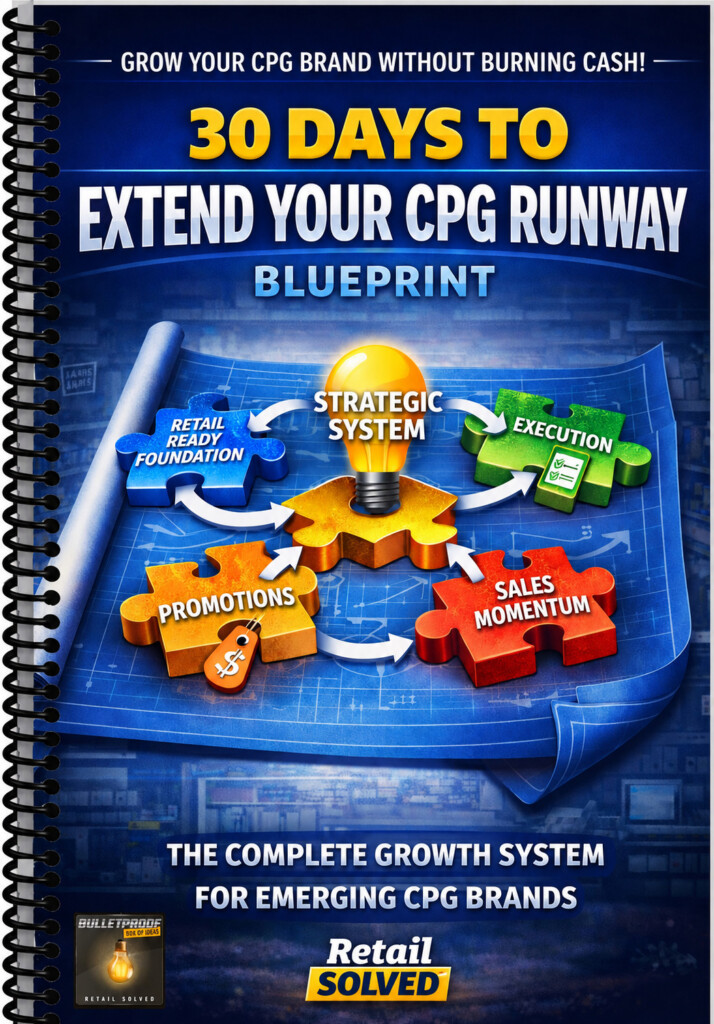
Extend your runway one focused day at a time.
Build the retail fundamentals behind profitable growth with one practical skill, one action, and one better decision each day.
Image is the property of CMS4CPG LLC, distribution or reproduction is expressively prohibited.