Most CPG brands think promotions grow sales. They don’t. Pricing strategy does. If your pricing architecture is wrong, deeper discounts and more promotions will only destroy your margins, train shoppers to wait for deals, and drain your cash flow.
In this episode, I break down the pricing and promotion architecture that premium brands use to scale profitably. You’ll learn how to price for your core shopper instead of competitors, build a pricing ladder that protects margin at every level, design disciplined promotion strategies, use contribution — not velocity — to justify your pricing, and create guardrails that stop margin erosion.
Promotions are tactics. Pricing is strategy.
Download the New Item Essentials Guide at RetailSolved.com/session308 and learn how to build a pricing architecture that protects margin, strengthens retailer relationships, improves promotion ROI, and creates sustainable growth for your brand.
Listen where you get your podcast








Like what you’ve heard?
Please leave a review and comment on iTunes
Let me know your most pressing question, I’ll do my best to answer it on a future episode.
🎙 EPISODE 308 — How to Build a Pricing & Promotion Architecture That Creates Sustainable Growth Promotions Don’t Grow Brands. Pricing Strategy Does. And If You Get Pricing Wrong, No Amount of Promotion Can Save You. This is the question I get asked the most, what should I price my products at. There is a lot more to this than picking a number. Let’s dig in. If you’re like most emerging CPG founders, pricing feels like a moving target: It feels like you're constantly chasing the “right” price rather than leading with a pricing strategy that: And here’s the part most founders don’t realize: 👉 You don’t control promotions until you control pricing.
And you don’t control pricing until you control architecture. Promotions should sit ON a pricing strategy —
not be a replacement of one. Promotions are event based, they happen at scheduled intervals whereas pricing happens every day. Your pricing plan is what drives velocity and, when done properly, your contribution - what the retailer takes to the bank. Think of contribution as the profitable growth in a category. When contribution is predictable and profitable, retailers love your brand. Most promotions erode contribution so setting up the right pricing architecture is critically important. Remember that the primary goal of each promotion is to boost base sale after the promotion ends. Base sales are your sales in the absence of a promotion. Today, I’m going to show you how to build a pricing & promotion architecture that: But first, I want to tell you the story that taught me this lesson the hard way. THE STORY — The Brand Who Lowered Price to “Grow Faster”… and Nearly Bankrupted Themselves A founder once came to me frustrated because growth had slowed. Velocity was still healthy, but competitors were running increasingly aggressive promotions. Their broker kept saying: So they did. They widened their price gap.
They deepened their discounts.
They ran more promotions.
They trained the buyer to expect constant deals meaning that customer would only buy their brand when it was promoted. Sales went up — briefly. The founder thought the solution was “better promotions.” 👉 They never had a pricing architecture.
They only had a price. Pricing is a strategy.
Promotions are a tactic. And when you apply tactics without strategy, you create a financial death spiral. This episode will ensure you never fall into that trap. Let me back up a moment and dig into the strategy some brands use, why this matters, and how those strategies overlook what matters most - your customer. Big brands invest heavily in pricing elasticity projects. Those are their go-to frameworks for determining their optimum pricing. While that sounds super complicated and scary, pricing elasticity is just a fancy way of finding the sweet spot for your pricing. Too low and you erode margins. Too high and shoppers ignore you. Now, this does require a lot of sophisticated modeling and advanced analysis and it can be very expensive for each project. This is an expense small brands can avoid. I’ve personally done a lot of these projects and I’ve even built the tools and models to do this. I share this because I know first hand that even the most sophisticated tools and pricing models don’t accurately predict customer behavior. Funny thing, shoppers do what they want because of what they want. No algorithm will ever accurately predict shopper behavior - period. That includes AI. The quote unquote experts will lead you to believe that price is the only variable that drives sales and velocity. It does not. Personally, I hate this argument because it assumes customers are stupid and that they do not have any other considerations when choosing a product. We all know that is not true. If it was then premium and decadent items would be deciding in sales and the exact opposite is true. This is also true in trying economies. We’ll dig into this more as we move through this episode. For now, I just wanted you to have that additional context. WHY PRICING ARCHITECTURE MATTERS Pricing architecture sits at the intersection of: In the New Retail Operating System, pricing is foundational because: And most importantly: Let’s break down the five pillars of a pricing & promotion architecture that creates sustainable growth. ⭐STRATEGY #1: Price for Your Core Shopper — Not for Your Competition “Your Price Isn’t the Problem. Your Pricing Architecture Is.” That was really important. Let me repeat that again. “Promotions can’t fix bad pricing — they make it worse.” When you have the wrong pricing coupled with poor retail execution and ineffective strategies, your promotions will make them worse. They will shine an unflattering light on the problems - something you want to avoid at all costs. Most brands price themselves based on: This is the fastest way to destroy your margin. Your pricing must reflect: Premium shoppers are: Consider the problem your customers are trying to solve when they purchase your brand. This includes your mission. If they want clean label mission based products then they know those come with a premium price. Your price highlights your commitment to provide consistent quality and value every time they reach for your brand. Remember that your pricing sets the standard customers can expect with your brand. Action Step This Week Identify your value anchor:
This becomes your pricing guardrail. ⭐ STRATEGY #2: Build a Pricing Ladder — The Foundation of All Margin Protection “Stop Pricing for Competitors.” Most brands use competitive products as a benchmark for their products. While this is a quick easy way to measure your daily pricing. It overlooks the value your products deliver. Your pricing comparisons need to take that into account. Build that into your KPI’s. Your pricing ladder must include: Why This Matters Consider this. Are there any categories that you only purchase when they are on deal? You know their exact promotion cadence and you plan your purchases ahead. I know I do. One of my favorite brands goes on sale every 12 weeks. I always stock up then it goes on sale. Your customers will do the same thing IF you train them to only purchase your brand when it is discounted. Conversely, you need to know when your competitors promote. What is their promotion cadence? we’ll talk about how to use this to your advantage in future episodes. For now, realize that their promotions might cannibalize your sales if your pricing signals to shoppers that your brand is comparable, that it is a good substitute for your brand. Action Step This Week ⭐ STRATEGY #3: Build a Promotion Architecture — Not Random Deals “The Ladder That Protects Your Margin.” Trade spend is your second-largest expense behind your COGS. Your promotion architecture must define: Why This Works Action Step This Week This instantly improves retailer confidence. ⭐ STRATEGY #4: Use Contribution — Not Velocity — to Justify Pricing and Promotions Velocity is NOT the most important KPI.
Contribution is. Contribution asks: Here’s the truth: A high-contribution brand: Action Step This Week This will clarify your pricing strategy instantly. ⭐ STRATEGY #5: Build Guardrails That Prevent Margin Erosion Your pricing & promotion architecture must include non-negotiables: Quarterly checks for: Why This Works Action Step This Week 🔁 RECAP — HOW TO BUILD A PRICING & PROMOTION ARCHITECTURE THAT CREATES SUSTAINABLE GROWTH When you integrate all five, you create: This is how premium brands scale —
not by racing to the bottom,
but by controlling the architecture that supports their value. If you have additional questions about pricing and promotions, reach out to me. I built a really cool to to help evaluate the impact of your pricing. It does require access to syndicated data. Until then: Promotions don’t create growth.
Pricing architecture does.
Enter your name and email address below and I'll send you periodic brand building advice, tips and strategies.
Distributor margin here
Retailer markup there
Freight increases
Promo depth pressure
Competitor pricing shifts
Inflation
Slotting fees
Admin fees
Promotional creep
protects your margin,
drives trial,
supports retail partners,
and grows the category.
scales profitably,
strengthens trade partner trust,
eliminates unnecessary deductions,
improves promotion ROI,
protects your velocity,
and removes the chaos from your retail engine.
“You need deeper discounts.
More promos.
More frequency.”
Then everything collapsed:
margins evaporated
promotions no longer lifted
retailers expected deeper discounts
This caused mis-forecasted everyday sales
deductions skyrocketed
cashflow dried up
the product couldn’t command premium price perception anymore
But the real issue?
Once we rebuilt their pricing architecture — top-down, shopper-first, retailer-aligned — their margin recovered, velocity stabilized, and they no longer had to “race to the bottom” to compete.
This is part of the Retail Operating System
brand health
trade spend
KPIs
contribution
promotions
retailer expectations
your competitive framework
your shopper mindset
category dynamics
margin preservation
Your distributor modeling depends on it.
Your retailer markup depends on it.
Your promotion ROI depends on it.
Your perceived value depends on it.
Your ability to scale depends on it.
👉 Pricing—not product—is what determines whether you survive retail long-term.
“Promotions can’t fix bad pricing — they make it worse.”
competitor pricing
category norms
retail feedback
“What seems right?”
cost-plus formulas
your brand value
your attribute strategy
your problem-solving role
your trade-up logic
your category contribution
your product experience
your shopper’s willingness to pay
less price-sensitive
more loyal
more values-driven
more profitable
Price for them — not the bargain hunter.
What comparable premium product sets the price “context” your shopper already accepts? They can be in different categories.
“Premium shoppers aren’t comparing you the way you think.”
1. COGS (Fully Loaded)
Ingredients, labor, packaging, overhead allocation.
2. Distributor Cost
COGS + outbound freight + distributor margin.
3. Wholesale / Retailer Cost
Distributor cost + markup.
4. Retail Price Range
What shoppers will see on the shelf.
5. Sale Price Range
Your promotion windows.
6. Everyday Margin and Promoted Margin
Both need to be healthy. A lot of brands erode margin during a promotion. This is a mistake.
If you skip this architecture:
retailers will choose their own Suggested Retail Price
distributors will create their own pricing
your promotion margins will disappear
deductions will explode
inconsistent pricing will confuse shoppers
Build your pricing ladder for all SKUs.
You will immediately see where you’re leaking margin.
“One diagram can eliminate 80% of pricing chaos.”
Most brands treat promotions like events.
You must treat them like a system.
Frequency — How often you run promotions.
Depth — How much you discount.
Mechanics — TPRs, BOGO, multipacks, loyalty offers, secondary displays.
Objectives — increase Trial? Build Awareness? Boost Velocity? Increase Basket size or lift? - what is the purpose of the promotion? What are you trying to accomplish
Seasonality — When promotions matter most. What time of the year influences your sales. For example, soup demand increases in the cold months.
Retention Targets — What % of buyers to your want to repeat purchase
Promotion discipline:
Prevents dependency. Makes you less dependent on competitor pricing
Protects your premium positioning. Your pricing signals your value
Improves ROI. Protects margin
Makes forecasting easier. Predictable sales are easier to plan and forecast
Reduces deduction exposure. Most deductions are based on pricing discrepancies
Aligns retailer expectations. Retailers want predictable profitable brands
Trains shoppers appropriately. Rewards shoppers, invites new customers, and increases shopper foot traffic when done right.
Map your next 12 months of promotions on one page.
Include:
dates
depth
objectives
expected lift
retention target
“Contribution drives Velocity.”
“Retailers don’t care who sells the most units — they care who makes them the most money.”
How many profitable dollars are you bringing into the category?
Are you adding or subtracting from the retailer’s margin?
What is your dollars-per-point-of-distribution relative to others?
👉 Premium brands can win pricing arguments even with lower velocity — because their contribution is higher.
needs fewer promotions
protects more margin
is more valuable to retailers
is less likely to be discontinued
commands better placement
They attract premium shoppers
And they have higher market baskets
Run contribution for:
your best SKU
your weakest SKU
your top competitor
your category average
“Your Promotion Calendar Needs Guardrails.”
“Discipline is what protects your premium positioning.”
1. Minimum Margins
Never run a promotion that drops you below your acceptable margin.
2. Pricing Floors
Never discount below your premium positioning threshold.
3. Suggested Retail Pricing Guidance
Retailers need clarity — otherwise they’ll price you incorrectly.
4. Promo Caps
Limit how deep and how frequent your promotions can be.
5. Pricing Integrity Audits
regional drift
distributor inconsistencies
competitor-driven pressure
margin creep
Guardrails create discipline.
Discipline protects runway.
Document your guardrails on one page and share them with:
your broker
your distributor
your internal team
Everyone must be aligned.
Price for your core shopper, not your competitor.
Build a pricing ladder that protects margin at every step.
Create a promotion architecture with discipline — not randomness.
Use contribution to guide decisions — not velocity.
Establish guardrails that prevent margin erosion.
predictable profitability
retailer trust
consistent promo performance
clean invoices
fewer deductions
protected margin
scalable pricing logic
AND a stronger brand story
subscribe and follow the show
visit RetailSolved.com for brand building tips and strategies
connect with me on LinkedIn
share this with a founder struggling with pricing
I’m Dan Lohman, and this is the Bulletproof Your CPG Brand podcast.
Sign up to receive email updates
FREE Trade Promotion ROI Calculator:
Click Here To Maximize Sales And Profits
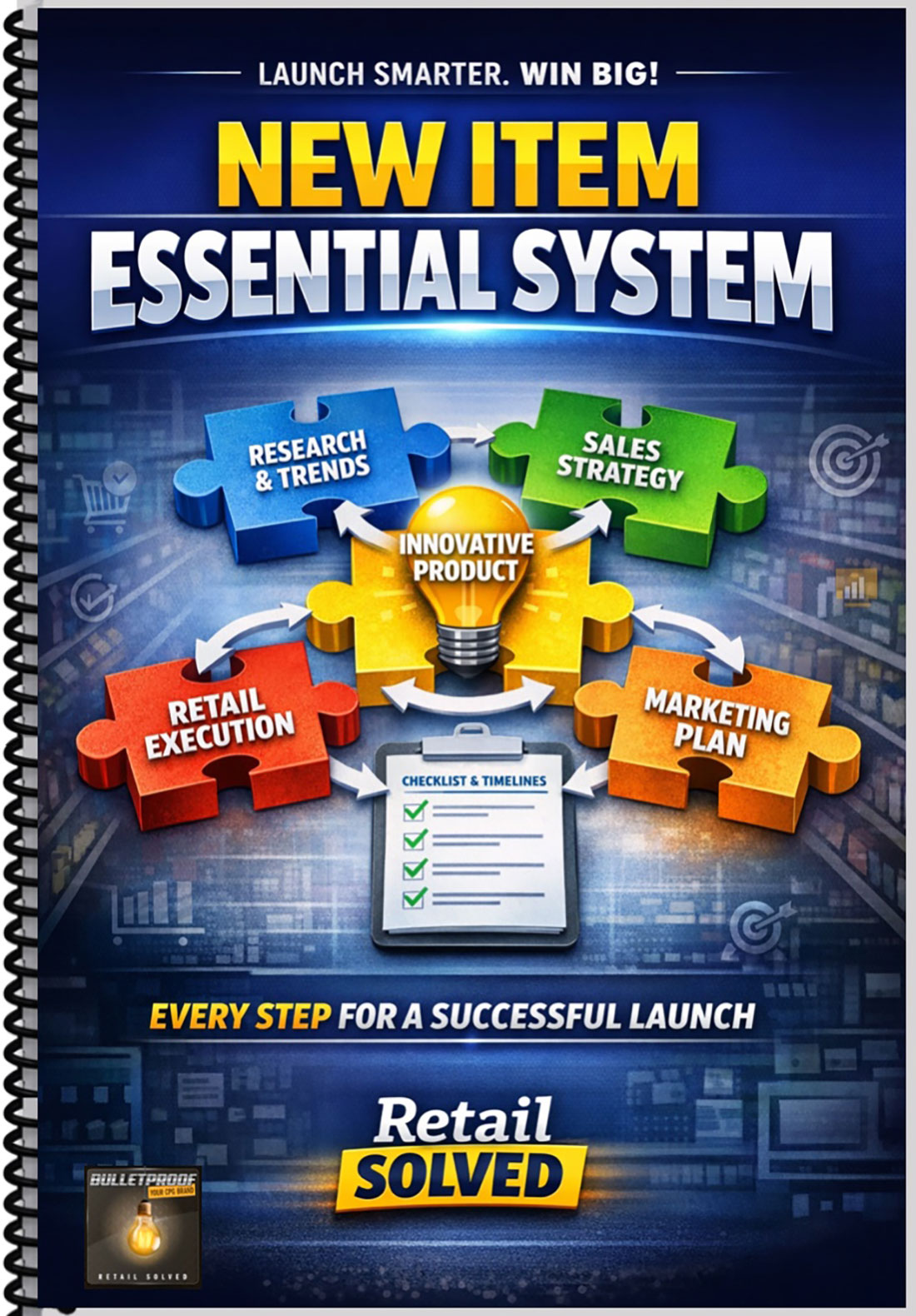
Most new items do not fail. They never had a real chance.
Pressure-test the shopper, placement, retailer value, execution, economics, and support behind the launch.
Retail Operating System™
The complete 11-module framework for protecting margin, optimizing trade spend, and scaling distribution with confidence.
Retailers run on systems.
Most brands run on hustle.
That gap is expensive.
The Retail Operating System™ is the only structured, data-driven retail growth framework built by a Certified Professional Strategic Advisor who has sat both in the founder seat and across the table from retailers.
It gives emerging CPG brands the same operational discipline, trade strategy, and category leverage that big brands use — simplified and systemized to protect margin, optimize trade spend, and extend runway while scaling distribution.
This is not education.
It’s infrastructure.
Image is the property of CMS4CPG LLC, distribution or reproduction is expressively prohibited.