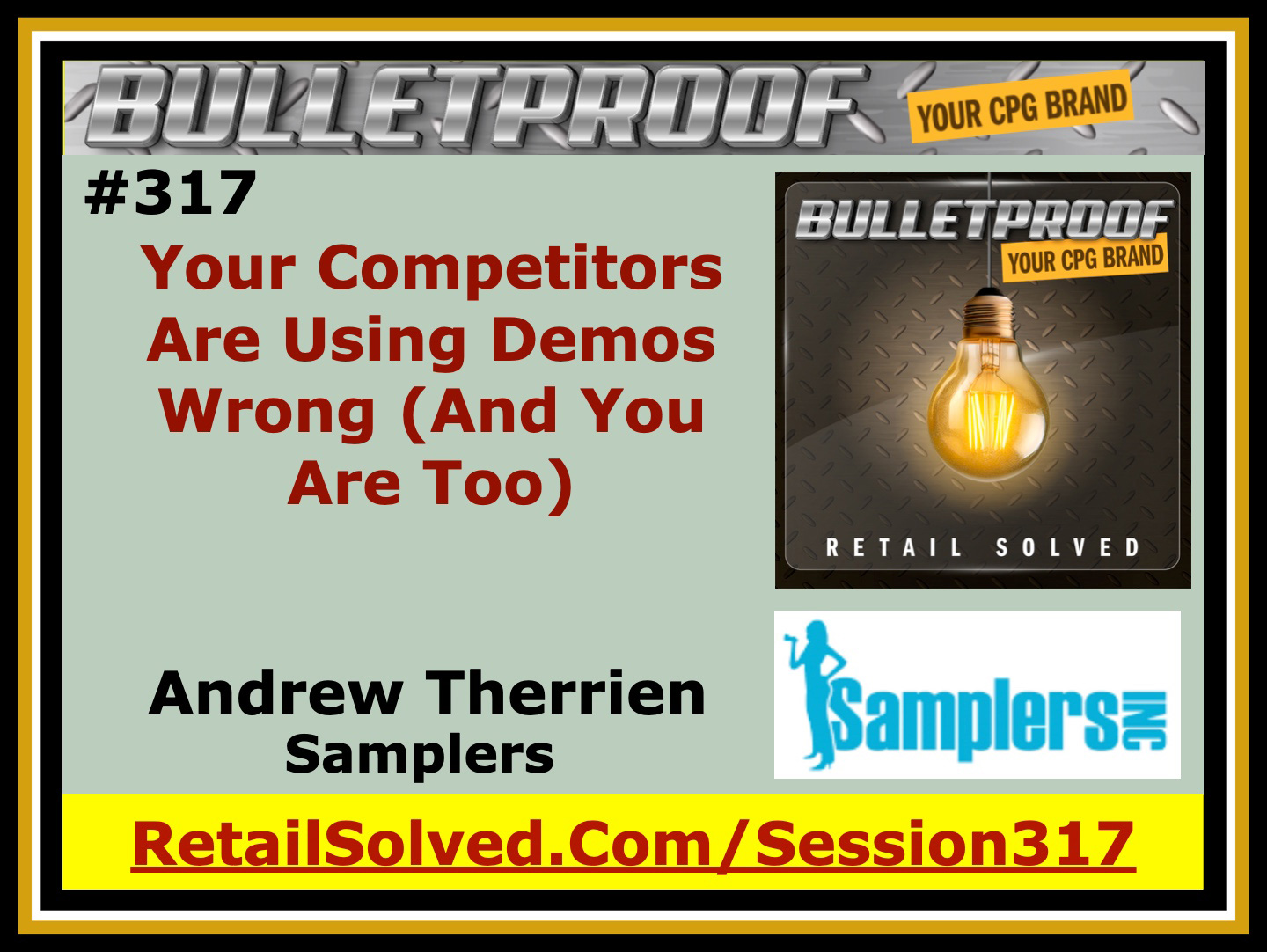
From Checkpoint to Growth Engine: Reimagining In-Store Sampling
Most brands treat demos like a checkbox. Hand out samples, move on, hope sales follow. That approach fails—and it matters because you’re wasting money while missing one of the most powerful growth levers in retail.
In this episode, I sit down with Andrew from Samplers to break down how in-store demos should actually work. You’ll learn why demos are not events—they’re systems, how to turn trial into repeat and habit, why base sales (not spikes) are what matter, and how professional execution, training, and storytelling dramatically improve results.
We also unpack how demos provide real-time shopper feedback that can reshape your product, messaging, and growth strategy—often faster and cheaper than traditional research.
Sampling doesn’t grow brands. Strategy does.
Download the Retail Audit Checklist at RetailSolved.com/session317 and start identifying the gaps in execution, placement, and promotion that are costing you sales.
Download the free The 15-Minute Trade Spend Leak Finder at RetailSolved.com/guide30
⏰ Timecodes
03:20 Why Samplers – The Purpose Of Demos
05:59 What Actually Drives Base Sales
10:39 The Biggest Mistakes Brands Make
11:56 The Right Model: Demos as a System
14:30 Base Sales Defined – Your Strategic Growth Lever
17:46 The “In-Store Funnel” Framework
18:51 Retailer Perspective
22:14 ROI Framework: Making Demos Financially Make Sense
22:33 How To Get Incremental Opportunities Not Available To Other Brands
25:34 Demos – Your Secret Weapon To Grow Sales And Loyal Customers
27:33 Actionable Playbook for Brands
29:47 Elevating the Industry
35:23 Why Retail Execution Matters
38:09 Why Training Matters – Use Assisted Sales Professionals
40:08 Case Study / Real-World Application
42:51 Confidence Matters – Partner With The Right Company
45:32 Recap – Why Samplers
46:39 Choose The Right Model
51:46 Make Every Product Experience A Success
Listen where you get your podcast







Like what you’ve heard?
Please leave a review and comment on iTunes
Let me know your most pressing question, I’ll do my best to answer it on a future episode.
I can remember, there was a product that had palm oil in it.
Enter your name and email address below and I'll send you periodic brand building advice, tips and strategies.
Right?
Um, and It
was a, it was a great product.
And people just wouldn't buy it.
It was at Whole Foods.
And we had a conversation because the demos
brought out that the palm oil was part of the problem.
A lot of people were objecting to it.
And we saw that as trends throughout the reporting that we do.
So they made a strategic
decision because they had fair trade palm oil, but they didn't go through the process.
Because it was expensive and all of that.
So they went through the process.
And they were able to put that it was fair trade palm oil.
People didn't buy it.
Right?
Because they just didn't think that that was what it was.
So they changed it to a separate oil that was much more effective.
Within a matter of 4 months.
Their overall sales spiked like 35%.
And it was, it was a game changer for them.
That long term change.
That came from the feedback from the demos.
Funded their line extensions.
They are super successful now.
Are you ready to hear more?
Welcome to the ballproof of your CBG brand podcast,
where we discuss tactics and strategies that you
need to give your brand the unfair competitive advantage it deserves.
Hello, I'm Dan Loman.
Be certain to comment and subscribe to get immediate access to
new brand building episodes.
Please recommend this to friends and colleagues and
help me raise the barn natural.
Let me know what your most pressing issues are, and I'll
do my best to address them on future episodes.
There's a free downloadable guide at the end of every episode to
help you go deeper into the topics we discussed.
Now, let's roll up our sleeves and get started.
Andrew, thank you for coming on today.
Can you please start by sharing something about yourself and tell us
a little bit about your background and how you got to where you're at today?
Dan, always great to chat with you.
Um, appreciate all the work that you do.
Uh, I'm Andrew with Samplers Inc. for those who don't know me.
Um, vice president of sales.
Um, I've been at the company, um,
going on 15 years now.
Um, sort of got into it because, um,
kept in touch with old college friends.
Uh, then I met the 1st weekend of school and
we've kept a great relationship over time for,
for me outside of work.
You know, it's just really spending time with my
2 boys, um, trying to stay healthy
in a crazy time of,
uh, you know, just work and life
in general being a dad.
So, um, you know, that's that's sort of my story.
Cool.
And tell us a little bit about samplers.
What do samplers do?
what does it matter?
Why does it matter?
And the point being is that, I used to run demos
years ago, and we've talked about this a lot, and what
a great opportunity for a brand to not
only get exposure, but the lift stays
or remains long after the event ends,
and that's not typical for most trade events.
Yeah, I mean, samplers is
a nationwide experiential agency.
We do about 180,000 events a year
of different types.
You know, um, I have a personal love
for the natural specialty space.
Um, but we also have sort
of segmented talent that also handle the conventional food
space, um, adult beverage, and
more experiential events sort of out in
the community, whether it's concerts, uh,
guerrilla marketing, that that type of thing or parking lot events.
Um, and, you know, really, it's
our ultimate goal is to support
the experiences for the retailers that we're in for the brands.
Um, gain exposure for the brands, make sure
that people know that they're there, sort of take
away that risk, um, that people have
to try new items, um, and,
you know, drive overall sales, but with
the experience as well.
There's a marketing aspect to it and there's a sales aspect to it.
And we try and bring sort of that nice
blend that supports everybody in the ecosystem.
You know, sometimes we do business directly with
the brands because retailers don't have a set.
Um.
Vendor of record,
let's say, within the organization.
So they sit there and say, you know, go out and find uh,
an agency that can go and do demos.
And then other times we partner directly with the retailers
and you'll see that a lot more, especially with the regional retailers.
Um, and with Sam's Club in particular,
where we actually run a portion of their test program.
Uh, where we onboard new items, identify
new items that are on trend, test it out in their
ecosystem and 25 to 600 stores.
Um, and provide the data back
to the buyers of, you know, is this a
good fit and is it, is it going to have legs to be
able to meet their metrics from a square footage, you know, sales
perspective, which you know well from, you
know, your time of the precursor for for Costco and such?
Yeah, I mean, it's a great opportunity, great event.
So thank you for sharing that.
So we've talked a lot about some of the challenges,
and so let's talk about the industry problem.
Demos being treated as a tactical versus a strategic lever.
Why does it, let's reframe that and then let's
talk about why that matters.
and how brand can maximize the experience.
A lot of times when people are on
the growth phase of a brand.
particularly, cash flow is always an issue, right?
And it's always a concern.
Um, you get into new doors,
and, You know,
the, the retailers today are starting to work towards, um,
media groups or shopper marketing
groups is what it used to be called, but now people are kind
of calling it media groups with the advent of
sort of digital and, you
know, fairly unique tactics that are out there.
And brands, We'll
sit there and use demo sometimes as a negotiation tool to be able to get in.
Um, but sometimes it turns into
a check the box where it's like, hey, we said we were going to do this.
So we're gonna, we're gonna do a round of demos and then we're gonna move on.
Um, where it's almost looking at it as
a finish line instead of a starting line.
Uh, of getting in getting in the doors and
really what I try and encourage people to do on a more regular
basis is figure out.
You know, sell for a little bit,
establish your base sales inside a store, through
other promotions, whether it's temporary price promotion,
uh, you know, um, signage,
end caps, whatever it might be, establish sort
of your base sales, and then, figure out,
not the top performing stores or the bottom performing
stores, but let's figure out a subset of those middle performing stores.
That we can hit multiple times over a 3 to 5 month period.
Strategically, because that's where the majority
of the growth is going to be able to come from.
The top performing stores are always going to be your top performing stores.
The bottom performing stores, might have other issues outside
of anything that the brand.
Has any control over, but
that middle market of stores within a retailer
is really important to focus on.
And we can always pivot, right?
But hitting the
same store multiple times over a reasonable
period of time, will create a
better return on investment, because the
day of, very rarely, do you
cover the expense of the demo, right?
It's more about looking back 4 weeks prior
with no promos going on.
What was your base sales?
And 4 weeks after.
To be able to sit there and say, not only did
we have this many sales the day of the demo.
But how many people came back and
made that part of their regular shopping experience?
And how can we impact that the most, and
it's through product education?
Training, and really investing
in the training of what's the story of the brand?
What's the 3 main selling points?
With the idea of you're selling against other items, right?
What can you say positively about yourself?
Without saying anything about another brand, where
an educated consumer is going to go, I know why they said that.
I know why that, this makes them different.
And this is why I want to try it.
And then really.
What are the common objections and misconceptions
that, um, consumers have about the
brand, and how do you want us to respectfully overcome that?
Um, in a way that drives
experience, education and sales, essentially.
I love the fact that you framed it that way.
I'm going to talk about base, but let's go back for a minute.
Let's talk about what makes sampler so unique and what
makes you stand out in the industry.
So the point being is that if
you can visualize when you go to a store and there's someone handing
out samples, a lot of companies just hand
out the samples, but they don't understand the product, they're not connected to their product.
It's just somebody that they're paying to stand there and
just give out product.
I mean, it's, there's, when you say experience on market,
let's talk about that and understand why that matters so much.
And the reason I wanted to go here is because if
you just demo your product, hand out samples, you're not making an impact.
But if you can bring someone into an experiential
situation, where there's a memory that's
formed or an experience that's so positive that
they want to share that, that's what matters,
that's what's going to drive sales long term.
So please talk a little bit about that.
And then how samplers uses
that to differentiate themselves in the market.
So, from a differentiation
standpoint, really, the training is critical.
That's why I spent so much time sort of explaining those buckets.
Because I think that that's probably the
place that gets missed.
It's, it's all about figuring out, the schedule, figuring
out the distro to make sure that there's going to be enough product, and
the training gets missed.
We really focus and we really
sit there and we'll encourage a delay in
the actual events, which delays our revenue, right?
But it's in the best interest of the ecosystem to
make sure that the training is intact.
That is probably one of the most critical, but one
of the most overlooked in our industry, just in my opinion, right?
Secondarily, when it
comes down to the actual experience inside the store.
I'd ask sort of the people that are watching.
What do you envision when you think of the in-store demo?
And usually it's a cart somewhere along the racetrack.
Mabel with a table, sort
of hairnet, ready to go, you
know, usually a bubbly person, outgoing, hopefully
is the perception that you have, right?
But how can we sort of change that, right?
One of the things that we had was, um,
it was a charcuterie board, right?
It was a, it was an all in one charcuterie board.
So instead of us standing at the cart and
just setting up a table on an end cap and blocking an end cap.
One of the things that we talked about was getting
them a chef's coat, getting them a nice hat, and
doing past hors d'oeuvres throughout the store.
So people weren't just,
we didn't, one, have to rely on them walking up to us.
But two, we created an environment that the
retailer approved to sit there and say that
we were okay to approach customers.
And by and large,
people loved it, right?
Because it was a premium experience,
you know, there's sort of this, um,
you know, yeah, we know we're in a grocery store, but it felt
a little bit like a nice cocktail party and person was
dressed nice and sort of trained
and, you know, they, they knew about the cheese and they knew about what
was sweet and they knew about, you know, all the different pieces of it.
It really creates a different experience
compared to, There's
a chip in a cup, and if you like it, it's 399 now 5 for
this week only kind of thing.
So that's what we try and that's what we try and do and get creative.
You know, there's certain times where we're cooking, right?
So maybe it's a code demo.
If you have somebody that you know that compliments you well.
You know, bad example, but a pasta, pasta
sauce, and, you know, a garlic bread company.
Let's get the 3 together and let's split the cost and
let's make your dollars go further, and let's
make the experience better for the retailer, uh, because
you're going to be able to go back when you do your recaps or your top to tops.
To be able to sit there and say, here's some pictures of some events we did.
And it wasn't just about me.
It was about you, Mr. Customer.
It was about you, Mr. Retailer.
And the way that we did that was, we cross
pollinated to make sure that the pasta sauce
got bought, the pasta got bought, the, you know,
whatever the add-on was, um, to
that dish where we gave the customer a 20 minute
meal idea, um, that cost them less,
gave them a better perspective on the price of groceries.
Um, you know, at your particular store and
we put on a great event.
Love that, love that.
So let's unpack.
I want to go back and want to pack some of the things you said about base sales because I want to frame this.
So base sales are the sales in the absence of a promotion.
And any of the databases that you're using have that calculation.
So you don't need to worry about figuring out yourself.
But to your point, understanding base sales,
that's your benchmark, that's your threshold.
I mean, that's where you, where you start.
And then you want to look at where you're building.
So if I take a product and I use a temporary price
reduction, a TPR, I'm going to get a lift and the
lift is going to be small, but not very big.
If I were to put that on an in cap, that product on
an in cap, I'm going to get a huge lift.
But the problem is, to your point, that
after the event's over, typically that lift disappears.
And so your base sales doesn't grow.
So if you, as you look at your sales,
base sales removes that promotion
from your sales.
Okay?
And ideally you want Bay sales to trickle up.
Typically with most promotions, they remain
flat or even decline, depending on the category.
So the point here is that why you get a nice
spike, and this is why it matters.
Most founders or most brands look at the
spike or the increase in sales.
They don't look at what happened afterwards.
That's not as important.
Because if you're just worried focusing on that,
You're missing the point of the promotion.
So let's keep going.
So if I've got base sales, and I have
an event, and it forces that that number,
that base sales number up.
That's contribution that you can that the
retailer takes to the bank.
That's growth.
you can count on over time.
So you mentioned having a promotion,
a demo with multiple items.
Brilliant idea because if I put 3 items
on an end cap, the lift is exponentially higher,
I'm introducing my product to other customers.
And so we're, like, to you said, cross pollinating.
So my lift is going to explode.
But again, that lift,
if you just put it on an end cap, is going to be high,
but base sales is probably going to go back to where it was.
The key point here is, and the key takeaway is,
is that when you create an experience, people
come back time after time after time, they share with
their frame, and your base sales trickle up.
So, The reason this matters is
because when you're looking at your trade spin, instead of
just throwing money at trade spin, you're actually using this
as a strategic growth lever.
So the fact that you don't see the huge
spike in base sales, because that takes time to realize
that's where the opportunity is.
That's what you're trying to accomplish is trying to grow that.
So, when we're talking about base
cells, and some of the core drivers are trial repeat and habit.
Can you talk about that, your velocity signals
to the buyer, and then how you also, I love the way
you put this, retail confidence in terms of space?
You're justifying it, but more importantly, you're
giving the retailer what they want.
And retailers want 3 things.
More traffic in the store, reasonable profit, and
they want contribution.
Yeah, from a trial repeat
habit perspective.
The trial takes away that risk, right?
Allows for them to do it.
If we do a one off demo, there
still is base sales, sort of
increase over a 4 week period.
But if you do the repeat.
One, you're going to capture more
clients that, you know, maybe just weren't shopping on
that Saturday for the 4 hour event that we were doing.
So you catch them sort of the next time around.
But additionally, you're,
you're, giving additional marketing impressions,
and it's showing sort of the resources, because
consumers,
One of the things that we see
from the research that comes back get very nervous about
new items because they feel as though it
was introduced and then I can't find it anymore.
Right?
Um, and they don't want to invest
that sort of bandwidth.
Um, if they don't think that they're going to be able to get it long term.
So seeing multiple demos over a period
of time is going to give them sort of that impression,
subconsciously, that this has longevity,
secondarily from a store perspective.
It reminds the store associates
and the store managers and the people who potentially,
you know, in a lot of retailers are going to be in charge of whether
or not they're going to order more, of the product,
they're seeing that.
So it's going to help you as well because especially for new items.
You know, one of the biggest problems that I have is,
is, you know, even if they're slotting paid, sort
of the, um, the
compliance from a store level and
actually checking it.
So, one, the demo can check
and double check because we're making, you know, we're going
to need enough product to sample and to sell.
But secondarily, it's going to give a better
impression to the store associates that the
brand is real and has staying
power and will give you better compliance from
a reorder standpoint and shelf
integrity standpoint.
Um, so that sort of ties
into the velocity signal to the buyers, but from
a habit standpoint, we generally
recognize that if somebody buys the same product 3
times, it becomes part of their regular purchasing
sort of, uh, cart.
If you will, right?
So we have to figure out a way, okay,
we got them purchase once.
How do we remind them again?
And demo isn't the only tool in your toolkit.
I want people to understand.
This is, this is one tool to the tool kit.
You kind of have to approach it from a shopper marketing perspective,
but it's a very important part of it.
And not just because I run a demo company, right?
But, um, you know, you really want
to figure out the different ways that we can get them to
buy it 3 times, just to be able to sort
of create that habit.
Um, and then, you
know, once, once they see the support from
a, from a retail standpoint on a consistent basis,
and not just a one off basis, because there's a lot of traffic,
there's a lot going on in stores, um,
you get the reorders, and now you
have, now you have strong base sales, that's
going to give the retailer confidence.
And then they're gonna start calling you for things.
Hey, we have a special event that's going on.
We'd like for you to be involved.
Hey, we have this idea from a media
group standpoint.
We'd like we'd like for you to be involved.
And it's going to give you opportunities because, you
know, I think most people get it, but sometimes in
the minutia of sales, we really forget that to
the brand, the retailer is the customer.
And then you're, Customer
one B is the shopper, right?
So it's really making that impression on
the retailer to be invited to the party
and sort of expand that relationship through not
only demo support, but all the other support that we talk
about from a shopper marketing perspective.
Thank you for sharing that.
If you listen to any of my content, the key theme throughout
everything, is that the more you do for the retailer,
that's how you differentiate yourself and become what I call
a category leader, the point being is this, is that
if you can do that to the point where the
retailer trusts you and leans on you.
You're going to get incremental opportunities not
available to other brands.
Let me repeat that again.
This is your opportunity to get displays and opportunities
that you may not have to pay for that
may not be available to other brands because you
prove yourself at store.
So thank you for sharing that.
And then the other point...
That's why I send people your way.
I'm one piece of a cock, right?
You understand.
I mean, granted, I understand other parts of it, because
I'm a student of the business, right?
But that's where your value comes into play.
of listen, I've done all these different things.
Uh, I've been on the retailer side.
You know, I, I, no trade spend inside and out.
That's where the value of
you sort of being that fractional
quarterback, internally, really
shines through because, you know,
brands don't realize how money can leak out the back door.
And you're a very inexpensive,
relatively speaking, uh, option for
that to make sure that the money's not leaking out the door, and
any investment that somebody makes on your side.
They're gonna, they're gonna make that money back.
Five fold, tenfold.
50 fold, depending on, depending on
what their organization's doing and and and how they're doing it.
Because I tell you what, there's a lot of brands that
go in, get approved, and then ask
the shopper marketing team.
Hey, what would you like me to do?
And they sit there and dictate based off
of their comp plan and the buckets that they need to fill?
Nothing wrong with that.
They're doing their job, the way that their comp plan is written at the retailer.
But it doesn't mean that it translates to what's
good for the brand and the retailer.
It might only be good for a portion of
that retailer's media group, but not that brand in particular.
Anybody that has new
items or they're coming through and even
if they have established items, but they're getting into a new
retailer or they're trying to grow within that retailer.
I really, Strongly
suggest that they talk to you because it's
not just about the demo.
It's about the whole picture and where
things make sense the most.
And if you come in with a plan, One,
you're going to gain more respect from the retailer, but two, you're
going to be able to spend your money, generally speaking, where
it makes the most sense for you.
And sometimes you got to throw them a bone just to
be able to help them out in one specific bucket.
But holistically, generally speaking, everything
is going to be moving you in the right direction towards a
better relationship with the retailer and better sales where it matters.
Appreciate you saying that.
Thank you so much.
And where I...
The reason this matters, the reason I love working with you, the reason I
love having this relationship with you is because you're
the secret weapon, having an experiential marketing
opportunity where I can build a relationship not
only to your point with the retailer, but the customer.
The cool thing is this.
If I am a customer and I go in and look at a product
on a shelf, you're packaging has to do all the selling.
And then I take that product home, I like
it, don't like it, whatever, but I don't know anything special about it.
I don't know anything extra outside of what's written on your packaging.
Assume I read it.
If you set up the demo right.
And again, this is your point of differentiation.
Because of the way you guys do this, you
create a story in my mind that I can then share with other people.
And the benefit of that is that, like
I said, the lifts are exponential and they last.
So thank you for saying that and thanks for breaking all this
out because I think it's important that people understand that
this is a very, very,
what you do is a very, very important strategic lever that
people can rely on.
And if you do this and do this right,
this can create opportunity down the road.
So thank you for sharing them.
One of the things you kind of touched on a
little bit or some of the biggest mistakes brands make, you talked
about Mabel with the table, love that reference.
You shared a story with me once that, just
briefly, you were doing, uh, you you heard about
someone doing a demo for a vegan male.
And a customer came up and said, how
can they make mail without eggs?
And the demo person said they can't.
It kind of defeats the purpose, but can
you talk about some of the mistakes that, that
people make and how do you, how do you help
people navigate around that so that
this becomes a win?
Yeah, I, you know, a couple things.
I think one and done mentality.
which I'll sort of dig into a little bit, you know,
not having that store level strategy, um,
you know, and then integration into the
distribution and sales team for, like,
bridging that gap.
So whoever's handling it from a marketing perspective,
and sort of has that responsibility, making
sure that I'm in touch with either the distributor,
the broker, sales team, uh,
anybody, unless, of course, we
already have an established, uh, you
know, continuity program with the set retailer, then it's our responsibility, right?
Uh, but making sure that product's on the table.
So, I kind of talked about that one and done mentality previously,
right, earlier in what we talked about.
And it's really, we sampled in all the stores
once, we check the box and then feel
like, all right, we're at the finish line.
Um, figure out more strategically.
Do less stores multiple times and
strategically pick that, you know, with with
data the way it is today.
We have access, um, where we
have a, we have a data partner that we work with, where
if we put in demographics and we put in the retailer, it'll
spit out top 20% of stores.
Right?
Based off of the demographic, you know, um,
so we can, we can make the biggest impact and we can
be as strategic as possible.
So, um, and then take
some time off from it, right?
That it's not like demos have to happen in a continuous basis.
But where I think people miss the boat, really,
is once your brand's sort of established
and things are humming, uh, in a retailer,
it's easy to sort of sit back because there's
a bunch of fires burning, let's be honest, like, you're trying to
get into new retailers.
You're planning for Expo West.
You're planning for fancy food.
Um, you know, it's show season.
Um, you have deductions that you're going to have to
deal with from your distributor and you're trying to tackle that.
Go back.
to the retailers that are working well and
delight them by sitting there saying, I know things are
going well, but I think that they could be better.
Right?
And I'd like to be able to strategically figure out where
we can go and help make experiences.
And sometimes it's a demo.
It's it's a one.
it's a one off demo that you're doing.
Sometimes it's a code demo.
Who can I partner with?
You know, hey, category manager?
You know, we're established.
Is there a new item that you're in love with?
That you would like for us to partner with?
So we could help bring them along.
And we could help them be successful, but
we could split the cost of the demos.
You know, now you're sitting there putting
yourself in your customer's head to sit there and go,
this person actually cares about other products, that
they're not affiliated with, because I care about them.
And they wanna help me.
That's a completely different approach.
Um, then sort of things
are going well at that retailer.
Um, we're gonna do the bare minimum from a promotion standpoint
because things are, you know, we have to put the resources elsewhere.
Um, that kind of ties
into the store level strategy, but, you know, really looking at the data.
And understanding your retailer too.
Is your retailer an early adopter or are they a lagger?
Sort of, or are they somewhere in between?
You know, how innovative can they be?
Um, and that needs to sort of shape,
uh, what you propose and put forward.
You know, some people want clean floor plan, chippers
aren't an option.
Um, you know, stickers or shelf
talkers, whatever.
You know, all these things help.
And all these things matter, but knowing your
customer matters more.
Um, you know, we talked about demographics and volunteers.
Um, You know,
and really treating all stores equally.
Not all stores are are equal even within the same banner, right?
There's some that are just small concept stores.
Maybe that works for you.
Or maybe it doesn't.
But understanding, you know, what
stores, you know, this was something.
Um, In
particular that I remember, what, the,
the common, Understanding is that Thursday,
Friday, Saturday, Sunday, are the demo days.
Um, and that's where a lot of the foot traffic comes from.
One of the things that we recognize really
quick because we had a, we have a continuity program
with a, uh, urban chain.
And one of the things that we realized was 3
to 7, uh, during the week, especially
Wednesdays and Mondays, were awesome because
we were catching people coming off the commuter trains,
and they were coming home and they were looking for, you know, because
of where they were, they they couldn't carry a lot, right?
So they would do their shopping multiple times a week.
Um, and we recognized
that Saturdays, there wasn't as much foot traffic.
Because you didn't have sort of that business commuter
going back and forth doing their shopping for the next 2 or 3 days.
Um, so really knowing
your retailer and knowing when to be there, and
we can sort of help with that, obviously, both you and
I can sort of consult as it relates to that.
Um, and then, sorry, I'm talking so much.
Well, keep going.
The, from an integration with the sales
team, um, you know, when
you, if we're the vendor of record and
we have a continuity program where you sort of have
to deal with us in that retailer, will
have the ability to send a distro.
But if it's Whole Foods, for example, or,
you know, fresh market, where
they don't have a specific demo partner
that they utilize on a daily basis.
Um, and you're hiring us to do that.
We're gonna handle the coordination with the store.
We're gonna handle the schedule with the store.
But a lot of times, we'll ask, um,
okay, we know the base sales, can
you order an extra 4 cases for the demo?
And we hear, sure.
And we follow up the
week before, and it doesn't happen.
We get there, there's 5 units on the shelf.
We have to use some of that for sampling.
And then, We sell
through it in a matter of an hour.
That's not, that's not a
good use of our time and that's not a good use of your resources or
the time you spent putting this all together.
If we can get in touch with
either the broker.
The distributor, uh,
or sometimes even the the buyer,
to make sure that they can do a distro, and they can
support it, appropriately, or
they will give you an inkling of whether
or not they're actually going to support it.
And maybe you want to consider reallocating those resources
to something else if you, if you don't
have the confidence that there's going to be enough
product there and that there's going to be a buy.
Because if you're doing the support,
you want to be able to get the buy-in from the players
to make sure that there's going to be enough product present,
not only for us to sample, but for us to actually increase those base sales.
I'm so gr- glad
that you talked about producting in a stock, retail execution.
Let's talk about this is back up.
The worst thing in the world, and I'm just going to paint a picture for
everyone listening, is to see a demo cart with
your sign on it, and nobody's standing there.
And that is...
than not doing the devil.
It is.
It is.
It says that you don't you don't understand your business.
But the cool thing is that because
of your relationship with the retailer, you're
going to take the extra steps.
So if I'm running a demo, I don't know how much extra product I need,
but you should have.
As a side note, anytime you run a promotion, doesn't
matter what kind of promotion is in a store.
You should be able to tell the retailer.
This is how much incremental product you need in every store.
Every store individually, so that
that product's on stock, so that you don't have out of stocks,
because when people measure their sales.
If you run out of something, that's
not picked up in the POS data, your sales data.
That is a void, a blind spot.
But 1st impression, right?
If you have an out of stock, an empty hole on a shelf, that
leaves a lasting impression with the consumer.
So, long story short, the fact that you can
help guide me and help work with me to make sure
that I've got enough backstock.
That's critically important and then your other point about
coordinating with the store and the store staff.
This is, I think, perhaps one of the best values
that you offer, because if I'm a brand,
these are things I'm not taught.
These are things that I don't understand.
And if you can help me negotiate that, so
that, I become the value added resource to the retailer,
so that the retailer calls me up and
says, hey, Dan, we've got an opportunity, can you do this?
So why does this matter?
The grand opening of a superstore in Colorado.
I was back when I was doing a DSD driver and
I sold the, the, the private label chips
and also a regional chip.
And because I had had such a good relationship with
the retailer, Frito could not get a display in the store.
They couldn't get an end cap or sidesack or anything else.
4,900 baggage.
Yeah, it was great.
It was amazing.
And by the way, I didn't have to pay for that.
So, I mean, it is huge.
And so, and this is how I, my whole
reputation is both, and not, not, we're not talking about me, but the point
is, this stuff works.
This stuff makes a lot of sense.
So thank you for sharing the fact that you
can help guide me into that position so
that I can maximize each and every opportunity.
So thank you for that.
Let me let me add one more thing too.
You know, when I think about,
Professional execution,
right?
And the reason why I break out the training the way I do?
You know, the reality is,
I'm pulling from the same, Full
of talent, if you will, that other agencies are pulling through.
Right?
The differentiator is how I prepare
those individuals and the expectations that I set and
how I hold them accountable.
Right?
So, you know, when we,
When we
put that training together, it's with the idea that,
We treat our people like assisted
sales professionals.
Not samplers, per se, right?
They're talent.
They're not just part-time W2 workers.
Right?
So we need to be able to,
you know, there's a reason why we're talking about the 3 main
selling points, you know, strategically written.
Um, so they can put talk tracks together.
These are already naturally outgoing people.
Uh, or they would have been merchandisers, right?
Um, there's a reason why they're demo people.
They like talking to people.
They like opening up conversations with new people.
That talent they already have.
It's really,
Week to week, they're constantly
introduced to new items.
We need to follow a process that
will create an environment of professional
execution of setting standards.
Giving them the why behind the
selling points of why it's important so
they can understand the dynamic within a conversation that they're having.
This is effective communication that that, that, that we're
essentially trying to teach them and give them the tools to be able to do.
And then the objection handling, you know, is huge.
I can remember, there was a product that had palm oil in it.
Right?
Um, and It
was a, it was a great product.
And people just wouldn't buy it.
It was at Whole Foods.
And we had a conversation because the demos
brought out that the palm oil was part of the problem.
A lot of people were objecting to it.
And we saw that as trends throughout the reporting that we do.
So they made a strategic
decision because they had fair trade palm oil, but they didn't go through the process.
Because it was expensive and all of that.
So they went through the process.
And they were able to put that it was fair trade palm oil.
People didn't buy it.
Right?
Because they just didn't think that that was what it was.
So they changed it to a separate oil that was much more effective.
Within a matter of 4 months.
Their overall sales spiked like 35%.
And it was, it was a game changer for them.
That long term change.
That came from the feedback from the demos.
Funded their line extensions.
They are super successful now.
I mean, they, but there were times where they were like,
why did we get out of tech?
Why did we get out of finance to start this natural food
company?
But it mattered, right?
And so, We've talked a lot about how
the sales are gonna convert.
But also, really the data that we're going to be able to provide.
We're going to be able to provide the trends on the back end
because these people are professional, you
know, assisted sales people, and
we're going to be capturing photos, we're going to be capturing other
information from a data that we can sort
of cultivate together as a team, both you, me, and the brand.
Uh, to be able to sit there and say, What other information?
Can we gather that will make this spend worth it to us?
You know, potentially it's competitive information.
You know, hey, we need it.
We need a picture of, you know, uh, a specific
other brand that's sold within within the store, a
picture of ours, just to see how it's slotted, so we
can go back and sit there and say, we paid for slotting fees.
Please help us from a compliance standpoint.
So giving giving them the proof necessary
to be able to do that.
There's there's a lot of ways that
we can bring value other than putting Mabel
in behind the table at the incap.
That's funny.
I appreciate you're saying that.
So the key word here, the takeaway is confidence.
You're giving the brand confidence that they
can rely on you to get the job done and do it right.
that you're going to be professional, the people that you're
going to put in there are going to maximize each
and every opportunity.
And you're given the retailer confidence that
they know that you're going to do, that
brand's going to do everything right.
And the point there is that going back to what we've been talking about,
The retailer needs to have trust.
When they look at our brand, it used to be, hey, I'm a nice
guy, please put my product on the shelf, but now you're giving
that retailer confidence that they can trust that
you're going to grow sales, increase foot traffic, all that stuff, things retailers want.
I love your story about the palm oil.
That's something that goes above
and beyond what we're talking about.
So when a brand makes a product and
they put it out there, they assume everyone's going to like it.
And for you to help validate that is gold.
So a brand could spend not 1000000000s,
but a ton of money, big brand spent a lot of money doing this.
And a lot of times that money's wasted.
I could have, we could go on for hours about stories where brands fail.
Focus group said this would be great and it didn't.
But the point is, now you're actually having customers,
real life people tell you, give you feedback in real time, hey, here's what I like.
Here's what I don't like, so that the brand can pivot.
And then explode sales.
That is a great story.
So thank you for sharing that.
So, we'll also filter.
Because there's sometimes where you get certain feedback that's
maybe inaccurate that a brand's like, hey, I want to jump on this.
And it's like not every feedback is the right thing.
Maybe you're in the wrong retailer.
Right?
It's a natural specialty brand and it's
really healthy and it's a really clean label and you're selling it at a certain retailer
where the shopper isn't looking for that.
Don't make changes, like, will help
you from an advisement standpoint.
To sit there and say, this isn't actionable.
Other than, maybe you're not in the right place.
Let's focus your resources on retailers that
fit your ethos and sort
of brand a little bit better.
Or, hey, this is actionable.
We're seeing this wherever we go.
And this is hurting your growth
potential in the retailers that matter, and
we'll help sort of differentiate that on the back end as well.
That's a great selling point.
So thank you for sharing that.
So samplers to recap is going to partner
with you in this as opposed to someone who's
just going to take a paycheck to hand out samples.
That's a wasted money.
In fact, actually, when I talk about Expo West, it's not a sampling event.
It's a trade event.
And the point being is this kind of very relevant
to what we're talking about, is that instead of just handing
stuff out, getting feedback, understanding what people
like, what they don't like.
And the other cool thing is, you could be getting testimonials
for me so that when I go into the retailer or
maybe even a future retailer, I have quote unquote,
pre-sold the product so that I've got validation behind it.
So thank you for sharing that.
Can you talk about the right model,
demo versus a system?
So how do you, when you're setting this up, how do
you structure this, if I'm coming to you, I don't know what I don't know.
So how do you do that?
The cadence of store segment, you talked a little bit about this, but what
are some of the things that you would ask me or help me lead into so
that I can maximize each and every opportunity with you?
Yeah, so we
start, and it really depends on where you are with the retailer, right?
Are you in already
or are you just launching?
In in a store.
Um, if it's, if it's a launch.
It's really going back to the buyer and saying, you
know, what are, what are your top 20,
30% of stores?
And we're gonna, we're gonna go and capture those.
If it's an established brand and
you at least have some time under your belt.
It's going to be going and asking the retailer or
figuring out in different ways, um,
that you can help them with, you know, what,
what sort of those mid-range, where is the biggest potential for growth going to come from?
and education going to come from?
And identifying those stores.
From there, concurrently, we're
going to be working on training.
And making sure that that's good.
And then at the same time, my team's
going to be going out scheduling.
So we're going to be evangelizing and communicating with
the individual stores.
to be able to put a schedule out, usually 4 to 6 weeks out.
The A team of brand ambassadors,
generally, make their schedule 4 to 6 weeks out.
If it gets under 4 weeks, you're kind of going to the B squad, if
it gets under sort of 2 or 3 weeks,
it's whoever happens to be available at that time.
They get to pick what they want to do.
We want to capture the really good people early.
So we'll get that schedule and we'll get that done.
At that point.
It's really about us getting in touch with the distro team.
Whoever's going to be in charge of that distroke.
Is it a broker?
Is it going to be a distributor?
Is it going to be somebody internally that sits inside corporate?
Um, because A
lot of times people will take the easy way out and say, well, the store's going to handle it.
Just please ask them to do it.
It probably
has, when a store is responsible
for the order.
We generally see.
About a 70% compliance rate.
And that's not good.
Right?
That can blow up a demo program or
any sort of program.
So what we'll, we'll generally try
and do is, is, is to push back.
Usually we'll utilize our relationships to
be able to go in to the retailer, to
sit there and say, here's the support that's going to happen over
the next 3 to 6 months.
What can we do to get some help to make sure that
we're going to have enough product?
Here's the here's the product array that we're going to be utilizing.
Can we push that in?
And it's it's obviously much easier when we're
the vendor of record for the retailer.
Because we can easily do that.
Sometimes it's harder with the ones that don't
have a centralized, uh, demo program and
we're sort of coming in ad hoc where we're bringing everything
in and taking everything out with us.
Um, then we'll talk
about sort of what that setup's gonna look like.
So what's the person going to be wearing?
Um, how is it going to be merchandised?
How is it going to be prepped?
And then we'll strategize um,
as it relates to the reporting.
What information do you want to capture because sales
is one KPI, if you will, but
what are some of the other marketing and sales KPIs
that we can have to be able to make sure that we can
give you a nice snapshot on the back end, that you
can utilize as a selling tool when your broker
has inevitably gets you that meeting to sit there
and talk about your future promotional schedules, line extensions,
any other promotional support that's gonna happen.
Andrew, thank you for sharing this.
I guess the key point I want to come back to is that we're
talking about confidence, confidence in the brand. and
confidence to the retailer.
And one of the things I want to really emphasize is
your relationship with a bram.
If I'm a founder and the retailer says, hey, I need you to do demos.
I'm thinking, I don't have the bandwidth.
I dont have the time.
I don't have the ability to structure it, to
hire people, to train people, whatever.
The point that you will take over and
do everything for me in partnership with me.
So I'm not operating alone.
You're not going to blindside me.
You're going to help me guide this, guide me through this process
so that you can so that I can maximize every opportunity.
And then, not only are you going to do that,
but you're going to give me the feedback on the back end.
I think that's critically important because when I'm
looking at measuring this and understanding this.
That's, I think, the missing piece.
That's how I'm able to turn this into
a strategic growth lever, that I can measure,
and then look our ways to maximize this down the road.
With that said, what am I missing?
and is there anything you want, any dots you want to connect?
Yeah, I, I love the way that you framed it.
The only thing that I would even add to it is
that samplers, as
a culture, right?
The way that we hired, the
fact that we have a very flat hierarchy where a lot of our
supports out in the field, we structured
it because we understand what brands
and retailers go through.
And we're not just looking at it through
the silo of demos.
Right?
We understand.
All of the other challenges.
I've run my own brands before, right?
Uh, people work internally.
I've worked at retailers.
They've worked, uh, you know, at other marketing
agencies, where it wasn't just about demos.
It might have been a holistic marketing agency.
Um, so we're
able to see the different perspectives, and
we're able to see the different challenges that people face day to day.
So, You sort of said it.
We're handling it, but we're
staying in constant communication with you.
Where our job is
to be, your ultimate support for
what we specialize in.
And There's a lot
of agencies out there.
that, um, try
and be everything to everyone, right?
quite honestly.
You know, they're your broker, they're your private
label, they're your demo company, they do everything.
Okay.
Right?
We specialize in creating
those experiences in the process that
goes into play to make these events successful.
And that's a huge differentiator, not only for the brand.
But for the retailer as well, right?
So, it's like, and
there's a benefit to the brand in that regard, because if we make
it easier for the retailer, it's that much better
for the brand because the retailer is looking at that brand
through a different lens.
So, um, we
understand that this isn't the only thing you're doing too.
Right?
So, you know, especially when it's a launch.
There's a lot going on.
We're gonna be a good use of your time.
We're not gonna overdo it, but we're not gonna leave
you on an island either and be like, okay, we've got it.
we're gonna go handle it.
Wish us luck, because we understand that it's people's livelihoods.
It's people's jobs.
And they need to be able to know what we're
doing, you know, throughout the process and whether
it's a shared Google Doc or, you
know, a check-in because we're a couple weeks out.
We just want to give you an update as to where we are.
I mean, that goes a hell of a long way.
So when inevitably your boss comes and says,
hey, where are we at with this launch?
You have, you have the information at your fingertips
and you're, you're in the know, but you're not in the wheats.
Love that.
So to recap that, you,
every brand wants to convert their occasional shopper into
a loyal evangelist.
You are going that extra step where you're
helping me, the brand convert me
to a loyal advantage, not only for you, but helping helping
me understand how to maximize each and every opportunity.
And I love how that ties back
to, this is the way you would treat your customer.
Here's how we're going to treat you the brand.
So thank you for sharing it.
You and you, the retailer.
So thank you for sharing that.
Any parting comments, anything else you want to share, Andrew?
You know, if anybody's
struggling with this and if anybody's sort of, you
know, having hiccups or they haven't had the greatest experience
in the world, call me in first, right?
And kind of do that, Sigma
360 sort of assessment, just to
understand where you're at.
And then from there, It's
a natural progression where, you know,
you're you're great at seeing where the lakes are, right?
And figuring out what makes the most sense.
You know, sometimes, quite honestly,
I'm, I may not be the right tool in the tool belt.
But the thing that I love about you is,
if a brand calls me and says, hey,
I don't know how to do this, but I trust you.
Uh, is it something that you can help me with?
Generally speaking,
my 1st call is to you.
If I don't know the answer.
So you're sort of the,
the hub, if you will, and,
you know, there's offshoots.
Some of the people that you've introduced me to, the Brian Bookas of the world, right?
You know, uh, invaluable,
not only to my profession,
but just life because, especially in
the natural specialty space, the thing I think I love most about
it, is just the camaraderie and the ecosystem.
Um, that, that we're building and
have built over our careers.
And that matters, and that's
meaningful because I know how much time we all spend at work.
And being able to enjoy the
people that you work with.
It's, it's a game
changer when it comes to quality of life.
Well, I appreciate you saying that, and thank you right back at you.
I love the fact that I can, can, can connect you with
someone, and I know that they're in good hands, and you guys are absolutely amazing,
and I love the fact that you guys have that company
culture because, That's what
this industry is about.
It's the relationship.
So thank you so much for sharing that.
And again, cannot thank you enough for coming on, Andrew.
Thanks for making time for me today.
And for sure, not only sharing your story, but helping
to differentiate why this matters and
how I can maximize this as a strategic growth level.
Anytime.
I appreciate you very much.
And likewise, thanks, Andrew.
Have a good day.
You don't have a sales problem.
You have a visibility problem.
Most brands rely on reports to understand their business,
but those reports don't show you what actually happened in store.
The retail audit checklist helps you quickly identify
gaps in execution, placement, pricing, and promotion,
so you can fix what's costing you sales.
This is one of the fastest ways to improve performance without spinning more.
If you want to see what others miss and act faster.
Download the retail audit checklist in the show notes.
Thanks again for joining us today.
Please reach out and share your most pressing questions, and I'll
do my best to get you the answers that you need on future episodes,
including with expert advice from CEOs and industry thought leaders.
Comment, leave your questions, and get this week's free downloadable
guide and the show notes.
Sign up to receive email updates
FREE Trade Promotion ROI Calculator:
Click Here To Maximize Sales And Profits
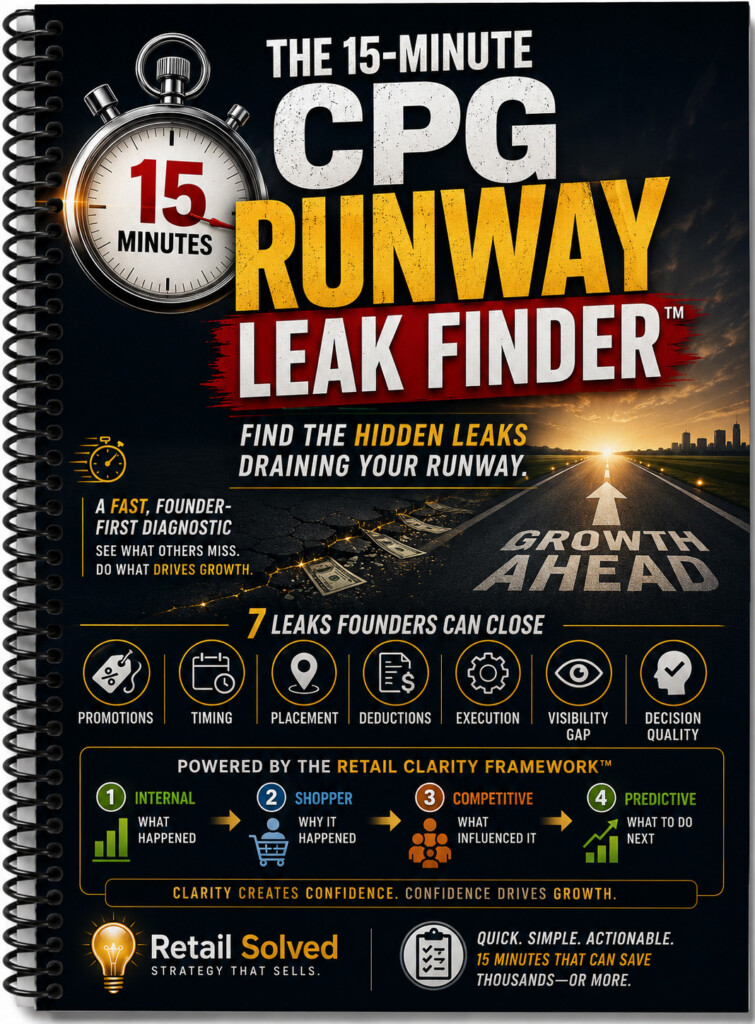
Start here: Find where your CPG brand is losing cash, margin, and runway.
In about 15 minutes, identify the leak creating the most pressure so you know where to look first.
No friction, no email required.
Retail Operating System™
The complete 11-module framework for protecting margin, optimizing trade spend, and scaling distribution with confidence.
Retailers run on systems.
Most brands run on hustle.
That gap is expensive.
The Retail Operating System™ is the only structured, data-driven retail growth framework built by a Certified Professional Strategic Advisor who has sat both in the founder seat and across the table from retailers.
It gives emerging CPG brands the same operational discipline, trade strategy, and category leverage that big brands use — simplified and systemized to protect margin, optimize trade spend, and extend runway while scaling distribution.
This is not education.
It’s infrastructure.
Image is the property of CMS4CPG LLC, distribution or reproduction is expressively prohibited.