You have data. Reports. Dashboards. And still… you don’t know what to do next. Which SKU should you scale? What should you produce? Why didn’t that promotion work? That’s not a data problem—and it matters because guessing leads to wasted spend, missed opportunities, and slower growth.
In this episode, I break down why most CPG brands get stuck even with great data—and how to fix it using the Retail Clarity Framework™. You’ll learn how to move beyond internal reports by understanding shopper behavior, shelf dynamics, and competitive context so you can make better decisions faster.
Data tells you what happened. The shopper explains why. Clarity determines what happens next.
Download the 15-Minute Clarity Audit at RetailSolved.com/session316 and start connecting the dots in your business. Then listen to related episodes on trade spend, forecasting, and execution to go deeper and extend your runway.
Download the free The 15-Minute Trade Spend Leak Finder at RetailSolved.com/guide30
00:40 The STORY — When There Was No Data to Rely On
01:37 The Shift … I Used Trade strategy Thinking to Solve It
02:08 This is How We Actually Solved It
02:51 The RESULT — From Guessing to Predictable Growth
03:17 The INSIGHT — Why Most Brands Get This Wrong
03:38 The Break Down — Where “Why” Actually Comes From
04:00 Use This Framework
04:52 The BRIDGE — Why This Matters for You Right Now
05:09 Focus first on the LEAKS — Where to Apply This Immediately
05:56 Do this — The 15-Minute Clarity Audit
06:28 Your Next Step
07:06 Recap – Here’s the shift
Listen where you get your podcast








Like what you’ve heard?
Please leave a review and comment on iTunes
Let me know your most pressing question, I’ll do my best to answer it on a future episode.
🎙 EPISODE 316 — You Don’t Have a Data Problem. You Have a Clarity Problem. The Real Problem Isn’t Execution 🎯 here’s the STORY — When There Was No Data to Rely On 🔄 here’s the SHIFT — This Wasn’t a Trade Problem… But I Used Trade strategy Thinking to Solve It 🧠 This is How We Actually Solved It 🎯 the RESULT — From Guessing to Predictable Growth 💡 here’s the INSIGHT — Why Most Brands Get This Wrong 🔍 Let Me Break This Down — Where “Why” Actually Comes From 🧭 here’s the FRAMEWORK — The Retail Clarity Framework™ 1. Shopper — Why They Buy 2. Shelf — How They Find You 3. Competition — What They Compare You To 4. Execution — What Actually Happens Most brands focus on one thing: 🔄 Here’s the BRIDGE — Why This Matters for You Right Now 💸 focus first on the LEAKS — Where to Apply This Immediately Leak #1: Promotions That Don’t Drive Demand Leak #2: Poor Timing vs Competitors Leak #3: Weak Visibility and Placement Leak #4: Forecasting Blind Spots ⚙️ Do this — The 15-Minute Clarity Audit Question 1 Question 2 Question 3 Question 4 If you can’t answer those clearly… 🎯 here is the NEXT STEP 🔁 RECAP — here’s The Real Shift
Enter your name and email address below and I'll send you periodic brand building advice, tips and strategies.
The biggest problem most CPG brands have right now…
👉 isn’t execution
It’s not:
your broker
your promotions
your retailer
or even your product
The real problem is this:
👉 you don’t know what to do next
You have data.
You have reports.
You have dashboards.
You can see what’s happening in your business.
But you’re still asking:
“What should we produce next?”
“Which SKU should we focus on?”
“Which retailer should we prioritize?”
“Why didn’t that promotion work?”
That’s not a data problem.
👉 That’s a clarity problem
And that’s exactly why I created the Retail Clarity Framework™.
Let me ground this in a real example.
I recently worked with a brand that launched a new product line that reimagined a popular snack.
It was:
high protein
better-for-you
positioned against a massive mainstream brand
And the early response?
👉 Everyone loved it
Strong concept.
Strong demand.
Clear differentiation.
On the surface, it looked like a slam dunk.
But behind the scenes…
👉 they were completely stuck
They didn’t know:
how much to produce
which flavors to prioritize
what pack sizes would work
which retailers to launch into first, second, third, and so on
or what the long-term potential actually looked like
And this is more common than most people think.
Because when you create something novel…
👉 you don’t have clean historical data to rely on
So what do most brands do?
They guess.
They follow instinct.
They listen to fragmented advice.
And that’s where things start to break.
Here’s what’s interesting.
This wasn’t a trade marketing problem.
But I solved it using trade marketing skills.
Because at its core…
👉 trade marketing is about understanding behavior
- Brand behavior
- Category behavior
- Competitor behavior
Shopper behavior
Market behavior
Not just performance.
So instead of looking at their internal data…
👉 we built a model from the outside in
Here’s what we did.
First, we looked at adjacent categories.
Not identical products.
👉 Similar behaviors
We analyzed:
products with similar attributes
how those products performed
how they impacted other items in the category
Then we went deeper.
We broke it down by:
pack size
flavor
positioning
price tiers
attribute sets (high protein, clean label, etc.)
We studied:
👉 how shoppers actually made decisions
Then we layered in:
seasonality
promotional patterns
retailer-specific dynamics
Because what works at one retailer…
👉 does not always work at another
So we built retailer-specific models.
Not generic assumptions.
What happened next is the important part.
We went from:
👉 guessing
To:
👉 making informed, strategic decisions
They knew:
what to produce
where to launch
how to prioritize SKUs
what realistic demand looked like
how to scale
And most importantly:
👉 they understood the why behind every decision
The models proved to be extremely accurate.
And we were able to expand them across additional innovation.
Now here’s the lesson.
Most brands look at their own data and assume:
👉 “This should tell us what to do”
But it doesn’t.
Because:
👉 your data tells you what happened - past tense
👉 it does NOT tell you why it happened
And without understanding why…
👉 you can’t predict what happens next
That’s where brands get stuck.
The “why” doesn’t live in your dashboard.
It comes from:
👉 the shopper
👉 the shelf
👉 and the competition
What problem is the shopper solving?
Where are they looking for solutions?
What are they comparing you to?
What else is influencing their decision?
If you don’t understand those things…
👉 your data will always feel incomplete
This is exactly why I built the Retail Clarity Framework™.
Because what brands need isn’t more data.
👉 They need a way to interpret what they’re seeing
Here’s the simple version:
What problem are they solving?
What matters to them?
What triggers the purchase?
Where is the product placed?
Is it intuitive?
Is it easy to shop?
What else is on the shelf?
What are the alternatives?
How are they positioned?
Is the product in stock?
Is it merchandised correctly?
Is the promotion executed as planned?
👉 their internal data
But your business lives across all four.
Now here’s the important part.
You don’t need to rebuild your entire strategy overnight.
You don’t need:
new software
new tools
or a massive overhaul
👉 You just need to start applying this lens
And the fastest place to do that?
👉 is Your trade spend
Because this is where most brands lose money.
Not because they overspend.
👉 Because they can’t see clearly
Let’s connect this back.
You see lift.
But you don’t see:
👉 if it created new behavior
You run a promotion.
But you don’t see:
👉 what else was happening in the category
You measure sales.
But you don’t see:
👉 what didn’t sell because it couldn’t be found
You produce based on past data.
But you don’t understand:
👉 how behavior will change
This is one of the biggest hidden leaks—especially in perishable categories.
So here’s what I want you to do.
Take 15 minutes.
And run this simple audit:
👉 What happened in our last promotion?
👉 Why did it happen?
(shopper, shelf, competition)
👉 What didn’t we see?
👉 What would we do differently next time?
👉 that’s your gap
And that’s where your opportunity is.
It’s this weeks free download
If this way of thinking resonates with you…
This is exactly what I go deeper into:
how to interpret what you’re seeing
how to connect the dots
and how to make better decisions faster
And if you want a more structured way to apply this to your business:
👉 If you want to go deeper, I walk through this in a free workshop
Details in this weeks free guide and on my home page retailsolved.com
And if you want help working through this in your business…
👉 Just reach out. I’m happy to help.
But for now…
👉 Start with the 15-minute audit
It’s the fastest way to see what’s actually costing you money
Because clarity is what unlocks everything else.
You don’t need more data.
You don’t need more tools.
👉 You need better interpretation
Because:
👉 Data shows what happened
👉 The shopper explains why
👉 Clarity determines what happens next
The brands that win aren’t the ones with the most data.
👉 They’re the ones who understand what they’re looking at
If this resonated with you, share it with a founder looking for clarity
Subscribe so you don’t miss an episode
Connect with me on LinkedIn
Visit retail solved .com for more brand building advice, tips, and strategies
I’m Dan Lohman
And this is the Bulletproof Your CPG Brand podcast
Sign up to receive email updates
FREE Trade Promotion ROI Calculator:
Click Here To Maximize Sales And Profits
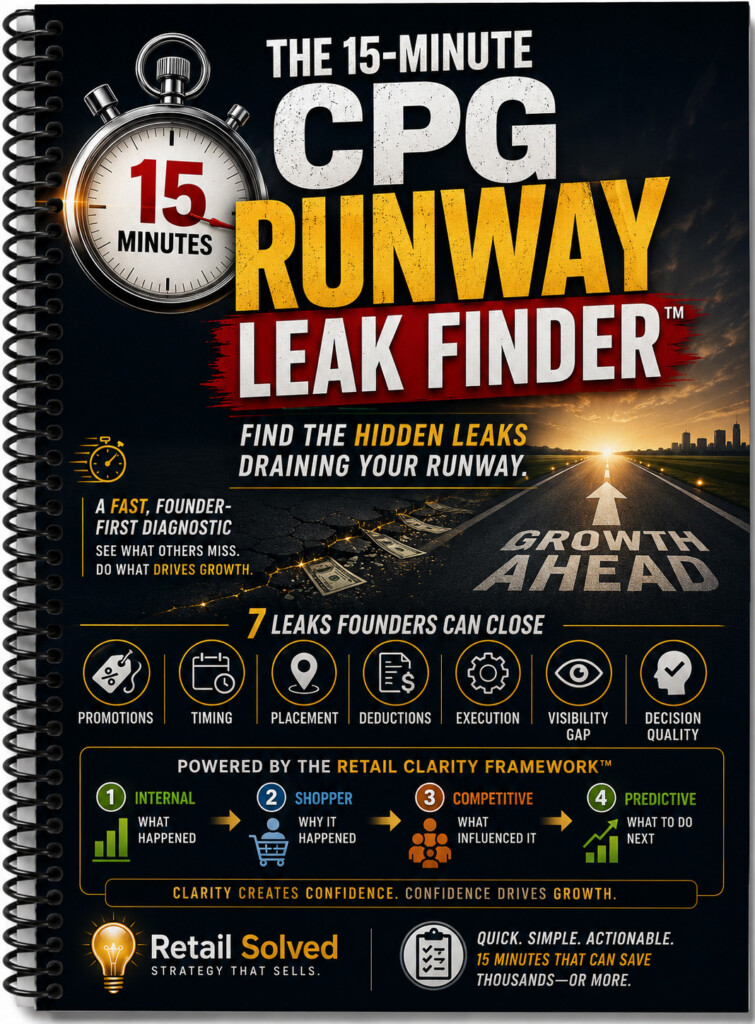
Start here: Find where your CPG brand is losing cash, margin, and runway.
In about 15 minutes, identify the leak creating the most pressure so you know where to look first.
No friction, no email required.
Retail Operating System™
The complete 11-module framework for protecting margin, optimizing trade spend, and scaling distribution with confidence.
Retailers run on systems.
Most brands run on hustle.
That gap is expensive.
The Retail Operating System™ is the only structured, data-driven retail growth framework built by a Certified Professional Strategic Advisor who has sat both in the founder seat and across the table from retailers.
It gives emerging CPG brands the same operational discipline, trade strategy, and category leverage that big brands use — simplified and systemized to protect margin, optimize trade spend, and extend runway while scaling distribution.
This is not education.
It’s infrastructure.
Image is the property of CMS4CPG LLC, distribution or reproduction is expressively prohibited.