Everything feels harder right now—costs are rising, demand is slowing, and margins are getting squeezed.
If you’re doing everything right but still not seeing predictable growth… you’re not alone.
Here’s the problem: most brands are making decisions based on data—but not understanding what’s actually driving performance.
In this episode, I break down:
- Why data alone is not enough
- The difference between data and insight
- Why promotions often hurt more than help
- Why forecasting is failing right now
- How to identify where you’re losing leverage
Because this isn’t a strategy problem.
It’s a clarity problem.
Listen where you get your podcast








Like what you’ve heard?
Please leave a review and comment on iTunes
Let me know your most pressing question, I’ll do my best to answer it on a future episode.
EPISODE 319 — Why Most Brands Struggle in This Economy (And What to Do Instead) Let me re-frame this Here’s the problem Here the Shift Here’s a real life example Here’s the problem Here’s Why Most Brands Misread Data Why Forecasting Fails Right Now Here’s the Framework Here’s how to apply this and make it actionable today 2. Execution 3. Visibility Lets bring this all together
Enter your name and email address below and I'll send you periodic brand building advice, tips and strategies.
Everything feels harder right now.
Costs are rising.
Demand is slowing.
Margins are getting squeezed from every direction.
And if you’re like most founders I talk to every week… it feels like you’re doing everything right—and still not getting the results you expected.
You’re working harder.
You’re spending smarter.
You’re paying closer attention to your numbers.
And yet…
Growth feels unpredictable.
And Margins are getting squeezed
So the question becomes:
“What am I missing?”
Let me explain.
We’re in a different kind of environment right now.
This isn’t just a normal cycle.
What’s happening is a shift:
shopper behavior is changing
retailers are getting more selective
competition is getting sharper
Costs are rising in unpredictable ways
and capital is tighter
Which means…
The strategies that worked before don’t always work the same way anymore.
And that creates pressure.
Pressure to:
make faster decisions
prove results quickly
justify every dollar you spend
So naturally, most brands respond the only way they know how.
They:
cut spend
double down on promotions
chase velocity
react to whatever the latest report says
And on the surface, that makes sense.
Because it feels like you’re “doing something.”
But here’s the problem—
That approach is reactive. Not strategic.
And in an unpredictable environment, reactive decisions don’t stabilize your business…
They amplify the volatility.
That confusion is expensive.
And that increases the longterm risk to your brand.
So let’s challenge the assumption.
Most brands think:
👉 “We need a better strategy”
👉 “We need more data”
👉 “We need to spend more efficiently”
But that’s not the real issue.
The real issue is clarity.
Because when you lack clarity:
you second-guess decisions
you chase the wrong opportunities
you misinterpret what’s actually happening
You become reactionary
Fear and doubt guide your decisions
And over time…
That creates inconsistency.
Now back to what actually drives predictable growth.
I recently worked with a snack brand that had a really interesting challenge.
On paper, they were doing everything right.
They had:
a strong product
a clear point of difference
early traction with both retailers and consumers
They had even validated demand.
People liked the product.
Retailers were interested.
So you would think the next step would be obvious.
Scale.
But that’s where things got complicated.
They started asking questions like:
Which flavor should we lead with?
What pack size should we prioritize?
How much should we produce?
Which retailers should we focus on first?
And every one of those decisions mattered.
Because getting it wrong doesn’t just slow growth…
It creates costly mistakes:
excess inventory, especially with perishable products
missed opportunities
poor shelf performance
damaged retailer confidence
So they did what most brands do.
They looked at their data.
Sales reports.
Velocity.
Early test results.
And they tried to use that to guide their decisions.
But here’s what they ran into—
The data didn’t tell them what to do next.
It told them what happened.
But not why it happened.
And without that…
They were guessing.
Let’s slow this down, because this is where the real insight is.
Data vs Insight
Data tells you:
what sold
when it sold
where it sold
But it does not tell you:
why shoppers chose it
what trade-offs they made
what alternatives they considered
What competitors were doing at the same time
what problem they were actually solving
And that distinction matters more than ever right now.
Because in a stable environment, patterns tend to repeat.
But in an unstable environment…
Behavior changes.
And if behavior changes, then historical data becomes less predictive.
Consider this—
If you run a promotion and see a lift, what do most brands assume?
👉 “The promotion worked.”
But what if:
those sales would have happened anyway?
shoppers just pulled forward demand?
or you trained them to only buy on deal?
Now ask yourself:
Was that growth… or was that subsidized sales?
This is the kind of clarity most brands are missing.
Forecasting breaks when:
assumptions are wrong
behavior shifts
context changes
Competitive threats increase
And right now, all four are happening at the same time.
So when brands rely purely on:
historical trends
internal reports
isolated metrics
They lose the ability to predict what happens next.
Which brings us back to the core issue.
This is exactly why I built the Retail Clarity Framework™.
Because without a structured way to think about this…
Everything feels random.
Let me break it down simply.
Step 1 — What happened
This is your data.
Important—but incomplete.
Step 2 — Why it happened
This is shopper behavior.
What problem were they solving?
What drove their decision?
Step 3 — What influenced it
This is your competitive and category context.
What else were they considering?
What changed around you?
Step 4 — What to do next
This is where strategy becomes clear.
Not reactive.
Not guesswork.
The reality is that
Most brands never get past step one.
And that’s why they feel stuck.
So how do you apply this?
You don’t start by doing more.
You start by identifying where you’re losing leverage.
1. Trade Spend
Ask yourself:
Are your promotions actually driving incremental growth…
Or are they just:
discounting existing demand
training shoppers to wait
compressing your margins
Being drowned out by competitors
Because if you don’t understand the why behind your performance…
You can’t optimize it.
Let me be direct here.
Retailers are not responsible for telling your story.
You are.
So if your product is:
in the wrong location
inconsistently merchandised
missing key visibility drivers
Then your performance will suffer…
Regardless of how good your product is.
This all differs by retailer and market
This is the big one.
Most brands assume:
👉 “If we’re on shelf, we’re available.”
But availability is not the same as visibility.
If shoppers don’t:
see you
understand you
recognize why you matter
They won’t choose you.
Even if they would have loved your product.
This is why I say:
Most brands don’t have a spend problem.
They have a visibility problem.
So when everything feels unpredictable…
It’s not because growth is impossible.
It’s because you’re trying to make decisions without full context.
You’re looking at:
partial data
incomplete signals
isolated outcomes
Instead of seeing the full picture.
And without that…
Everything feels like a guess.
Here’s The key takeaway
So here’s what I want you to take away from this.
If you want to grow in this environment:
You don’t need:
more data
more spend
more activity
You need clarity.
Clarity around:
what’s actually driving your performance
where you’re losing leverage
and what to do next
Because once you have that—
Everything changes:
decisions get easier
strategy gets sharper
growth becomes more predictable
Here’s Your next step:
Share this episode with a founder looking to cut through the noise and start growing sales
Connect with me on LinkedIn
👉 Download the free The 15-Minute Leak Finder in the show notes or at retailsolved.com/guide30. This will tell you exactly where to look for and close the leaks that are compressing your margin. This is something that literally every struggles with - even big brands.
👉 Or DM me “319” and I’ll send it to you directly
👉 Join the free workshop to go deeper - details in the guide and on my home page retailsolved.com
Because you don’t need more information.
You need a better lens to use it.
This is Dan Lohman and this is the bulletproof your cpg brand podcast
Sign up to receive email updates
FREE Trade Promotion ROI Calculator:
Click Here To Maximize Sales And Profits
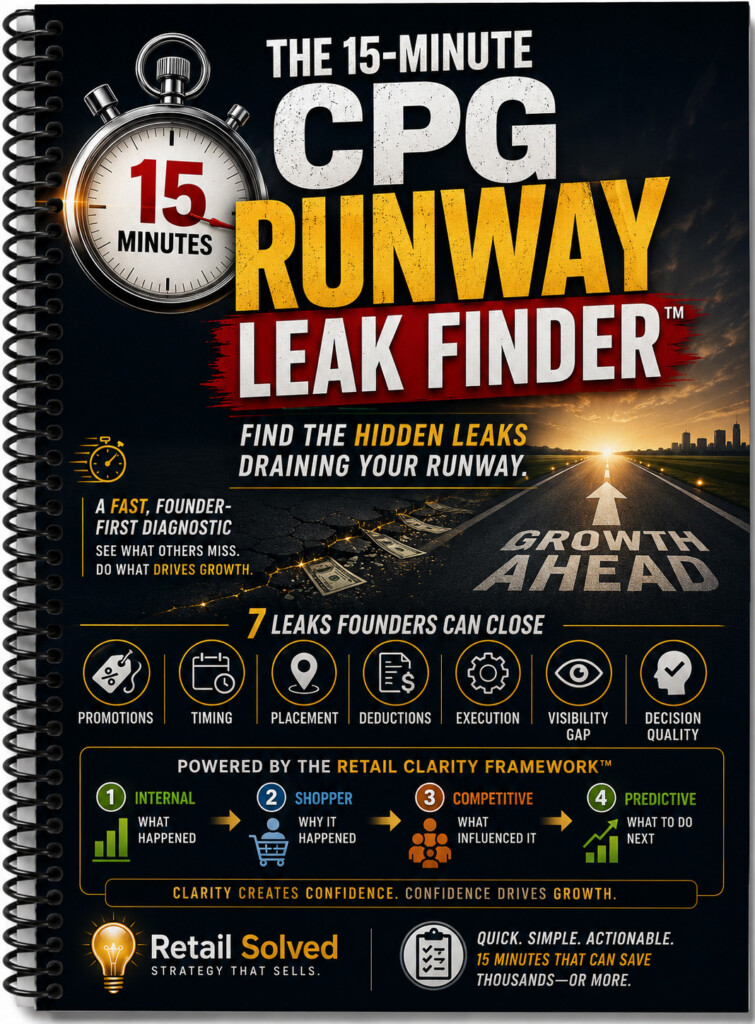
Start here: Find where your CPG brand is losing cash, margin, and runway.
In about 15 minutes, identify the leak creating the most pressure so you know where to look first.
No friction, no email required.
Retail Operating System™
The complete 11-module framework for protecting margin, optimizing trade spend, and scaling distribution with confidence.
Retailers run on systems.
Most brands run on hustle.
That gap is expensive.
The Retail Operating System™ is the only structured, data-driven retail growth framework built by a Certified Professional Strategic Advisor who has sat both in the founder seat and across the table from retailers.
It gives emerging CPG brands the same operational discipline, trade strategy, and category leverage that big brands use — simplified and systemized to protect margin, optimize trade spend, and extend runway while scaling distribution.
This is not education.
It’s infrastructure.
Image is the property of CMS4CPG LLC, distribution or reproduction is expressively prohibited.