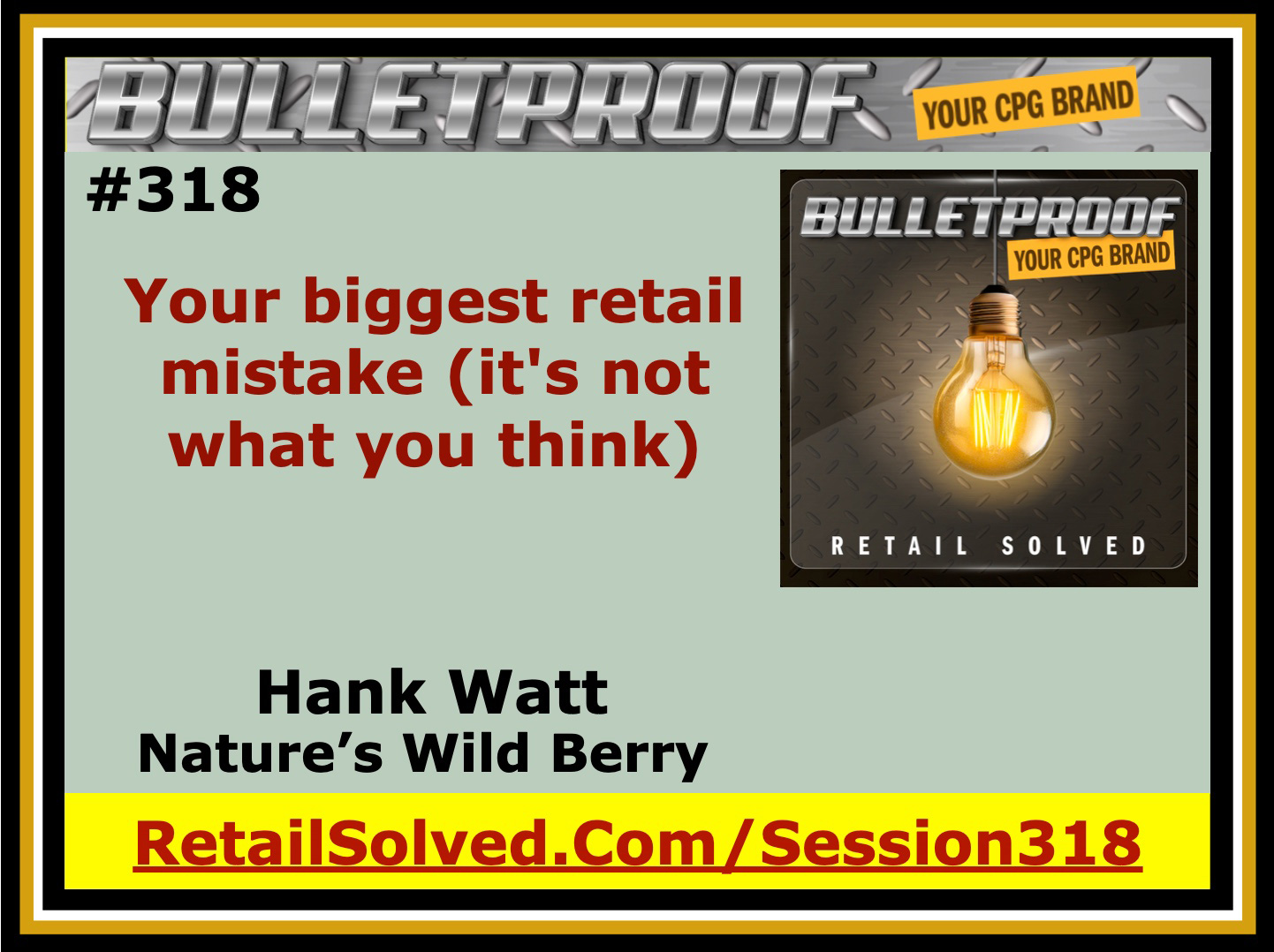
Your product isn’t failing because it’s bad—it’s failing because shoppers don’t understand it fast enough.
That gap is costing you sales, shelf space, and runway.
In this episode, I sit down with a founder whose product creates an instant “wow” reaction—but only when people experience it. That’s where most brands get stuck.
We break down:
• Why product market fit is more than “people like it”
• How shopper behavior determines repeat sales
• Why Amazon became the breakthrough channel
• The real role of demos, education, and positioning
• How to scale a product that doesn’t explain itself
This is a masterclass in turning curiosity into conversion—and experience into repeat purchase.
If your product isn’t moving, this episode will show you why.
Listen where you get your podcast








Like what you’ve heard?
Please leave a review and comment on iTunes
Let me know your most pressing question, I’ll do my best to answer it on a future episode.
Shark Tank happened because I was, uh, I
Enter your name and email address below and I'll send you periodic brand building advice, tips and strategies.
didn't want my application to get lost amidst the
40,000 applicants.
So I just DM'd them and said, yeah, no special treatment.
Just want to make sure that my application was received,
and in 2 weeks, we got the call to be, um, a guest on the show.
And, you know, they, they end every conversation with,
you know, the next step is not guaranteed
you made it this far and congratulations, but, you know,
there's no guarantees of moving after, after this step.
Um, and so you get used to hearing that, but
it was about a year process from the time that we applied to
the time that we aired.
Are you ready to hear more?
Welcome to the bulletproof your CBG brand podcast,
where we discuss tactics and strategies that you need
to give your brand the unfair competitive advantage it deserves.
Hello, I'm Dan Loman.
Be certain to comment and subscribe to get immediate access
to new brand building episodes.
Please recommend this to friends and colleagues and
help me raise the bar in natural.
Let me know what your most pressing issues are, and
I'll do my best to address them on future episodes.
There's a free downloadable guide at the end of every episode to
help you go deeper into the topics we discussed.
Now, let's roll up our sleeves and get started.
Hank, thanks for coming on today.
Can you please tell me a little bit about yourself and your journey to where you're at?
I also want to hear you talk about how you found
this product and how your friend introduced it to you.
But before we go any further into your story.
I want to frame this for founders.
Hank's journey is not just a Shark Tank story.
It's a story about founder fit, product market fit,
resilient, and building a brand around experience.
That matters because most products do
not win because they're interesting.
They win because shoppers understand them, experience
them, and come back.
Yeah, absolutely.
Before I thought that I was
going to be good at marketing miracle berries to the
whole country, I was in retail,
and I did sales, and I worked with food as a food server,
so I got to see how restaurants worked, and I learned
a lot about communication and timing, and this
is where I really became a people pleaser type of person.
And uh, I would actually get so good after
10, 11 years.
I would take the menu away from a couple or anyone
who's dining at my fine dining establishment and kind of take the pressure off of them.
And, um, I would give them the choice,
uh, going down the list, just having memorize the
entire menu and knowing everything that's really good or
in season, things like that.
And, um, let them know like, and if there's anything
that I miss, that I think that's
going to be great, that wasn't great for you, and it just kind of missed
the bucket, I'm going to buy it myself.
So I'm going to take it off the tab.
And that would give them a lot of confidence and trust in me.
And they would come back and ask for me constantly because they
knew that, um, I would give them an experience, not
just something like a night, um, in
the restaurant, but a night to remember.
And so, um, I kind of took that with me into
retail after 11 years of uh,
working in, um, like places like cheesecake factory
and claim jumper and and fine dining.
I started a business with cell phones.
And so I would help people, um, see
the value in, in what they were getting and
versus what they were paying.
And we, it actually surprised me because
I didn't think I would enjoy that job, but I enjoyed it so
much that we started a business out of it, and that was my 1st, um,
uh, experience being a founder.
And I got to work with my 2 best friends at the time, and
we called it MobileCom.
And we grew so fast.
Um, it was, it shocked me.
We grew to about 16 stores in 18 months,
and I was in charge of doing all the hiring and the
training and the recruiting, and, um, and
we were very, uh, successful.
What I didn't foresee is the 08 uh
crash that happened and um, Sprint,
who was our carrier that was paying so much at the time,
told um, everybody that if you didn't have 30 locations
that um, they were going to need to cut the commissions in half.
And this is where I learned a very
valuable, a lot of lessons, but the most valuable takeaway was,
if you don't own the product that you're selling, then you're
completely at the mercy of another company.
or the market or something like that.
And so also, if you, if you, um,
you know, we probably were at over a 100 employees at the time.
You know, good, that large, you cannot sustain
a 50% revenue cut,
like you, like, if you need to, um, Experience
50% revenue cut.
You better be pretty lean because a lot of people are depending on you for payroll.
And uh, we were lucky that we were able to sell all
of our locations within 2 weeks, but, um,
that opportunity taught me a lot and it allowed me to move out to
California where I've been since 08.
And, um, Here
is actually, you know, when you talk about having
something that you feel like cannot ever lead to something good.
Like I was just kind of crippled by all the effort
that I put in, um, and having to sell within 2 weeks.
Hank, let me pause you right there because
there's a lesson every founder needs to hear.
You learn very early on that if you don't control
the product, you don't control the business.
That applies in retail too.
If you do not control the story, the execution,
and the shopper experience, then someone else is deciding your outcome.
Um, I looked back and thought, well,
if that didn't happen, I would have never moved to California, I would have
never met my best friend, uh, Giuliano.
Um, and we would have never had this what
I call my calling with nature's wild berry.
And it turns out that, um, because I had all this restaurant experience,
I was kind of a snob when it came to,
uh, food, and he had this really amazing restaurant
in the heart of downtown Santa Monica.
They also had another location in West Hollywood and
they started out in the Bay Area.
So they had 3 locations and they served raw food.
And they attracted a lot of the raw vegans.
And Giuliano's restaurant called Planet Raw,
served raw honey on every dessert.
And if you've ever been in the food world, especially
restaurants and you've got something on the menu that's never selling,
you know that you're losing a lot of money.
And um, for years,
he did not have a good substitute for his desserts.
And he's just losing money over these things.
The funny thing about Giuliano, is that
his favorite flavor is bitter.
And his 2nd favorite flavor is sour.
And I read, I looked up the statistics on this,
and 4% of Americans claimed that bitter is
their favorite flavor, only 4 and 5% say
that their favorite flavor is sour.
So like, in my mind, like he's like this top 10
super taster, but he could not pick out what's
a good dessert for the life of them.
He's just got the worst taste in sweets.
And um, I identify with the 55%
of Americans that say that uh, sweet is their favorite flavor
and um, 35% of Americans to
say that, like, savory mommy is their 2nd favorite flavor.
So, that's where I came in and he was like, would you help me
design this dessert menu?
And I said, uh, say less, like I'm
31 years old, and uh, I will definitely help you
design your next dessert menu.
And he said, well, I'm going to use these berries.
They're called miracle berries.
They're kind of magic, and I thought magic berries.
I, I call BS on this because at 31,
you tend to know like the entire world, like you have everything figured out.
And I thought if there were berries that were like jack
in the beanstalk beans, I would have heard about them by now.
And he said, no, really, uh, just give it a
shot, like, you know, humor me.
And, um, with all my skepticism, I went in,
and in 30 seconds flat, I was
proven wrong by this miracle Barry.
And I didn't come up with the name.
It that had been called miracle berries for uh,
decades and decades.
They're native to West Africa in Ghana,
and when you study like world history, back
in the day, you learned like in Pangea times,
West Africa Ghana shared a border with Miami, Florida.
And so um, they have the same type of soils,
the same type of climate.
And when the miracle berries came over to America in
the early 1900s, they grew like weeds in
Miami just because the plant took really well to it.
And it turns out that the largest farmer in
the Western Hemisphere was supplying Giuliano,
which became my supplier.
Um, and, uh, these miracle
berries ended up transforming my life.
So, for the 1st time, I could eat something
that was healthy, like a green juice.
That's how I got hooked.
I had green juice that had dandelions that were,
you know, before the berry, I couldn't eat just because they're so bitter.
Um, but they are very, very healthy.
And so I would have dandelions and celery.
Forget about it, but um, cucumber and
lemon, for example, and then on the berry,
as I put it, that would taste like a green jolly rancher candy.
And longer the short, it's too late.
But the longer the short is that, um, I was improving
my dietary habits, but tasting
candy instead of tasting the health part.
And in a place like LA, um,
people notice when you start looking and acting healthier
and they would all ask, what, what is this uh,
secret that you've got?
And I would be like, oh, you're not going to believe me.
I won't don't get me started.
And they were like, no, really, what is your secret?
And then I would give them a frozen miracle berry.
And uh, completely blow them away.
Like you know, everyone's reaction is very,
very similar.
By the way, I'm going to be eating
a lot of cough drops here.
So I'm not sure that this is going to be the best experiment for the
berries, but I have tried them before.
For anyone listening,
We are going to do something a little different.
Hank sent me the product before the interview.
I'm going to try it during the conversation.
This matters because this is an experience your product.
You can talk about it all day, but the real proof
happens when someone actually experiences it.
Actually,
Actually, um, I think that it would be.
Because, um, this
is basically like astronaut food.
And when you go
in space, I've heard it's a lot like eating
with a cold, because all the blood rushes
to your extremities, and no one can taste.
And so literally, they'll put hot sauce on everything,
just to taste anything.
And yeah, and so my,
um, one of my goals, long term goals is
to, because you can't put powders in space, but you
can put berries.
Um, yeah, pretty excited that, uh, I
actually think that we're going to have something to do with,
um, improving cloi life.
But anyway, since you have a cold or whatever.
It's kind of going to be like, you know, you're an astronaut,
and this is kind of, maybe like the
flavor enhancing will do a lot more to like
make you haste better.
I don't know.
It's...
No, I got the cough top of my mouth.
It's an experiment.
It's, let's just, you know, I'm,
I'm totally down to try.
I would like to capture it on the podcast
just so that other people can see like, holy.
This is freaking, the last thing that I expected for
this to do is to work and it actually freaking works.
But, Honestly, if you don't, if you want to
skip the podcast and you want to do it right now, I couldn't care
less, um, because.
We're recording.
Oh, we're recording.
Okay, okay.
So I've already got the cough out my mouth.
If I need it now, is that okay?
Yeah, absolutely.
Let's try it.
Let's try it
Normally, we say start with a clear palate, but I want to try.
I'm so interested in new things.
Like experimenting has become like this daily
routine, this daily habit.
So, uh, I'm very, I'm I've become a very curious person.
But the whole goal is to take the berry and
um, let it coat your entire tongue.
And since you've done it before, um, you've graduated.
But any new person, I always recommend
taking 2 pieces.
That way you don't miss out on the 1st experience,
and you learn how the berry works because it's going
to be light and airy, kind of like popcorn.
And most people are not familiar with freeze dried foods.
So, um, just breeze dried in itself as
a novelty, and then you add this next layer of being a,
like, I call it an anti-additive because every
sweetener you put in your drink or in your food,
and, uh, this, you don't do that.
You keep your food and your drink separate
and you let the berry coat your tongue.
And so it has to be 30 seconds.
I'm taking this moment to just kind of jabble, you know, gabble away.
But I think it's been a close to 30 seconds.
I don't want to rush it.
I'm kind of excited though.
So sometimes.
There's a difference.
There is absolutely different.
I am, let me frame this.
I am so sick and tired of eating all the cough drops because of my, I'm
trying to get rid of this thing since the last time we talked.
But, yeah, it
doesn't taste disgusting icky.
So no, I'm thrilled.
you know the way it used to.
It's made a difference.
Cool.
I have my lemon juice right here.
All right, let's give it a shot.
So it's just lemon and water?
Straight lemon.
Oh, just lemon.
and I like lemon juice, but no, this tastes very different.
Awesome, awesome.
Yeah, I like to add a little bit of water because I'm
a huge lemonade geek and um,
the more water you add, dilutes it, the more lemon
juice, ratio to water, the sweeter it'll be.
So you can leave out all the artificial sweeteners,
all the sugars, all the added stuff, and just go with straight mother
nature, lemon juice, and water.
And, um, same thing, if you substitute
the water for unsweetened iced tea.
Or, um,
Any, any, uh,
anything that's unsweetened, um, you can experiment with that too.
So thank you, Dan.
This was a great way you completely caught me by surprise.
I was not expecting us to lead off
with that, but what a cool, what a cool experience.
Yeah, actually it worked out really well.
In fact, actually, I was telling you that we tried it before.
And um, I like it.
I mean, it's it's, I'm impressed.
Now, as a connoisseur, no right or wrong, obviously.
I'm just curious.
Foodie to foodie.
Have you tasted something that reminds, um, before
that the berry reminds you of?
Actually, a fresh pomegranate.
Yeah.
Yeah, yeah, yeah.
Because when I 1st bite into a pomegranate,
kind of has that hang to it, and then it
gets sweeter by the 2nd somehow.
Um, If you love pomegranates,
try the pomegranate on the berry, it is going to blow you away.
It's whole new way.
And on that note, the difference between a pomegranate that you go to the store versus
a fresh one organic?
Oh, night and day difference.
But that's that's what it reminds me of.
An organic pomegranate that just got picked.
Exactly.
And a lot of people, because, you know, the lemon is the classic thing
to go to when you try the miracle barrier out and you
want to prove that it works, a lot of people will have the
lemon juice out of the bottle.
The problem with these berries at the time was
that they're so darn perishable.
Like you pick it off the bush, um, and you put it on the counter
and within about 2 hours, the magic that's held within the pulp.
It's a glycoprotein that grows, um, occurs naturally,
and, um, it's called miraculous.
Well, that miraculous withers away and doesn't
work after about 2 hours just sitting on a tabletop.
And it takes a little less than 2 days to wither
in the refrigerator and less than 2 weeks in the freezer.
And so I'm having to have overnight
shipping, which only works Monday through Thursday.
You can't order it on Friday and it has
to come all the way from Miami and it has to have dry ice.
And all of this adds to the cost of the berries.
And so it was getting to be about $10 on
average per berry.
Which um, for me, you know, was
the only thing that made healthy things taste good.
And so if I'm like saying I'm going to have $10 to this juice,
I'm going to have to, you know, make this juice at home.
I can save money there and cost me about $7 for a liter.
And so it'd be about $17 total,
which I justified like if I had a leader at Whole
Foods or just, for example, that would be 15, but I know that I'm
getting, having this be organic and I'm making it
myself and it's actually tasting much, much
better than anything I could buy in the store.
And so that's kind of how I justified it in my mind.
But, um, if I, instead of, instead
of, if I bought 100 instead of 50 at a time, then
the price would get closer to about $7 per berry.
And um, the only problem was that um, I was wasting
berries, some of them would go bad in the freezer.
And so I didn't like wasting food.
Uh, so it was between 7 and $10.
And, um, I knew that there had to
be a better way, but I did not want to be the person to solve this.
I did not want to be the food industry person.
I thought, you know, I can't compete with Pepsi
or Coke or Monolies or anybody in the food world,
and there are professionals that definitely know about this miracle, Barry.
So they're going to be the ones to take it over
and after 3 years.
Uh, no one did.
And so that's, I'm going to stop now, but that's how Giuliano
and I kind of looked at each other and thought, you know, this
might be our calling.
I want to connect this to something.
Every founder Russell's product market fit is
not just whether people like your product.
It's whether the product solves a real problem.
In a way, people understand.
Repeat and share.
That is the part most founders underestimate.
That's interesting.
So let me back up a bit.
When I watch you on Shark Tank, we'll talk about that in a minute.
You talked about how, because of the berries, you're
able to retrain yourself to eat good food.
Please share how it helped you lose a lot of weight.
So let's talk about that transformation.
And the reason I want to talk about that is because
you've already hinted at this, how did that come about?
You gave Julian credit for finding it on Shark Tank,
but did he just recommend it?
How did you end up trying it?
Um, you know, it was actually more of
me wanting to avoid diabetes.
I got diagnosed as pre-diabetic, and
I did not want to live the rest of my life
or even a part portion of my
life, um, with type 2.
And, um, the weight actually became a byproduct
of me just wanting to put, um, these
macro micronutrients into my body.
It was actually, And I
got inspired like my entire life.
uh, through movies.
And I saw this documentary called Fat Sick and Nearly Dead.
And, um, I don't
think that I remember seeing a documentary that has made me,
like, kind of cry, but it spoke to me in
a way because, um, you
know, this, this guy was a CEO of a company and
he was, like, the title suggest, uh,
overweight, obese, and very sick because of
it, and uh, so sick that he uh, nearly died.
And so, um, he kind of learned about this
macro micro nutrient through his journey
with juice fasting.
And I was never that brave to juice fast,
but it did kind of teach me like,
you know, I need these macro micronutrients.
I am eating just because of taste.
So if it's fried, I'm in, if it's breaded,
I'm in, you know, you know, I was kind of happy
and bragged a little bit that I never ate a salad.
You know what I mean?
Like, I was the guy that rebelled against his mom, who
has her masters in nutrition, and, you know, taught
me how to eat healthy and stuff like that.
And so, um, and then, uh,
after watching it, I bought a Braveville juicer, I think, just like
everybody else, uh, who watched the documentary, and it
sat there for months not being used.
And, um, And
the problem with this juicing business is that if it
doesn't taste great, you're not going to repeat the process.
So usually the green juices have some
sort of apple pineapple pear agave honey.
These are the type of things that, you know, sweeten it up and make you
want to come back for more, unless you're like Giuliano or
somebody else that just really loves that tart, sour, bitter flavor.
And that just couldn't work for me.
I could, you know, like, maybe it could if I tortured myself
for a month and month and a half or two.
Like, you know, there are ways that you can change your taste palate.
Um, but going through that.
Just always, I never wanted
to go through that because it was a little bit too close to torture.
And so um, but the berries,
as soon as Giuliano gave me this berry, I thought, dang,
what else can I use this for?
So, I started experimenting with concoctions
like, you know, um, the stuff that you
would see in those little bottles, like the apple cider vinegar,
cocktails or, you know, the ginger or
the, you know, blah, blah, blah, fill in the blank, and that
actually started tasting really freaking good.
And so I would make those for myself.
And then a little bit later on, I thought, what could I,
you know, do for salads.
And so I would go to these, you know, um, salad
places and get like a big old bowl of salad like this.
And if I felt like eating a ton, I would just binge eat on
a salad and, um, you know, make just make sure that
the dressing was a healthy, you know, dressing and,
um, you know, fill up on a dang salad.
Um, so these are the type of things that uh, ended
up, you know, helping me reverse
this pre-diabetic condition um, that I was in.
And, um, I just started,
I just started losing weight.
That's important because so many founders get criticized
for solving a problem.
They'll look simple from the outside.
But the real problem is never just a product.
It's the behavior behind it.
If a product helps someone make a better choice consistently.
That can be incredibly powerful.
Yeah, I got a lot of backlash for this Shark
Tank episode because I was telling people that I
identify with those people that, um, are
emotional eaters and, you know, there's a, it's called binge
eating, uh, disorder where you're just sometimes,
sometimes discipline doesn't work for you.
And it's, uh, like about
80% of the time, you can be super disciplined, and
you can say, you know, I'm not going to have that, and,
you know, you're, that's exactly what you need for that day.
But when the cravings
really hit like the 20% of the time that you
give in to them, um, the berries there for,
uh, me to kind of use to my benefit, it's like
a tool in the toolbox that it's like, okay, if I really need something
sweet at midnight, I'm gonna have this tart cherry
juice or, you know, this unsweetened cranberry juice
or something and it will taste so freaking
sweet that it'll satisfy that craving.
Um, and uh, you know, have other benefits too.
So, that's, uh, that's the why behind
it and the how.
And, uh, and then, thank God
I just had the right, who, which was Giuliano,
because, um, I knew I couldn't do this by
myself, Dan.
I, I have so much respect for founders who are solo
founders, but, um, this is not something that
I, couldn't be talking with you today.
Definitely would have, uh, nose dived and
bombed in in the 1st couple of years if I had attempted this without
Giuliano.
And I shared that, you know, I put in 125,
which was my life savings and um, inheritance.
And, uh, Giuliano put in 25,
but we were 5050 partners, and I get asked about that a lot.
But it wouldn't have worked if I
gave Giuliano less than half.
I mean, forget about it.
Like, I didn't give it to him.
1st of all, he earned the whole freaking half.
For sure.
Like, you know, even, to this day,
we talk every single day about, you
know, what we're doing and, um, you know, how, you know, the
progress of that, and we're making decisions together every single day.
So, um, being able to go to bed
at night trusting in your partner that, you know, he's making
the right decisions and has your back on everything, uh,
is something that money can't buy.
So it's, I know how privileged I am and I never
take a day for granted that I get to work with my best friend.
Well, that's fantastic.
I mean, most people would be, I would that you're lucky to be able to do that.
And by the way, so I'm sorry that people shamed you because
I hate it when they do that because, you know, a
lot of people, things, different things work for different people.
And a lot of people have been struggling to lose weight.
I know I did.
I used to be Joe Athlete.
Bad divorce, whole different story, but
I gained a lot of weight, and I was struggling to lose it for a long time.
Finally figured it out.
But my point is, Different things
work for different people, but I remember talking to people.
was like, well, just eat less.
I was like, God, I wish I would have thought of that.
I'm just... just control what you put in your mouth.
Yeah, I was like, hey, I eat healthier than you do.
I eat organ, you know, that kind of stuff.
And when I was an athlete, I thought the exact
same way, but you know, you're younger and the
human condition is to kind of need to experience it before you understand.
And the same thing goes with the berry too,
because talking about it just doesn't know justice.
Um, you know, I could talk to them blue in the face, but
people can't really wrap their minds around how it
works or what it's for, all of that stuff
until they actually experience it for themselves.
And um, for that reason.
I knew that we did not need to take investment right away.
This was going to be a long commitment on my part.
And I gave myself 20 years, um, because I
needed to know that I had founder fit and that the product had
market fit and, um, you know, Giuliano
and I both were able to, you know, kind
of transform our relationship from being best friends to being co-founders.
And um, all this, all this stuff needed to be proven out.
And I gave it 5 years and the pandemic,
um, turned it into 6 with, uh, with Shark Tank being
our investors and everyone asked me, like, how helpful are they?
And just today, you know, I'm on the phone with Mark Cuban's
team and Lori is so just a total delight.
And, you know, they are very engaged.
And I think a lot of it has to do with how we structured our deal,
but we can get into that later.
Um, but I knew that this wasn't going to be something that,
you know, we can just light money on fire and and
have the whole country get swept away, uh,
you know, throw it in every Starbucks or whatever.
This was going to have to be person to person, like,
literally, like, influencer,
if, you know, fan base.
Shark Tank has helped out tremendously.
I estimate that we've probably had 1000000 viewers
just with all the re-airs that we've had on Shark Tank.
Um, but still to this day, 5000000
views on social media.
Ask a 100 people if
they know about nature's wild barrier, if they've
ever had a miracle bury, and still to this day, 99 will say,
what are you talking about?
So this is day one.
For me, I get to wake up very excited, um, on
the strategy, and I know that we're on the ground floor.
And um, I feel like, you know, we're halfway
through in June.
Um, we'll have hit our 10 year anniversary and
um, you know, if you're keeping track at home, that means I've
got 10 more years at least.
But I think it'll probably take, you know, more longer than that.
And I know that I'm comparing ourselves
to, you know, the greats.
I'm trying to, you know, I'm not trying to like put that out there publicly,
but I'm comparing it in my mind.
I wanna be around.
Uh, you know, way longer than I am.
You know, I want this company to be around in its 75th year or it's
125th year, 150th year.
So that's kind of what I'm building too.
And I, you know, I'm encouraged because the
effect works on everybody.
You just have to, you know, all the instructions are do it right.
Like you can't imagine, um, it being a
tablet and you suck in it through the skin.
Like that doesn't let it work.
It has the pull has to get to your tongue.
And I've done, you know, countless demos and
I've told people like next to them.
I've said, okay, we're gonna do this for 30 seconds and then they swallow after five.
You know, it's like, you really have to let, you can't rush that part.
But if you do those things, um, then it'll work on you.
And um, we're just driven by taste.
And I think that the value is the value proposition is there.
That if you, well, if you want to have health,
like the prob, the enemy is to how healthy things just taste.
That's the enemy.
You know, it's not a brand.
It's not a group of people.
It's just a healthy food.
We've kind of, lived in a
culture where we've made, taste
king, and we can't help that anymore, and
it's just a kind of accepted fact that
the worst stuff, things are
for you, the better they take.
And so, um, in the 1st
few years, my thing was just all about making
healthy foods taste better, but I learned a valuable
lesson like about halfway through, which
is that if people can't wrap their minds around the
berry, and they have to try it first.
Don't lead with like making the unpleasant
thing taste better because they can't understand that.
Um, now we started leading
with, we're gonna make that thing that you can't believe
taste better, taste even better.
Like, that's a little bit easier for them
to, like, imagine because, um, if
you start talking about how bad things taste.
I think you've turned off half or more of the people right out of the gate.
But if you start talking about like their favorite foods,
then they'll stick around and listen.
So um, that's kind of the different positioning.
Uh, but I learned that during Shark
Tank, um, times and um, I'm
so happy that I get to work with these award-winning chefs
and chefs that aren't even award-winning, you know, but they just are
so committed and dedicated to their work.
And um, they don't think in the way
that you would expect people to think.
Which is they don't feel like the
Barry makes them less of a chef because
they are very, um, confident
in their abilities to make food taste delicious.
What they view the berry as it's more of
like a condiment, more of like, well, you cook with butter.
And you use spices.
And, you know, like, I kind of, to
simplify it, I think of, we live in a world of
hot dogs and hamburgers, but no ketchup,
and I'm trying to introduce ketchup to everybody.
Well, think about how many more hot dogs and hamburgers
we could sell now that we have ketchup.
There's so much here that I'd like to unpack.
Let's share from the personal transformation to the business.
You had something people reacted to immediately, but
that does not automatically mean you have a scalable product.
This is where founder discipline matters.
How did you know that this was a business and not just a cool experience.
Please talk about that process.
Well, I'm working
as a um, manager at this sprint store
um, in the middle of West LA and Brentwood.
And it gives me an access to an
unlimited number of people walking in my door.
So usually when you're
getting your cell phone upgraded or switching plans or whatever.
It's like an hour or 2 process.
But I started giving people the
option of trying this berry because I would have this bleeder of
green juice out on the counter as I'm going through my day
and they're like, what are you drinking?
I'm like, I'm drinking my green juice.
Oh, and they're like, gross.
And I'm like, actually, it tastes like a jolly rancher candy.
And they're like, no way.
And I'm like, and next to me was a Jersey
Mike's that always had its citrus next to the,
you know, the fountain drinks.
And so, you know, I had, they would be very happy to give
me some lemons and so I'd go next door and give them the
Barry demo with the citrus and then blow their minds away.
And, um, I noticed that it happened on every single
person, every single person, um,
and then they would bring in friends who have never tried it
before, and then, I, you know, this is how I'm not wasting my
frozen berries.
And, uh, It's so predictable
and they would all say the same thing, like very encouraging
feedback, like, please make this a thing.
Um, so I did that for about 3 years,
and I set up the Google alerts to find out if anyone
was working with this miracle, Barry, this miracle fruit, um, and no one would.
I think that they, uh, looked at it as
a huge liability, like, uh, if they
were to go into this miracle berry, um, world,
this universe, um, you know, they're looking at decades
of, or, you know, 100s of 1000000s
of dollars of uh, education.
And a lot of people don't want to take that time,
um, because something needs to sell itself on
the shelf within like, what, 2 seconds, 3 seconds,
if you're lucky you have that time.
And, um, I looked
at it as instead of a liability.
I looked it as an opportunity because I can
talk for a long time.
I like talking about things that are,
you know, impressive and um, novel and
things, especially things that have transformed my life that
I have personal experience with.
And so these 2 hour conversations,
usually about phones and plans, ended up being like
30 minutes, they would pick the phone and a picket plan real fast, and
as I'm setting up the activation and swapping over info
from one phone to another.
They're asking me questions about the bear age.
I was like, you know, talking about the berry for over an
hour, hour and a half with these people, um, and my
bosses, the districts and the regionals and the owners of the company.
When I put in my 2 weeks notice, they were like, no, no, no, no, no.
Did I give you your last day?
Go run and chase your dream with the business.
Uh, you don't need to work here for
your 2 weeks because, um, you know, they had heard
this spiel so often and they knew that I was onto something.
And, um, we did not know that I, I couldn't
put in my 2 weeks until I knew we had a product.
And the farmer told us that um,
this was not a new concept of trying to preserve the berry,
that it had been failed um, for over 3 decades.
People had tried and failed.
And, um, he wasn't going to discourage
us and say, no, don't, don't do it if you're using my
berries, but he wasn't going to encourage us either.
He wanted us to remember that it was going to be a waste of time and money.
And, um, you know, timing
is such a funny thing because if I had tried to rush
this right away, um, you
know, people often ask you like, what's the regret or what would you do differently?
And in the beginning, I thought, you know, it would be
great if I didn't wait 3 years to start the company
because I'd be 3 years ahead, you know, and, you know,
how, you know, what does that mean in terms of revenue and blah, blah, blah.
But the year that we started was the year
that Harvest Wright made its 1st affordable
home freeze dryer.
And so freeze dryers are very, very expensive traditionally.
They're, you know, in the high to, you know,
um, about 10s of 1000s or uh,
low 100s of 1000s of dollars.
And we didn't have that kind of money to experiment.
Um, we knew that it would take a long time to
experiment because, you know, with so many people trying and
failing, like, obviously, if it was easy, it would have been done by now.
Um, but few things happened
to work in our favor, that I couldn't predict, harvest
strike making its uh, freeze dryer affordable like 3000.
I can afford $3000 for a freeze dryer.
Um, but it was still too kind too big for my apartment.
Um, and these things are not, they're they're loud.
So like when people call it a home freeze dryer.
It's like, yeah, but you have to kind of like keep it away
from your family because these things are much louder
than a washing machine.
Um, and they take 30 plus hours to to run a cycle.
So I knew I needed to put it somewhere.
And, um, being in this restaurant
scene so connected to Giuliano in his
restaurant world, and um, having friends in
the restaurant, seeing other food servers, um, friends of mine.
I got introduced to the owner
of sliced truck pizza, a very popular
pizza place in West LA, and I pitched
him on the idea after giving him a demo, and he was just floored
by it, just loved, loved the experience, and
I asked him, you know, would you let us use your
restaurant after you close to do our experiments
with the freeze dryer.
And he said, you know, funny thing about our business model,
uh, being a pizza place is that we wait for everybody else
to close, and that's when we make our money, like we make all our
money at night, and uh, but he said, I
do have ownership of the place next door.
And um, it's vacant right now.
So if you make me an offer, I will, uh,
you know, consider that and you can put your freeze dry in there.
And just, because I didn't know what to say,
I just threw something out and I was like, how about 250 a month?
We could afford that.
And he said, you know, if you write me a check for
$750, you can have it for the next 3 months.
And that was such a blessing, Dan,
we were able to move it in there and start testing right away.
And um, that's all Giuliano and I did.
All we did was, you know, stay on the phone with harvest right,
uh, making sure that we knew how to tweak and, you
know, fix sometimes we would break the machine and they would
need to teach us how to fix it over the phone.
Um, and, you know, the settings, there's a,
there's almost a countless number of ways you could run a freeze dryer.
So, um, you know, we we tried out a lot of settings.
And I remember the 1st time that we got it
to work after, um, very close to 3 months.
I was like, holy Schnike's Tommy boy, we have a product.
We have something that, you know, we didn't have to,
um, worry because it
was consistently working.
And, um, We were still
getting berries flown out overnighted from
the farm in Miami.
And we, the hypothesis was
that if we moved the freeze dryer to Miami within 2
hours of it being picked, we could get that fresh berry into
the freeze dryer.
And that would give us like a closer,
um, product to peak pot
And, uh, That's what it
became, it became something we didn't have to use any, you know, chemical
free preservation.
At peak potency, and our farmer, you
know, was absolutely floored, that we were able to kind of
crack the code.
And I remember that 1st flight out to Miami.
Uh, we stayed there like 10
days and we brought back, you know, a lot of product.
We brought back a lot of berries.
It was a funny experience, but, um,
Yeah, that was the 1st time that I knew that we had
something very special.
Could not sell it for the life of us.
We took it to every single restaurant around.
And, um, we learned a lot of valuable
lessons there about not, not bragging
that you're the 1st people don't like taking
extra risk than they have to.
Their business is already risky enough.
Um, you know, if you wanted to be 1st to anything, focus on
being 1st to mind because you are the best at what you're doing.
Um, and I had to learn that the
hard way for like 6 or 7 months.
We couldn't make a sale.
And then we figured out Amazon.
I remember our 1st sale on Amazon like it was yesterday.
It was March 23rd, 2017.
And uh, I was like, wow, we have a
customer here um, built in, and if it wasn't
for Amazon, have to give credit where credit is due.
Um, you know, obviously no system
is perfect, but there's absolutely no way nature's wild
dairy would be alive today if it wasn't for Amazon, the
way, um, the way the market was in 2017 and since.
So, um, yeah, they are
still our number one channel.
Uh, target has become number 2 uh, only recently.
And then, um, you know, Walmart marketplace
is picking up.
It's competing with our Shopify store.
So we've gotten to be, um, kind
of successful across marketplaces.
We're on places that you wouldn't expect us as a
gift option, like even party favors.
Um, but, um, We
have the best product for a fulfillment center.
And, um, that's kind of what I'm most, I geek out the
most right now that, uh, we have 5 fulfillment centers
that allow us to have a sub 2 day, um,
transit time for delivery.
So we've kind of, you know, it took us 10 years to
do it, but we have this kind of like prime-esque,
like delivery in 2 days or less, um,
because, uh, the product is perfect for ambient, um,
storage.
We don't have to have a cold chain.
It's small and it's very lightweight.
And so the economics of transportation
just work out really well for us.
And we can do this drop shipping thing that a lot
of these marketplaces love to do.
And um, they love that, you know, it's not any
longer than 2 days and our customers freaking come back
and order when they realize, oh, I could get it next
day or or about 2 days and not have
to pay like a lot on chipping.
Hank, this is a powerful point.
Sometimes the 1st real channel tells you what the business wants to become.
You are trying restaurants, but Amazon revealed
where people were already searching, already curious, and already willing to buy.
That's a lesson every founder should pay attention to.
So, how long did it take you to get to that point where,
like you said, you had a business on Amazon.
Then, how long did it take you to scale to the point where
you knew you had reoccurring sales where you saw...
as soon as we got it on Amazon.
Um, we had enough to pay
our bills and and to turn a profit.
Yeah, yep.
We hadn't, we had a lot.
We weren't, we never stopped producing inventory, even
though we weren't selling.
So we had a lot of inventory.
And we were sitting on quite a lot.
And, um, and luckily that
we, you know, that was the one channel that everybody was
going to to search for the keyword miracle berry.
Almost nobody finds the miracle, Barry, by typing in
sweetener or artificial sweetener or natural sweetener
or anything to do with sweetener because, um, technically
it's not a sweetener.
And, uh, the one key word is the miracle Barry.
And thankfully, we didn't have to develop that keyword.
We were 2nd mover in the miracle bearing market.
Uh, credit also, credit where credit is due, um,
Embury, uh, started in 2006.
And they're the huge enormous gorilla
in the Miracle Berry world.
They're obviously now on their 20th year.
And they specialize in tablets.
And, um, they've been uh, doing
social media 10 years longer than we were.
So we took a page right out of their playbook, and we decided
that social media slash these marketplaces
were the best way to go because, you know,
they had been doing a great job of educating, but, you know, we also
needed to educate because our products were, you know,
similar, but very different.
Um, the, the red berry is,
uh, is in its red berry form as you, as
you just showed our audience that, um, you know, it looks like
a berry because it's preserved as a berry, but the tablet,
you, um, you know, has additives and other things in
there to preserve it as a tablet.
Um, but I noticed that when I was going out to events
or the bar or the restaurant or whatever,
and sharing the berry, um, you know,
I could only imagine if I was trying to share a tablet
what people would think of me, like, why are you trying to give me this tablet?
you know, what's in this thing?
But when it's a berry, people can see.
oh, you know, it's still mother nature and there's kind of this nature bias
because we have a millennia of wondering, you know, how delicious can a red berry be?
You know, in the back of our animal mind.
Um, but it also, the tablet takes about 10
minutes to dissolve on your tongue, if, you know, you're doing it the
right way, and the berry's a 32nd process, so that's
a 20 times faster, you know, experience.
And, you know, I've never had somebody say that the
tablet tastes better than the berry.
It's just not how it works.
Like the berry is like, it kind of explodes and it's mother
nature flavor as it's preserved like right after getting picked.
So, um, you know, that's always been kind of like a,
in my mind, I was like, I always want to taste the berry,
um, and I'll pass on the tablet.
And, um, then, you know, it just became a matter of price also
because that's the, you know, 3rd thing or 4th thing
that people care about.
And the tablet is about $2 a tablet.
So I priced this berry at a dollar or less um
per serving.
So, and our servings are one half of a berry.
So technically one berry is the same price as
one tablet, but people always told us that,
you know, after I figured out how to do the whole coding thing.
The half of a berry was plenty enough because
it will last 15 to 20 minutes and typically that's all I needed
to do if I'm having a sweet snack or a breakfast or, you
know, blah, blah, blah, blah, blah.
So, um, a lot more scalable, a lot
more approachable, and, um, because we're trying to put it as many
places as we can online right now, it's a lot more available.
How do you compete against that company now?
Do you know how they're doing relative to you?
I want to ask this because most founders often treat
competitors like enemies, but often a competitor
validates the category, educates the shopper, and
proves there's a demand.
How do you think about competing without turning this
into a race to the bottom?
Oh, there's yeah, yeah, yeah.
They have, um, a
lot better marketing, they pay for their marketing.
Um, so I don't know, like, obviously, I can't tell you what their internal
numbers are or how profitable they are.
What are they a threat?
Are they a threat?
Oh, they're not a, no, they're, they're not a threat, but they, they
make more than us, but they're not a threat.
Um, uh, I would never consider a competitor a threat.
Uh, we have so much respect between our companies.
They welcomed us when we 1st launched.
Uh, they let us know like you have an open channel communication,
um, and vice versa.
Uh, you know, we do uh, talk to them occasionally.
Um, I, I kind of think that we have a future where
we can do kind of like a Coke Pepsi challenge
and, uh, you know, kind of see like what people
prefer out of the 2 of us.
Um, but, you know, it's, it's
nothing that I would ever consider, ever considered a
competitor, a threat.
We have, um, Like,
I don't know, we separate ourselves quite a lot.
Like we went with the non-GMO verified project early on.
We felt like that kind of gave us a little bit of validation.
Also, we, this year we became non-UFP,
uh, verified.
Um, so we have that 2nd um, certification.
Uh, we're looking at getting some more, but
uh, Shark Tank was a huge differentiator, you
know, like the 18 months after Shark
Tank, I think that we were outselling in Barry.
Um, you know, of course, there's always going to be a correction
after Shark Tank, you're going to come back down to Earth, and that's why 2004,
uh, into 2005 was kind of an adjustment for me.
And I'm like, I mentioned in the very beginning of this interview.
Um, Being a lean team has helped
us not have to worry about, um,
letting people go.
Honestly, I don't think that we, if we had a huge organization
that we would be, um, where we are today.
That's my way of saying, like, we would have
had to fire some of the people that we had hired for sure
because just the volatility in the
market and having like a slow burn.
Um, is not conducive to having
large teams, uh, or even, you
know, I think almost the biggest impact that
Shark Tank has had for us is that we've gotten access
to the teams of the sharks.
So our payroll and our
cash flow has gotten to, you know, be very
predictable and affordable for us.
Um, you know, the teams that they have given
us and allotted to us that we would normally have to pay
for, have helped us collapse time frames,
like in a huge, huge, unimaginable,
unexplainable way.
That's fantastic.
Let's talk about Shark Tank because this is important.
A lot of founders see it as exposure.
But for you, it sounds like it became validation,
access, credibility, and speed.
What made you decide this is the right path?
Were you looking at other paths?
And what was the plan if they didn't call you?
What caused you to choose that route versus something else?
I knew we needed help from day one.
Like we, we were going to need help for sure.
Uh, so, that was, that
wasn't like a light bulb moment for us.
In fact, I applied to Shark Tank after our
1st year in 2017.
I applied to it in 2018.
Um, not surprising that I didn't hear back because
40,000 companies on average a year applied to Shark Tank.
Um, But I was just a
huge stinking fan ever since uh, 2009.
I, my friend showed me uh, episodes in the
1st season and I, you know, started watching every single one
and then, um, you know, became a personal dream
of mine to be on the show after we launched in 2016.
And so, um, I would, I would continuously,
religiously watch and,
um, bite my nails, being nervous
that, um, and Barry or a competitor of
ours would beat us to the show because, uh, that it is
1000000s of dollars in advertising that you're not paying for.
It's hard to quantify exactly how much, but it's in the 1000000s for sure.
And, um, just being a fan of the
show, I was always, I always had my favorite sharks.
And so when we got, um,
the call back, actually how we got the call back was interesting in
2017 and 2018, I decided, you know,
I'm going to get to know the people who are making the decisions to be on the show.
And I did that by becoming 1st
connections with them on LinkedIn.
And, um, you know, I got
to comment and read their post and stuff like that.
And so when it came time for the casting call.
Quite frankly, we were too busy during the pandemic to apply.
Our numbers skyrocketed.
We grew 4.5 times during the pandemic.
Um, anyway, so, yeah, we did, we did,
uh, you know, Jennifer Carner was the 1st one who
really popped off as an A-list celebrity and she gave kind
of this permission.
I put it in quotes because, um, you know, she's just so well known
and people love her so much, but, um, that was because Ari
Raz became a mentor to me.
Um, and, um, you know, LinkedIn is
such a powerful place that, uh, I would highly suggest,
especially if you're a founder or you make, uh, decisions in your company
because, uh, you're in a position of, uh, being a decision maker.
You get on LinkedIn and you get to know people who are
posting regularly or have interesting things to say in your field.
Um, it sounds a little cliche because you probably have
heard that a couple times by now, but I can't
really underscore the importance of it because almost every
positive thing in the business in
one way or another kind of started because of a relationship
built on LinkedIn.
So, um, and that includes all the trade shows that
you go to and all the people that you um, ended up becoming
really close, like, friends with.
I don't want to put friends in quotes because some of these people I
really consider friends now.
Um, but yeah, but Shark Tank
happened because I was, uh, I didn't
want my application to get lost amidst the 40,000 applicants.
So, I just DM'd them and said,
yeah, no special treatment.
Just want to make sure that my application was received and
in 2 weeks we got the call to be, um, a guest on the show.
And, you know, they they end every conversation with,
you know, the next step is not guaranteed.
You made it this far and congratulations, but, you know, there's
no guarantees of moving after this step.
Um, and so, you get used to hearing that, but it
was about a year process from the time that we applied to
the time that we aired of, is, is May
to May, actually, um, that it took us, and it was a
stack of paperwork, and you had to,
you know, like if you are not accurate with any
of those sheets, it could lead to you not having your
deal completed during due diligence, and, um,
and, and have to tell you another thing
that Giuliano, uh, is respons
for was making sure that, you know, we replied so fast,
like within 24 hours of any ask, and our numbers
were spot on because he was on
top of all of that paperwork game.
So, um, yeah, couldn't do it without him.
And I feel like we, we did need this external
validation from the sharks.
Um, you know, they're, as we grow into
retail, they're instrumental and opening doors, the
buyers care about having a story that, um,
you know, is is, um, something that people want to listen to.
And they care about the re-airing, and that's
a real thing, like that's built-in marketing all the time.
And, um, and
countless other ways that they're helping us.
Like there's a movie coming out about Shark Tank next month.
It's called Breadwinter, starring Mandy Moore.
And, um, because they're, executive
producers on the show, they're producers on this movie and Lori
was able to secure us some product placement.
So I can't wait to watch this in the theater and see nature's wildberry
right there in the grocery store.
Uh, but, uh, you know,
I can't like, so many different ways.
I'll, you know, I can't talk about it all the time, you know,
I'd be talking about all day, like all the ways to help us, but,
um, we needed help for sure, we needed to make
sure that the company was the last mover, instead
of known to being the 1st mover, because no one cares about
the first, but people care about the last man standing.
And so that's um, that was our strategy.
And throughout the process, I knew that we would need to have protection,
IP patent protection.
And, um, But we ended up getting it.
So now that we have that and we have a pretty
good plan to demo constantly
in retail and we have done
have executed on our plan with Shark Tank
and education online.
I think that we're about ready for retail.
And we're going to go slow, of course,
and, um, you know, just one
person at a time demoing and and one location
at a time demoing.
And I know that that's way too slow for most people.
But thank goodness we have a business that does
e-commerce well, and that's going to help us help
us grow where people kind of relate to food the most in the grocery store.
Fantastic.
I introduce you to Andrew Therian of samplers.
In fact, he was our podcast episode 317.
He's going to help you a lot.
He is a demo expert.
He can help you scale a lot faster if you want.
This is where your story connects directly to retail strategy.
Your product does not just sit on a shelf and explain itself.
It needs education.
It needs demonstration.
It needs the sharper to experience the difference.
That changes how you have to think about retail expansion.
So let's talk about that for a minute.
How do you make those connections?
Um, well, thankfully, over 10 years,
uh, through LinkedIn, through our connections, um,
out of Los Angeles.
We have people that really believe in the brand.
And they have seen the Barry work
firsthand not just on them, but their friends and their family, and
they love just like me kind of feeding off people's reactions.
And so they have, um, agreed
like a week or 2 ago.
Um, Alison Kane, who you probably know from
uh, LinkedIn.
if anyone.
Anyway, um, uh, she did a huge event
at uh, Columbia Business School, and so one
of uh, my favorite people, to ever
do a demos for us, decided that, you know, she was available that night.
And so we were able to pay her to show up and
give us a presence and we do the same thing in Chicago
and Miami and Dallas Fort Worth.
So we have these one off kind of ambassadors,
um, that are instrumental
in just being there where Giuliano and I can't physically be there.
But if it's in Los Angeles, um, like
last week, I did, uh, the SoCal,
uh, vet, uh, vegan or SoCal veg fest.
Yeah.
And so this was about 2000 people almost, uh,
in in, uh, Hollywood that uh,
showed up for uh, basically a free event and they were
just, you know, buying from vendors, who they
enjoyed the products of.
And so those are the exact type of events that we do very well at.
Um, you know, we get the health certificate.
We, you know, show up there with minimal amount
of overhead, and we have
a lot of product.
And, you know, it's just about like, can you sustain the energy?
And the way I do that is because I love watching people.
I genuinely love watching people's reactions and I genuinely
never gets old for me after 13, 14 years
of doing demos.
Um, you know, to watch somebody new, try to
bury and, you know, see how are they going to react,
you know, because it's, it's predictable, but everyone, you
know, you usually fall into certain categories of reactions and,
um, I, you know, even with kids, you know, I, I kneel
down and get on their level, their eye level, and I walk them through it,
and parents have told me over and over,
like we've never seen kid, our kids love
fruit or react this way around fruit ever.
And, you know, if I do have help, like my chef will slice
the fruit super thin because the kids will
eat $600 worth of fruit.
Other different kind of niches around, uh,
this type of space where you wouldn't
expect a food brand to show up and do demos.
But, uh, Yeah.
Well, it's experience.
I mean, that's what we were talking about.
You're you love being able to help people with that, help people walk through it.
So thank you.
And then, of course, if I hadn't had
your help.
I'm sure I would have done it wrong too.
Because most of us aren't patient enough to chew for 30 minutes,
30 seconds and then try, but it worked out real well, so thank you.
Do that or just read the instructions.
you know, like it is very few people.
Like reading.
But, um, I've noticed that this
does well when people explain it on
video or it does well when a doctor explains
it to a patient.
Oh, that's another cool thing.
I'm really excited about.
We just got HSA approval to sell through our website,
so health savings accounts can make payments.
Before we go any further.
I want to frame this carefully.
We're not giving medical advice here.
What is powerful about your story is that real
customers are sharing personal experiences around taste, food enjoyment,
and quality of life.
That is inspiring, and it also shows you
why you have to be disciplined about how you communicate the mission.
And we're also approved to
be marketing it with for people who have lost their appetites.
So the more we educate people about that.
The more, um, I think that will kind of
get to some stuff that has driven me for a long time.
I open up and I share about, you know, the main
reason why I became a, um, emotional
eater was in my 20s, in my late 20s.
My mom and my dad were diagnosed with cancer
18 months apart.
So my mom got diagnosed earlier and
then my dad got diagnosed and I, you know, I,
I know what it's like to have a,
lose a parent because of cancer.
My dad passed in 2011 and I know what it's like to have a survivor
as a parent because my mom has, um, been a
survivor throughout the process, um, 2 time survivor now.
And so I speak about it very personally.
And I've always felt like, 0 man, this
would be really awesome to have an impact in this area.
Uh, I think it's just the beginning of,
of, uh, miracle berries as medical food and
so I'm, I'm very excited about the future there.
Did you ever anticipate that when you were starting?
Well, you know, so many people wrote about it.
Um, the article, the journalists
were writing about that um, before we got involved
in like 2012, 2011,
um, and, uh, so,
journalists don't have a problem, don't have a problem writing about it because
there's no liability on their end.
The brands have to, you know, you can't talk about it unless you
can prove it.
Um, for a brand standpoint.
So we're kind of handcuffed with what we could talk
about, help a lot of people already who are tapped
into that world, um, improve their quality of life too.
That's encouraging.
Thank you for sharing that.
Hank, I wanted to bring this back to the founder lesson.
What I hear in your story is patience, proof, and discipline.
You did not rush into every channel.
You kept learning from real shoppers, real feedback and real behavior.
This is exactly how brands earn the right to scale.
So thank you for sharing that.
What else would you like to share?
Um, you
know, I think that, Because,
The economy is the way it is.
There haven't been a
lot of people feeling like they
want to be stuck in a
job that feels like it's going nowhere.
Like a lot of people, I've noticed, um, in customer
service roles or retail roles or even some sales roles.
Um, have been
opening up businesses at their own.
Like, I think if you take a look at the number of business
applications, it's never been higher than right now.
And so, Um,
I know what, I know what it feels like to, um,
you know, make uh, $2500 or $3000
a month in a place like LA, and,
you know, feel like, um, you know, I'm in my 30s, you know,
what, what's gonna, you know, what's the next 10 years or 15
or 20 years gonna look like?
Um, and it can get a little bit discouraging,
uh, when you kind of look at it through
those that lens.
But I would actually argue that if you're
in customer service or sales or retail,
um, in your, you know, 20s or your
30s or any age, really, uh, what you're doing is
you're, you're staying really sharp because everything that
you do in your own business is going to revolve around communicating with people.
And I think that you only lose that when, um,
you know, you stop, you know, being around a lot of people.
And um, you never know what
is going to come into your world.
So what I do know is that if I
followed a lot of my friends who
got finance degrees because I got a finance degree too, it
would have been extremely difficult for me to give that up and
start a business, especially one that's as risky and
time consuming as this.
So I actually think that if you change your perspective,
and and don't look at it like it's a negative, but
a positive, if you're in a role like that, that,
um, you're actually positioned really well, as
long as you have the patience, um, in the fortitude, uh, to see it through.
So once you, you know,
you're one amazing product away from, you
know, you're, what can kind of define your life for your career.
And, uh, the world is such a huge place.
This is definitely an, uh, example of how
reality is stranger than fiction.
Like, you know, there are magic berries.
There are, like Willy Wonka is in a product, like Mother
Nature gave it to us, like it's pretty crazy.
So, um, that kind of thing can happen to you.
Like I'm learning about these fruits that have been written about for 100s of
years that no one knows about that are just ready to go to market, you know?
So, um, you know, doesn't have to be
in the food world or anything like that.
But I think that you're in a very good spot.
Um, if you're, you know, in a retail
sales or customer service position, I think that you just um,
might not, might not see it that way, but I, I think that you're in a really great spot.
Yeah, I really appreciate your sharing that.
Well, this has been a great conversation.
What I appreciate most is that this is not about a product story.
This is a founder story.
It's about resilience, education, curiosity, and
building a brand, one experience at a time.
For founders listening, that's the real key takeaway.
Build something people can feel.
Understand a repeat.
Thank you so much for coming on.
And thanks for connecting with me on LinkIn.
I appreciate it.
It's been great to get to know you, and I love your positive energy.
So thank you for that.
Oh man, Dan.
I've been watching just to give you some feedback, man.
I've been watching you for years and
what you have talked about.
I let just kind of soak in like a sponge.
And, um, it's definitely become a part of my pitch
that I need to, you know, focus on
somebody else's perspective and
not my own when I'm going into retail specifically.
And a lot of people just think, you know,
I, you can walk into a meeting and say, oh, I've got the
best tasting this and that and, you know, you need us and we're
going to blow up sales and all that.
But really, the important part is considering what they want.
And they want a product that's a
premium product because that's gonna.
Um, you know, give them better margins,
but it's not enough to be an expensive fill in the blank.
Like, you need to drive in a premium buyer
to buy that product.
And, you know, that needs to, you
know, initiate some sort of curiosity that can,
um, you know, sell, the velocity
goes up across categories, uh, that way when
they check out, they have a fuller basket at checkout.
And this is like me being like an event,
like, I'm like one of your disciples because you've been
saying this forever, but that's exactly how, you
know, when I, when I look at our product,
That's exactly the points that I want to make to buyers out there.
So thank you for being the, the,
the guiding light, I would like to say.
Well, I appreciate your saying that.
There's 2 kind.
It's, it's, it's been a lot of fun and I could see you being a
tremendous basketball builder for any retailer.
So, I wish you all all the luck
in that space when you get in, you'll have to let me know how things go.
I sure will.
I think this is a part one.
Maybe we'll do a part two.
No, I would like that.
I'd like that.
Yes, sir.
Well, I appreciate your coming on.
You don't have a sales problem.
You have a visibility problem.
Most brands rely on reports to understand their business,
but those reports don't show you what actually happened in store.
The retail audit checklist helps you quickly
identify gaps in execution, placement, pricing,
and promotion so you can fix what's costing you sales.
This is one of the fastest ways to improve performance
without spinning more.
If you want to see what others miss and act faster,
download the retail audit checklist in the show notes.
Thanks again for joining us today.
Please reach out and share your most pressing questions, and
I'll do my best to get you the answers that you need on future episodes,
including with expert advice from CEOs and industry thought leaders.
Comment, leave your questions and get this week's free downloadable
guide, and the show notes.
At retailsolve.com slash session 318.
Sign up to receive email updates
FREE Trade Promotion ROI Calculator:
Click Here To Maximize Sales And Profits
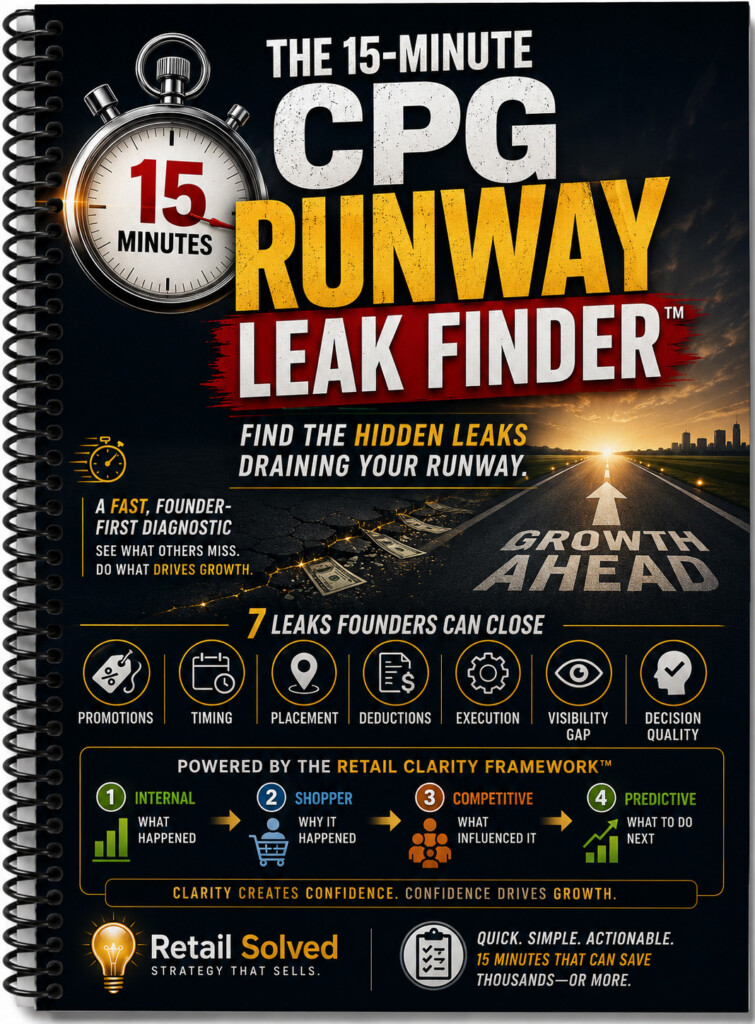
Start here: Find where your CPG brand is losing cash, margin, and runway.
In about 15 minutes, identify the leak creating the most pressure so you know where to look first.
No friction, no email required.
Retail Operating System™
The complete 11-module framework for protecting margin, optimizing trade spend, and scaling distribution with confidence.
Retailers run on systems.
Most brands run on hustle.
That gap is expensive.
The Retail Operating System™ is the only structured, data-driven retail growth framework built by a Certified Professional Strategic Advisor who has sat both in the founder seat and across the table from retailers.
It gives emerging CPG brands the same operational discipline, trade strategy, and category leverage that big brands use — simplified and systemized to protect margin, optimize trade spend, and extend runway while scaling distribution.
This is not education.
It’s infrastructure.
Image is the property of CMS4CPG LLC, distribution or reproduction is expressively prohibited.