Your sales report may be one of the last places you learn that the shopper changed.
By the time velocity slows, repeat purchase weakens, or a retailer starts asking harder questions, the shopper may have already made a different decision.
This episode uses trade shows as a practical example, but the bigger lesson is not really about trade shows. It is about turning shopper conversations, demos, email replies, community engagement, buyer questions, and event follow-up into a listening system.
Dan Lohman explains why your email list should be more than a coupon channel and how better signal capture can help your team understand what shoppers are thinking before the numbers finally explain it.
You will learn:
- Why sales reports often reveal shopper change too late
- How to capture useful signals from conversations and events
- Why segmentation makes follow-up more relevant
- How email can strengthen relationships, validate ideas, and create retail proof
The event creates the moment. Your system creates the return.
Download the free Shopper Signal Flywheel™ at: RetailSolved.com/guide31
This is the Listen chapter of the Retail Clarity series.
Retail Clarity Series Podcast playlist
328: Listen
329: Understand
330: Decide
331: Build
Listen where you get your podcast








Like what you’ve heard?
Please leave a review and comment on iTunes
Let me know your most pressing question, I’ll do my best to answer it on a future episode.
# Episode 328 — Trade Shows Do Not Create ROI. Follow-Up Systems Do. Welcome back to Bulletproof Your CPG Brand. I’m Dan Lohman, founder of Retail Solved. I help entrepreneurial CPG brands protect runway, improve execution, and compete smarter with the resources they already have. Today I want to talk about trade shows. Fancy Food. Expo West. Distributor shows. Retailer shows. Investor events. Founder events. Any place where a CPG brand spends real money, real time, real energy, and real focus trying to get in front of the right people. And I want to start with something most founders already know, but not enough people say out loud. Trade shows are expensive. And I don’t just mean the booth. I mean the real cost. The booth. The travel. The hotel. The samples. The shipping. The setup. The signage. The team. The materials. The meetings. The prep. The follow-up. The time away from the business. The work that does not get done while you are there. The momentum that slows down while your team is focused on the show. The retailer issue that waits. The broker follow-up that gets delayed. The production problem that still needs attention. The cash that goes out before you know what comes back. That is the part most brands underestimate. They look at the invoice. But they do not always calculate the total cost. A trade show does not just cost money. It costs attention. It costs focus. It costs bandwidth. It costs momentum. And when you are an entrepreneurial CPG founder trying to extend runway, that matters. A lot. That is why today’s topic is so important. Because trade shows do not create ROI. Follow-up systems do. Now, I am not anti-trade show. I want to be clear about that. Trade shows can be incredibly valuable. Relationships matter in this industry. Especially in natural, organic, better-for-you, and mission-driven CPG. You see the same people again and again. Someone you meet at one show may be at a different retailer two years from now. A broker you meet today may introduce you to someone tomorrow. A buyer who is not the right fit right now may become the exact buyer you need later. An industry partner may remember how you showed up. A founder peer may make an introduction you never could have made on your own. So this is not about saying shows do not matter. They do. The problem is that too many brands treat the show like the event is the strategy. It isn’t. The show is the opening. The follow-up system is what determines whether the investment keeps working after everyone goes home. To help, I created the The Shopper Signal Flywheel™ where I show you how to leverage this strategy in your business. Stay tuned to the end to learn more and how to get your free copy. In Episode 306, I talked about this idea that trade shows are not sampling events. That is still true. Sampling matters. People need to taste the product. The sensory experience matters. But a show is not just a place to hand out samples or business cards. It is a leverage event. It is a relationship event. It is a listening event. It is a signal-capture event. It is a chance to open doors that may not open any other way. It is an opportunity to build community. But only if you have a system to carry the relationship forward. Without that system, a show can become one of the most expensive forms of hope in your business. You hope the buyer remembers you. You hope the broker follows up. You hope the distributor reaches back out. You hope the investor looks at the deck. You hope the samples get shared. You hope the person who said, “This is interesting,” still thinks it is interesting two weeks later. Hope is not a system. And when runway is tight, hope gets expensive. Let me repeat that, when runway is tight, hope gets expensive. Here is what happens to a lot of brands. They get ready for the show. They spend weeks preparing. They worry about the booth. They worry about getting samples there. They worry about whether the product will arrive on time. They worry about whether the team will say the right thing. They worry about whether the right people will stop by. Then the show happens. The booth feels busy. People say nice things. Some buyers come by. Some brokers come by. Some distributors come by. Some investors come by. Some consumers try the product and smile. The founder feels encouraged. And that is real. Founders need those moments. When you are building something hard, it matters when people respond. It matters when someone says, “I love this.” It matters when a buyer stops and asks a smart question. It matters when the product gets attention. But booth traffic is not the win. The win is what happens next. The win is whether the right people are followed up with in the right way. The win is whether the conversations are remembered accurately. The win is whether the signals are captured. The win is whether the people who stopped by are segmented properly. The win is whether the message continues after the booth comes down. That is where most of the value is either captured or lost. And the loss is usually quiet. It does not feel like a big failure. It feels like getting back to work. The founder comes home tired. The inbox is full. The team is behind. Retailers still need answers. Orders still need attention. Deductions still need to be chased. Production still has issues. Cash is still tight. And the show follow-up becomes one more thing on the list. One day becomes three. Three days becomes a week. A week becomes two. And by then, the other person may not remember the conversation the way you do. That buyer had a hundred conversations. That distributor met dozens of brands. That investor saw a lot of decks. That shopper tried a lot of samples. They are back in their own world. Your job is not just to meet them. Your job is to make it easy for them to remember why the conversation mattered. That is where follow-up becomes strategy. Not admin. Strategy. A good follow-up system does three things. It remembers the conversation. It continues the relationship. And it creates the next logical step. That sounds simple. It is simple. But simple does not mean common. Most brands still follow up too generically. “Great meeting you at the show.” “Thanks for stopping by.” “Attached is our sell sheet.” “Let me know if you have any questions.” That is not bad. It is just not enough. Everyone is sending that email. What makes your follow-up different is relevance. “I enjoyed meeting you at Fancy Food. You mentioned that your team is looking for products that can bring new shoppers into the set without relying only on discounting. That connects directly to what we talked about at the booth.” Make the comment personnel and memorable - so that they are instantly taken back to your conversation in their mind. That is different. Now the person knows you listened. Now they remember the conversation. Now the follow-up has context. That is how relationships start to deepen. And relationships are everything in this industry. I have had opportunities open because of relationships that started years earlier. Retailers have asked for my opinion because I took the time to understand their category. Buyers have shared what they were trying to solve because the relationship was not just transactional. That is when the work gets interesting. Not when you are just presenting your product once a year in a category review. But when the retailer starts treating you like someone who can help them think. That is a very different kind of relationship. And that is the bigger opportunity I want founders to see. Because the best trade show follow-up is not just about getting a meeting. It is about continuing the conversation. It is about staying relevant. It is about becoming useful. It is about building trust over time. Imagine this. Instead of waiting until your new item is fully packaged, priced, finalized, and ready for a formal buyer meeting, what if you had been nurturing the relationship all year? What if the retailer already understood the shopper problem you were solving? What if they had seen early signals? What if they had watched you gather feedback? What if they knew your community was asking for it? What if they saw the product take shape before the final presentation? What if they were not being surprised by your innovation? What if they were being invited into the journey? That changes the conversation. Instead of walking into a meeting and saying, “Here is our new item, will you put it on shelf?” The buyer may already be thinking, “I have been waiting for this.” That is the difference between a sales pitch and a relationship. That is where the email strategy we have been talking about becomes so powerful. Because your email list is not just a coupon channel. It is a relationship system. It is a signal system. It is a way to keep the conversation going after the first interaction. Most people hear that and immediately think about shoppers. And yes, your shopper list matters. It can help you understand why people buy, what they value, where they shop, what they want next, and how to convert occasional buyers into loyal evangelists. But there is a second layer. Your industry relationships need a system too. Retailers. Brokers. Distributors. Investors. Influencers. Strategic partners. Founder peers. People who can help amplify the brand story long after the show ends. Those relationships need nurturing. They need context. They need consistency. They need to be reminded what you stand for, what problem you solve, and why your brand matters. Not in a spammy way. Not in a hard-sell way. In a useful way. Because when enough people understand your story clearly, they can repeat it clearly. That matters. You want the people who touch your brand to sing from the same hymnal. The founder knows the story. But does the broker know it? Does the distributor know it? Does the retailer understand it? Does the buyer know why the product matters? Does the consumer understand the mission? Does the investor understand the growth logic? Does the category manager understand the shopper need? If every person tells a different version of the story, the brand gets weaker. If everyone understands the same core message, the brand gets stronger. That is another reason trade show follow-up matters. It is not just about chasing leads. It is about reinforcing the story. It is about turning brand-curious people into informed advocates. And over time, some of those people can become evangelists. Not because you pushed them. Because you kept showing up with value. This is the part that feels like common sense once you see it. If someone stops by your booth and shows interest, that is not the end of the interaction. That is the beginning. If a buyer gives you five minutes, that is not the relationship. That is the invitation. If a shopper says, “I wish you were in my store,” that is not just a compliment. That is a signal. If a distributor asks about velocity, that is not just a question. That is a clue about what proof they need. If an investor asks about repeat purchase, that is not just diligence. That is a reminder that your community and shopper data matter. Every conversation is giving you information. The question is whether you have a system to hold it. This does not need to be complicated. A simple spreadsheet can work. A clean CRM can work. A segmented email list can work. The tool matters less than the discipline. But you need to capture the right things. Who was the person? What type of contact were they? What did they care about? What did they ask? What product were they interested in? What retailer or channel did they mention? What objection came up? What signal did they give you? What is the next step? Who owns it? When will it happen? That is not busywork. That is how you protect the value of the show. Because without it, the show becomes a pile of memories. With it, the show becomes an asset. And when you consider the true cost of a trade show, you need the show to become an asset. You need it to keep working. You need it to create more than a few days of energy. You need it to create relationships, insight, retail proof, and future opportunity. That is how you extend runway. Not just by cutting costs. By getting more value from the money you already spend. That is one of the biggest mindset shifts for founders. Extending runway is not only about spending less. It is also about wasting less. Wasting fewer conversations. Wasting fewer samples. Wasting fewer introductions. Wasting fewer buyer signals. Wasting fewer shopper insights. Wasting fewer opportunities to build trust. A trade show is filled with potential energy. The follow-up system converts that energy into momentum. And the better the system, the more momentum you keep. This is why I would think about every trade show in three stages. Before the show. During the show. After the show. Before the show, decide what you are trying to learn and who you are trying to reach. Do not just ask, “How do we get booth traffic?” Ask better questions. Which retailers matter most? Which contacts do we want to deepen? Which shopper questions do we want answered? Which objections do we need to understand? Which product ideas do we want to validate? Which relationships are worth nurturing after the show? During the show, listen. Really listen. Do not just pitch. Pay attention to the questions people ask. Pay attention to what confuses them. Pay attention to what excites them. Pay attention to what they compare you to. Pay attention to what retailers they mention. Pay attention to what they ask for that you do not yet have. Then after the show, follow up with relevance. Not a generic blast. A relationship-based follow-up. Different messages for different people. Retailers get retailer context. Brokers get sales clarity. Distributors get proof and readiness. Investors get traction and focus. Shoppers get a reason to stay connected. Fans get invited deeper into the story. That is how the show becomes bigger than the show. And this is where the shopper signal strategy fits perfectly. A brand’s email system can become the bridge between the show and the long-term relationship. You meet someone once. The email system helps you continue the conversation. You capture interest once. The email system helps you learn from it. You hear a shopper comment once. The email system helps you test whether that comment is part of a pattern. You meet a buyer once. The email system helps you stay useful until the timing is right. That is the part most brands miss. They think of email as a promotional tool. Send a coupon. Announce a product. Push a sale. That is too small. Email can help you build trust. It can help you listen. It can help you educate. It can help you validate. It can help you nurture relationships that are not ready to convert today but could become incredibly valuable later. That is true for shoppers. And it is true for industry relationships. Now, I want to be careful here. I am not saying you should dump every buyer, broker, distributor, investor, and shopper into the same email sequence. Please do not do that. That is the opposite of the point. The point is list segmentation. The point is relevance. The point is continuing the right conversation with the right person. The founder who learns how to do that has an advantage. Because most brands stop too soon. They stop at the sample. They stop at the badge scan. They stop at the sell sheet. They stop at the “great meeting you” email. The better brand keeps building. And that is where trust compounds. This is also where reciprocity starts to work in your favor. When you are useful to people, they remember. When you help a retailer think through a category problem, they remember. When you send a thoughtful follow-up that connects to what they actually care about, they remember. When you share a shopper insight that helps them understand demand, they remember. When you make their job easier, they remember. That does not mean every relationship turns into immediate business. It does not. But it does mean you are building something much more valuable than a one-time booth interaction. You are building reputation. You are building trust. You are building a network of people who understand what your brand stands for. That is how doors open. Sometimes not today. Sometimes later. But the work compounds. This is why I say trade shows do not create ROI. Follow-up systems do. The show gives you the moment. The system creates the return. So before you spend money on the next show, ask yourself a better question. Not just, “How do we get more people to the booth?” Ask: What are we going to do with the people who stop by? How will we capture what they tell us? How will we segment them? How will we follow up? How will we continue the conversation? How will we turn interest into trust? How will we turn trust into proof? How will we turn proof into retail growth? That is the work. And the good news is that this does not require a giant team. It does not require a giant budget. It requires intention. It requires a simple system. It requires the discipline to keep the relationship going after the show ends. That is how you get more from the money you already spent. That is how you protect runway. That is how you improve execution. That is how you compete smarter. And that is how your brand becomes easier to believe in. If this resonates with you, I created a free guide that goes deeper into this strategy. It is called The Shopper Signal Flywheel™. The guide is designed to help CPG founders turn their email list into more than a coupon channel. It shows how to use email to listen to shoppers, validate ideas, strengthen repeat purchase, create retail proof, and convert occasional buyers into loyal evangelists. And this is directly connected to what we talked about today. Because the show may create the contact. But the follow-up system creates the relationship. You can download the free guide at: RetailSolved.com/guide31 Again: RetailSolved.com/guide31 One final thought. If you just got home from a trade show, do not beat yourself up if the follow-up is not perfect. Start where you are. Pull the names together. Segment the contacts. Write the first thoughtful note. Capture what you learned. Ask what should happen next. Then build the system a little better before the next show. You do not need to make this complicated. You just need to make it intentional. Because your booth traffic is not the win. Your follow-up system is. I’m Dan Lohman. This is Bulletproof Your CPG Brand. Thanks for listening.
Enter your name and email address below and I'll send you periodic brand building advice, tips and strategies.
Sign up to receive email updates
FREE Trade Promotion ROI Calculator:
Click Here To Maximize Sales And Profits
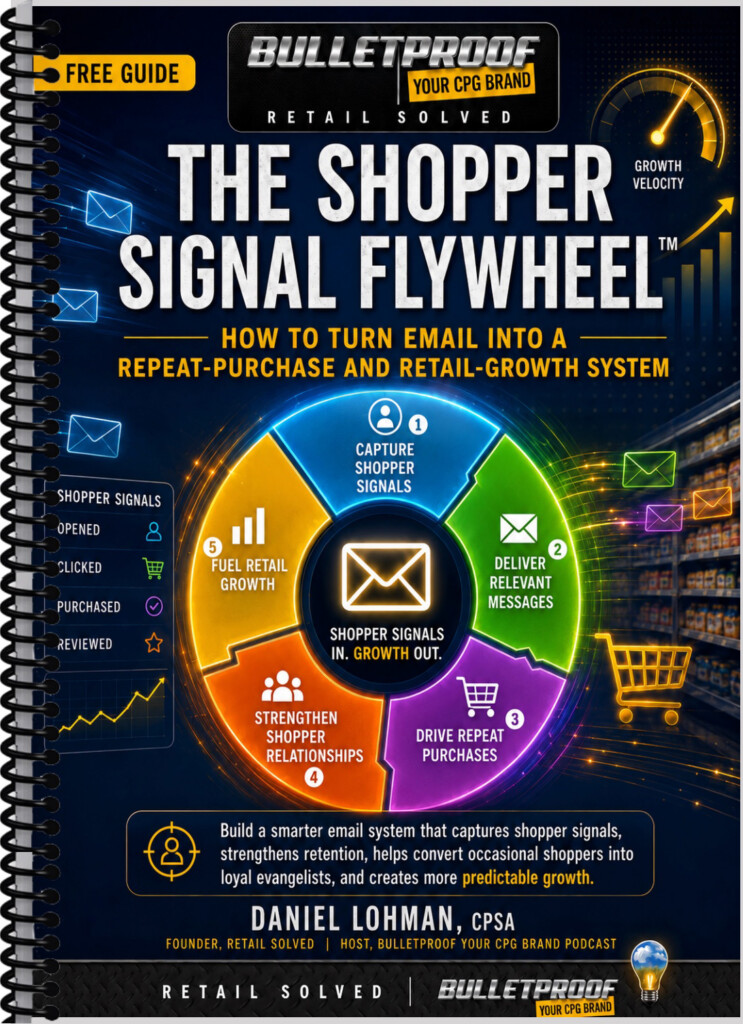
Your shoppers may know what your sales report cannot tell you.
Use your email list to capture real shopper language, validate ideas, strengthen repeat purchase, and build retailer-ready proof.
Your email list can become more than a marketing channel.
Retail Operating System™
The complete 11-module framework for protecting margin, optimizing trade spend, and scaling distribution with confidence.
Retailers run on systems.
Most brands run on hustle.
That gap is expensive.
The Retail Operating System™ is the only structured, data-driven retail growth framework built by a Certified Professional Strategic Advisor who has sat both in the founder seat and across the table from retailers.
It gives emerging CPG brands the same operational discipline, trade strategy, and category leverage that big brands use — simplified and systemized to protect margin, optimize trade spend, and extend runway while scaling distribution.
This is not education.
It’s infrastructure.
Image is the property of CMS4CPG LLC, distribution or reproduction is expressively prohibited.