Growth feels harder right now.
That does not necessarily mean your brand, product, mission, or founder instincts are broken. The environment around the business changed, and the margin for error got smaller.
Sales may be growing while cash still feels tight. Promotions may move volume while compressing margin. Shoppers may still love the brand but buy it less often, wait for a promotion, or make different choices at the kitchen table.
Dan Lohman explains why the old playbook is less forgiving and why stronger decision quality has become one of the most important ways CPG founders can protect runway.
You will learn:
- Why sales growth does not always make the business stronger
- How changing shopper behavior affects founder economics
- Why reports often explain the pressure too late
- How Retail Clarity connects internal, shopper, competitive, and predictive signals
Your brand may not be broken.
The margin for error got smaller.
Start with the free 15-Minute CPG Runway Leak Finder™:
RetailSolved.com/leakfinder
This is the Understand chapter of the Retail Clarity series.
Retail Clarity Series Podcast playlist
328: Listen
329: Understand
330: Decide
331: Build
Listen where you get your podcast








Like what you’ve heard?
Please leave a review and comment on iTunes
Let me know your most pressing question, I’ll do my best to answer it on a future episode.
Episode 329 Your Brand Is Not Broken. The Margin For Error Got Smaller. Good business thrives on predictability The kitchen table is where this starts This is why “more data” is not enough The promotion example founders need to understand The four questions that change the conversation The old playbook was more forgiving The leak is not always obvious What founders should do now In Closing
Enter your name and email address below and I'll send you periodic brand building advice, tips and strategies.
Why CPG Growth Feels Harder Now — The Margin For Error Got Smaller
Welcome to Bulletproof Your CPG Brand.
I’m Daniel Lohman, founder of Retail Solved, and this is the show where we help entrepreneurial CPG founders protect runway, improve execution, and compete smarter.
Today, I want to name something that a lot of founders are feeling.
And I want to name it carefully.
Because this does not need to be political.
It does not need to be dramatic.
It does not need to be another conversation about who is right or wrong.
But it does need to be honest.
Growth feels harder right now because the margin for error got smaller.
That is the phrase I want you to hold onto today.
The margin for error got smaller.
Your brand may not be broken.
Your product may not be broken.
Your mission may not be broken.
Your founder instincts may not be broken.
But the environment around your business changed.
And when the environment changes, the old assumptions stop working the same way.
That is what a lot of founders are feeling right now.
They may not always have the words for it.
But they can feel it.
Sales can be up, but cash still feels tight.
Distribution can grow, but the business still feels more fragile.
Promotions can move volume, but margin can still get compressed.
Retail conversations can look promising, but execution can still break down.
Shoppers can still love your brand, but buy it differently.
And your reports may show what happened, but they do not always tell you why it happened, what influenced it, or what to do next.
That is the problem.
The business is being asked to make better decisions in a less forgiving environment.
That is why this episode matters.
Because a lot of founders are still trying to solve today’s problems with yesterday’s margin for error.
And that can get expensive fast.
Good business thrives on predictability.
That is true for retailers.
It is true for manufacturers.
It is true for brokers.
It is true for distributors.
It is true for investors.
And it is absolutely true for entrepreneurial CPG founders.
When things are predictable, the business has more room to absorb mistakes.
A promotion that performs a little below plan may not hurt as much.
A deduction that comes in later than expected may be frustrating, but manageable.
A freight increase may be painful, but not devastating.
A retailer delay may slow momentum, but not threaten the business.
A little inefficiency can be absorbed.
That is what I mean by margin for error.
In more predictable times, the business can sometimes survive imperfect decisions.
It can recover.
It can adjust.
It can make up ground.
But when inflation remains elevated, input costs move faster, freight changes quickly, shoppers become more cautious, and retailers expect more support, the room for error shrinks.
A small mistake gets bigger.
A delayed decision costs more.
A promotion that does not create profitable demand can shorten runway.
A deduction that should have been prevented can drain cash you were counting on.
A weak follow-up system can waste money you already spent to create the opportunity.
A report that tells you what happened too late can leave you reacting after the damage is already done.
That is what many founders are living through.
The decisions are heavier now.
The kitchen table decisions are heavier for shoppers.
And those decisions eventually work their way back to the brand.
Let’s talk about the shopper for a moment.
Because this starts at the kitchen table.
Shoppers are doing their own version of runway management.
They are looking at the grocery bill.
They are looking at gas.
They are looking at rent.
They are looking at childcare.
They are looking at debt.
They are looking at everything that competes for the same dollar.
That does not mean shoppers stopped caring about better-for-you products.
It does not mean they stopped caring about mission.
It does not mean they stopped caring about quality, health, sustainability, or trust.
But it does mean they are weighing decisions differently.
They may still love your brand.
But they may buy it less often.
They may compare more carefully.
They may trade down in one category so they can still trade up in another.
They may wait for a promotion.
They may buy the larger size if it gives them better value.
Or they may buy the smaller size because the cash outlay feels safer.
They may still believe in your mission.
But they need your brand to make sense inside their current reality.
That matters.
Because when the shopper’s math changes, the founder’s math changes too.
And your sales report may be one of the last places you find out.
By the time velocity slows, repeat purchase weakens, promotion performance changes, or retailer confidence gets softer, the shopper already made a decision.
That is why shopper visibility matters.
It is not a nice-to-have.
It is one of the ways brands protect runway.
Because the faster you understand what the shopper is thinking, the faster you can make better decisions.
A lot of brands have data.
They have sales reports.
They have distributor reports.
They have retailer portals.
They have broker updates.
They have deduction files.
They have promotion recaps.
Some have syndicated data.
Some have dashboards.
Some have more spreadsheets than they know what to do with.
But more data does not automatically create more clarity.
This is one of the biggest traps in CPG.
A dashboard may tell you what happened.
That is useful.
But it may not tell you why it happened.
It may not tell you what influenced it.
It may not tell you what to fix first.
It may not tell you how to avoid the same problem next time.
And it may not tell you where the opportunity is hiding.
Here is the analogy I keep coming back to.
We all use map apps.
If there is traffic ahead, the app warns you.
That is helpful.
But the real value is not just the warning.
The real value is that the app helps you reroute.
It tells you where the delay is.
It gives you an alternative.
It helps you make a better decision before you lose more time.
Now compare that to how a lot of CPG reporting works.
Most dashboards tell brands they are already in heavy traffic.
They show the slowdown after it happened.
They show the missed number after the quarter closed.
They show the deduction after cash was already drained.
They show the promotion result after the spend is gone.
They show the sales gap after the retailer conversation gets harder.
That is not enough anymore.
Not when the margin for error got smaller.
A better tool should help you see what is coming.
It should help you understand why it matters.
It should help you decide what to do next.
That is what Retail Clarity Decision Tools are built to do.
They are not generic spreadsheets.
They are decision tools.
They are built around the question the team actually needs to answer.
Which gap matters most?
Which retailer needs attention first?
Which promotion window gives us the best chance to win?
Which deduction root cause keeps repeating?
Which item should be prioritized?
Which broker action needs to happen next?
Which shopper signal should change the plan?
That is the difference between reporting and retail clarity.
Let’s make this practical.
Imagine your brand is planning a promotion around a busy holiday window.
A lot of brands default to the obvious week.
The retailer asks for support.
The competition is active.
The calendar looks full.
The discount needs to be deep.
The display cost is higher.
The noise is louder.
And because everyone else is trying to win the same moment, your brand may be forced to spend more just to get noticed.
Now imagine a better decision tool.
Not just a spreadsheet that says what happened last year, past tense.
A tool that helps you think through the actual decision.
What if it showed that promoting the week before the major holiday could produce a better outcome?
Maybe competitive noise is lower.
Maybe premium display space is less expensive and easier to secure.
Maybe the retailer is more open to support because fewer brands are fighting for that exact week.
Maybe you can maintain a stronger price point with less discounting.
Maybe you introduce your brand to shoppers while they are still planning.
Maybe you drive traffic into the category before the category gets crowded.
Maybe you create a better retailer story because you are not simply asking to join the same price war everyone else is funding.
That is the kind of thinking most dashboards do not give you.
But it is exactly the kind of thinking brands need right now.
Because if the only tool you have is a report that tells you what happened last year, you may end up repeating the same pattern.
More discount.
More noise.
More spend.
Less clarity.
A better question is:
Where can we win without funding the same fight everyone else is in?
That is Retail Clarity.
It is not just knowing the numbers.
It is knowing what decision the numbers should help you make.
This is why I built the Retail Clarity Framework around four questions.
The first question is:
What happened?
That is the internal view.
Sales.
Shipments.
Deductions.
Promotions.
Distribution.
Inventory.
Retailer scorecards.
Invoices.
Reports.
You need that.
But you cannot stop there.
The second question is:
Why did it happen?
That is the shopper view.
What did the shopper understand?
What did they miss?
What did they value?
What did they reject?
What were they comparing you to?
What changed in their kitchen table math?
This is where a guide like The Shopper Signal Flywheel™ becomes so important.
Your email list is not just a coupon channel.
It can become a listening system.
It can help you understand what shoppers are thinking before the sales report finally shows the result.
The third question is:
What influenced it?
That is the competitive view.
What did competitors do?
Was private label more aggressive?
Did another brand own the display?
Did pricing shift?
Did the retailer change strategy?
Did your product get compared to a different category than the one your data platform uses?
Did the shelf tell a different story than your report?
The fourth question is:
What should happen next?
That is the predictive view.
This is where clarity becomes action.
Not just more information.
Not another meeting.
Not another report.
A better next decision.
That is the whole point.
The Retail Clarity Framework is designed to help founders see what others miss and then decide what to do next.
That is how you get more runway from the resources you already have.
That is how smaller brands earn a more equal seat at the table.
That is how you compete with bigger, better-funded brands without simply trying to outspend them.
I want to come back to this idea of forgiveness.
Because this is the part I do not think enough founders are being told.
CPG used to be more forgiving.
Not easy.
It has never been easy.
But more forgiving.
Capital was easier to access.
Some retailers had more patience.
Promotional mistakes could be absorbed more easily.
Input costs were not always moving as quickly.
Consumer behavior was not always shifting as sharply.
The path from trial to repeat could feel more predictable.
And when there was more room in the model, the business could survive more inefficiency.
That is less true now.
Now, the wrong decision can have a longer tail.
Cutting the wrong spend can weaken future demand.
Funding the wrong promotion can train the shopper to wait.
Ignoring deductions can quietly drain cash.
Chasing the wrong retailer can add complexity without enough profit.
Launching the wrong item can use up shelf trust you may need later.
Failing to follow up after a trade show can waste an investment you already made.
Relying on a dashboard that does not show what to do next can keep the team busy but not focused.
This is why I am being so direct.
Founders do not need more random advice right now.
They need clearer decision discipline.
They need to know what to protect.
They need to know what to stop.
They need to know what to fix first.
They need to know where the business is leaking.
When founders hear the word leak, they often think of cash.
And yes, cash leaks matter.
Deductions.
Chargebacks.
Trade spend.
Bad promotions.
Pricing mistakes.
Retail programs that do not pay back.
But not every leak shows up immediately in the bank account.
Some leaks show up as lost momentum.
Some show up as weak execution.
Some show up as confused shoppers.
Some show up as poor follow-up.
Some show up as data that does not answer the real question.
Some show up as time wasted debating the wrong issue.
And those leaks eventually become cash problems.
This is why I built the 15-Minute CPG Runway Leak Finder.
It is not meant to solve everything.
It is meant to help you slow the problem down.
To look at your business through a sharper lens.
To ask:
Where might we be leaking margin?
Where might we be leaking execution?
Where might we be leaking visibility?
Where might we be leaking decision quality?
Where might we be losing runway without seeing it clearly?
That is the starting point.
Because before you cut more, spend more, raise more, chase another retailer, or fund another promotion, you need to know where the pressure is really coming from.
So what should you do with this?
Start with the loudest leak.
Not every leak.
Not every problem.
Not every system.
The loudest leak.
If the pressure is cash and margin, look at trade spend, deductions, pricing, and promotions.
If the pressure is execution, look at broker follow-up, inventory, distribution, merchandising, and store-level reality.
If the pressure is shopper visibility, start listening more intentionally.
Use your email list.
Use your reviews.
Use your trade show conversations.
Use buyer questions.
Use customer service.
Use every signal you already have access to.
If the pressure is decision quality, ask whether your current reports are actually helping you make better decisions.
If they are only telling you what happened, you may need a better decision tool.
And if you are not sure where to start, that is exactly why the Leak Finder exists.
The goal is not to diagnose everything today.
The goal is to find the loudest leak so you can stop guessing and choose the right next step.
That is how you protect runway.
That is how you improve execution.
That is how you compete smarter.
The margin for error got smaller.
That is the reality founders are operating in.
But that does not mean small brands cannot win.
In fact, I believe the brands that build clarity now can create a bigger advantage when the environment improves.
Because they will not just survive the uncertainty.
They will come out sharper.
They will understand their shopper better.
They will manage trade spend with more discipline.
They will prevent more deductions.
They will build better follow-up systems.
They will use better decision tools.
They will know where to focus.
And they will be able to compete with more confidence.
That is the space Retail Solved is built to serve.
Helping entrepreneurial CPG brands get more runway from the resources they already have.
Helping them see what others miss.
Helping them act faster.
Helping them win smarter.
This week, start with the free 15-Minute CPG Runway Leak Finder.
No email required.
Download it instantly.
Review it in about 15 minutes.
Use it to find where your brand may be losing cash, margin, execution, visibility, or decision quality.
You can get it at:
RetailSolved.com/leakfinder
And if your loudest leak is shopper visibility, I also recommend downloading The Shopper Signal Flywheel™.
That guide will help you start thinking about your email list as more than a coupon channel.
It can become a way to listen, validate ideas, strengthen repeat purchase, and create retail proof.
But start with the leak.
Find what is loudest.
Then choose the next right step.
Thanks for listening to Bulletproof Your CPG Brand.
If this episode helped you put words to what you have been feeling, share it with another founder.
Because they may not be broken either.
They may just be trying to grow in a world where the margin for error got smaller.
I’ll see you next time.
Connect with my on linkedIn
Sign up to receive email updates
FREE Trade Promotion ROI Calculator:
Click Here To Maximize Sales And Profits
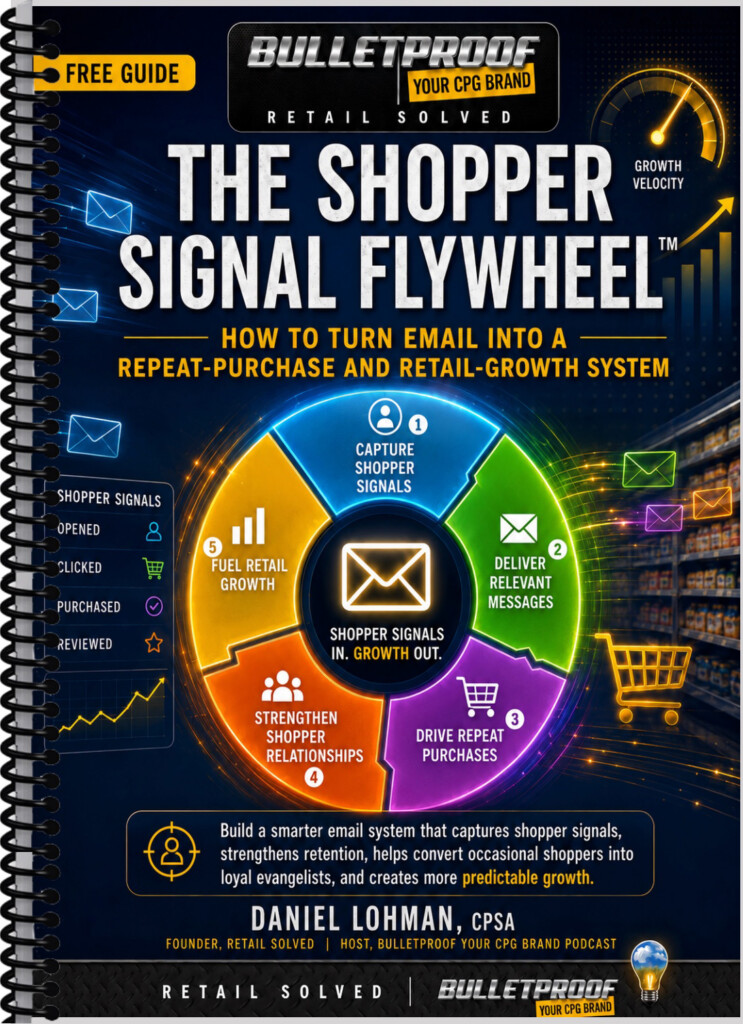
Your shoppers may know what your sales report cannot tell you.
Use your email list to capture real shopper language, validate ideas, strengthen repeat purchase, and build retailer-ready proof.
Your email list can become more than a marketing channel.
Retail Operating System™
The complete 11-module framework for protecting margin, optimizing trade spend, and scaling distribution with confidence.
Retailers run on systems.
Most brands run on hustle.
That gap is expensive.
The Retail Operating System™ is the only structured, data-driven retail growth framework built by a Certified Professional Strategic Advisor who has sat both in the founder seat and across the table from retailers.
It gives emerging CPG brands the same operational discipline, trade strategy, and category leverage that big brands use — simplified and systemized to protect margin, optimize trade spend, and extend runway while scaling distribution.
This is not education.
It’s infrastructure.
Image is the property of CMS4CPG LLC, distribution or reproduction is expressively prohibited.