Growth feels harder right now because many brands are making decisions with only part of the picture.
In this episode, Dan Lohman explains why most CPG brands do not have a spend problem — they have a visibility problem.
Learn how the Retail Clarity Framework™ helps founders identify hidden profit leaks, improve decision quality, protect margin, strengthen retailer relationships, and compete smarter in unpredictable markets.
Listen where you get your podcast








Like what you’ve heard?
Please leave a review and comment on iTunes
Let me know your most pressing question, I’ll do my best to answer it on a future episode.
Episode 322 — How To Protect Margin When Growth Gets Expensive Last week, I talked about hidden execution leaks — the problems that begin after production and quietly drain margin, retailer trust, and runway before the product ever reaches the shopper. Execution is one leak. This week, I want to zoom out. Most CPG founders are feeling pressure from every direction. That creates a dangerous situation for entrepreneurial brands. Because when margins get compressed, the natural instinct is to react. But here’s the problem. That confusion is expensive. WHY THIS MATTERS RIGHT NOW The uncertainty was real, but the source of disruption was visible. The brands that survived and thrived adapted. This stretched brands to rethink their go-to-market strategy. During normal times when things are preditctabble, your dashboards, canned reports and internal systems can predict and forecast velocity with reasonable effectively and accuracy, even during promotions. These are not normal times. Today feels different. Things are extremely volatile. And all of that compresses the smaller brand in the middle. Now consider this: It costs more to: And if your shopper is under financial pressure, they scrutinize every purchase more carefully. Big brands can often absorb that pressure longer. …in ways many emerging brands cannot. It means they need to compete differently. Because clarity creates leverage. THE ORIGIN OF RETAIL CLARITY That shift was not cosmetic. The mission became sharper. That is the work. They need a better operating system for making decisions. Early in my career, I saw how traditional category management was often practiced. A lot of it relied on: The reports were useful. They showed what happened. And where there is a blind spot… You cannot fix what you cannot clearly see. THE QUESTION THAT CHANGED EVERYTHING That question forces you to slow down. That question is the heart of Retail Clarity. Because your product does not operate in isolation. Everything influences everything else. The brands that understand that gain an unfair competitive advantage. THE RETAIL CLARITY FRAMEWORK™ 1. Internal — What happened? This work matters. Most brands stop here. They don’t. Internal data tells you what happened inside your world. But your brand is not the only thing happening in the category. When you manage only from internal data, you manage in isolation. This is where brands start leaking: Not because the data is wrong. 2. Shopper — Why did it happen? Before we talk about the shopper, we need to talk about the retailer. They are trying to: Retailers want: If you can help them achieve those goals, the relationship changes. You stop selling products. Years ago, when I was in direct store delivery selling salty snacks, I learned this firsthand. So when the retailer opened a major new location, I was given: At no additional cost. The largest national brand did not get that space. Not because I had the largest budget. Retailers reward clarity. That experience shaped how I think about retail forever. Now let’s bring the shopper into this. Most brands say they know their shopper. That is not the same thing. When you understand the need state better than competitors, you can reverse engineer: This is where smaller brands can beat larger brands. Not by outspending them. A REAL EXAMPLE They had: But we had the shopper. The competitor’s shopper was more price-driven and promotion-driven. That changed the conversation. The retailer realized they were not simply choosing between products. They were choosing between shopper relationships. That is Retail Clarity. Not generic shopper data. 3. Competitive — What influenced it? This is one of the most overlooked parts of retail strategy. Most brands compare: That matters. You also need to understand what else was happening around you. Were competitors: Did private label shift the equation? Consider this. But maybe: The sales report will not always tell you that. This is why canned reports are a starting point. 4. Predictive — What should happen next? This is where the first three pillars come together. Internal tells you what happened. And this is where many brands struggle most. And when uncertainty increases, decision quality matters more. This is the opportunity. You are not trying to predict the future perfectly. What should we fix first? Let me give you a real example of what I mean. Let’s face it. Years ago, our largest competitor was the category captain for the largest retailer in the country at that time — this was before Walmart became dominant. They introduced a completely new product line and leveraged their influence as category captain to convince the retailer to authorize it across every division. Their proposal required the retailer to discontinue 17 items to make room for the new brand. Eleven of those items belonged to us. That was nearly half our business with that retailer. At the time, I was responsible for only one division. Every other division simply accepted the recommendation because the category captain’s data and presentation looked convincing on the surface. But something didn’t feel right to me. So instead of blindly accepting the plan, I did a deep dive. First:
Internal — What happened? There was no obvious reason we should suddenly lose nearly half our distribution. Second:
Shopper — Why did it happen? So I began studying not only our shoppers… I wanted to understand: Third:
Competitive — What influenced it? My experience taught me to watch competitors obsessively: That level of due diligence was rare. The competitor’s sudden pivot into this entirely new brand caught almost everyone off guard. That meant forecasting: Now here’s where the fourth pillar changed everything. This is the key. Whenever a retailer adds or removes items from a category, one of two things happens. That second part is critical. That impacts: Most assortment reviews never go deep enough into this. But they should. So I built an analysis showing the long-term impact of: And again — this is not about being braggadocious. I’m sharing this because I want founders to understand what’s possible when you stop relying only on canned reports and start thinking strategically. Now let’s recap what happened. Instead… Think about the difference between those two outcomes. One path would have crushed sales, leverage, and profitability. That is the power of Retail Clarity. And here’s why this matters so much right now. If this framework can create that kind of outsized advantage during highly competitive stable markets… Imagine the leverage it can create during volatile and unpredictable markets like the ones founders are navigating today. This is how smaller brands outmaneuver larger competitors. THREE LEAKS TO CHECK RIGHT NOW Let’s make this practical. Leak 1 — Promotion ROI What happened: Did baseline improve? A temporary spike is not always growth. Leak 2 — Execution Did: Execution gaps quietly destroy runway. And many deductions begin much earlier than brands realize. Earlier. Execution is not just an operational issue. Leak 3 — Decision Quality Do we: Because a bad decision made confidently can drain more runway than an obvious mistake. Partial information creates expensive decisions. If this conversation resonates with you, make sure we connect on LinkedIn. That’s where I continue many of these deeper conversations around: I also publish a weekly LinkedIn newsletter where I break these concepts down further using real-world examples founders can apply immediately. Because my goal is not simply to teach theory. Here’s YOUR NEXT STEP If you struggle to answer any of these questions quickly and confidently… That is probably the first leak you should investigate. And if you want help identifying those leaks, download the free 15-Minute CPG Runway Leak Finder™. Go to:
RetailSolved.com/findleaks The guide will help you identify seven common leaks: And if you want to go deeper after that, join me for the free Retail Clarity Workshop. Because the goal is not simply to spend less. Before you raise more money… And let me leave you with this. Founders are not powerless. The brands that survive and grow over the next several years will not necessarily be the brands with the biggest budgets. And the best part, learning this now while things are challenging, will make these strategies even more impactful in the future! That is the opportunity. If this episode helped you see your business differently, please share it with another founder. The stronger mission-driven brands become, the stronger this industry becomes.
Enter your name and email address below and I'll send you periodic brand building advice, tips and strategies.
Promotions are another.
Deductions are another.
Placement.
Timing.
Visibility.
Decision quality.
Because the real opportunity is learning how to see the system behind the leak.
And right now, that matters more than ever.
Costs are higher.
Retailers expect more.
Promotions are harder to predict.
Shoppers are more cautious.
Private label is getting stronger.
And bigger brands can often absorb margin pressure longer than smaller brands can.
Cut spending.
Run deeper promotions.
Delay investments.
Push harder for distribution.
Raise more capital.
Move faster.
If you don’t know where the pressure is actually coming from…
You can cut the wrong thing.
Fund the wrong activity.
Damage retailer trust.
And make the leak even worse.
Let me explain.
A few years ago, when the world shut down, the problem was obvious.
Everyone knew what was happening.
Retailers knew it.
Brands knew it.
Distributors knew it.
Shoppers knew it.
Now the pressure is coming from everywhere at once.
Ingredient costs rise.
Freight costs shift.
Labor costs increase.
Retailers demand more support.
Shoppers become more value conscious.
Big brands promote aggressively.
Private label becomes more competitive.
If gas prices double in your market, that is not just a consumer problem.
That is a CPG margin problem.
• move ingredients
• manufacture products
• support field execution
• deliver inventory
• service retailers
They have scale.
They have leverage.
They have deeper pockets.
They can use:
• pricing
• promotion
• shelf influence
• supply chain efficiencies
• and retailer leverage
But that does not mean smaller brands are powerless.
They need clarity.
And leverage extends runway.
This is why I rebuilt everything around the Retail Clarity Framework™.
And honestly, this ties directly back to Episode 269 — the episode where Brand Secrets and Strategies became Bulletproof Your CPG Brand.
It was strategic.
Help entrepreneurial brands:
• extend runway
• improve execution
• compete smarter
• gain more leverage from existing resources
• and stop quietly leaking profit
And the reason this matters so much right now is because most founders do not need more disconnected tactics.
• canned reports
• syndicated data
• ranking reports
• generic shopper data
• and the same playbook everyone else was using
But they were incomplete.
But they did not always explain:
• why it happened
• what influenced it
• what the shopper was trying to solve
• what competitors were changing
• how retailer economics shaped the outcome
• or what the brand should do next
That created a massive blind spot.
There is usually a leak.
Let me repeat that, You cannot fix what you cannot clearly see.
The question that changed how I looked at every retail problem was simple:
Why did what happened happen?
It forces you to reverse engineer the outcome.
It forces you to stop managing your brand in isolation.
And it forces you to ask:
• What did the shopper see?
• What did they miss?
• What did the retailer need?
• What did the competitor do?
• What changed in the category?
• What broke in execution?
• What decision was made with only part of the picture?
Your promotion does not operate in isolation.
Your shelf set does not operate in isolation.
Your retailer relationships do not operate in isolation.
Your:
• competitors
• retailers
• shoppers
• brokers
• distributors
• pricing
• timing
• visibility
• execution
• forecasts
• promotions
• deductions
…all influence the final outcome.
The Retail Clarity Framework has four pillars.
This is where most brands live.
• Sales.
• Shipments.
• Velocity.
• Trade spend.
• Inventory.
• Forecasting.
• Deductions.
• Retail scorecards.
• Operational reporting.
But here is the trap.
They look at an internal report and assume they understand the business.
They understand part of the business.
And that is dangerous.
• margin
• retailer trust
• execution quality
• and decision quality
Because it is incomplete.
Because retailers are not simply buying products.
• attract shoppers
• grow profitable categories
• strengthen loyalty
• and create competitive differentiation
• more shoppers
• a reasonable profit
• and a stronger competitive position in their market
You start solving category problems.
I made the retailer’s life easier.
I solved problems.
I supported the store.
I helped them succeed.
• a huge front-lobby display
• multiple endcaps
• and premium visibility
I did.
Because I had built trust.
They reward brands that help them win.
But often what they really have is:
• a demographic profile
• a syndicated report
• a generic focus group summary
• or broad category assumptions
Your shopper is not a data point.
Your shopper is trying to solve a problem.
That problem is the need state.
• your merchandising
• your pricing
• your messaging
• your innovation
• your retailer story
• your placement strategy
• your promotion strategy
By understanding the shopper better.
I once worked on a situation where a much larger competitor tried to remove a brand from a key retailer.
• the budget
• the leverage
• the relationship
• the category influence
I showed the retailer that our shopper was deeply loyal to the parts of the store they cared most about:
• produce
• fresh
• premium
• mission-driven departments
Strategic understanding.
• this quarter versus last quarter
• this promotion versus the last one
• this shipment versus the prior shipment
But it is not enough.
• promoting more aggressively?
• better placed?
• gaining secondary displays?
• simplifying their message?
• reducing price?
• expanding assortment?
Did the retailer reset the category?
Did your product lose visibility?
A founder sees sales softening and assumes the issue is pricing.
• a competitor secured secondary placement
• the retailer reduced visibility
• another item captured shopper attention
• the category reset changed traffic flow
• or the shopper simply stopped noticing the item
But the shelf will.
They are not a strategy.
Shopper explains why.
Competitive explains what influenced it.
Predictive helps you decide what to do next.
Especially in unpredictable markets.
Because old assumptions stop working.
Promotions become less reliable.
Forecasts become less stable.
Shopper behavior changes faster.
Retailers become more selective.
Margins tighten.
You are trying to improve the quality of your decisions.
What should we stop funding?
What should we investigate?
What should we say to the retailer?
What should we measure differently?
What protects margin best?
This is where brands stop reacting and start leading.
And honestly, this is one of the experiences that shaped how I think about retail strategy forever.
Getting on the shelf is the easy part.
The hard work begins once your product actually reaches that shelf.
And without realizing it at the time, I was using all four pillars of what eventually became the Retail Clarity Framework™.
Our brand was growing steadily.
Velocity was strong.
The category was healthy.
Retailer performance was strong.
We had innovation planned.
That was the first signal.
Our product design created a unique advantage shoppers genuinely loved.
…but the competitor’s shoppers and the retailer’s shoppers by division.
• loyalty
• purchase behavior
• switching behavior
• retailer preference
• basket behavior
• and what role each item played inside the category
• pricing
• promotions
• innovation
• go-to-market strategy
• distribution behavior
• retailer relationships
• shelf movement
And it consistently gave us an advantage.
So I had to become an expert in a product that had no historical track record.
• shopper adoption
• sales transfer
• category impact
• retailer impact
• and competitive impact
Without historical reference points.
Predictive — What should happen next?
The sales either:
• transfer somewhere else inside the category
or
• leave the category entirely
Because when shoppers stop finding what they want, they often buy the category somewhere else.
• category sales
• shopper loyalty
• retailer traffic
• and total basket profitability
Because every assortment decision changes shopper behavior.
Every promotion changes shopper behavior.
Every placement change changes shopper behavior.
• adding the new brand
• removing the proposed 17 items
• and how the retailer’s competitors would benefit if those shoppers migrated elsewhere
The analysis was eventually adopted by the other divisions.
We were originally projected to lose 11 SKUs across more than 2,500 stores.
That would have eliminated nearly half our business with that retailer.
We gained four additional SKUs in every store.
The other accelerated growth dramatically.
This is how you future-proof your brand.
This is how you improve investor confidence.
This is how you strengthen retailer relationships.
This is how you protect margin while competitors react emotionally.
And this is how you build an unfair competitive advantage.
Here are three leaks founders should evaluate this week.
Ask yourself:
Did the promotion create demand—or rent sales?
• before the promotion?
• during the promotion?
• after the promotion?
Did shoppers repeat?
Or did existing shoppers simply buy cheaper?
That’s expensive.
Ask:
Did the plan actually happen?
• inventory arrive correctly?
• displays get built?
• communication happen clearly?
• replenishment flow properly?
• execution support the retailer promise?
Not when the invoice gets short-paid.
In:
• communication
• routing
• production
• compliance
• fulfillment
• documentation
• execution discipline
It is a margin protection issue.
Ask:
Are we making decisions from reports—or from clarity?
• understand the shopper?
• understand the retailer economics?
• understand competitive context?
• know what to fix first?
• know what is actually driving the outcome?
• margin protection
• retail execution
• hidden profit leaks
• shopper behavior
• retailer expectations
• and strategic clarity
It’s to help founders build stronger businesses.
No email required.
No friction.
Just download it and use it.
promotions
timing
placement
deductions
execution
visibility gaps
decision quality
The goal is to stop funding what is not working.
And start building the margin protection system behind profitable growth.
Find the money already leaking inside your business.
Smaller brands absolutely can compete in this environment.
But they cannot compete blindly.
They will be the brands that:
• understand the shopper better
• execute more consistently
• protect margin more intelligently
• strengthen retailer trust
and make clearer decisions faster
A rising tide really does lift all boats.
Make sure you subscribe to the podcast.
Connect with me on LinkedIn.
And I’ll see you next time.
This is the Bulletproof Your CPG Brand podcast and I am Dan Lohman
Sign up to receive email updates
FREE Trade Promotion ROI Calculator:
Click Here To Maximize Sales And Profits
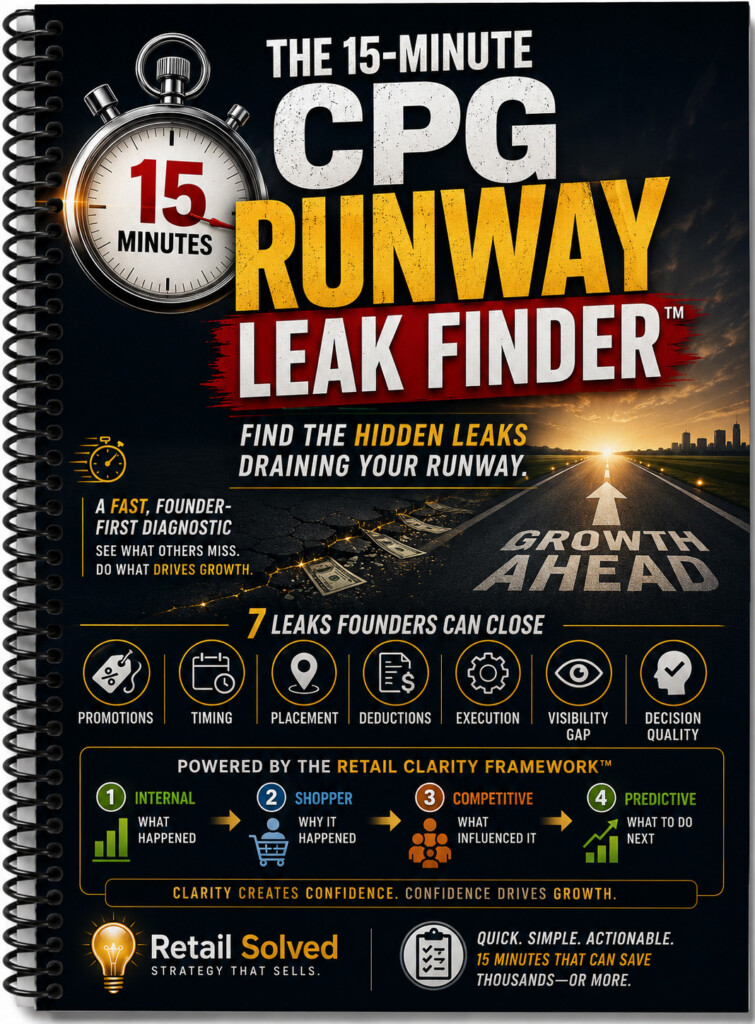
Start here: Find where your CPG brand is losing cash, margin, and runway.
In about 15 minutes, identify the leak creating the most pressure so you know where to look first.
No friction, no email required.
Retail Operating System™
The complete 11-module framework for protecting margin, optimizing trade spend, and scaling distribution with confidence.
Retailers run on systems.
Most brands run on hustle.
That gap is expensive.
The Retail Operating System™ is the only structured, data-driven retail growth framework built by a Certified Professional Strategic Advisor who has sat both in the founder seat and across the table from retailers.
It gives emerging CPG brands the same operational discipline, trade strategy, and category leverage that big brands use — simplified and systemized to protect margin, optimize trade spend, and extend runway while scaling distribution.
This is not education.
It’s infrastructure.
Image is the property of CMS4CPG LLC, distribution or reproduction is expressively prohibited.