
Cutting slow-selling SKUs can improve shelf velocity and simplify a planogram. It can also remove the reason a valuable shopper chose that retailer—taking the trip and the rest of the basket somewhere else.
In Episode 344 of Bulletproof Your CPG Brand, I use a premium-laundry example from my retail experience to explain why a mathematically reasonable assortment cut may still be the wrong category-management decision. We examine what item-velocity reports measure, what they cannot automatically see, and why shopper needs, trip missions, retailer economics and the total basket belong in the same conversation.
Facing an assortment or shelf decision that the report doesn’t fully explain?
https://retailsolved.com/DecisionTools
Retail Clarity Decision Tools are designed to connect the data to the actual retailer and shopper decision. This is a professional problem-solving resource, not a promise that every SKU should be saved.
IN THIS EPISODE
– Why inflation can temporarily change the apparent product mix
– How a retailer can improve an item metric while risking a valuable shopper or basket
– Five questions before a SKU, format or segment is removed
– How a smaller brand can make itself more useful to the retailer
CHAPTERS
00:00 The risk behind cutting SKUs
01:14 The retailer competes for the entire shopping trip
01:53 Category velocity vs shopper and basket value
02:36 When the metric is right but the retailer loses
03:03 What the existing data cannot automatically see
04:05 Five questions before removing products
05:04 Inflation’s temporary mix shift
05:57 Make the retailer’s next decision better
06:32 Your Retail Muscle rep
06:47 A better frame for your next shelf decision
WATCH NEXT — Episode 342: Category Management: When the Math Is Right and the Decision Is Wrong
https://www.youtube.com/watch?v=SakWSXenzy0
I’m Dan Lohman. Retail Solved helps CPG founders and growth-stage brand teams make better retailer, category and shopper decisions that protect runway and build productive growth.
Listen where you get your podcast








Like what you’ve heard?
Please leave a review and comment on iTunes
Let me know your most pressing question, I’ll do my best to answer it on a future episode.
EPISODE 344 Retailers Are Cutting SKUs. Here's What They Risk Losing. Inflation changes what shoppers buy. A retailer sees faster-moving, lower-priced products and says, "Give them more space." On paper, that can look smart. It can also teach one of your most valuable shoppers to buy the category somewhere else. I've watched versions of this play out across categories for decades. Let me use a familiar example from my experience at Unilever. Laundry detergent. Think about what happens when inflation changes the shopper's math. Large liquid packages may start looking more attractive on a price-per-load basis. Some premium formats may slow. A retailer looking only at the current category mix can reasonably say: "Pods are slowing. Give more space to liquid.” Or perhaps, “premium brands are slowing so give more space to discount brands”. That may improve the velocity of the remaining shelf. But before you celebrate, I want to know something else. Which shopper did you just invite to leave the store? I’m Dan Lohman. This is Bulletproof Your CPG Brand, where every week I share an expensive retail lesson so you can learn it before your brand has to pay for it. Now, Let’s roll up our sleeves and get started. Traditional grocery has been fighting this battle for years. A supermarket does not compete only against the supermarket down the street. It competes against mass. Club. Online. Subscription. Amazon. Every time a traditional grocer removes one more reason for a valuable shopper to complete the trip in its store, it makes the competitor's job easier. Detergent is a perfect example because it can be a trip catalyst. If the premium format I want is not there, I may not simply substitute to the cheapest bottle on the shelf. I may buy the detergent somewhere else. And once I am there, what happens to the rest of my household basket? That is why category management cannot stop at item velocity. Velocity matters. Space productivity matters. Holding power matters. Margin matters. But the retailer does not manage one SKU in isolation. The retailer manages a shopping destination. That is why the exact same decision can look smart from one seat and expensive from another. Category says, "The premium format slowed." Finance says, "Free the space." Operations says, "Fewer SKUs are easier." The shopper says, "Fine. I'll buy it somewhere else." And the basket follows that shopper to the competition down the street. This is the point I keep coming back to. The department can be right about its metric. The retailer can still lose the shopper, the trip and the basket. Years ago, I saw the same thing in a very different context while working for Kimberly-Clark. The tempting answer looked like a huge immediate payday for the retailer. But the bigger question was not, "Can we make money on this decision?" It was, "Does this make sense for the retailer, the shopper and the long-term business?" Those are different questions. And this is why I care so much about what the data can actually see. This matters even more to small brands without the deep pockets to absorb dramatic assortment changes. Years ago a huge retailer adopted a strategy to remove all but the top brands and their private label. The logic was fewer choices and better velocity. But the risk is that when you remove a product serving a distinct shopper need, you may not simply transfer those sales to the items that remain. You may send the shopper and the rest of the basket to another retailer. Here’s why this matters. If all I give a model is the transactions inside my four walls, it can become incredibly good at explaining what shoppers bought from the assortment I decided to offer. It cannot automatically show me the demand I removed. It cannot see the shopper who stopped coming. It cannot see the basket that moved to another retailer unless I have a data source that actually observes that behavior. That missing demand matters. So here is a simple way to pressure-test a space decision. Before you cut a segment, format or group of SKUs, ask five questions. One: Who buys this? Not who buys the category in general. Who buys the exact products you are removing? Two: What job does this product do for the shopper? Convenience? Premium experience? A specific need state? A dietary requirement? A family size? A particular occasion? Three: Where will that shopper go if you remove it? Another SKU? Another category? Another store? Online? Four: What else is connected to that trip? That is the basket question. How will the basket change within the store? How will the change impact the other items shoppers purchase when they purchase the item that was removed. And five: What does the retailer actually gain from the cut? More productive space? Lower inventory? Simpler replenishment? Better margin? Or just a cleaner planogram? Those are not the same thing. This is where inflation-driven assortment decisions get interesting. The mix may have changed. The sales data may be accurate. But a temporary response to price pressure is not necessarily the shopper's permanent preference. The dangerous move is to treat a short-term buying shift as a complete, permanent answer about the category. Those decisions rarely turn out well for retailers, especially as they trade down for a less valuable shopper - when you consider the basket - their total purchase at checkout. I want to know what happens when the pressure changes. Will the shopper resume their old buying habits? Perhaps at a new retailer? I want to know which shopper is being retained. I want to know whether the retailer is protecting a need state competitors are willing to serve. And I want to know whether the shelf is maximizing the whole retailer opportunity, not simply the average velocity of the remaining items. That is the kind of question I want brands to bring to retailers. Not: "We need more space." But: "Here is what your shopper is telling us. Here is what this part of the category does. Here is what you gain by protecting it. And here is the risk if the decision is made only from the topline." That makes you useful. It makes the retailer smarter. And it gives a smaller brand a way to contribute that does not require outspending the biggest company in the aisle. More specifically, how does the unique shopper your brand attracts benefit the retailer and the category. Your Retail Muscle rep this week is simple. Pick one category decision that looks obvious. Then ask: If we optimize this metric, what valuable behavior could disappear somewhere else? That is where some of the best opportunities hide. If you have a retailer decision that looks logical but something about it does not quite fit, bring me the report and the decision. RetailSolved.com/DecisionTools. Sometimes the number is not wrong. Sometimes you just need a bigger frame. I'm Dan Lohman. Thanks for listening. Learn the expensive lesson before your brand has to pay for it. You can get the founder problem finder and the show notes at retailsolved.com/session344
Enter your name and email address below and I'll send you periodic brand building advice, tips and strategies.
Sign up to receive email updates
FREE Trade Promotion ROI Calculator:
Click Here To Maximize Sales And Profits
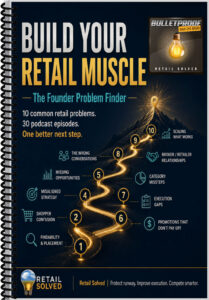
335+ podcast episodes. Start with the problem in front of you.
Choose the retail problem you are facing and get three conversations, one practical action, and the next resource to help you build that muscle.
Retail Operating System™
The complete 11-module framework for protecting margin, optimizing trade spend, and scaling distribution with confidence.
Retailers run on systems.
Most brands run on hustle.
That gap is expensive.
The Retail Operating System™ is the only structured, data-driven retail growth framework built by a Certified Professional Strategic Advisor who has sat both in the founder seat and across the table from retailers.
It gives emerging CPG brands the same operational discipline, trade strategy, and category leverage that big brands use — simplified and systemized to protect margin, optimize trade spend, and extend runway while scaling distribution.
This is not education.
It’s infrastructure.
Image is the property of CMS4CPG LLC, distribution or reproduction is expressively prohibited.


Leave A Comment