
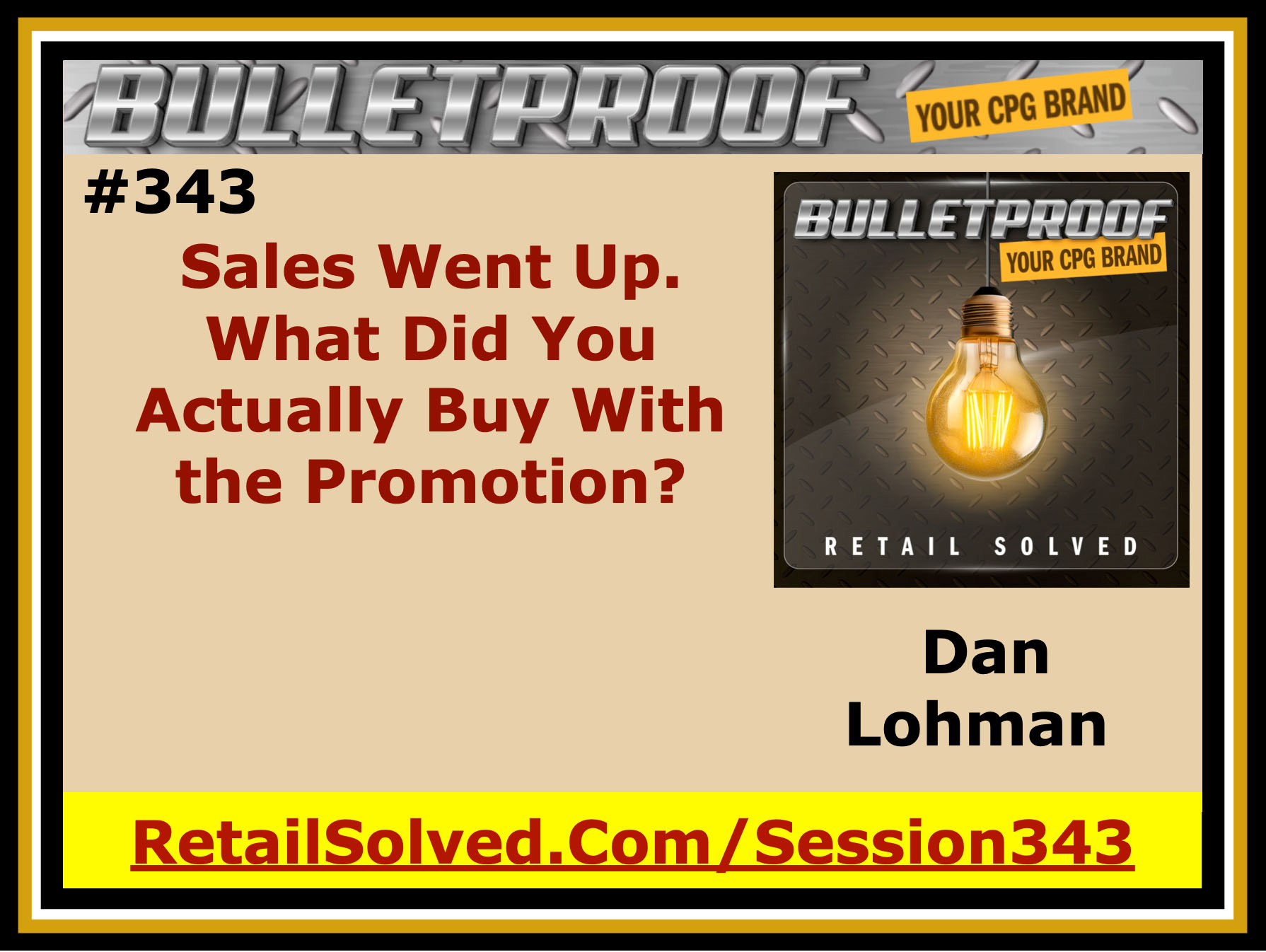
Imagine a promotion lifts sales by 35%. That sounds like a win. But did you acquire a valuable shopper, create a new occasion, increase the basket, earn repeat purchases, or simply pay someone to buy three weeks of product early?
In Episode 343 of Bulletproof Your CPG Brand, I explain why measuring trade promotion ROI requires more than looking at sales lift. An event can look great on the chart while margin erosion, allowances, retailer deductions and delayed cash recovery leave the brand with less working capital.
I also share a lesson from selling chips against a national competitor with a much larger promotion budget. Rather than copying its buy-one-get-one-free events, I promoted earlier to influence shopper timing. The strategy helped us create a more useful outcome for the retailer, reinforced by reliable execution and stronger retail relationships.
You’ll learn the three questions I ask about every promotion: SOURCE, RETENTION and INCREMENTALITY. Then I’ll walk through five planning questions you can use before spending the next dollar.
Your Retail Muscle rep: Choose the next promotion on your calendar. Define its job, the shopper behavior you want to change, expected volume source, retailer value, true cost, and the evidence you’ll review afterward. Decide what you’ll do if your assumption is wrong.
Free tool: https://retailsolved.com/promotion-analysis/ — Use the calculator without an email. Email yourself a scenario only if you want a copy for later comparison.
Show notes and free Founder Problem Finder: https://retailsolved.com/session343/
The goal is not to prove the last promotion worked. It’s to make the next decision better.
Listen where you get your podcast







Like what you’ve heard?
Please leave a review and comment on iTunes
Let me know your most pressing question, I’ll do my best to answer it on a future episode.
EPISODE 343 Sales Went Up. What Did You Actually Buy With the Promotion? Imagine your promotion lifted sales 35 percent. Congratulations. Now tell me what you bought with the money. Did you buy a new shopper? A new occasion? A bigger basket? Competitive switching? Trial that repeated? Or did you pay a shopper to buy three weeks of product early? Sales lift is real. If you are trying to calculate your trade promotion ROI, that sales lift is only the beginning. It just does not answer the whole question. Years ago, we were up against a national chip brand with a much bigger promotion budget. Instead of copying their buy-one-get-one-free event, I changed the week we promoted. It changed when shoppers bought, and it gave the retailer a reason to work with us. I'll show you why that matters more than simply reporting a sales spike. I’m Dan Lohman. This is Bulletproof Your CPG Brand, where every week I share an expensive retail lesson so you can learn it before your brand has to pay for it. Now, Let’s roll up our sleeves and get started. This is one of the reasons trade spend can become so expensive. This is also one of the most frustrating and confusing aspects of managing a brand. Let me simplify this in a way that gives your brand the edge it deserves. But first, does this sound familiar? Most brands promote because they are told they need to but few, including big brands effectively use their trade spend to drive sustainable sales. Let me explain what I mean by that and why this matters. The report comes back. Both dollars and units up. The team calls it a win. Then finance looks at the margin. The total trade investment. The deductions. What happened to sales after the promotion. Did sales spike during the promotion but then quickly returned to normal? And then the cash actually available for the next production run. Someone finally asks: "What exactly happened?" A promotion can look great on the sales chart while extra allowances, short-pays or disputes in the form of deductions tie up the working capital you needed to grow. Even when you recover that money later, you could not use it when you needed it. The retailer may also be asking a different question. They may care about traffic. Basket growth. Category growth. Margin. The Competitive response. A specific seasonal mission. The brand may care about trial. Repeat. Incremental units. Profit. Cash. Both sides can look at the same event and define "worked" differently. And here is the trap in repeating last year's promotion because it was "successful": if nobody stated the objective up front, you cannot meaningfully improve the next one. Now, let me show you a better more effective way to drive profitable growth with your trade spend. Before I evaluate the promotion, I want three words. SOURCE. RETENTION. INCREMENTALITY. SOURCE means: where did the volume come from? Did we take share from a competitor? Cannibalize ourselves? Pull future purchases forward? Bring in a new shopper? Take volume from outside the category? If you do not know the source, you do not fully understand the lift. RETENTION means: what happened after the event? Did the shopper buy again? Did the base business strengthen? Did we keep any of the trial? Did the retailer keep the shopper or trip? INCREMENTALITY means: what happened that would not otherwise have happened? That is the hard question. I learned this years ago selling chips. The largest competitor had a lot more money than we did and regularly ran buy-one-get-one-free events around the biggest chip occasions. I could not match that. So I stopped trying. I promoted one week earlier. The idea was to get shoppers to pantry-load before the national promotion even started. By the time the competitor's event arrived, many households already had chips at home. That did not simply change our discount. It changed the shopping pattern. And because our company also supplied the retailer's private-label chips, stronger traffic and displays helped more than our branded item. That gave the retailer a reason to care. Execution did the rest. We kept displays full. Protected availability. Made the store's job easier. Over time the retailer gave us better display opportunities and reduced some extra fees. The lesson is not "always promote one week early." Please do not take that from this. The lesson is to decide what behavior you are trying to change before you spend the money. This should be your first question before you plan any promotion or event. The national competitor's BOGO looked enormous on a sales chart. My objective was different. Change when the shopper bought. Help the retailer win. Execute better. Create a result worth repeating. That is why I use five questions before a promotion. 1. What job should it do? 2. What shopper behavior should change? 3. What does the retailer gain? 4. What is the true cost? 5. What should happen next? Notice what is missing. I do not begin with: "What discount should we run?" Discount is a lever. It is not the strategy. This is also why I want you to stop retrofitting the objective after you see the sales chart. Before the promotion begins, write: We believe this event will ______. Then After the event, ask: What evidence would prove that happened? Now you have something to learn from. Maybe the event did not hit the sales target but brought in a valuable new shopper. Maybe sales exploded but the volume was mostly pantry loading that crushed the next four weeks. Maybe the event worked for the retailer and lost money for the brand. Maybe the brand made money while the retailer got no category growth. Those require different next decisions. Remember that little improvements or adjustments to your plan compound over time. This is the secret to maximizing your trade spend ROI and to giving your brand the edge it deserves. Your Retail Muscle rep this week: Take the next promotion on your calendar. Before anyone changes the discount, write down: The job of the promotion. The shopper behavior you want to change. The source of expected volume. The retailer benefit. The complete cost. The evidence you will review afterward. Then decide what you will do if the hypothesis is wrong. I’ve made this super simple and easy to do. I built a free Trade Spend Efficiency and Promotion Analysis Calculator to help you explore the cost, model a promotion and see which levers matter before you commit the money. You can also return after the event, enter the actual results and compare your plan with what happened. This is where the real benefit is - learning what actually worked and building on it for the next promotion! Go to RetailSolved.com/promotion-analysis/ You can test your own numbers without giving me an email address. If you want a copy of the scenario, you can email the report to yourself to compare to the actual results. Use the calculator. But remember what I keep saying. The tool can help you model the event. You still need to decide what job the event is supposed to do. Sales went up. Great. Now tell me what you bought. I'm Dan Lohman. Thanks for listening. Learn the expensive lesson before your brand has to pay for it. You can get the founder problem finder and the show notes at retailsolved.com/session343
Enter your name and email address below and I'll send you periodic brand building advice, tips and strategies.
Sign up to receive email updates
FREE Trade Promotion ROI Calculator:
Click Here To Maximize Sales And Profits
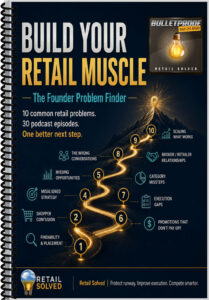
335+ podcast episodes. Start with the problem in front of you.
Choose the retail problem you are facing and get three conversations, one practical action, and the next resource to help you build that muscle.
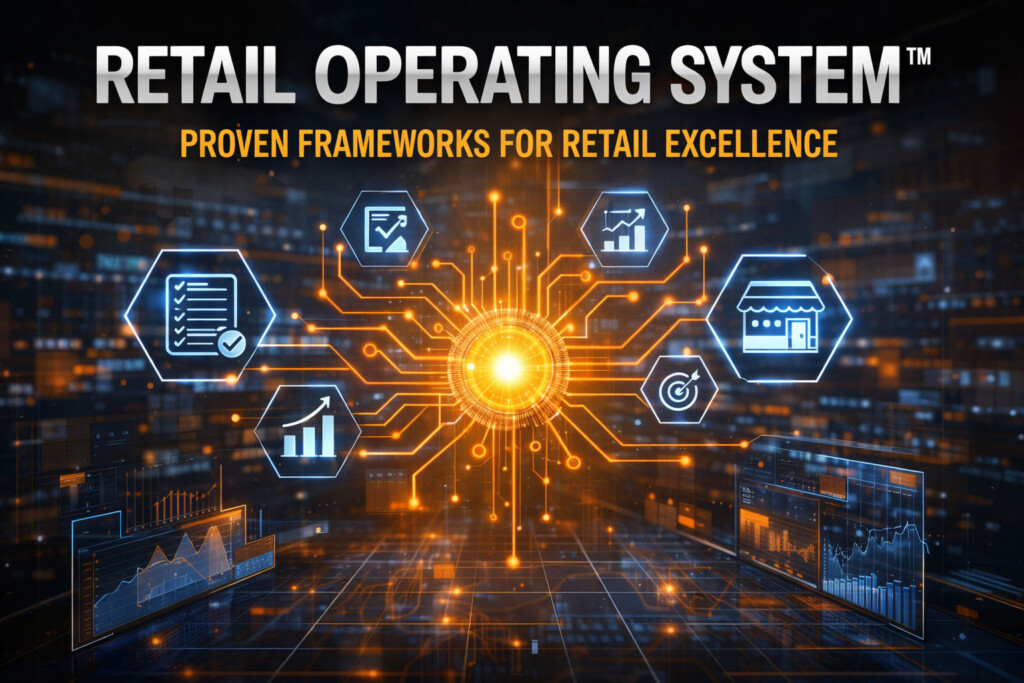
Retail Operating System™
The complete 11-module framework for protecting margin, optimizing trade spend, and scaling distribution with confidence.
Retailers run on systems.
Most brands run on hustle.
That gap is expensive.
The Retail Operating System™ is the only structured, data-driven retail growth framework built by a Certified Professional Strategic Advisor who has sat both in the founder seat and across the table from retailers.
It gives emerging CPG brands the same operational discipline, trade strategy, and category leverage that big brands use — simplified and systemized to protect margin, optimize trade spend, and extend runway while scaling distribution.
This is not education.
It’s infrastructure.
Image is the property of CMS4CPG LLC, distribution or reproduction is expressively prohibited.
Leave A Comment