We were the category leader with nearly twice the sales share of our nearest competitor.
The retailer still planned to remove us.
By the time I walked into the meeting, they told me the decision had essentially already been made.
What changed their mind taught me one of the most important retail lessons of my career:
Getting onto the shelf isn’t the win. Becoming irreplaceable is.
Getting the retailer to say yes is a big win.
It is not the finish line.
Years ago, a retailer was preparing to discontinue a category-leading brand I worked with, even though we had nearly twice the sales share of our nearest competitor.
Another sales deck was not going to save us.
Instead, I showed the retailer something different: who our shopper was, what else she bought, how valuable her basket was, and what the retailer could lose if that shopper went somewhere else.
The decision changed.
That experience helped shape the way I think about retail today.
Getting onto the shelf is only the first win. The real opportunity is becoming valuable enough to the shopper and the retailer that you become increasingly hard to replace.
In Episode 340 of Bulletproof Your CPG Brand, we unpack what that actually means for challenger brands.
You’ll learn:
- why your sales velocity tells only part of your retailer value
- the two questions every brand should ask: would the shopper miss us, and would the retailer miss us?
- why challenger brands should stop trying to outspend larger competitors and start outlearning them
- why a retailer report can tell you what happened without explaining why it happened
- how Retail Muscle makes AI more useful rather than less important
- why authorization does not guarantee shelf availability, trial, repeat, or productive distribution
- how to become a useful resource to the retailer instead of another vendor asking for more space
- the three-question Irreplaceability Test you can use with your most important retailer
Big brands may have bigger budgets.
Challenger brands can be closer to their shoppers, learn faster, experiment faster, and turn what they learn into better decisions.
You don’t have to outspend them. Outlearn them.
Listen where you get your podcast








Like what you’ve heard?
Please leave a review and comment on iTunes
Let me know your most pressing question, I’ll do my best to answer it on a future episode.
Episode 340 Getting Onto the Shelf Isn't the Win. Becoming Irreplaceable Is. One of the biggest consumer brands in the world just disappeared from Kroger shelves. We don't know the confidential business reason behind what happened, and I'm not going to pretend we do. Red Bull doesn't own the retailer's shelf. The retailer controls some of the most valuable real estate in their store. GETTING ONTO THE SHELF And no, I don't mean that literally. I mean becoming valuable enough that if your brand disappears, the shopper loses something and the retailer loses something. That's a completely different way to think about retail growth. Are you ready to hear more. That's what we're going to unpack today. I'm Dan Lohman, and this is Bulletproof Your CPG Brand. There's a free guide with every episode to help you put what we talk about into practice. Let's roll up our sleeves. Years ago, I got a panicked phone call from a sales rep first thing Monday morning. I quickly scheduled an appointment with the retailer for that Friday morning. By the time I got there, they had essentially made the decision. In fact the SVP for the retailer said that while they had made their decision, they were going to give me the courtesy of the meeting. That is exactly why I keep talking about how important it is to become trusted value added resource for your retail partners. Without the earned trust, the meeting would not have happened and we would not have had an opportunity to present our case. I could have walked into that meeting with another lengthy deck explaining our sales with what mades our brand unique just like most brands do. I could have talked about market share and I could have explained why our brand deserved the space. I didn't. I showed them who our shopper is and how they were different from our competitors shoppers. I showed them how they were loyal to our brand as well as the specific categories the retailer cared about the most; their produce department, their meat department, their deli, and their prepared foods. These were all signature categories for the retailer and these were their biggest point of differentiation between them and from other retailers in the market. Then I talked about what mattered to our shoppers, how she spent money in their stores, how our shopper had a dramatically larger basket than the competition - what they spent on on average per shopping trip to the retailers stores when our item was in their shopping basket. Then I talked about our competitor - the one that was trying to literally buy our shelf space and have us discounted. I did not bad mouth them. Instead, I showed the retailer how their shoppers were loyal to price and how their shoppers would chase the best price even if it was at the retailers competitors. Now my goal was simply to keep our brand on the shelves - period. I understood how discontinuing the largest national brand would negatively impact the retailers category and force our shoppers to buy our brand at their competition. What happened was unexpected. First thing Monday morning the SVP called and said that our brand was in and our competitor was out. I’ve heard and seen different versions of this thoughout my career. This was not an isolated incident. This is especially true for large brands looking for space. This is also why this needs to be a warning to challenger brands. Getting onto the shelf earns you the opportunity. Becoming irreplaceable requires a different playbook. That experience changed the way I thought about retail. We did not save the shelf by asking the retailer to care more about our brand. We made the retailer's decision easier by showing them something useful about their shopper and their business. That's the difference. If you're already selling in retail, or you're trying to get there, subscribe. What happens after the buyer says yes. Every week I want to take one problem that can cost a challenger brand distribution, margin, cash or runway, understand why it happened, and help you make one better decision. That's the Retail Muscle we're building here. The shelf is not a trophy A lot of founders spend years dreaming about the buyer saying yes. But the retailer did not award you a trophy. They gave you access to scarce real estate. The retailer gave you access to the shelf. They did not guarantee you the sale. Your job begins after the yes. And now that space has to produce for the retailer. And what matters is different by retailer, category and item. That is why simply telling the buyer: The buyer's question is: What “irreplaceable” really means I think about it in two directions. First: Not: Would they notice if you disappeared? Are you solving a need or occasion another item doesn't solve the same way? You may have fewer shoppers. But if they love what you do, understand why they buy you, tell their friends and intentionally seek you out, that matters. Then look in the other direction: WOULD THE RETAILER MISS YOU? What do you add beyond your own sales velocity? Do you make the retailer smarter about the category? That is where the moat starts getting interesting and this is where challenger brands have a unique advantage - if they take advantage of it. +9% proof One strategy I worked on for a major retailer helped grow the retailer's category by about 9%. Our goal wasn't: Our goal was: That meant looking beyond our own products. That's what I mean when I talk about becoming a valued resource. You stop being another company asking the buyer for something. You become someone who occasionally walks into the room with something the buyer can actually use. Retailers sometimes reward useful brands with incremental opportunities unavailable to others. That's important. Ask: “Why should I care about helping the retailer instead of just selling my stuff?” Small brands should not fight the big-brand battle This is where I think challenger brands sometimes make a mistake. They look at the biggest company in the category and try to play their game. You probably can't. Trying to win dollar for dollar is usually a terrible fight to choose and it is almost a waste of resources and runway. But you have advantages too. You can be closer to your shopper. And because you are smaller, scrappy, and more agile, a little bit of proprietary shopper knowledge can change the entire strategy. Big brands can buy reach. Challenger brands can build intimacy. YOU DON'T HAVE TO OUTSPEND THEM. That is one of the ways David beats Goliath in our industry. Not by pretending to be bigger. By being smarter about where the stone needs to land. This is where brands get fooled by the report Here is another reason this matters. A retailer portal might tell you sales are down. Useful. But now what? Was it because you lost stores? Without the context, the number can tell you what happened and still hide why it happened. Did the category fall? The report is the beginning. WHAT HAPPENED? That is one of the muscles I want brands to build. Why what happened happened. Because until you understand that, you don't know what to fix. AI makes this more important, not less Retail Muscle does not compete with AI. It makes AI more valuable. If your team understands the shopper, retailer, category, economics and the limits of the data, AI can help you explore ideas faster. But if you give AI an incomplete picture and ask it for the answer, it can help you reach the wrong answer much faster and with much more confidence. This is why I worry about some of the promises being made to brands. The last point matters a lot! That is the danger. A bad spreadsheet might look suspicious. A polished AI response can make an incomplete answer feel authoritative. The better the tool gets, the more important it becomes to know: We'll go much deeper into that in another episode. Authorization is only the first link There is also a very practical piece of becoming hard to replace. The buyer can authorize you. This is where poor execution can result in huge leaks. Neither guarantees that your shopper saw it, bought it and came back. Someone inside the brand still needs to understand what happened on the shelf. You can outsource work. You cannot outsource the understanding required to manage the work. Be useful before you need something And here's a test I wish more brands would use. Imagine your retailer calls tomorrow. They ask: Could you answer? Could you tell them something useful about the shopper? If the answer is no, don't feel bad. Because when you consistently help the retailer understand their business better, something changes. You become more than another vendor asking for another facing. You become useful. And useful is much harder to replace and this is where challenger brands can gain a huge edge. The irreplaceability test Here is the practical rep I want you to do this week. Pick your most important retailer. Finish these three sentences. That third question is what keeps “irreplaceable” from becoming motivational fluff. That last one is important. Show me. And if you cannot fill in one of those blanks, congratulations. You just found your next Retail Muscle rep. This is the long-term moat This is how I want challenger brands to grow. I want every retail problem you solve to make the company a little smarter. Because competitors can copy a discount. What they cannot instantly copy is years of learning about: When that learning becomes the way your company makes decisions, it becomes part of your competitive advantage. That's Retail Muscle. If you're listening to this and thinking: It doesn't ask you to figure out which one of my many guides, courses or podcast episodes you need. It starts with the retail problem sitting in front of you. Then choose how you want to solve it. Work through the free resources yourself. Build the capability more deeply. Or, if the problem is expensive enough that you need another set of eyes, bring it to me. One problem. Getting onto the shelf is a win. But don't confuse getting the opportunity with winning the opportunity. The retailer gave you the shelf. Now give the retailer and the shopper a reason to want you there. Become the brand shoppers look for. Learn faster than the companies you're trying to beat. And keep getting better. Because getting onto the shelf isn't the win. Becoming irreplaceable is. I'm Dan Lohman and this is the bulletproof your CPG brand. Find the problem. Before you go, I want you to answer one question. If your brand disappeared from your biggest retailer tomorrow, what would the shopper or retailer actually miss? Put it in the comments. And if you're already in the stores and trying to make those stores actually work, watch Episode 338 next. This week's free download is the Founder Problem Finder. If one of those three blanks was hard to answer, use it to identify the next Retail Muscle your brand needs to build. You'll find it with the show notes at RetailSolved.com/session340.
Enter your name and email address below and I'll send you periodic brand building advice, tips and strategies.
Red Bull.
But there is a lesson here that every challenger brand should pay attention to.
Neither do I.
Neither do you.
Getting access to it is a huge win.
But it isn't the finish line.
ISN'T THE WIN.
BECOMING IRREPLACEABLE IS.
No brand is impossible to replace.
A retailer was preparing to remove our brand from the shelf. We were the category leader with nearly twice the sales share as our nearest competitor.
I showed them something different instead.
Because this channel is increasingly about something I don't think the industry spends enough time teaching:
Whole Foods said yes.
Kroger said yes.
Sprouts said yes.
Target said yes.
Congratulations. Seriously.
It might need to generate sales.
Margin.
A new shopper.
A bigger basket.
A new occasion.
Shopper Traffic.
Introduce new Innovation.
Something the category was missing.
“We're growing really fast.”
isn't enough.
WHAT ARE YOU DOING FOR ME?
WOULD THE SHOPPER MISS YOU?
Do they recognize the logo?
Would they go somewhere else to find you?
Would they substitute something else?
Would they buy less of the category?
Would the basket change?
That is where small brands can be incredibly powerful.
Do you bring in a different shopper?
A different occasion?
A more valuable basket?
Better category economics?
Incremental sales?
New Innovation?
Do you execute reliably?
Do you follow through?
How do we protect every one of our items?
How do we make this category work better for this retailer and its shoppers?
Looking at who the retailer was trying to attract.
Looking at the category.
Looking at the assortment.
Looking at what shoppers actually needed.
And then helping the retailer make a better decision.
Because retailer value can create opportunities money alone cannot buy.
The bigger company may have far more money for promotions, additional distribution, displays, field support, data and people.
You can listen without waiting for a massive research study.
You can notice a problem and change direction next week.
You can experiment.
You can learn.
OUTLEARN THEM.
That's what happened.
Lost an item?
Changed price?
Changed promotion?
Went out of stock?
Lost a display?
Changed placement?
Did the competitor promote?
Did shoppers move to another pack size?
Did the retailer change something?
Not the answer.
IS NOT THE SAME QUESTION AS:
WHY DID IT HAPPEN?
And this is why I am actually excited about AI, when you know how to use it properly.
Pressure-test possibilities.
Compare scenarios.
Find patterns.
Move faster.
What question am I actually trying to answer?
and
What can't this information see?
That does not mean the shopper can buy you.
A broker can get the authorization.
A distributor can ship the case.
They don't ask:
“How is your brand doing?”
“What are you seeing in my category that I should care about?”
Without immediately talking about your product?
An occasion?
A competitor?
A gap?
A behavior you're seeing?
Something happening in their stores?
Something they might want to test?
That's the muscle to build.
Not every retailer.
One.
1. If our brand disappeared tomorrow, our shopper would lose ______.
Then:
2. If our brand disappeared tomorrow, the retailer would lose ______.
Then:
3. The evidence we have to prove that is ______.
Prove it.
That is Retail Solved.
Because “our customers love us” is not a retailer strategy.
Talk to the shoppers.
Look at the basket.
Look at repeat.
Look at velocity.
Look at the category.
Look at the stores.
Look at the occasion.
Find something real.
Not simply:
More stores.
More sales.
More people.
Bigger.
A little more useful.
A little harder to replace.
They can hire the same broker.
They can buy the same syndicated data.
They can use the same AI.
your shopper,
your retailer,
your category,
your mistakes,
your wins,
and why what happened happened.
“I know we have a problem. I'm just not sure which one to start with.”
That's exactly why I rebuilt Retail Solved.
Go to:
RetailSolved.com/start
One retailer.
One decision.
Then build the learning into the business.
Celebrate it.
You earned it.
Become the resource the retailer trusts.
Solve that.
Build the next muscle.
Sign up to receive email updates
FREE Trade Promotion ROI Calculator:
Click Here To Maximize Sales And Profits
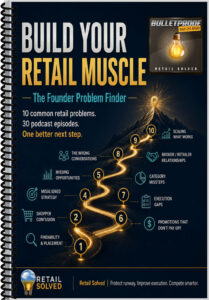
335+ podcast episodes. Start with the problem in front of you.
Choose the retail problem you are facing and get three conversations, one practical action, and the next resource to help you build that muscle.
Retail Operating System™
The complete 11-module framework for protecting margin, optimizing trade spend, and scaling distribution with confidence.
Retailers run on systems.
Most brands run on hustle.
That gap is expensive.
The Retail Operating System™ is the only structured, data-driven retail growth framework built by a Certified Professional Strategic Advisor who has sat both in the founder seat and across the table from retailers.
It gives emerging CPG brands the same operational discipline, trade strategy, and category leverage that big brands use — simplified and systemized to protect margin, optimize trade spend, and extend runway while scaling distribution.
This is not education.
It’s infrastructure.
Image is the property of CMS4CPG LLC, distribution or reproduction is expressively prohibited.