Getting into retail is a big win.
But for many founders, that is where a different set of problems begins.
In this episode of Bulletproof Your CPG Brand, Dan Lohman sits down with Julia from Livemore Superfoods to talk about what happens after the retailer says yes. Julia shares how Livemore grew, what they learned the hard way about retail expansion, and why being in more stores does not automatically mean the business is stronger.
One of the most valuable lessons from this conversation is simple:
The goal is not just getting into stores. The goal is making those stores actually work.
Dan and Julia discuss:
• why getting distribution and building productive distribution are not the same thing
• how spreading a brand across too many retailers, regions, or channels can weaken support
• why concentrated effort helps build awareness and velocity
• how customer learning can lead to better product decisions
• why founders need to think beyond the yes
If your brand is already in retail but the results are not where you want them to be, this conversation will help you think differently about what happens next.
Listen where you get your podcast








Like what you’ve heard?
Please leave a review and comment on iTunes
Let me know your most pressing question, I’ll do my best to answer it on a future episode.
338 We finally got the stores. Now how do I make those stores actually work?
Enter your name and email address below and I'll send you periodic brand building advice, tips and strategies.
Exactly.
Yeah, we've learned the hard way with that, but I think you have to
learn and learn quickly and pivot to focus
your efforts in the right retailer right region.
I think something that I'm sure you've talked to others about
is when you're like scattered across the US and conventional and natural.
How do you really drive velocity awareness?
And I think that's what we're doing a better job of now with the rebrand
is staying very focused in one area, making
sure you're in the right accounts and not spreading yourself too thin.
I think that's something that we tried to do and had a lot of learnings with.
Ready to hear more?
I'm Dan Loman.
And this is the bulletproof your CPG brand podcast.
There's always a free guide at the end of every episode to
help you go deeper into topics we cover.
Now, let's roll our season and get started.
Julia, thanks for coming on today.
Can you please tell me a little bit about yourself and how you got to where you're at today?
More importantly, why did you start this business?
But tell me about yourself first.
Perfect.
Well, thank you for having me.
Very excited to have the opportunity to speak with you.
Um, I'll start with my family background.
I am 4th generation in the fruit business.
My family's been selling fruit for almost 88 years.
My great grandfather was one of the 1st importers
of boys and berries to Knotts Berry Farm from New
Zealand to California.
So if you've had Boys and Mary J.
He was very instrumental in the launch of that
jam as well as my grandma got into the business as one
of the 1st female entrepreneurs in the fruit business.
So was very incredible to watch her growing
up in the business.
And then my dad got involved and just
really loved creating new products.
So he was one of the 1st innovators of dried pomegranates,
dried bananas, if you've had those before, um, growing up.
All the dried fruit was like candy to my sisters and I
and really was inspired by all the innovation.
And then on a different note, he
actually had brain surgery when I was about 10 years old and went
through a lot of health struggles, was in and out of doctors offices and
really taught my sisters and I that there's nothing more important than your health.
So that's what really inspired my dad and I to start live more.
And we have been building the brand for
almost 8 years.
So, in college, I already kind of knew
what I wanted to do and studied business and nutrition at
USC in Los Angeles and really, my
passion is helping people eat better.
So, uh, Livemore was really born to help
people feel better, live better, live more.
And we've been really proud of what we've built, so excited
to tell you more about it.
Looking forward to that.
Thank you so much for recapping all that.
So let's back up to the farm part.
I thought you actually lived on a farm.
You were a distributor or do you live?
So talk about that.
Because you then, I'm assuming you had all different kinds of
fruits coming in.
So how did that work?
Where did you get them from New Zealand?
So our strongest partners are out of South America.
So actually in Chile, and I'll
tell you more about that partnership, but really my dad has
been working with the largest, um, grower
partners, farmers in South America for 35 years.
So we're really strong in berries actually and
been importing berries into the United States for
quite some time now.
So I would say, I don't never lived on a farm.
We've had a lot of partnerships with farmers and well,
we, my family's done really well is building relationships
with farmers around the globe.
Appreciate that.
So, let's jump forward to where you're at now.
Let's talk about the product, but more importantly, you said
that you wanted to put together something or create something that
would help people be healthier.
Let's talk about that and then why this product fits in that space.
Mm-hmm.
So really, we believe that simple ingredients are
the best nutrition.
So whole foods and my dad and I are very
big on the berries, antioxidants.
We believe less is more.
So going back to our roots of fruit.
We've started with blends of berries
that have been in Costco now, almost 9 years.
And then what we developed together was
smoothie cups.
So you can make a smoothie in a minute, and we were
the 1st to retail with this format.
Um, and in the smoothie cups, we started very basic,
just fruits and cups, and then now we've
really transformed to the next level where you
have nuts and seeds, and then we have formulations
with different functionality.
So really focused on immunity, energy,
protein and helping people get something out of their
daily smoothie.
I think that's great.
In fact, actually, when you were saying that, I was thinking about how I used to go to the
store, Costco, et cetera, and buy a huge bag full of mix,
but then you're kind of stuck with that flavor.
I like the fact that you have the variety in terms of what you're doing.
So please talk about that.
And then you said that some of them offer immunity, different different functionality.
So how did you build that out?
And then why?
Well, originally, we had seen a competitor
that had done 2500000 in annual revenue,
selling just direct to consumer, and really, their
products were $9, $10 a smoothie cup.
And because we're vertically integrated with our farmers and
growers, we're able to offer something more affordable.
And we believe that going to retail first, um,
was the right move for us because you can drive
trial where someone could buy one smoothie
cup for five, $6 and, um,
we really started there at the retail channel and
started simple where we had, it
was called Mind Over Mango, and it's mango, goji berries,
bananas, and then we had one that pineapple
passion and really kept it more in the tropical berries.
and then really evolved to see that our community
was adding collagen or protein.
So that's where now, a few years down the road,
we've had learnings that we want to have the functionality
in the products.
So still keeping it very simple, um,
no artificial ingredients, but adding in the
functionality has been where we see the
market going and the demand of the consumers.
Actually, I think that's brilliant because that's exactly where it's going.
We can get into more of that in a minute.
So I buy your cup, but then
I need a blender for it, right?
Yes.
Do you have a blender?
I do.
Okay.
Okay.
But I mean, but I mean, I'm just in general, for everyone, using it, I have
to have a, they'll use it, right?
Yeah.
So, and I would say, I feel like I've had a lot of friends start
to get blenders because of me.
It's funny how many people didn't have blunders, but you look on
Amazon now and you can buy a blender for $20, $30.
It's become so much more affordable, and I think
maybe your next question is, did we ever think of just doing like
ready to drink, and without the blender, because that could
potentially take away, um, the obstacle to trying
our product, but we have felt that blending
a smoothie is part of the experience that our community
loves, like the moms and kids in the kitchen, having a smoothie party.
Um, it gives your our product,
like the consistency that you could try a smoothie king or
jamba juice, but in your home.
So we've really embraced the blender because
there are other products that don't have a blender.
But for now, we feel that blending,
the smoothie gives you the best, like, consistency and quality smoothie.
No, actually where I was going.
I mean, you're kind of right, but what I was really thinking about.
Have you ever seen the personal blenders, the one single serve?
You should white label one of those. and
then add that to your mix.
Yeah, we thought about that.
So maybe down the line, that's something that we could do.
But in the technology business.
I think it's smart.
Oh yeah, I think it would be great.
Anyhow, it'd just make it more accessible.
We actually, I will tell you, we have smoothie machines
that have started in South America where I don't know if you've
seen them in Japan at 7-Eleven where you walk in
and put your ready to blank cup in the machine.
It blends it, and then you're on the go.
So, um, I do think there's something about the
ease and instead of like Starbucks, go in,
grab your coffee, being able to go to
convenience stores, gas stations and have a smoothie, I think that's where the,
I guess, society's headed.
They want something healthier, but they don't have the time sometimes,
to go make a smoothie.
So we're trying to also evolve with that and make it easier to eat healthy.
Well, I think that, and that's exactly where I was going with that because then it could go
into sea stores and I could see a lot of opportunity there.
Yeah.
I've not,
I'm not familiar with the smoothie machine you're talking about.
Does it make the smoothie in your cup or do you pour it in something?
No, it makes it your cup.
So, um, maybe you'll see it in the United States
soon, but they, we have a clip and I can send you after.
You have ready to blend frozen cups, put it in the machine,
it blends it, and then you're on the go in a minute.
Oh, that's handy.
Mm-hmm.
That's the future of smoothies.
Well, I think that's a great idea.
And the reason I'm where I'm going with her.
So I spent a lot of time, I think I told you.
Came up with a creative strategy that we launched into a major retailer,
and it was all about providing,
um, protein, collagen, all that stuff people are interested in.
And I could see this being a natural fit for that.
with the exception of the fact that you're frozen.
So that changes the dynamic a little bit, but then again,
your ingredients are fresh.
So, I mean, I wouldn't let that hold you back.
So let's talk a little bit about you're in Walmart.
Where else are you at?
Costco and Walmart.
Yeah, so I want to add, in the last year, the
next step after smoothies was covered fruit.
So we've actually launched a new product line
that is enrobed covered fruit.
So there's one very big player out there doing this.
And because we've been so strong in the
fruit business, um, the next evolution was
really investing in a facility equipment and
getting into this business.
And with Walmart, we have yogurt
and granola covered strawberries and raspberries.
So it's very snackable.
that one you don't need the blender.
Um, and we're getting a lot of attention and momentum
with this product line.
And, um, we believe because
we're vertically integrated, we can have won the cost structure
to be competitive, but then, and the quality, but
really our focus is innovating there.
So in the next 6 months to year, you'll start to see
some really fun formulas launched in different
retailers across the country that I feel are really great fit
for our demographic.
Have you had the covered fruits before?
I have, I have, excuse me, yes, I have had color covered fruits before.
Okay.
Yeah, so we feel that next to the smoothies,
it's a huge category.
Those that are having a smoothie a day.
They want a better for you snack, better for you dessert, and
we see not only chocolate and yogurt, but a
lot of other fun formulas that you'll see launched under
the Livemore brand in the next year.
Um, but really excited about that product
line, and that's currently we launched into 700
Walmarts across the country, um, in the frozen fruit
set with that product, and then, yeah, we're looking
at more retailers coming on again in the next few months.
So really excited about that product line, but Currently,
I will say our brand has gone through a rebrand.
So it feels like we're starting a
bit from the beginning again of we're
going out to retailers and re-pitching
like this new California inspired brand
that you'll see in more stores soon.
But, yeah, hopefully that answers the question of today
we're in Walmart, we're in club, Costco, but soon
to be in a lot more stores, um, that
have the right demographic for our products.
I appreciate you mentioning it.
In fact, actually, I'm really glad you mentioned the covered fruit, the rope fruit,
because that looks really tasty.
Yeah, so I can see that.
So it's all frozen.
Nothing's refrigerated.
Everything's frozen.
We have about a year or 2 shelf life on every product,
which is helpful.
I always am fascinated by like the fresh business where
people have like turnover in a week or two.
It's nice with the frozen is there's so much less waste and,
um, obviously we want to turn product
quickly, but it's nice that this product can last
in the freezer for a while.
Sounds good.
So you're moving into other retailers.
Without mentioning which retailers you're looking at,
how what is your strategy?
What are you doing to get in, how you how are you deciding where
you want to be positioned or where you want to locate?
No, that's a good question.
And I think I can tell you a story of that the very beginning we had
some very big retailers come to us and
you realize about naming names that maybe they're not a
fit, but because they're like a big banner and it sounds glamorous.
You say yes, and then you realize like, are people shopping?
I mean, I can just say Target, CBS, uh, for smoothies.
And there was a lot of learnings there of maybe we were too
early as also the retailer is moving towards that.
But I think for us, going to stores
that our customers are already shopping it.
So, um, I guess without
saying the name, like natural.
The natural channel, I believe, where you
already have customers that are willing to pay the premium.
They want healthier products, our focus is really there
right now, and then being available on our website has
been important too to start to build community and
have communication with customers and have quick learnings,
but I would say focusing on the natural channel,
whereas Livmore did start very conventional.
We launch into Target, Walmart, CVS, but really,
if I was to tell you where the best fit is, and I'm
sure you would guess, I think the natural channel where you
already have customers looking for products that are
clean ingredient labels and, um, to
us, that's where we want to focus our efforts and ideally,
regionally, we feel that the coasts are very strong for us.
So, um, I grew up, born and raised in California.
I now live in Florida, but, and I can talk about that transition
of moving from more of startup
with my dad to a corporate company
who after we got acquired.
But I would say focusing right now in
the natural and then on the coast for our customers is where
we want to be in distribution.
I love that.
In fact, actually, the last couple podcast episodes were about exactly this.
making sure that you grow your distribution, where
your customer shop, where it fits.
So important.
It is.
And I'm really glad that you shared that story because so many brands think
that the, the, the finish line is getting the door without
thinking about, is it a good door to be in?
One, and the...
learned the hard way with that, but I think you have to learn
and learn quickly and pivot to focus
your efforts in the right retailer, right region.
I think something that, I'm sure you've talked to others about
is when you're like scattered across the US and conventional and natural.
How do you really drive velocity awareness.
And I think that's what we're doing a better job of now with the rebrand
is staying very focused in one area, making sure
you're in the right accounts, and not spreading yourself too thin.
I think that's something that we tried to do and had a lot of learnings with.
Without putting on the spot, and I apologize if I am, we can,
we can switch, we can skip this, but can you talk
a little bit about some of your learning, some of the things that you
did, that you wish you wouldn't have done, the things that you learned from and why you're doing what you're doing now?
Mm-hmm.
I would say so many learnings, but I'm trying to think of.
I think, yes, having the right retail partner very important.
So if you're going to a
conventional account and Just
saying yes, because you have the banner, that might not be the right fit
and then you're spending a lot of money investing, but your customer's not
there, so that would be one.
Um, I would say.
Yeah, I think that one has been a really big learning, and then,
I think having the right product line, something,
if you go way back to when I started, we were actually in
the beverage space, so we had like a ready to drink beverage,
which was interesting before this movies, and I haven't really talked about that, but
we and we tried to do a natural healthy
energy shot, and I drank them every day.
I was addicted, but the thing is, it was more processed.
It wasn't as, um, it
didn't resonate with what my dad and I really stand for,
and that's food is medicine.
And with the smoothies, once
it became more authentic, more genuine of,
hey, we're selling this because it aligns with what
we believe in, and our messaging is now clear.
The name is clear, live more.
I feel like everyone understands what we stand for.
The story.
Everything started to work better, if that makes sense, instead
of like chasing the shiny object.
I think that would be my biggest learning is if you try
to do something that you see is successful
in other brands.
To me, you don't want to go chase that.
You really need to hone into why you're doing what you're doing.
And you're messaging, you're branding.
There's so many things I have to work, as you know, for a brand to succeed.
And I think with Live more, we're finally there where I feel we have
the right product mix.
We have the right, um, branding, we have the right partners.
We have the right story, but it's taking, taken years
of really honing in on that messaging
and branding to get to where we are today.
But instead of chasing the idea that, oh, well,
5 hour energy does well.
Let's have a natural energy shot, but
really our strength is in fruits.
We went back to our roots and said, let's
do what we really know best and it aligns so
well with our mission and our story.
So I think it's just been a lot of iterations of,
Hey, we could go try that, but what do we know best and what can
we succeed in because the market is so saturated.
There's so much competition, how can we focus in on
what we can be best in and excel at?
Love that.
Thank you for sharing that.
So, but if you want, I have one question about that.
So how did you get the idea to go into those retailers that you shouldn't have been in?
Where did that come from?
Actually, Expo West.
And I love sales.
I love telling our story.
So I think if a buyer came by and it
was, I wish I could like make up a name right now.
Retailer A.
Retailer A, and they sell, let's say,
energy drinks and cigarettes or something,
but I was like, you know, we can change that because the
world's becoming healthier.
I think we sold them on the idea of smoothies
in their retailer, but at the end of the day, I
don't feel like it was a fit, and then you're really gonna
have to spend more and like put a lot of investment
into the wrong retailer A.
So I think that is so crucial that you're almost saying no.
to the shiny objects, just because they have a big name.
They have 1000s of stores.
You have to really, I almost think say
no more at the beginning until you
realize, It's a fit, if that makes sense.
So, yeah, I think being, if
I could redo from the start, we would have said no to more opportunities than we did.
I'm so glad you said that.
Thank you for sharing that.
Again, that ties in so nicely with what I was talking about.
And here's where I wanted to go with that, why I was going there with that.
is that this industry spends a lot of time teaching brands how to pitch.
And then that's it.
You get the yes, then what do you do?
But is it the right yes?
And then what do you do once you get that?
Yeah, and when you're so hungry for sales,
I feel like I was, like, I ingrained it in myself.
Like, let's sell to everyone.
Let's get retailer A, B, C, D.
But then you're so spread thin, your
customers don't know where to find you.
There are so many stores in America.
Um, I, if I, again, was to redo, I
think, having pilot programs in
very concentrated areas from the start
that you're proving out and like walking before you're running, because,
I think it's very tempting to say yes to retailer A,
because they have the big name, you're going to be next to the giant
on shelf, but at the end of the day, If
your customer's already there, it's going to be pretty difficult
to drive health conscious consumers to that retailer
especially when you're, I think my hardest part was being
spread so thin across the country that,
let's say there's 4000 doors, 3000 doors, and you're in 500,
and it's very hard to drive velocity,
and to your point, it's one piece to get on the shelf.
But the journey, the battle, it all starts on
how can you start driving the velocity?
Thank you for sharing this.
Okay, so now we're going to switch to retailer in.
How are you approaching them?
How are you helping them?
How are you helping them understand and appreciate the
value of the product that you want to put on their shelf?
Mm-hmm.
I think being very intentional now with where our
partnerships are focused.
So if we have a partnership, I think less
is more, it's definitely quality over quantity, and then,
Being on shelf, I think the hard,
again, the hard part is like driving the customers into the stores.
But asking for regional tests, I do think
is very important if you're in such a concentrated area.
Like, we have a retailer coming on in the next few months,
and it's going to be in California, and just really focusing
the efforts on California, that's where the brand's been rooted,
been made, having events there, having demos.
I think the samplings are so huge that people can actually try the product
and then buy it.
I think it's very hard.
Nowadays.
everyone's on social media.
There's so many banners everywhere.
It's hard to really know what to trust and try.
So I do think samplings in a concentrated area to
me is the best way to start to drive sales and
showing the retailer that we're supporting
and investing the best way we can.
I have someone that I can recommend if you need, that
is demos that's fantastic.
I'll be great.
Yeah, I'll reach out.
I'll let you know.
Yeah, I think demos are like the best way, really, to capture
customers' attention and drive sales because once you try
the product and then, let's say, give them a coupon.
There, it's so much easier to now acquire that customer and
bring them into your community to start, like, why buy,
live more over the other products on shelves?
Right.
And but demos done right, because a lot of companies do demos.
It's like here you go.
But somebody who has your passion, your enthusiasm
can explain the product, talk about it.
So you're going to the retailer and you're
talking about them putting you on the shelf.
How do you help the retailer?
By driving incremental sales to their shelf.
I think every buyer, And I'm sure you've talked
to lots of buyers and, um, maybe everyone's said the same
thing, but I feel like it's they want to have the brands that,
are driving the most velocity on their set and for a
frozen set, it's so limited.
Um, even I've, I mean, you have one
door sometimes in some of these stores.
So you're really only going to be able to be on the shelf if you're driving the
benchmark or higher.
And I think that's something we're still continuing.
I don't think anyone has this down unless you're a
huge company, but for us, now seeing like giving
them our only our top flavors.
Um, sending customers to
that retailer.
And I think it's an easier task if you have
the right retailer, again, in a concentrated area,
when you are spread across country, I think it is difficult, um,
being a smaller company to do that.
Well, so 1st of all, go back and listen to the past several
episodes, more recent episodes.
I talk about this throughout all the episodes, all 337,
but the most recent ones I talk about this specifically, but
here's what I wanted to offer you, okay?
Okay.
So when you go to the retailer, just don't say,
hey, I'm really nice person.
I got a great smile.
Here's a great product.
Please put it on your shelf, okay?
That's what most brands do.
Instead, what I want to help you do is
go to the retailer and say, here's the customer that buys our product.
Here's how we can help drive that customer into your store.
Oh, and by the way, when our customer comes in your store, they
buy a lot of the other stuff you want to sell.
Therefore, they're a lot more valuable than the
customer that doesn't buy our product.
Does that make sense?
Yes, that makes sense.
So on that note, what do you do?
Do you collect email addresses?
Well, I know you do, but what do you do with them?
So with our new rebrand starting
to drive those customers to the stores.
So say, hey, go ahead.
Well, I would say, like, email block.
So if you launch into, let's say, Walmart and you can send
a coupon to go shop at Walmart with our store
locator, I think it's the best way to
have the correspondence with the customer of like where to go,
new flavors, rewards.
I mean, for me, brands that I love, getting rewards
out of like continuing to go back to this brand.
I think is very important.
So it's something we're just starting to embark on with the new rebrand,
but I'm sure you have a lot of advice and tips of
how you can like utilize email lists and make
sure that you're nurturing your customer.
Yeah, I mean, so that's what everybody else does.
So we're going to teach you to be better than that.
So here's, okay?
So you and I are having a conversation.
You and your best friend have a conversation.
And think about that intimacy,
the relationship, the conversations, you're invested, et cetera.
When you just email me as a customer.
There's no investment there.
Mm-hmm.
So if you find a way, and there are ways to, we
could talk about this, ways to nurture me as a customer and
help me become part of the mission, educate me, teach me things
about your brand, get me excited about it.
Yes, give me the coupon, but more importantly, then you can start learning from me.
And here's the magic.
You reach out to me and you ask me, why do I like your product?
Or how do I use it or who do I share it with and stuff like that?
And I tell you.
And then you use my exact language when
you go to the retailer and say, well, here's what
a customer said, exactly specifically.
So the reason this matters.
I came up with the strategy many, many years ago.
And there was a brand that I was working with that
had distribution that was scattered throughout the store.
And I had them do a very informal Facebook,
yeah, excuse me, Facebook study back then.
Pardon me.
And so they took those insights.
I put them in the sales deck, they went back to the retailer
and told the retailer, here's where people are looking for our stuff.
What that did, Julius.
It moved all their product to where customers were looking for it.
They went from 400 stores to
1600 stores and explode itself, but
more importantly, they helped become a value added
partner to their retailer as opposed to
someone saying, hey, I got a great product.
Please put it on the shelf, like everyone else does.
Makes sense.
I like that.
So yeah, you're helping the retailer understand their customer
better, understand what they want and in
turn driving more sales.
So I think having that relationship
with the customers, 1st
and foremost, the most important, and I will add on that,
sense the inception of the brand.
My dad and I have pride ourselves of every customer.
Even a mom and pop shop, one store.
They're so important to make sure, I know it's hard at scale, right?
And we can talk about that, but I would say I've been the one
handling our customer service until we've now grown
and have a larger company and I've loved doing
that because you learn so much, but also, I
do believe the most important part of building this community is
making sure every customer comes 1st and hearing
them out on what they want
to see and that's the most valuable for
our product development and innovation pipeline is like listening
to our customers that are already
drinking the products and we've had a customer since the beginning,
that orders, I think it's like 48 banana split
cups, um, every month or 2 and
it's just been amazing to see the loyalty.
But then also the feedback of, hey, can you do this better, that better?
So yes, I agree with you that listening to your customer?
truly is the best learning of
what can we do better, but then also taking that to the retailer?
Exactly.
And that becomes you a value, like I said, a value added resource.
Now, there are some mainstream retailers that
actually have your customers shopping at them.
And that, you can also use that list as
a signal to find out where your customer shopping.
So in Colorado, for example, I can
think of a lot of stores that you're not in that your customers are already shopping in.
And they would tell you that.
Mhm.
No, I think that's great.
And I will say, now that we have this
new brand new website, everything.
Um, the foundations there.
The next step is like really starting to nurture that customer.
I don't know if that's like a reward system or surveys
that they get something out of like, where do you shop?
What do you want to see from us in the future?
And the good part about Live Mars,
we're still very nimble and quick to be able to listen
and pivot versus we're not at the stage where we're
so big, so corporate that we can't, um,
adapt and move quickly.
No, that's great.
And I appreciate you saying that as well, because a lot of brands, that's Herchilles heel.
And if you can, like you said, be nimble,
be quick and repurpose
whatever, then that's going to give you a huge advantage.
This is exciting.
I think something we didn't touch on is the acquisition
with Nutrisco.
Yeah, I would love to talk about that.
The way that came about is really my
family's relationship with the grower partners
out of Chile, um, for 35 years and
they were at, so Nutrisco is the
food company of Impresses Kopec, and it's one of Chile's largest
leading divisions.
They have seafood.
Um, really, it's seafood and fruit, but there's a
lot of different categories under Impressive
Kobak and Nutrisco has been on a
mission to build a portfolio better for you brands in the United States.
Livmore was the 1st brand acquired.
So they bought majority of our company, and they're
a huge company that has a mission and
goal is to help people eat better.
So it aligned perfectly with Livmore.
And that's why I actually relocated from California to
Florida to be at our headquarters here.
And it's been a really great learning experience
to go from like father-daughter startup
to more of a corporate company where we have departments
and experts and the resources to grow.
Um, but I think it's finding the balance between keeping
our mission, our heart.
and why we started Livemore, but then also having
more structure and processes in place to
scale the company and with this partnership.
We're now a global brand where we have presence in
South America, Europe, um,
Australia, and the focus really is
the United States because of the market size, but yeah, I would say.
The question or topic for you is how you've seen smaller
brands that are acquired change and grow and
ways that we can continue to keep the heart of
the company, but also reach more people.
And I feel like we're doing a really great job of that, um,
with the example of being this Walmart launch where it
was developed by my dad.
He had 100 iterations of the product of
love and just he's very passionate about this, but then
now with the scale and resources with our
parent company, were able to reach
more people through this acquisition.
No, I think that, I mean, 1st of all, I love what you're doing.
I think that makes sense
And I appreciate the fact that you have, you're doing this with intention.
You're doing it very strategically.
Yeah.
So the answer to your question is keep doing what you're doing.
And so here's the problem.
A lot of big brands by small brands and
they try to take that small brand and turn it into their brand.
And when they do that, they ignore
the customer that built that brand.
Mm-hmm.
And so that's the 1st bottleneck.
The 1st thing that I see, big brands have killed a lot of brands.
A lot of big brands have a really long,
sad story, a history of killing little brands.
So if you can maintain your connection to your consumer.
And then like I was talking about earlier, if you can nurture
that and stay focused and grounded in that, like
you said you are, that's going to help differentiate you.
And at that point, then you're still that authentic
company, regardless who owns you.
makes sense.
Exactly.
And I think that Nutrisco, live more partnership is a great
example that it can work that way.
And I know there's all sorts of examples
that it changes the whole integrity
of the brand, but for us, it's so important that
both of our missions have aligned of how can we continue
to develop cleaner labels?
How can we develop, um, more
products that reach the right,
like, need and demand of people looking for better for you?
Um, so I feel really proud and excited
right now of the track that we're on because at
some point, yes, my dad and I couldn't do this all of ourselves.
Like I, Try, and I learned every part
of the company, but at the end of the day, I think it takes a
lot of muscle to get to where we want to go.
And for me, my strength
and excitement is really sales.
So I would love to continue to tell the story and focus there,
whether it's someone that's better than me to do the logistics
or the product formulation.
So I think it's been great to now have more focus in
the different departments to like take us to the next level.
That is some, you know, I'm really glad you mentioned that too, because that's another challenge
founders have.
is I talked to a lot of founders that said, you know,
I did, I did, excuse me, accounting in college.
I took a course.
So then they tried to do the accounting, although they hate it, they're not good at
it, and it pulls them away from what they enjoy doing.
Well, I think for me, it's been about letting go and trusting
in the process a little bit because I am,
and my dad and I, I think we like to control to make sure everything is
going well, but at some point,
Even doing the customer service, it became too much for me, right?
And that's a good thing, but you have to let go and trust that
your team, it can take care of this.
And I think that's been something that I'm definitely working on
is letting go of the other aspects
of the business and trying to really excel at what
I'm doing and focus there.
Very good, very good.
I'm impressed with what you've built, so thank you for sharing.
I really appreciate that.
We'll have to get you some products and you try it.
Yes, I'm going to have to go do that.
So thank you.
So is there anything else you want to cover?
Anything else you want to talk about?
something else that we didn't talk about yet?
trying to think.
I mean, where do you see, I guess,
the whole space, headed, like, frozen,
any, like, insights you talk to a lot of founders?
Um, do you feel like retail
versus direct consumer is somewhere that
you feel like is going
to like take over more?
I guess I'm curious to hear from you.
Any insights you have of like where the industry is headed in general.
That's a good question.
Thank you for asking.
So 1st of all, given the chaos in our in our current
and situation right now, with the volatility,
the tear offs, all that stuff.
Um, you need to protect yourself and what I mean by that.
Because if you have a direct to consumer,
That's going to help support your business if something happens at retail.
So that's important.
And the other thing is, it's a great people, great
way to get people in the door and gets people started.
So let's go back to the list and let's say that you're
coming up with a new product and you've got choice A choice B and
then you take a survey and you ask me
and everyone else, what do you think?
And then you send me one and say, which one do you like?
And then you take that information and that becomes your next product.
So the I become your R and D, okay?
So that's one thing.
And bringing out that aside.
So then, um, you can also use that list
to help you with your trade support, et cetera.
But in terms of your question, in terms of where the industry is going, I
think you're in that sweet spot where you
have an opportunity to really grow and expand.
The challenge is that there's so much noise.
Go back to your list.
How do you help the retailer understand why
you versus someone else?
So let's say that your velocity is not
where another brand is.
Is it because the other brand has really deep pockets
and they can promote the heck out of it.
So they're commoditizing the value of the product on the shelf.
That's going to look good to the retailer.
You need to help the retailer and say, hey, we're driving contribution
of the profitable dollars you take to the bank.
Yes.
And 2 very different conversations.
And so I can get into that more in a minute if you want.
But in terms of giving you the
ability to help you maintain your footprint, make sure you get the right products
on the shelf, you talked about that already.
You need to make sure that you have the top 3 or 4 or 5, whatever.
items that customers are looking for and then sprinkle
in the variety after those items are there.
And then as far as the opportunity,
I think you're in a sweet spot.
And the reason for that, when you look at the industry, food
is medicine, people are looking for healthier alternatives.
We don't trust people in general don't trust a
lot of the things that are out there today because
of the hype and all the, the stuff, you know, all the,
the garbage of slops, excuse me, are on social media.
So we want something authentic.
Definitely.
And again, if you can stay rooted in that and you can keep
me invested in your product and I celebrate it to your friend, to
my friend, excuse me, then that's going to help.
But to your point, If you can continue
on that mission, I love the idea that you're building out
functional capabilities.
That's super cool.
And then, excuse me.
and then and figure out a way to help me
help me use, help me find more use cases for the product.
So let's say I'm going to go work out.
I drink a protein shake.
Well, like you said, even though it's
healthy, it's organic, et cetera.
It's plan-based.
You've got a better solution.
It's going to provide me with a lot more benefits than that.
So how do you help me understand that?
Well, and I think that's a lot of education, right?
Because there are so many brands to choose from.
How do you educate that ours will make you feel
the best and it has the best quality protein.
best tasting.
I also think we don't want to compromise on taste just so
that you get the nutrition out of the product.
And that's been very important to us.
And I think you'll like to hear this, even when we're figuring out how
much protein, it's about having communication surveys
with the customers and saying, would you rather see 15 grams
or 20 grams and really listening to the
customer, um, before we go out to market with the product?
I did a lot of research into that, so I can help with that too.
But to answer your question.
Think of it, let me, let me, phrase this differently.
Think of Patagonia.
Are you familiar with them?
Yeah, of course.
Think about the product is, what they stand for, what they represent.
Okay.
They don't need to spend a lot of time trying to educate
you or try to convince you to buy their product because you know they're great.
You know, they stand behind it, et cetera.
So if you can adopt a lot of that same mindset.
and help build your brand around that.
Take me as a customer, just joined your list because
I want a free coupon.
Yeah. and then help me get help me.
I'll take this, um, go up your your value
ladder, ladder in terms of what you're presenting, what you're, oh, you're offering.
And at that point, I become part of a co-creator.
I helping you with your brand.
I feel invested in your brand.
You're an advocate.
Yeah, and then so now you turn me into a loyal evangelist.
And I'm going to go sing your praises to everyone else I know.
Mhm, I agree.
No, I think trust is number one in this industry of we
got to establish that our product is the
best quality, have the most like,
I think my dad has always said that to me.
He's like, Julia, why we can stand out as our quality,
the 808 years.
We know what we're doing.
It's, The best safety, quality.
And I said, well, everyone has that.
And then you really look at the industry and I think with
AI today or how easy it is to create products.
A lot of people just come up with anything.
And there isn't that trust there.
So sometimes I do think I take the quality, safety.
For granted, because at the end of the day, you can't have a successful brand
unless you're credible and trusted, and I
feel like that's something that I'm very proud of that we've built through
multi-generations of sourcing
the right ingredients, having the right protocols in
place, and that's, at the end of the day, you can't be successful without
that trust with your customer.
Well said.
And on that note, since you mentioned AI, the moat
that you're going to build around your business to protect it, is
that authenticity, is that trust?
Yes.
Because AI and et cetera cannot replicate that.
And the other issue is, are there people are going
to try to copy you at one at some point?
Yeah.
And you need to be prepared for that.
And again, if you build a loyal community, they're going to see right through it.
And you know that they'll probably
use cheaper ingredients and stuff like that.
So be ready to speak to that.
But again, it's leveraging the strength of the unique
consumer that buys your product.
which is going to help you in any situation.
Mhm.
It's very inspiring, um, for what we're
doing right now because sometimes it does get, um,
what is the word?
There's so much noise, so much distraction.
Everyone's launching a new product every day.
Um, and it's how can you sift through
the noise and Just keep doing
what you're doing and protect that.
And I think that's where trading the authentic,
reason for being, like why we started this.
Um, there's so much more than just like doing
a product rendering getting into a store.
about building the credibility and I think we've done a really great job of
that and just excited for elevating
to the next level, right?
We have the foundation right now and I'm excited to now be
write accounts, write product.
And I think just there's been a lot of learnings
in my past, like 9 years building the brand.
You're so young into this.
I know, but it feels like forever, right?
Because it's been a lot of
I don't know, there's days that you wonder, like where
it's all headed and I think it's, there's nothing more rewarding.
I know it's not that I've been doing it that long, but it's something
I've stuck with because I'm just so passionate about.
Well, and it shows that and the fact that you've done it right.
So the next part of the, what I was going to offer scaled properly
is scaled strategically, which makes sense.
But, you know, you've got a good foundation.
And I see a tremendous about a,
I see, I see a tremendous amount of opportunity for you.
And so just keep on that path.
Yes, thank you.
Well, I love
I've listened to a few of your episodes and I'm going to keep listening to more because
I love to learn something new.
There's always something new to learn in this industry and it's
very inspiring, what you've built as well and
just want to continue on our mission
of being better every day and helping people eat better.
And I think, um, just very proud of what
we built in the direction that we're in.
Oh, I appreciate you saying that.
And on that note, little bit of celebrate a little bit about what I do.
What I, the way I approach this is, is actually radically different than a lot of people.
And the point is, how do I help you get more runway out
of your existing resources?
One, how do I get you an equal seat at the retailer's
table with a bigger, better funded brands, and then how to give you the edge?
And start instead of teaching you, here's what everyone else does.
Here are the strategies that I've used to push around
some of the biggest brands on the planet.
Mm-hmm.
And you can use us today.
Mm-hmm.
love that.
Yeah, it's so important.
I think you can always improve in what we're doing here.
So, um, really applaud
you for what you're doing and gonna continue to be a foller and listen to everything.
I appreciate that.
If there's anything I can help you with, please reach out.
I will.
Yes, you want to try the product.
I'll follow up with you after.
That sounds good.
Okay.
Well, I appreciate you for coming on.
Any last words?
Um, if anyone hasn't tried, Live more.
would love for you to be part of our community.
Look for us.
at your stores in the frozen section, but just
really excited what we're building and excited
to continue to grow every day and help people live better.
So very grateful for this time with you and
excited to continue with the momentum that we have today.
I appreciate that.
Thank you for coming on.
Thank you, Dan.
Before you chase another retailer.
I want you to spend 15 minutes looking in the places where
growth may already be costing you more than you think.
I built the free, 15 minute CBG runway league finder
for exactly that.
It helps your pressure test, 7 places where
runway can quietly disappear.
Promotions, timing, placement, deductions, execution,
visibility, and decision quality.
There's no email required, nothing to buy.
Run it.
Find the lad of sleep.
Then build the muscle behind the problem.
If trade is the issue, I have a specific guide
and deeper training for that.
If deductions are the problem, there's a deduction system.
If the broker or field execution is breaking down,
there's a tool for that, if the assortment is weakening
the shelf, there's a place to start, you do not need to fix the entire company tomorrow.
Find the leak creating the most pressure, fix that 1st.
You can get the leak finder at retail solve.com
4 slash leakfinder.
And if you find the problem, but I'm not sure where to go
next, use the founder problem finder, more
than 335 podcast conversations.
Start with the problem sitting in front of you.
Your next retail door.
Maybe exactly the growth opportunity your brand needs.
Just make sure you understand what has to be
true for the opportunity to make your business stronger.
Because more distribution is not automatically better distribution.
Productive distribution is.
Please share this with a founder that needs to hear it.
I'm Dan Loman.
Thanks for listening to the Bulletprint for CPG brand podcast.
I look forward to seeing you next time.
Get the show notes and this week's free download at retailsolve.com
forward slash session 338.
Sign up to receive email updates
FREE Trade Promotion ROI Calculator:
Click Here To Maximize Sales And Profits
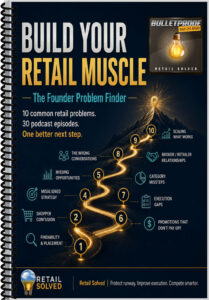
335+ podcast episodes. Start with the problem in front of you.
Choose the retail problem you are facing and get three conversations, one practical action, and the next resource to help you build that muscle.
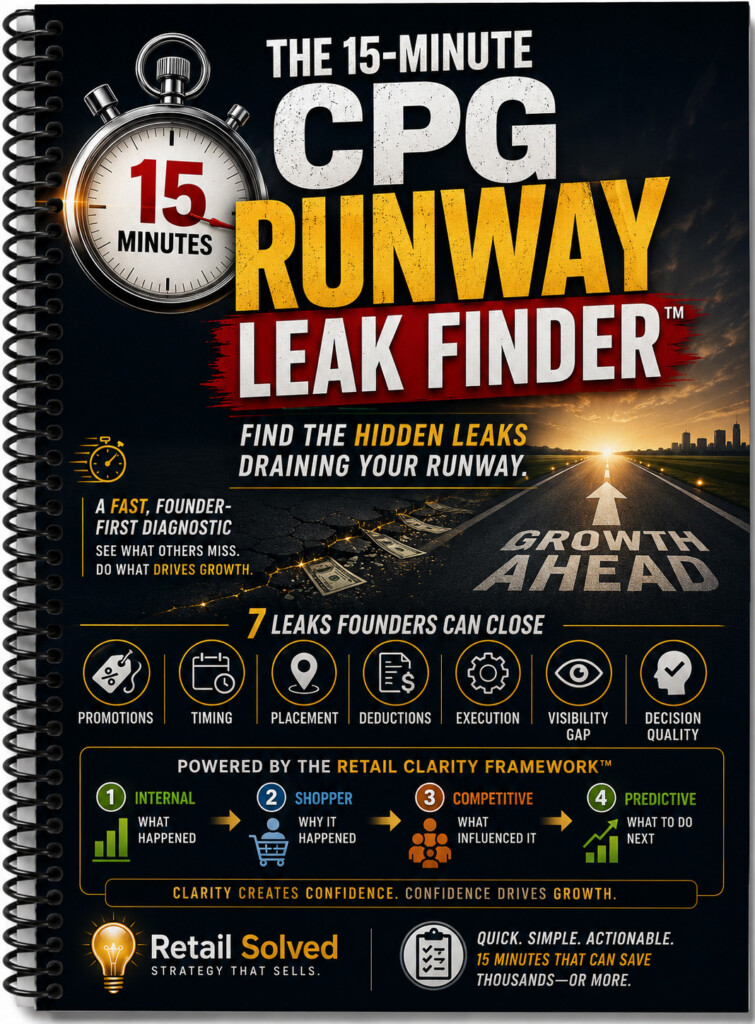
Start here: Find where your CPG brand is losing cash, margin, and runway.
In about 15 minutes, identify the leak creating the most pressure so you know where to look first.
No friction, no email required.
Retail Operating System™
The complete 11-module framework for protecting margin, optimizing trade spend, and scaling distribution with confidence.
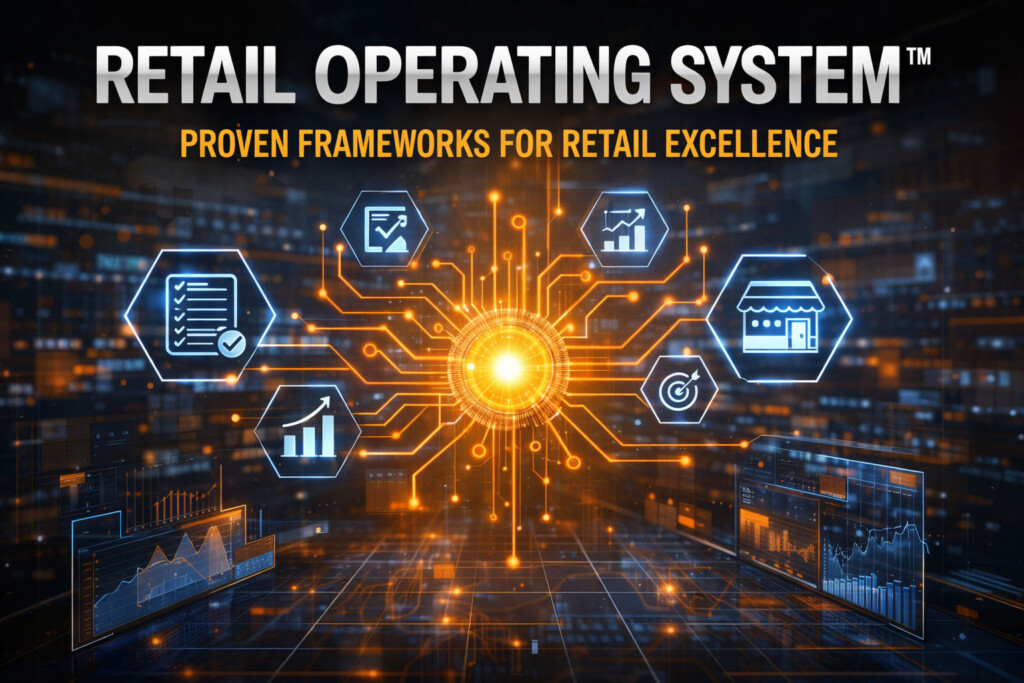
Retailers run on systems.
Most brands run on hustle.
That gap is expensive.
The Retail Operating System™ is the only structured, data-driven retail growth framework built by a Certified Professional Strategic Advisor who has sat both in the founder seat and across the table from retailers.
It gives emerging CPG brands the same operational discipline, trade strategy, and category leverage that big brands use — simplified and systemized to protect margin, optimize trade spend, and extend runway while scaling distribution.
This is not education.
It’s infrastructure.
Image is the property of CMS4CPG LLC, distribution or reproduction is expressively prohibited.