A CPG brand can add distribution, grow revenue and become financially weaker at the same time.
I’ve watched it happen.
A profitable brand expanded into more distributor DCs and markets. Distribution increased. So did inventory, free fills, chargebacks, distributor costs and the resources required to support all those new doors.
The sales report showed growth.
The underlying business was getting weaker.
That’s because getting the retailer’s yes isn’t the end of the investment. In many cases, it’s when the investment begins.
Inventory has to be produced before shoppers buy it. Distributor economics have to work.
Trade needs a job. Retail execution has to happen. Deductions can arrive after the sale. And the brand may finance weeks or months of activity before the cash comes back.
The problem is that those costs rarely appear together on one report.
In Episode 337 of Bulletproof Your CPG Brand, I break down the Retail Door Cost Stack and show you how to pressure-test one retailer before funding the next expansion.
You’ll learn how to think about:
• inventory and working capital
• distributor and path-to-retailer economics
• trade investment
• retail execution
• deductions and compliance
• cash timing
• organizational capacity
• the difference between more distribution and Productive Distribution
The goal isn’t to become afraid of growth.
It’s to know what must be true for growth to make your business materially stronger, not merely bigger.
Try this now
Pick one retailer.
Ask how much cash you must commit before meaningful cash comes back, what recurring costs come with the account, who owns what happens after authorization, and what evidence 90 to 120 days from now tells you to keep investing, change the plan or stop.
One retailer. One better decision. Then build the next muscle.
Listen where you get your podcast








Like what you’ve heard?
Please leave a review and comment on iTunes
Let me know your most pressing question, I’ll do my best to answer it on a future episode.
337 More Retail Doors. Less Cash? The Hidden Cost of CPG Growth I watched a profitable CPG brand expand its distribution and start burning cash faster. More distributor DCs. Distribution went up. Because another 500 stores can absolutely make your brand stronger. So before you celebrate the next retail yes, I want you to answer one question: Ready to hear more? Welcome to the bulletproof your cpg brand podcast. I’m your host Dan Lohman. Now, lets roll up our sleeves and get started. THE LAST TWO EPISODES GOT US HERE The brand did not need another retailer first. Adding more doors would not have fixed that. Today I want to take that one step further. That question is much bigger than gross margin. But even a product with healthy gross margin can become much less attractive once you look at the complete economics of one specific retailer. The product can make money in theory and the account can still put enormous pressure on the business. So the question is not merely: The better question is: THE RETAIL YES IS NOT THE FINISH LINE But operationally, that yes may be the beginning of a very large investment. Everybody suddenly has another retailer to support. So the headline may say: GROWTH AND PRODUCTIVE GROWTH ARE NOT THE SAME THING I want to be careful here because I am not arguing against distribution. I want you to grow. But I want those doors to make your brand stronger. Years ago, in episode 203, Stu from Green Circle Capital and I talked about the difference between strategic distribution and opportunistic distribution. You can keep saying yes to retailers, geographies and opportunities simply because somebody opened the door. I have seen this happen firsthand. And the work required to create velocity in those new markets. Eventually the founder made the difficult decision to pull back and concentrate on the markets the company could actually support. The lesson was not: Do not hand the keys of your brand to anyone. SALES ARE VISIBLE. THE COST IS SCATTERED. This is where the problem gets dangerous. Inventory sits with operations. Retail execution may not be quantified at all. So everyone can look at the same account and say: And everyone can be completely correct. Your sales report can be perfectly accurate and the decision can still be wrong. THE RETAIL DOOR COST STACK I want to make this practical. Then work down through what I call the Retail Door Cost Stack. The goal is to see everything that has to be funded, managed and executed before that retail door becomes productive. 1. INVENTORY If your minimum production run increases because of the new account, include that. And ask: Because a 500-store win that requires a huge inventory commitment can become very expensive if the velocity does not materialize. 2. THE PATH TO THE RETAILER Next, map the route from your dock to the retailer. Do not use somebody else's industry average if you have the real number. One of the problems in CPG is that we often talk about retail economics as though every door costs the same. 3. TRADE Now add trade. And then ask the question I keep coming back to: If you do not know the behavior you are trying to change, the sales spike afterward will not tell you whether the money worked. Trade can accelerate productive distribution. Those are very different things. If this is the leak you uncover, this is exactly why I built the free Trade Marketing ROI guide. 4. EXECUTION Now ask: Who tells you when what everybody thought was supposed to happen and what the shopper actually sees are two different things? Episode 336 was a perfect example. The opportunity was still leaking because the wrong assortment occupied some of the shelf. Authorization does not make a retail door productive. And if your product is not where the shopper expects it, the shopper does not care whose fault that was. 5. DEDUCTIONS AND COMPLIANCE Now ask what can come out of the check later. This is one of the reasons growth can fool you. You may celebrate the sale this month. By the time you understand the true economics, you may already have repeated the same decision hundreds of times. And a bad retail decision gets more expensive every time you repeat it. If deductions are the loudest leak, I have a free deduction-management guide specifically designed to help you work upstream instead of just fighting the claim after it lands. 6. CASH TIMING Now we get to the part founders feel in their gut. How many days separate your first check going out from meaningful cash coming back? Revenue is not cash. And rapid growth can increase the distance between those two. That is why a brand can be celebrating record sales while the founder is lying awake wondering how to make payroll. The spreadsheet can say growth. Both can be true. 7. COMPANY CAPACITY Finally, look at what the account requires from the organization. Buyer meetings. Every retailer creates recurring work. And here is a question founders almost never put in the economics: How much of this account eventually comes back to me? If every new retailer creates another set of recurring decisions that only the founder can make, you did not merely add distribution. You added another dependency on the founder. NOW ASK THE QUESTION THAT MATTERS Once the cost stack is in front of you, ask: Fantastic. But maybe the economics expose a weakness. That is useful too. I am telling you: That is clarity. WHAT GREAT LOOKS LIKE I do not want the lesson here to be: The lesson is: Imagine going into the next retailer opportunity knowing: Now the retailer is not simply another logo on your sales slide. You have a plan for making that retailer productive. And it makes the business less dependent on hope. That is what Retail Muscle looks like. YOUR ONE RETAIL MUSCLE REP I want you to do one thing after this episode. Number one: What cash do we have to commit before this retailer returns meaningful cash to us? Number two: What recurring trade, distributor costs, fees, deductions and support come with the account? Number three: What inventory and cash-timing burden does it create? Number four: What has to happen after authorization, and who owns each step? Number five: Ninety to 120 days from now, what evidence would tell us to keep investing, change the plan or stop? You may not have every answer today. The goal is not to grade your company. THE BIGGER LESSON This is really what the last three episodes have been about. Getting the retailer's yes is not the final win. Can you make the retailer's decision easier? Are you making the shelf space you already have productive? Are those retail doors actually making the business stronger? That sequence matters. Because the industry spends a tremendous amount of time teaching brands how to get access. Those things matter. But the brand still has to know what to do with the opportunity after the yes. And it is exactly where a smaller brand can compete above its weight. One skill. Then build the next muscle. Before you chase another retailer, I want you to spend 15 minutes looking for the place where growth may already be costing you more than you think. I built the 15-Minute CPG Runway Leak Finder for exactly that. It helps you pressure-test seven places where runway can quietly disappear: There is no email wall. Run it. Find the loudest leak. Then build the muscle behind that problem. If trade is the issue, I have a specific guide and deeper training for that. If the broker or field execution is breaking down, there is a tool for that. If your assortment is weakening the shelf, there is a specific place to start. You do not have to fix the entire company tomorrow. Find the leak creating the most pressure. Fix that first. You can get the Leak Finder at: And if you find the problem but are not sure where to go next, use the Founder Problem Finder. Your next retail door may be exactly the growth opportunity your brand needs. Just make sure you understand what has to be true for that opportunity to make the business stronger. Because more distribution is not automatically better distribution. Productive distribution is. Please share this with a founder that needs to hear it. I'm Dan Lohman.
Enter your name and email address below and I'll send you periodic brand building advice, tips and strategies.
More inventory.
More free fills.
More chargebacks.
More support required to build velocity.
The business got weaker.
Eventually, the founder pulled back and concentrated on the markets the business could actually support.
That is the part of retail growth nobody celebrates.
They can also require you to fund inventory, trade, distributor costs, deductions, execution and months of cash timing before those stores return enough value to justify the investment.
Will these new doors make the business stronger, or just bigger?
That is what we are going to solve today, how to help you grow profitably and with intention.
In Episode 335, we talked about how to make the retailer's decision easier before they say yes.
Then, in Episode 336, I showed you roughly $15 million of opportunity hiding inside distribution a brand already had.
It needed to make the shelf space it had already earned more productive.
The wrong products were occupying some of the most valuable slots.
Because even if the right products are on the shelf, there is another question you need to answer:
What does this retail door actually cost before it becomes valuable?
Gross margin matters enormously.
Trade.
Distributor costs.
Free fills.
Deductions.
Freight.
Inventory.
Execution.
Cash timing.
Does this product have a healthy margin?
Does this retailer make the business stronger after everything required to serve it is included?
A retailer authorization feels like the end of a long journey.
You pitched.
You followed up.
You sent samples.
You negotiated.
You finally got the yes.
Everybody celebrates.
And you should.
You need inventory.
Maybe more raw materials.
Maybe a larger production run.
More finished goods.
More warehouse space.
Potentially more distributor inventory.
Then the retailer may require introductory programs.
Free fills.
New-store openings.
Allowances.
Promotions.
Broker support.
Reporting.
Forecasting.
Compliance.
Field execution.
And then there is time.
Your time.
Your team's time.
Your broker's time.
Operations.
Finance.
Sales.
500 NEW STORES.
But underneath those 500 stores is an entire operating and financial structure the headline does not show.
That is what I want you to see.
My mission has always been to help challenger brands get onto more shelves and into the hands of more shoppers.
I want you to earn more retail doors.
I want you to compete with much larger brands.
Those are not automatically the same thing.
That creates top-line growth.
It also creates complexity.
And if the economics, team and support system are not ready, you can build something that looks fantastic from the outside while the foundation underneath becomes increasingly fragile.
A focused brand was profitable.
Then it expanded broadly through additional distributor DCs based on outside advice.
Distribution increased.
So did free fills.
Chargebacks.
Distributor costs.
Inventory.
The brand had more distribution.
It also had more ways for cash to leave the business.
brokers and distributors are bad.
The lesson was:
You need to understand what the opportunity requires.
Revenue usually shows up in one place.
The costs are scattered everywhere else.
Trade spend sits somewhere else.
Broker fees may be somewhere else.
Distributor charges live on another report.
Deductions may arrive weeks or months later.
Freight lives in another line.
Founder time almost never appears anywhere.
Sales are up.
But that still does not answer:
Was this good growth?
That is why context matters.
Pick one retailer.
Do not try to solve the entire company.
One retailer.
Write the retailer's name at the top of a page.
This does not need fancy software.
You can start on a piece of paper.
Start with inventory.
How much product do you need before meaningful cash comes back?
Raw materials.
Packaging.
Finished goods.
Safety stock.
Distributor inventory.
Retailer inventory.
If shelf life matters, include that risk too.
What happens if the forecast is wrong?
Inventory is cash wearing a different outfit.
Until it sells and you collect, you funded it.
Distributor margin.
Freight.
Warehousing.
Fuel surcharges.
New-store opening costs.
Free fills.
Allowances.
Whatever applies.
Use your product, your distributor and your retailer.
They do not.
What did you promise?
Promotions.
Discounts.
Ad fees.
Display fees.
Slotting where applicable.
Incremental inventory.
Anything required to support the account.
What job is this promotion supposed to do?
It can also subsidize weak distribution.
Not because you need more reading.
Because you need a way to pressure-test the next trade dollar before you spend it.
Who makes sure the plan actually reaches the shelf?
Who checks availability?
Who notices the wrong SKU?
Who catches the out-of-stock?
Who verifies the display?
Who knows whether the promotion actually happened?
The brand had the distribution.
Execution does.
They just do not buy it.
Pricing discrepancies.
Shortages.
Compliance problems.
Promotional deductions.
Distributor chargebacks.
Anything relevant to that account.
The deduction connected to that sale may show up later.
When does cash leave?
When do you manufacture?
When do you ship?
When does the distributor buy it?
When does the retailer buy it?
When are you paid?
What gets deducted before the money reaches you?
The bank account can say something completely different.
Forecasting.
Reporting.
Trade planning.
Broker management.
Retailer portals.
Compliance.
Sales calls.
Questions.
Emergencies.
Issues.
Post-promotion analysis.
Assortment reviews.
And the founder was never supposed to become the company's operating system.
What has to be true for this retailer to become productive?
Maybe velocity needs to reach a certain level.
Maybe the mix has to change.
Maybe deductions need to fall.
Maybe promotions need to work differently.
Maybe you need stronger broker execution.
Maybe the account is excellent exactly as proposed.
Now you know why.
You know what you need to protect.
I am not telling you to automatically walk away from the retailer.
You just found the part of the opportunity you need to understand before writing another check.
growth is dangerous.
prepared growth is powerful.
what the account requires before the first meaningful dollar comes back,
which SKU should lead,
what velocity makes the account productive,
how much trade you can responsibly support,
what the shopper needs to see,
where deductions are likely to originate,
what the execution standard is,
how much inventory the opportunity requires,
and when cash comes back.
That makes you a better partner.
It makes your broker more effective.
It makes your distributor easier to manage.
It gives your team clearer ownership.
Choose one retailer.
One sheet of paper.
Answer these five questions.
That is okay.
The goal is to find the question you need to answer next.
Episode 335:
Episode 336:
Episode 337:
How to meet the buyer.
How to get distribution.
How to get the broker.
How to find the distributor.
That is the retail muscle most challenger brands were never taught.
You do not necessarily need the biggest budget.
You need to be better at the fundamentals.
One item.
One retailer.
One better result.
promotions,
timing,
placement,
deductions,
execution,
visibility,
and decision quality.
There is nothing to buy.
If deductions are the problem, there is a deduction system.
RetailSolved.com/leakfinder
More than 335 conversations.
Start with the problem sitting in front of you.
Thanks for listening to Bulletproof Your CPG Brand.
I'll see you next time
Sign up to receive email updates
FREE Trade Promotion ROI Calculator:
Click Here To Maximize Sales And Profits
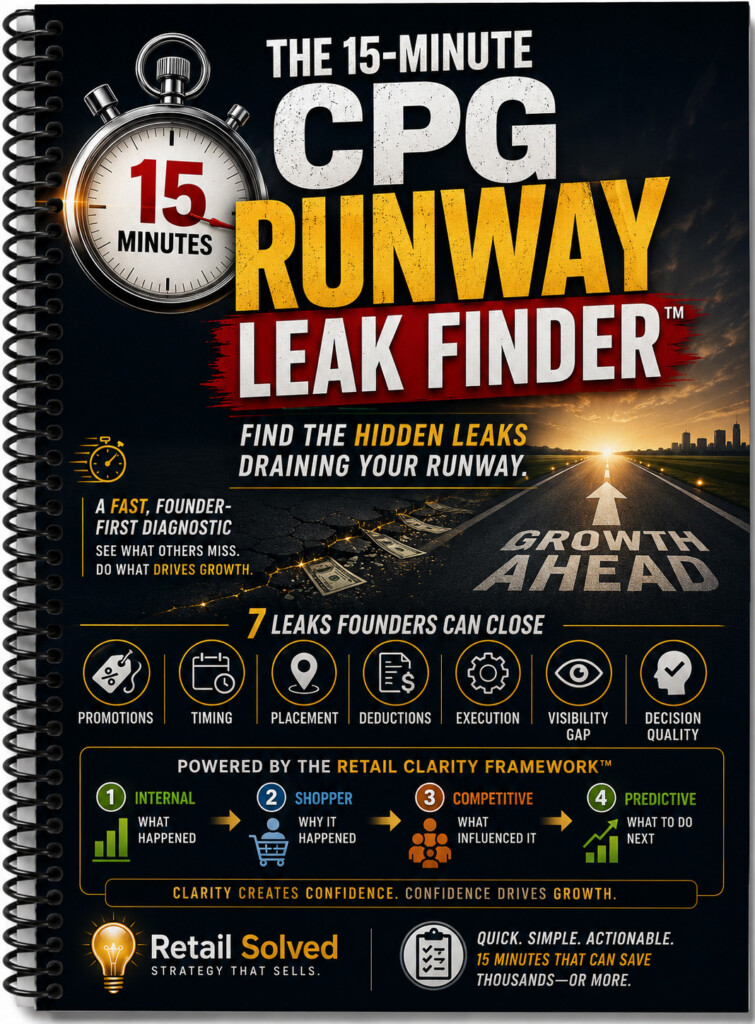
Start here: Find where your CPG brand is losing cash, margin, and runway.
In about 15 minutes, identify the leak creating the most pressure so you know where to look first.
No friction, no email required.
Retail Operating System™
The complete 11-module framework for protecting margin, optimizing trade spend, and scaling distribution with confidence.
Retailers run on systems.
Most brands run on hustle.
That gap is expensive.
The Retail Operating System™ is the only structured, data-driven retail growth framework built by a Certified Professional Strategic Advisor who has sat both in the founder seat and across the table from retailers.
It gives emerging CPG brands the same operational discipline, trade strategy, and category leverage that big brands use — simplified and systemized to protect margin, optimize trade spend, and extend runway while scaling distribution.
This is not education.
It’s infrastructure.
Image is the property of CMS4CPG LLC, distribution or reproduction is expressively prohibited.