A founder discovered roughly $42,000 in disputed retailer and distributor charges. The painful part wasn’t only the missing cash. She could not reconstruct enough of the agreements, prices, orders, shipments and approvals to prove what should have happened.
That’s why a short-pay is often the last domino, not the first. The charge appears in Finance, but the controllable problem may have started in a promotion agreement, a price file, inventory readiness, execution or an undocumented handoff.
In Episode 345 of Bulletproof Your CPG Brand, I explain how to trace a retail deduction backward; separate valid, preventable, disputable and unclear charges; uncover the working-capital cost that recovery alone does not solve; and create five practical controls that make recurring deductions harder to cause.
Your next step: pull your last six deductions, choose one recurring controllable charge, and trace it back to the earliest preventable step.
FREE EFFECTIVE DEDUCTION MANAGEMENT GUIDE
https://retailsolved.com/guide21
COMING SOON — BOOK
Stop Retail Deductions Before They Hit Your Cash: A CPG Founder’s Prevention Playbook. Read about the new field guide and find existing resources at: https://retailsolved.com/start
Book availability and purchase details will be added once the Amazon listing is confirmed live. The free G21 guide remains the episode’s one primary action.
CHAPTERS
00:00 A $42,000 short-pay: the last domino
00:53 Why treating deductions as a finance problem fails
01:27 What made the cash vulnerable?
02:18 Trace the deduction backward
02:53 Four types of retail deductions
03:41 The hidden cost of recovering cash
04:27 Five disciplines of deduction prevention
04:52 Why deductions belong in trade economics
05:17 Your six-deduction Retail Muscle exercise
05:49 The prevention field guide and free resource
06:37 Prevent the next recurring deduction
Related episodes: 305 (deduction prevention), 332 (sales up/cash down)
Listen where you get your podcast








Like what you’ve heard?
Please leave a review and comment on iTunes
Let me know your most pressing question, I’ll do my best to answer it on a future episode.
EPISODE 345 Your Retailer Short-Paid You Again. Fix the Problem Before It Repeats. A founder once opened a deduction statement and discovered roughly $42,000 had disappeared. Unauthorized promotions. Discounts deeper than the agreement. Back-end fees. Freight discrepancies. Late-delivery penalties on shipments she believed were not late. She thought the charges were wrong. She may have been right. If you are managing CPG deductions, the short-pay is often the last domino, not the first. The bigger problem was that she could not prove enough of it. That is why I do not think deduction management should begin when the short-pay hits. By then, you are usually too late. I’m Dan Lohman. This is Bulletproof Your CPG Brand, where every week I share an expensive retail lesson so you can learn it before your brand has to pay for it. Now, Let’s roll up our sleeves and get started. Deductions are usually treated like a finance problem. A claim appears. Somebody researches the code. They find the invoice. They email the broker. They call the distributor. They send proof of delivery. They dispute what they can. They recover some of it. Then everyone moves on. Until the next one. Recovery matters. I am glad technology is making recovery faster. I am glad software and AI can make hundreds or thousands of small claims economical to research. But there is a second question that gets more valuable as recovery improves. Why did the money become vulnerable in the first place? In the $42,000 example, the short-pay was only the receipt. The real problem had started earlier. The promotion agreements were incomplete. Emails were scattered. The approval trail was weak. SKUs were not consistently listed. Pricing floors were not documented in one place. Distributor communication was fragmented. Forecasts and orders did not line up cleanly. There was no scorecard tying ownership back to the event. No clean deduction tracker connected the charge to what should have happened. So by the time the money disappeared, the brand was arguing from memory. The retailer and distributor were arguing from documentation. Guess who had the stronger position. This is why I teach deduction prevention as an operating discipline, not an accounting tactic. Take your largest recurring deduction and trace it backward. Start with the deduction. What event created it? What agreement governed that event? How clear and specific were the terms on the agreement? What price was in each system? What order was placed as agreed? Was the inventory available? Was the shipment correct? Was the retailer requirement clear? Was execution documented? Who owned each step? Then ask the most important question: What is the earliest preventable step in that chain? That is where the leverage is. I like separating deductions into four buckets. The first bucket is valid and expected. You knew the cost was coming. You agreed to it. It is part of doing business. The second bucket is valid but preventable. The charge is legitimate, but something upstream could have stopped it from happening. The third is invalid and disputable. The charge does not match the agreement or facts, and you have the evidence to challenge it. The fourth is unclear. Nobody can tell exactly what happened. That fourth bucket should scare you. Because now you do not only have a deduction problem. You have a visibility problem. Your first goal should be shrinking "unclear." Then start shrinking "preventable." That changes deduction management from a recovery exercise into a business-improvement system. The other thing founders miss is the carrying cost. This can matter the most. Even when you recover a charge, that cash was unavailable while it was tied up. Your team spent time researching and disputing it. Maybe you paid a recovery fee. Maybe you had to delay inventory, a promotion or the next growth opportunity. Recovery can return money after it leaves. Prevention, when the charge is preventable, can help you keep that working capital available in the first place. Stop financing the same preventable mistake. So when someone tells me, "We recovered $80,000," my reaction is: Great. Now tell me why $80,000 was at risk in the first place. That is not criticism of the recovery company. That is the next layer of value. Here is the prevention system I want you to build around five disciplines. 1. Clear promotion agreements. 2. Pricing integrity. 3. Forecasting and inventory readiness. 4. Scorecards and ownership. 5. Centralized documentation. None of that is glamorous. That is exactly why brands skip it. Then the boring thing becomes expensive. This is also why trade and deductions cannot be separated. The promotion creates the agreement. The agreement creates the pricing condition. The promotion changes demand. Demand changes inventory. Inventory changes execution risk. Execution changes sell-through. Then the deduction eventually lands in finance. If you only look at the deduction code, you are staring at the last domino. Your Retail Muscle rep this week is simple. Pull the last six deductions. Do not analyze a hundred codes. Pick the largest recurring controllable one. For each occurrence, write down the earliest point where the outcome could have changed. Then fix that point. One recurring problem. One better control. One owner. One measure. One review rhythm. Then repeat. I have spent a lot of my career helping brands improve trade and deductions, and I realized I had allowed that part of my work to become too quiet. That prevention system also lives in a short field guide I am preparing for CPG founders: Stop Retail Deductions Before They Hit Your Cash: A CPG Founder's Prevention Playbook. In the meantime, you can start with my free Effective Deduction Management guide at RetailSolved.com/guide21. And if several leaks are showing up and you don't know which one is actually costing you the most, my CPG Cash Leak Triage is a separate paid diagnostic. Think of it like a check-engine light: find the first priority before you fund the wrong repair. Details are in the show notes. The field guide is meant to be practical enough to finish on a flight, mark up, hand to your team and put to work the next morning. Because cash flow is the lifeblood of your brand. Protect it before it leaks. Before your next deduction statement arrives, pull your last six charges. Pick one that keeps coming back. Don't start by writing another dispute letter. Trace it backward: which agreement, price, order, shipment, inventory record or execution decision created the opportunity for the charge? What is the earliest point you could have changed that outcome? Give one person responsibility for that control, and review whether the same problem returns. I have a free guide called Effective Deduction Management that helps you start doing that work. You can get it at RetailSolved.com/guide21. Use it with one real deduction this week. Your goal isn't simply to win a dispute after the money disappears. It's to prevent the next controllable mistake from making that cash vulnerable in the first place. I'm Dan Lohman. Thanks for listening. Learn the expensive lesson before your brand has to pay for it. You can get the founder problem finder and the show notes at retailsolved.com/session345
Enter your name and email address below and I'll send you periodic brand building advice, tips and strategies.
Sign up to receive email updates
FREE Trade Promotion ROI Calculator:
Click Here To Maximize Sales And Profits

The retailer short-paid you. Where did the problem begin?
Separate valid charges from disputable or preventable ones, then trace recurring deductions to the earliest controllable cause.
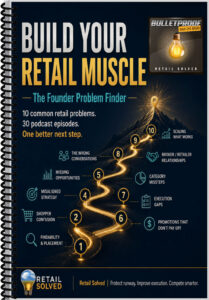
335+ expert conversations. Start with the problem costing you today.
Match ten common retail challenges with 30 relevant podcast episodes and one practical place to begin. No email required.
Retail Operating System™
The complete 11-module framework for protecting margin, optimizing trade spend, and scaling distribution with confidence.

Retailers run on systems.
Most brands run on hustle.
That gap is expensive.
The Retail Operating System™ is the only structured, data-driven retail growth framework built by a Certified Professional Strategic Advisor who has sat both in the founder seat and across the table from retailers.
It gives emerging CPG brands the same operational discipline, trade strategy, and category leverage that big brands use — simplified and systemized to protect margin, optimize trade spend, and extend runway while scaling distribution.
This is not education.
It’s infrastructure.
Image is the property of CMS4CPG LLC, distribution or reproduction is expressively prohibited.