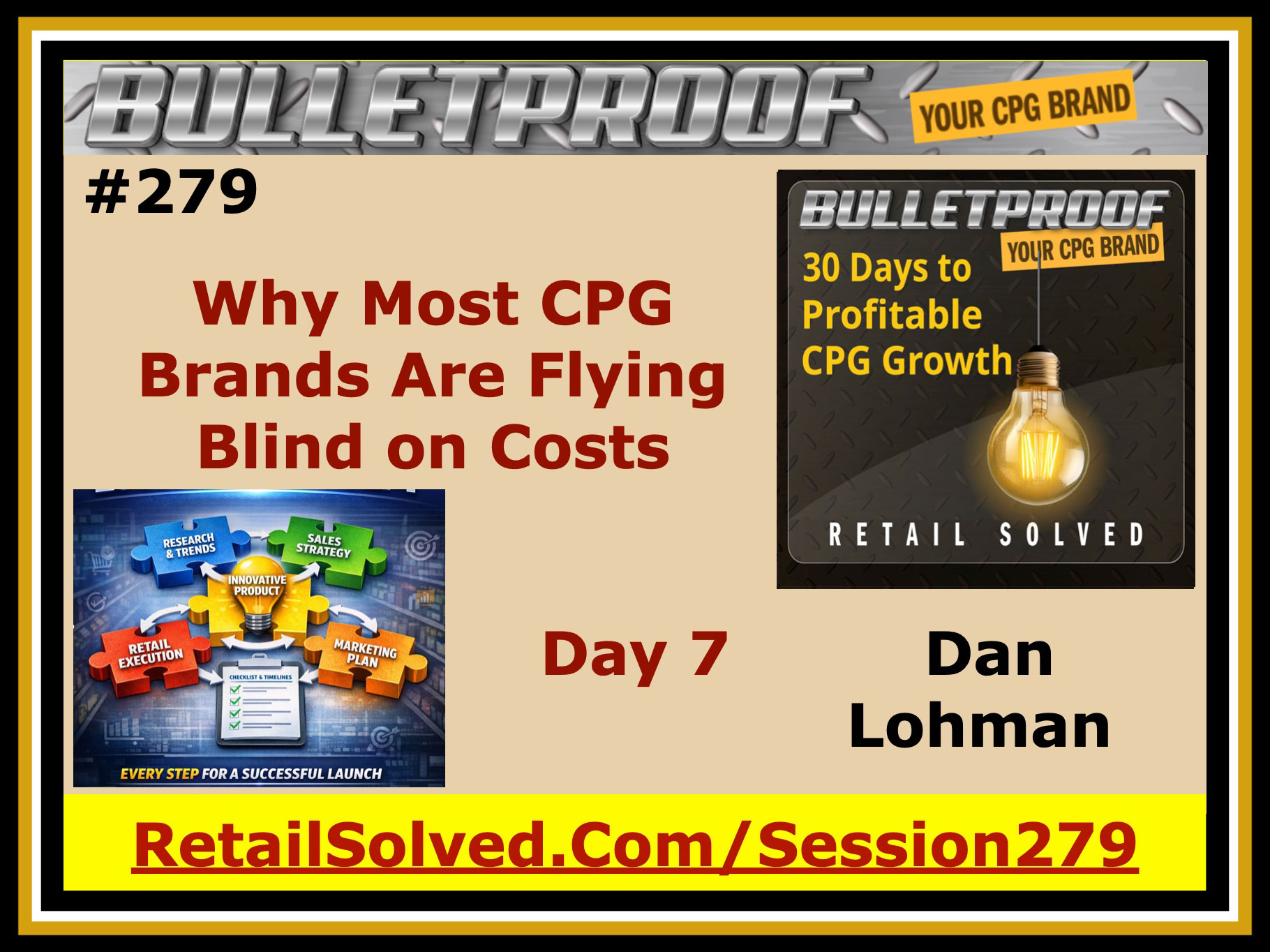
Most CPG brands don’t actually know what their products truly cost—and that blind spot quietly destroys margins and runway. In Day 7 of 30 Days to Profitable CPG Growth, I break down why estimating costs is dangerous, where hidden expenses show up from production to shelf, and how inaccurate costing leads to wasted trade spend. You’ll learn why precision down to the penny gives you control, confidence, and leverage with retailers and investors—and how knowing your true costs unlocks profitable scale.
Understanding the true cost of products is crucial for brand success, enabling accurate pricing, forecasting, and strategic planning. Many brands, however, lack this knowledge, relying on estimates and assumptions, which hinders profitability and scalability. By building a comprehensive cost model, brands can gain control over their finances, optimize margins, and make informed decisions for growth.
Action step: calculate fully loaded COGS per SKU including freight and fees.
Do you know your true margin by item today?
For additional inspiration listen to the following Bulletproof Your CPG Brand podcast episodes:
🎙️ 82 Know Your Brand Health for Long-Term Success
🎙️ 271 WHY TRADE SPEND FAILS (AND HOW TO FIX IT)
🎙️ 149 Sustainable Brand Growth Strategies for Success, Katie Mleziva with Real Food Brands
Day 7 of the Free 30 Days to Profitable CPG Growth
Tip of the day: Accuracy Matters. Knowing The True Cost Of Your products
Listen where you get your podcast








Like what you’ve heard?
Please leave a review and comment on iTunes
Let me know your most pressing question, I’ll do my best to answer it on a future episode.
Welcome to day 7: Episode 279 — The Importance of Knowing the True Cost of Your Products If you want to extend your runway, maximize profitability, and build a brand that scales sustainably, there’s one capability you cannot overlook: Accuracy matters.
Precision matters.
Clarity matters. And yet, across my career—from pre-revenue startups to multi-billion-dollar CPG giants—I’ve seen the same mistake repeated over and over: Ironically, many big brands don’t even know the true cost of their promotions or retail execution, which means they can’t accurately measure ROI—or justify the dollars they’re throwing into trade. The problem is not intelligence.
The problem is that no one teaches founders how to calculate true costs accurately, strategically, and consistently. Why Understanding Costs Gives You a Strategic Edge Those skills have served me throughout my entire career—whether working with global brands or mentoring early-stage founders. And here’s the insight I want you to take to heart: When you know your true costs, you can make smart decisions.
When you don’t, every decision becomes a risk. Knowing your costs helps you: A Founder Story: The Costing Blind Spot That Almost Broke a Brand. So I built a costing spreadsheet to uncover the exact cost of each batch, each bag, each ingredient, and each variable. What we discovered changed everything. Every founder I’ve worked with since then has had a similar blind spot—until we fixed it. Hopefully that story helped. Now for a quick story about a big brand to illustrate how wide spread this problem is. The point is not to shame anyone but rather to encourage you to learn this valuable skill. This will set you apart from other brands and it will give you a significant competitive advantage. Imagine knowing the true ROI from your promotions, a question most brands can’t answer. The more efficient your trade promotions are, the more runway you have for future growth. In episode 271 I talked about how most trade spending is wasted usually more that 70%. While working for a big brand, realized that there was no way to calculate the true ROI from a promotion so I built a custom tool. It pulled data from multiple sources including the brands shipment data, their sales data along with some other sources. The tool essentially tracked the cost of an item from our warehouses to the retailer and then through their register. This might sound easy but this granularity is not possible in most cases especially with all the variables and we did not use an external shipper. This is even harder for small brands that rely on distribution companies. More recently, I was working with a big brand that did not know how much margin they lost between production and a retailers shelf. That was before calculating what the cost of promoting that item was at that retailer. Every retailer charged different fees and that was after paying for the shipping. They, like most brand are flying blind when it comes to efficiently managing their trade marketing. This is even more problematic when you realize that trade marketing represents about 25% of a brands gross sales. Managing down to the penny might seem like small details. But small details compounded over thousands—or millions—of units can determine whether your company is profitable or operating at a loss. Now imagine scaling production. To drive the issue home. Ingredients, Packaging & Price Volatility This is how brands lose money without realizing it.
This is why founders feel like they’re drowning in cashflow issues.
This is why pricing strategy becomes guesswork instead of fact-based selling. The Overlooked Costs of Getting On the Shelf These too are real costs, and they add up fast. A Trucking Hack That Saved a Brand Thousands The Promotion Problem: Where Most Brands Lose Money We’ll go deeper into trade spend later in the series, but for now, understand this: Knowing Your Numbers Builds Investor Confidence Founders who know their numbers get better offers.
Founders who guess lose credibility instantly. Day 7 Action Item: Build Your True Cost Model In Closing: Accuracy Is Your Competitive Advantage Knowing your numbers is the foundation for building Operational Discipline—The Hidden Engine of CPG Scale, and why this one capability separates the brands that survive from the brands that dominate. Tomorrow, in Episode 280, we’ll talk about How to Build a Retail-Ready Pricing & Margin Architecture so you can walk into any retailer meeting confident that your pricing strategy supports your growth—without putting your brand at risk. For additional inspiration listen to the following podcast episodes: Episode 271 WHY TRADE SPEND FAILS (AND HOW TO FIX IT) Episode 149 Sustainable Brand Growth Strategies for Success, Katie Mleziva with Real Food Brands Tip of the day: Accuracy Matters. Knowing The True Cost Of Your products Thank you for listening. This episode has an accompanying video with illustrations and additional information I can’t share on an audio podcast. You can watch it at retailsolved.com/30daychallenge. You can get the show notes for this episode by going to RetailSolved.com/Session279. Tomorrows episode is How To Master Your Why and Connect with Customers. This episode will build on today’s conversation. Thank you for listening. I look forward to seeing you in the next episode.
Enter your name and email address below and I'll send you periodic brand building advice, tips and strategies.
Day 7 of 30 Days to Prosperity
You must know the true cost of your products—down to the penny.
Most brands don’t actually know what their products cost.
They estimate.
They guess.
They use round numbers.
They rely on assumptions instead of facts.
That ends today.
In college, I studied to become a CPA—not because I wanted to be an accountant, but because I wanted to understand how a business really works. I wanted to know how to measure and manage the costs that drive sales and profitability.
Price your products correctly
Forecast accurately
Plan promotions strategically
Negotiate more confidently
Prepare for supply chain fluctuations
Protect your margins
Increase your brand’s valuation
But most importantly, it gives you control.
You cannot scale what you cannot measure.
You cannot manage what you cannot see.
Years ago, I worked with a young brand at the Boulder Innovation Center. They had passion. They had product-market fit. They had early traction.
But they didn’t know what it actually cost to put their product in a bag.
They had a rough idea.
They used approximations.
They didn’t track seasonal ingredient price swings or yield loss.
And that meant:
They couldn’t price correctly
They couldn’t plan growth effectively
They couldn’t evaluate promotions
They couldn’t forecast cashflow
Once we isolated their costs, we were able to:
Build accurate forecasts
Improve margins
Strengthen their pricing strategy
Identify better ingredient suppliers
Extend their financial runway
Let me illustrate why this matters through a simple analogy.
As you produce more
Ingredient costs may go down
You get better pricing on packaging
Labor becomes more efficient
You can negotiate better rates with suppliers
But you only capture those efficiencies if you know your starting point.
Knowing your costs gives you the ability to:
Plan
Negotiate
Optimize
And Scale
Without it, you’re operating blind.
Ingredient prices fluctuate—seasonally, regionally, globally.
Packaging costs can shock you overnight. Lead times can stretch from 4 weeks to 16 weeks for reasons outside your control.
If you don't know:
Your cost per unit
Your cost per batch
Your cost per case
Your cost per pallet
…you cannot adjust quickly enough to protect margins or maintain retailer commitments.
Most founders underestimate—or completely overlook—the true costs of retail execution:
Slotting fees
Free fills
MCBs
Chargebacks
Distributor deductions
Broker commissions
Distributor freight and fuel surcharges
Overtime labor to fulfill last-minute orders
Promotional funding
Merchandising costs
If you want to optimize your margins, you need to understand every cost from:
Raw materials → manufacturing → packaging → freight → distribution center → retailer → shelf
Every step is part of your cost structure.
Let me give you a real example.
One company I worked with had no idea how much they were spending on shipping. They weren’t tracking freight cost per unit.
Their trucks delivered product one way…
And returned empty.
Empty trucks are wasted money.
Once we analyzed the data, they negotiated a contract with a furniture company to fill outbound trucks on return trips. That single move covered:
Fuel
Labor
Wear and tear
And dramatically reduced their overall logistics cost.
This is the power of understanding costs:
You start seeing opportunities that were invisible before.
Did you know?
About 25% of a brand’s gross sales go toward trade spend.
Over 70% of those dollars deliver little or no sustainable lift.
Most promotional spending is wasted.
Not because founders are careless, but because:
They don’t know the true cost of promotions
They don’t know how to measure ROI
They don’t know how to evaluate “incrementally”
They don’t understand retailer margin expectations
They don’t know how to analyze baseline vs. lift
You cannot have a profitable business if you do not understand the cost of every promotion.
Your brand deserves better than guesswork.
Look at what happens on Shark Tank.
The sharks always ask:
What does it cost to make one unit?
What’s your landed cost?
What’s your wholesale price?
What’s your margin?
What’s your promotional plan?
What are your true cash needs?
If you need a refresher, go back to Day 1: Episode 273.
Your numbers tell your story.
Your numbers reveal whether you’re ready to scale.
Your numbers determine whether investors trust you.
More importantly…
Your numbers determine whether your business survives.
Today, take one SKU—just one—and build a complete cost breakdown.
Include:
Ingredients
Packaging
Labor
Overhead
Freight to copacker
Manufacturing cost
Freight to distributor
Distributor margin
Retailer margin
All marketing + trade spend
Cost of free fills, sampling, and swag
Cost of inventory waste and shrink
Then ask yourself:
Am I priced correctly?
How much margin do I really have?
What happens if costs increase 10%?
What happens if I run a TPR?
What if freight spikes?
How long is my runway if sales double?
This is how you take control of your business.
Today’s lesson is not glamorous.
But it is essential.
When you know the true cost of your products:
You forecast more accurately
You plan more strategically
You negotiate with confidence
You protect your margins
You extend your runway
You build a business that scales
Subscribe so you don't miss it.
Share this episode with a founder who needs more clarity in their numbers.
And download the series guide to go deeper into todays topic
Your brand’s success depends on this.
And you now have the tools to take control.
Episode 82 Know Your Brand Health for Long-Term Success
In this episode, I talk about how you need to focus on contribution, not on velocity. Velocity does not tel the whole story when it comes to your brand performance. Big brands with deep pockets can buy velocity with deep discounting. That pulls profitable dollars form the category. Better-for-you brand contribute more to category growth. This is what retailers take to the bank.
In this episode I go deeper into how to maximize your trade marketing. Trade marketing is your brands growth engine. This is also where you leak the most cashflow.
Explore the secrets of sustainable brand growth. Learn how successful brands align products with customer needs for lasting success. Katie, from Real Food Brands, discusses her journey from big food to natural food and beverage to make a difference our food system. She emphasizes the importance of aligning brand strategy with consumer needs and preferences, highlighting the interconnectedness of branding, marketing, and sales.
Sign up to receive email updates
FREE Trade Promotion ROI Calculator:
Click Here To Maximize Sales And Profits
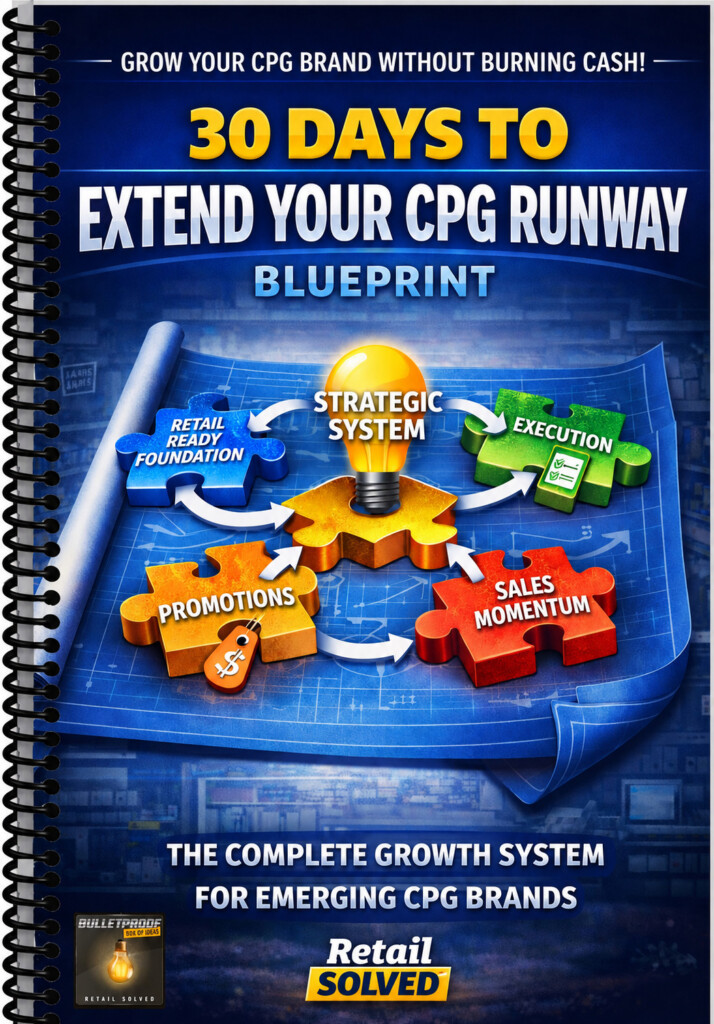
Extend your runway one focused day at a time.
Build the retail fundamentals behind profitable growth with one practical skill, one action, and one better decision each day.
Image is the property of CMS4CPG LLC, distribution or reproduction is expressively prohibited.