But very few spend enough time thinking about what happens AFTER manufacturing.
And that blind spot quietly creates:
• operational friction
• retailer problems
• deduction exposure
• execution failures
• damaged customer experiences
• and hidden profit leaks
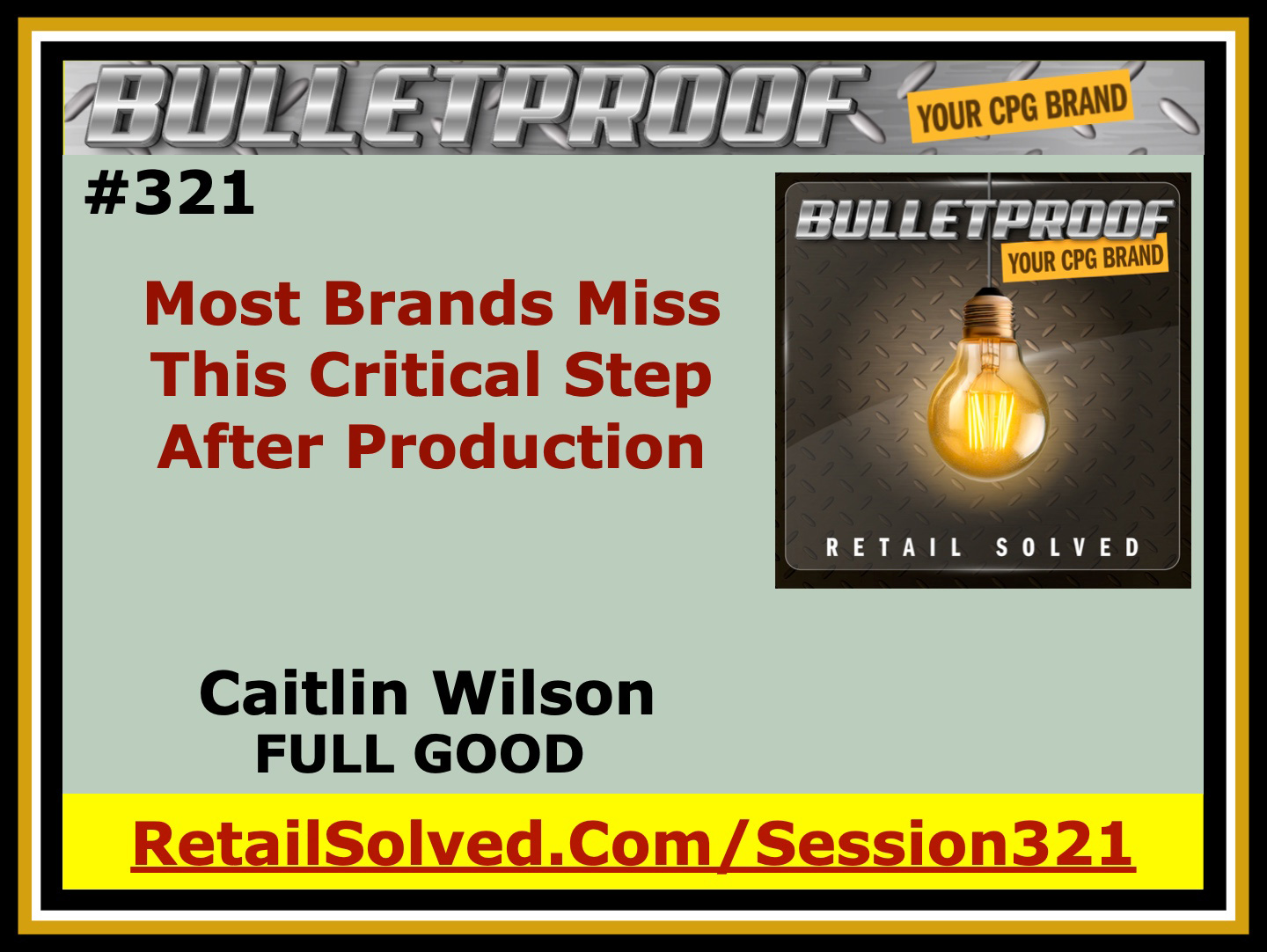
In this episode, I sit down with Caitlin to discuss why operational clarity, fulfillment, packaging, communication, and execution discipline matter far more than most founders realize.
We discuss:
• how fulfillment impacts retailer trust
• why operational mistakes create downstream margin pressure
• hidden costs most founders never calculate
• how poor execution quietly drains runway
• direct-to-consumer vs wholesale fulfillment strategy
• preventing deductions before they happen
• why details like packaging, counts, labels, and communication matter
• and how better operational systems help brands compete smarter
This episode is packed with practical advice founders can apply immediately to improve execution, reduce friction, and protect runway.
Download the free 15-Minute CPG Runway Leak Finder™ at RetailSolved.com/findleaks. No friction, no email required.
⏰ Timecodes
00:06 The importance of influencer and buyer boxes
03:33 We solve: the lack of support for brands with fulfillment
05:35 Why you need the execution of the orders
07:20 What brands need to know to be successful
08:44 We specialize in DTC white glove approach
10:13 We are an extension of your brand
11:38 We simplify how your brand is represented
12:39 How your brand aligns with your COGS – with fulfillment
13:26 We show you what’s possible
15:59 We provide another set of eyes – a different perspective
17:12 We want things to be perfect for you
18:19 We help you with retail operational strategy
19:59 We help make retail execution frictionless
20:49 You need to know who you are selling to, including the retailer
22:49 Why you need an EDI partner and what does that mean
24:57 Why you need to know your retailers expectations
27:06 Why you need to ask good questions with buyers
29:03 Why attention to every detail matters
36:00 What comes next
37:34 Why great partnerships matter
Listen where you get your podcast








Like what you’ve heard?
Please leave a review and comment on iTunes
Let me know your most pressing question, I’ll do my best to answer it on a future episode.
Yeah, well, we can go into detail about that.
Enter your name and email address below and I'll send you periodic brand building advice, tips and strategies.
There's a lot of brands that we support that
only do with us influencer boxes and
buyer boxes and they dedicate.
We help them set up a system within
Shopify or wherever they want to process these
orders so that from the beginning.
They have a way to capture
the costs of the program.
I think the biggest problem with influencer
boxes, marketing efforts, buyer
boxes, free out the door.
is that people do not capture
the programming properly.
So we always encourage people to like jump on Shopify
if you do not offer a, you know,
yogurt for sale online, which that would be weird.
But you still need to send yogurt, like
express overnight with tons of ice packs to a buyer,
create a ghost Shopify account for free.
Put our system in the back end of it so we can
read, we can read the orders quickly and translate the
tracking information quickly.
And then use the Shopify as
your CRM to capture who
have you sent everything to, create, use the tools in there.
So put tags on the orders.
Is it an influencer box?
Is it a buyer box?
Is it a marketing box?
Whatever it is, that's like a whole nother podcast
is just talking about the efforts.
that brands do
not take to try to capture all of that stuff.
Because I don't care if you're a $300000000 brand.
You still need to capture that stuff.
Are you ready to hear more?
Welcome to the bulletproof your CBG brand podcast,
where we discuss tactics and strategies that you
need to give your brand the unfair competitive advantage it deserves.
Hello, I'm Dan Loman.
Be certain to comment and subscribe to get immediate access to
new brand building episodes.
Please recommend this to friends and colleagues, and
help me raise the bar natural.
Let me know what your most pressing issues are, and I'll
do my best to address them on future episodes.
There's a free downloadable guide at the end of every episode to
help you go deeper into the topics we discussed.
Now, let's roll up our sleeves and get started.
Caitlin, thank you for coming on today.
Can you please tell me a little bit about yourself, and how you
got to where you're at, and why did you decide to choose launching
and running a fulfillment company?
Hello, thank you for having me.
Um, well, I
am a farmer's daughter from the central
coast of California, the Salinas Valley, and I grew
up in the, grew up in the produce industry.
Um, so that is where
I started my career.
Um, was with my family's business and then,
you know, within the produce world, um, and I was always
on teams or, um, drove
initiatives that had to do with trucking
and had to do with replenishment into retail and,
um, things like that.
So, um, that was a service that our company,
um, provided at the time, um, was replenishment
services and, and whatnot.
So that's that is how I started my career.
Um, and then I left my family's business and
I helped a friend of mine.
I left my family's business when I became a mom.
And um, took some time.
And then I helped a friend of mine who was
launching a fresh frozen dog food company.
Um, when he was coming to market and
in helping him, um, really
discovered the lack of support that, um,
that brands have, um, after production.
So after manufacturing.
It's like the what now happens.
And, you know, any brand at
any size, that's a very important question to answer.
And so that is, I, of course,
couldn't, you know, I didn't find us a great partner.
Um, I, you know, researched and interviewed
and Um, we worked with a number of partners
actually with that brand.
Um, but really the support and transparency
of like how much inventory do I have and did
this order go out or not?
And like really basic things, um, just
was not done in my opinion, done well,
um, to support this brand.
So, um, I ended up leaving that brand and
um, chose to kind of cut my teeth with
a few brands as my initial partners.
Um, as I developed the business model.
And then, and that was in like 2021.
Um, and then in 2022, um, to 2023.
We started this, um, this, this business.
So, um, Yeah, we we
support dry, refrigerated and frozen products now.
Cool.
So, and then, no, let's back out.
talk a little bit about what it is that you're doing because we
need to frame that because that is what's so critically important to
this, this entire conversation.
So what do you do?
And why does it matter?
If I'm a brand, why would I reach out to you?
Yeah, so after
brands are manufactured, some some
co manufacturers will support a brand with storage.
Um, and with orders, so fulfilling
orders, um, shipping orders out, some
some co-manufacturers do support those efforts, but most of them do not.
So, um, if your brand that
is, let's say, just getting started pre-revenue or if
you're a brand that's $100 million.
Um, you need the execution of the orders to
happen, um, into Kehi, and if I,
you know, Target, Walmart, and direct to consumer,
and kind of any way that you are selling your product, do you
need someone that is going to execute that for you?
And so that's what we do here at Fulgun.
Um, so we support brands, um, by way
of implementing our technology into the back end of
their direct to consumer sales channels.
So Shopify, you know, WooCommerce,
um, Fair.com, um, you
name it, um, and then also buy palette orders.
So, you know, heaven forbid, you know, you
get into a massive retailer, you do need to
have support to fulfill those huge orders as well.
So.
And just for clarity, clarity, I actually had opportunity,
I had the privilege of touring your warehouse, which, by the way, is amazing.
We'll talk about that later.
Yeah, it's really cool.
So if I'm a brand, I
can ship you the nuts and the bolts and all the pieces and then
you put it together and a nice box and then
you help ship that.
Can you talk a little bit about that because I think that's
something that people don't understand, don't think about when they're
building a brand is how do I get this into the hands of a consumer?
And how do I set this up so that
I'm not spending literally 1000000000s of hours putting boxes together.
Yeah.
So a lot of brands take,
I mean, every brand, what I think is really cool about this industry is like no brand is the same.
No brand, no day is the same.
Um you know, the weather affects a lot of what we do too.
Um, So, every
brand, I think like my biggest piece of advice to brands
and, you know, what I want them to know coming out of this call
is that it's really important to make
a decision, um, early on as
to where, where, what your approach is.
So, if you're focusing on direct to consumer, is your approach
that you want to really, really custom look, or are you
okay with just a standard corregate and just throw the,
you know, not throw, but place the products in
a standard corregate with a just plastic tape or craft
tape and slap label on.
You know, so I think some brands are
okay with that because they're price driven and they might have a product that they're
not concerned about the exterior of the box.
They're not concerned about the unboxing experience.
But then other brands, you
know, are very focused on that.
And so they might be trying to differentiate their category or
to, you know, challenge someone else in the category, and this
could be a leg up for them is the approach that they take.
either via direct to consumer or via,
you know, influencer boxes, um,
looking a specific way.
I will say that like with the palette orders and kind of the wholesale,
the retail stuff that we do, that's all very standard.
That's all the same and pretty much anywhere you go.
Um, things are on a palate.
It's how we communicate when orders are done and and whatnot.
Um, that is that is our differentiator there.
But as it relates to direct to consumer.
The white glove approach and the kind of high touch effect
that we provide to brands is definitely unique.
Um, and it's something that a lot of other fulfillment centers like don't want to touch.
Um, and what I mean by that is, you know, do you want a custom box?
Okay, great.
I have a community of box suppliers.
Let me introduce you to them.
You know, um, go down that path yourself as a
brand founder, right?
Decide if that's something that you want to do.
Um, and then, you know, do
you want to just corgate with a custom tape on top?
Let me introduce you to those suppliers as well, right?
The tape suppliers that supply Amazon are friends of mine,
you know, um, some other vendors.
Um, unboxing the box, right?
Do you want a card on top of your product?
Do you want your product to be surrounded with crinkle paper so it doesn't move?
Um, you know, what, what is like, what are
the details involved in actually
getting your order out the door?
So during onboarding, we handle a
lot of those kind of questions and answers over
the course of a call or two.
Um, we love to receive the product and
then send out examples if we have time.
Sometimes we don't have time because we're either taking on work
from another fulfillment center or a launch date that's
very important and it coincides with when we're
going to be receiving product.
But in that case, it's like, my client services team
does a great job of, here, let me get on like a FaceTime call
with you or so that you feel as a founder, that
we are truly an extension of your brand and we are really helping you through this.
And then once the bricks are laid and once everything's
established for who you are as a brand through fulfillment
and operations, we just execute.
Very cool.
Thank you for sharing that.
So let's let's unwrap this even more.
And the reason that I wanted to go down this path and thank you for sharing that
is that a lot of the brands that I mentor
and work with, they're struggling,
trying to figure out, okay, how do I get this package, not only,
how do I get this package to someone?
But what are the limitations?
What can I think of?
What do I think, excuse me, what do I look at?
What are the things I need to put together?
My point is this.
A lot of companies, if you go to ExpoOS and stuff like that.
A lot of companies, a lot of brands, they look at someone who provides
a label and someone who provides a bag and stuff like that.
And those are sort of the nuts and bolts of how they package your product, get it out.
What you're saying is that you
might be able to offer something creative, something
unique, something that's cost effective, that
I hadn't even considered yet.
Because again, I'm just trying to figure this out on my own.
Can you talk more about that?
Yeah, sure.
I mean, again, yeah, I think it is so
overwhelming for, especially new brands, like
you said, that may go to Expo
or may go somewhere else where they're meeting a ton of vendors to even know,
like, how do I put this puzzle together?
So what we try to do is simplify, break it down.
We ask the questions that are like, what
are your goals as a brand?
Is it that you're very price driven?
Great, like that that approach is going to be different.
Um, is it that you were an appearance driven,
you know, in, is there an incentive there for a really high touch look?
Great.
We will, you know, let's let's hold your hands there.
Um, I will say, like, if you're
a regular direct to consumer brand, um, and,
you know, you're only focused on your sales channel being
direct to consumer, and you're an emerging brand that's
coming here, I think there's little things that you can do that
have become kind of industry standard.
Um, because of Amazon.
Um, so that is, you know, to to
talk about the, do you need a custom tape
that just goes on your Corget and it's ¢5 or less,
um, per box?
You know?
Um, great.
Let's introduce you to those suppliers.
But we just try to like offer you what is industry standard.
And then we tell you, you know, okay, great.
This is how it meets, you know, your cog.
So these are all of the inputs that my team is adding
to your product to try to meet you where you need to be.
So what I mentioned earlier was like, you'd still
have to decide as a founder, who am I?
And so that's really, really important.
And if you don't know that answer, that's okay.
Like we can work, work through that with you by
way of kind of the questions that we ask during onboarding.
Um, but it's important to kind of consider that.
Um,
So
I hope that kind of answers that a little bit.
No, it does.
So I don't know what I don't know as a founder.
So could I reach out to you or could we tell
people, hey, reach out to you?
Yeah, absolutely.
For what's out there?
Yeah, and I do all the time we do
like audits for people.
So, you know, I'm starting a brand.
It's a ice cream company and it has
collagen in it and, you
know, I, this is a new product to the market and I am
trying to shake up, you know, whatever.
Okay, great.
What are your goals?
Are your goals to focus on direct to consumer
or your goals to focus on wholesale?
So that's that's the 1st question.
Right?
Second question.
If you're focusing on direct to consumer, it is, let's go
down the path of making sure that your ice cream arrives perfectly frozen.
Okay?
So that's going to be what box we use, what insulation
we use, how much dry ice is added.
Our team helps you figure that out.
We give you examples or we literally
send you sample boxes of what
we think you should do if you do not have that already.
If you have, if you come to us with any level of a
goal, we will meet those goals, but a lot of
these emerging brands that we help.
Just don't even know what they don't know, like you said.
So, and then if, you know, hey, your goal is only wholesale
retail, awesome, do you need us to still support
you with buyer boxes so that when you're getting into Kroger,
Albertson, Safeway, we can still send those
boxes, you know, for you to the buyers?
Um, that's interesting to think about too.
Um, so either path.
You still have to have some level of support by way of small box.
Um, so that will always be a discussion point.
Um, But, you know, again, it's,
there's so many variables involved because every brand is,
that's what I love those business, every brand is different.
Perfect.
So one of the things that we talked about when I was there, kind of a
little bit of a segue, but it makes sense.
I mean, this is relevant.
Is you talked about how a lot of times you get in
product packaging that maybe there's
misspellings and things that aren't perfect on the packaging.
So my point is, uh, with your expertise,
you can help me as a new brand, make sure that everything
is right so that it looks right and where
I'm going with, where I'm going here, Caitlin, is from an
experiential marketing point of view.
Your brand needs, your packaging needs to say a lot about your product.
And so being able to present at the consumer,
with your expertise, you can help guide me, as I
understand it, to help make sure that I've got the right look,
the right feel, the right communication, on my box,
the way it's wrapped, et cetera.
Can you talk a little bit about that?
Sure.
Yeah, we have, there's been a few cases where
we've helped brands that are, Pre-revenue
or very newly established.
Um, that have come to us with kind
of everything already sorted, and that's, that's great,
but every once in a while, it's interesting
to consider what about another set of eyes?
And so, um, there has been
a few times that we've received packaging or
exterior boxes that, you know,
that the spelling might be perfect and all of that stuff.
But the units of measure are off, or
the way that they present the barcode
is really interesting and should have been placed differently,
or, you know, kind of things that matter to ops, to operations.
So to my group and to retailers, wholesalers, is,
you know, not there.
So I always encourage brands.
I'm like it's never too early.
Please bring my team in to like any discussion that you want.
Um, we offer it as a line item on our scopes
of work, like you're, you could either pay us for your time or I
give a lot of free time away too, to our brand partners.
We want things to be perfect because our goal is
for you to fly off the shelf because at the end of the day, that's what I make
money, make money on, right?
But also, you make money too.
So it's a win-win partnership wise.
Um, there's just so many little mistakes that I've
seen and that I've, you know, I, you and I, when,
when we were here, we, yeah, we had a great discussion about that.
It's just, there's 2 approaches.
It's how many cooks are in the kitchen.
That's too many cooks in the kitchen.
But then the other approach is, well, what about a different perspective?
And so while you may have had 5 people look
at your label or your packaging or your
approach, have you thought of who
in that circle, you know, is offering that guidance?
Is anyone from the operational side?
And if they're not, maybe consider asking someone
in your network or me.
I'm happy to provide guidance to people that I don't work with
all the time because I want to see good things on the shelf.
Um, to give some guidance.
So, yeah, that's been really interesting.
You know, it's also something that I also talk
all the time with brands about is, why
are you a 50 count versus a 10 count?
Or why are you, you know, just kind of asking the questions that,
and I'm not afraid to ask those questions, and I think sometimes it comes
off like harsh, but I want just
what is good for everyone.
So, um, and
while I'm not a, you know, product creator,
I am seeing a lot of products, 100s of products,
100s of brands every single solitary day.
I'm seeing what's working.
I'm seeing what's not working.
So, um, and for the brands that I help
that are not working, they they want to work.
So we're riding those ships quickly.
Um,
Yeah.
So that's invaluable.
And on that note, a lot of product, a lot of
products, when they get to retail, there's a lot of friction because
of the stuff you're talking about.
And so the goal here is to make everything frictionless
so that the retailer can onboard
it, get it in the shelf, and start selling it.
That's critically important.
So thank you for that.
One of the things that you mentioned is that counts in the boxes.
This is something I don't think a lot of brands think about.
You've got slotting in almost every retailer, unfortunately.
slotting is.
It's, anyhow, I can go down to that path.
You get distracted there, but the point is, a lot of
brands charge slotting in terms of free fill, a box or 2
boxes or something like that.
So if you have 20 or 30 items in
a box and that won't fit on the shelf, then they have to have backstock.
Anyhow, a lot of things to consider.
Sometimes you don't have enough in the box, you got to buy bring
in 2 boxes.
So you can help branch with that as well.
Yeah, I mean, I think I
know enough to be dangerous about like all the categories in the grocery store at this point.
I obviously grew up in the produce world,
so I really know that that category very,
very well, but as it relates to dry,
refrigerated, frozen products.
Um, I think what's interesting is
that a lot of brands, and I'm going to like answer your
question, but I will say one thing.
A lot of brands focus so heavily on
getting into a retailer, and I know that you're in the same camp as me.
I would heavily focus on finding
the right retail partner first.
identifying who that's going to be with
your brand very early on.
That should be part of your ICP or, you know, ideal client profile.
If you don't do not know that answer, don't
don't go into business yet.
You need to know exactly who you're selling to,
and that involves the retailer.
Um, Secondly, it's once you're
on the shelf, it's velocity and getting off the shelf.
So how are you positioning yourself to do that?
If you have a box that is as
long as the shelf, And, you know, you and
I both know when you're grocery shopping and there's something in the very, very, very
back and it's dark back there, I'm,
as a consumer, I'm not even going to be able to see what's back there.
So I, I don't know, it's just really basic
things that um, people are forgetting about right
now, founders are forgetting about right now.
I think a 6 count is better than
an 18 count all day long, right?
Um, I, I, you know, your your
discussion earlier about the, the, you know, slotting
fees and all of these various fees and all these things.
That to me goes back to who your ICP is.
You know, what is your goal as a brand?
Who are your ideal clients?
Um, and and are you positioned properly?
And if you are, then, you know, you're going to
have to deal with some of the slotting fees and some of those chargebacks and some of the things.
Um, the beauty of AI, the beauty
of kind of all the things that are, a lot of this like darkness
in retail is being uncovered like quickly.
Um, and what I mean by that is there's a
lot of software out there and a lot of technology out
there that is really brand forward.
Um, and I'm I'm really excited to see.
how brands are going to come ahead.
Um I hope.
Um, pretty soon.
Yeah.
And um, yeah, I mean, there's a lot of really
cool groups out there.
I had a call and I'll pump them on this podcast.
I had a call with a group called retail Ready.
Um, and their whole premise is
that they support EDI.
So whenever, um, for people that are listening that don't
know, you know, whenever you receive an order from a retailer, a lot of times it's
either via PDF, so just like an email, or, and
this is part of your contract, um, you either receive orders
via email or you receive orders via EDI.
Um, and you must, that's
yet another layer to the cog.
So you must create, you must have an EDI
partner that can translate those electronic documents for you.
Um, retail ready is one of those groups
that I've, you know, they're up and coming.
They're out of, they're awesome, they're female founded.
So of course, I love them so much.
They're out of the Bay Area.
What they're doing, that's interesting that a lot of other like
EDI partners aren't doing is like they are translating, um,
and I'm not going to say it as good as they can, um,
but they are translating how to avoid chargebacks.
How to avoid certain things.
So whether it be the products sticker placement
on a palette, um, you know, are all the clicks
correct when you're accepting an EVI order.
These are all steps that brands have to know how to do.
Their, their software, it breaks
it down so that any retailer that you go into, they,
they like bulletproof it so that you essentially,
By an act of God, do not receive chargebacks.
Um, it's it's cool.
So those are the kinds of pieces of technology that are out there that
I'm like really amazed with and that I meet with as, you
know, an operational partner to brands.
I want my brands to get as much money from retailers
as possible, right?
I want them to succeed because that ends at the end of the day, it keeps me in business too.
So um, we have to break the cycle.
Um, and
give as much back to the consumer as possible by way of,
you know, cheaper food, you know, cheaper, great food, by
the way, like great sustainable, awesome natural products.
So that's what I'm really passionate about.
Love that.
Well, and if people knew how much wasted spend
is in just getting the stuff onto the shelf,
they would be dumbfounded.
Yeah, there's a partner, not to interrupt you, but there is a partner that I'm helping
right now that is going through this.
Um, a brand partner of mine that
is going through something with a big retailer by the name of Walmart.
Um, that, you know, on the back of their product,
they have a QR code, and they're having to place a sticker over that
QR code because something on the QR code, Walmart's not happy with.
That would have been so lovely for this brand to
have known prior to, you know, the
placement of all of these QR codes on their existing packaging.
You know, so just little things like that, that it's like these
big retailers have so much control over these brand people don't realize.
Yeah, I mean, and so now my team
is having to go back and touch that product yet one more time
to make sure that they don't receive chargebacks from Walmart.
And it's like, I've got to pay my bills, so I've got to then
charge the brand, right?
So then on the shelf, how much money is either going back
to, and in this case, it's, it's a farmer owned brand, which
is a really cool brand.
So how much money is, and that's a whole nother discussion,
but going then back to the farm.
literally.
You know?
And so it's just, it's just interesting.
I mean, we could talk about it all a day.
It's you know, it's really interesting.
Um,
Well, thank you for sharing that.
One of the things that I talk about a lot about is business leaking.
leaks in terms of your business, and the point
being is that those leaks, what you're talking about, are
so critically important to shower up.
So most deductions are 100% preventable.
And that's what you're talking about.
And so even if a brand were to pay someone to
manage a deductions for them, That's an expense.
One, and then two, that's cash flow, you don't have control.
So with that in mind, that's why this matters so much.
So having the right amount of stuff in the box so
that you're not putting too many, you know, enough boxes
to fill the shelf so that you can reorder it
and make sure you've got more coming in without putting backstock in the stores.
There's so many things to consider.
thank you for bringing all that up.
One of the things.
I think the other, like, really quickly, Dan, I think the other important thing
to note is that your buyers
don't have the control that you think that they have.
So, if that you have an
order that comes across from a buyer and
it's absurd and you have the data,
you have the wherewithal to know that that order is absurd, please
push back as a brand.
Because they're trying to play a game with you, right?
And I don't want this podcast to like evolve into like a,
the retailers are the devil.
But, you know, I just think that brands need to be
equipped to know that conversations must happen at
every single step of the process, and that if
something funky comes across from a
major retailer or a broker or whatever, ask the
questions, just ask the question back.
Um, I think that's something that is also critically
important for brands to know.
Thank you for sharing that.
And let's put distributors in that bucket too, because I think there
are some of the biggest violators of these problems.
And they actually, they create, in my opinion, a
lot more of the issues that we show that see, we see it retail.
And so, yeah, that's something brands
need to control is be aware of all this.
So thank you for sharing them.
So let's say that I start.
let's talk a little bit about your warehouse.
It is unbelievably clean.
I was so thoroughly impressed.
It looked like, well, I mean, my hat's off to you.
Honestly, it looked like you had just built
it, hadn't done anything, you know, no dirt, no dust,
it had a chance to land or anything.
I was so impressed at how clean it was.
I was shocked because, I mean, you could tell someone spent a lot of time on it.
Let's talk about why that matters.
From my perspective, that shows a lot of
care, a lot of quality, and it shows that you're putting my
products, my consumers first.
What else?
why do you do that?
What is, what's, why is, why do you make such a
point to make sure that your facility looks so great?
Yeah, so I think
it's not just about the look, right?
It's about, because things, I've been in warehouses that
apparent that apparently look great.
Like what you're saying.
Um, So what's really
important for me, especially coming from the produce world is food safety.
Um, and so, and this is something that not
a lot of warehouses have to worry about because in our country,
there are not a ton of regulations right now relative
to food safety as it relates to dry products in particular.
Um, so there's a lot of warehouses
out there that, and a lot of the reason why I started this business,
There's a lot of warehouses out there that will sell a Barbie doll
next to the peanut butter jar.
Um, and so while that sounds okay because
they're both like within their own little package and,
you know, that should be okay.
They may, they do not have the same standards
relative to lock codes, expiration dates,
FIFO that we have because they don't, they don't have to.
They primarily are working with Barbies or whatever.
Um, so we solely focus on food and beverage.
Um, as it relates to my past life
and, you know, many members of my leadership
team, I've, um, I've hired from co-manufacturing, actually.
And the reason why, like the approach there, is
that they know how to make these products.
So they've worked for manufacturing facilities.
The level of standards in manufacturing
is extremely high as well.
So as it relates to warehouse, if we can translate
some of that over to the facility that
stores and processes the orders, that is our goal.
Now, we are going for GMP certification,
they take 6 months of data to approve you.
Um, you know, that, that's great.
There's other certification companies out there.
There's not a ton that really relate to
warehousing and food movement um solely.
Um, there's a lot of, like, for example, with our GMP certification,
like we've had to be very clear on the fact that we are not a manufacturer.
So GMP stands for good manufacturing practices.
Now, we are only the warehousing component of that.
So really, like our certification.
I mean, we could pass our certification tomorrow.
Um, it's just they're waiting on the data.
Now the data shows how frequently are
we cleaning our warehouse.
So we clean it, um, once a day very, very thoroughly
and then at the end of our morning shift as well.
Um, so we have records of all of that.
And then we have zones.
So, um, and they're all color coded because we like
colors and whatnot.
But, um, So we have everything very
broken down in our warehouse that is
specific to the work spaces.
So as you walk down our facility, it's, you
know, every packing station um, translates
to 10 plus clients.
I mean, there's a packing station on almost every row of our warehouse.
Um, because we don't want our people walking super
far and things like that as they're working.
Um, and then with our refrigerator in our freezer,
I mean, we designed a unit that is super um, efficient.
So you quite literally can drive your forklift into the refrigerator.
The door opens with a laser eye, closes right behind you,
and then you keep driving and you go into the freezer.
So it's, uh, from a temperature and from an
efficiency standpoint, you're not walking straight from ambient to frozen.
So that's very, very important too.
Um, as it relates to direct to consumer,
when we're preparing frozen orders, we have certain time
restrictions that our team can have things out at ambient,
and same with refrigerated for that matter.
When we're dealing with ice cream, sorbet, things like that,
it's a totally different ball game.
Um to keep things frozen.
Um, or to keep things at temperature like we need them to.
So, um, kind of rambling a little bit, but I I
appreciate your, um, you know, your honesty
and saying that, you know, it's such a clean environment.
We really take a lot of pride in it.
Um, and the people that I have here in leadership
are like some of the, like top notch and they,
it is like one of our values is, you know, as
doing what we say we're going to do and and that translates to
the cleanliness and whatnot of our facility.
Thank you for sharing that.
And the reason I wanted to highlight that.
And again, this goes back to where we started kind of, it's that attention to detail.
So I'm a founder, I'm a brand.
I put my life, blood, sweat, and tears, whatever, into my product.
I want consumers to be happy with it.
I want the entire process between leaving
my mind or whatever, where I would build it,
to the retailer, to be frictionless, so that everything
goes through, sells easy, et cetera.
I create a few as a few problems as possible.
But my point is, the fact that you are
such an integral part of that, and you can help
me with, you know, how do I do this?
Again, attention to detail because my brand
is a representation of me.
Someone once made the comment to me, that when you're
selling something, think of it as you're handing them a
blank check, and you're asking them to put an amount on it.
What would they pay you for it?
And so that's kind of reflective of how I
present myself.
So thank you for sharing that.
I know that we're coming up on time.
What else would you like to share?
Because 1st of all, let me back up.
I think what you provide is amazing.
I think it's really correctly important.
Well, I really mean that, it's so important.
It's so desperately needed in this industry.
What else would you like to share?
What things have we not talked about yet?
Yeah, I mean, at the end of the day, I
have really big goals for this business.
Um, and so does my team.
Um, I'm very passionate
about a mission
and driven focused food environment.
Um, and what I mean by that is,
you know, I love great products that are translating
to better health for Americans and for,
you know, I do a lot of international shipping too.
Um, and I think at the end of the day,
I think our food system, I, everyone talks about
how our food system is broken.
Um, I actually don't think it's broken.
I think that it's, um, it's healing and
that there are a lot of founders out there that are doing a
great job as to trying to contribute to
that healing effort.
Um, and especially, you know,
being a farmer's daughter, I, you know, we grew
our mother's nature's best medicine.
which is fresh produce.
And so I think as fresh as we can all eat,
every single day is obviously very, very important for our bodies.
Um, but I think as that translates to the products that
I work with now, which is, you know, dry, refrigerated and frozen
products, um, I think as
best ingredients as possible is best for our bodies too.
So, I've got big goals for this business to
not only help those people in our
community, in our country, that are
really driving those efforts to truly support them.
So that hopefully will mean a national approach with full good.
So, you know, Denver is our 1st stop.
Um, and I would love to see this thing go, go really big time.
Um, and we're already making a huge impact
because we're providing those natural products.
I'm going to call them with some great support.
So, um, you know, and a lot
of times, I mean, we will take on brands that have been with other fulfillment centers.
And, and, you know,
it's it's not, we try to not shed negative lights, but
we will provide them with the data that they need during that transition.
So, yes, your fulfillment center told you that you had X
amount of products when we received, we actually received Y.
Or, yes, we did receive that amount of products,
but your palate had so much soot and dirt on the top of
it that we are concerned about the 1st 2 layers, you know.
Um, so things like that is kind of the level attention
of detail, um, that we do, like you said earlier, that we go into for brands.
We really do try to partner with brands.
I, I think the last thing I will say is
part of shaking up this industry,
by way of great natural products that are good for you, involves
great communication and involves great partnerships.
And so I always encourage founders and we go
through this during onboarding.
How would you like to be communicated too,
how frequently would you like to be communicated to?
And, you know, can you tell me when we're not doing something great?
Can you tell me right away so that nothing is left on the shelf?
Because if you can't have that great communication, then
that just lends itself to toxicity later on.
So yeah, I mean, we've got founders that are like, I don't want to hear from you.
I don't want to speak to you guys.
I'm far too busy trying to sell and market this thing.
Please give me an end of week download.
You know, we've got founders that are like, anytime there's something,
please flag me with a text message.
So we develop that kind of communication cadence too.
Um, I think it's just important no matter what partner
that you have as a natural brand founder
that you find these partners that, that, that work for you.
That work for you, by way of
knowing who you are and how you want to take your brand all
the way through to succession.
So.
Perfect.
I appreciate saying.
Well, and when I say broken food system to your point, I agree, the food's getting better.
However, it's all the touch
points and all the things that are broken between the founder
and the retailer.
So thank you for sharing that and some great antidotes too.
I really appreciate you coming on.
Thanks for making time for me.
Thanks for having me.
With all the uncertainty in our economy at the moment, many
brands are focused on survival, margin erosion,
growth, and getting an equal seat at the table, but here's
the reality check.
Big brands are not going to give up shelf space because your product is better.
Private label is not going to step aside because your mission is
stronger and retards are not going to do the work for you.
Traditional category management often optimizes
what's already existing instead of identifying what the current shelf is missing.
That blind spot drains runway through weak
promotions, for execution, misdistribution,
poor assumptions, and retail stories that land to fail.
Start with the 15 minute CBG runway league finder.
It helps you see where your brand is quietly losing cash,
margin, execution, and decision quality, before
bigger competition exploits those gaps.
It can help you see what others miss,
make better decisions, protect margin, and compete above your weight.
Get it instantly, no friction, no email required.
Go to retosol.com slash guide 30.
You need a sharper way to show the retailer why
your brand grows the category, serves as shopper, protects
margin, and deserves space.
Thanks again for joining us today.
Please reach out and share your most pressing questions, and I'll
do my best to get you the answers that you need on future episodes,
including with expert advice from CEOs and industry thought leaders.
Comment, leave your questions, and get this week's free downloadable
guide and the show notes.
At retailsolve.com slash session 321.
Sign up to receive email updates
FREE Trade Promotion ROI Calculator:
Click Here To Maximize Sales And Profits
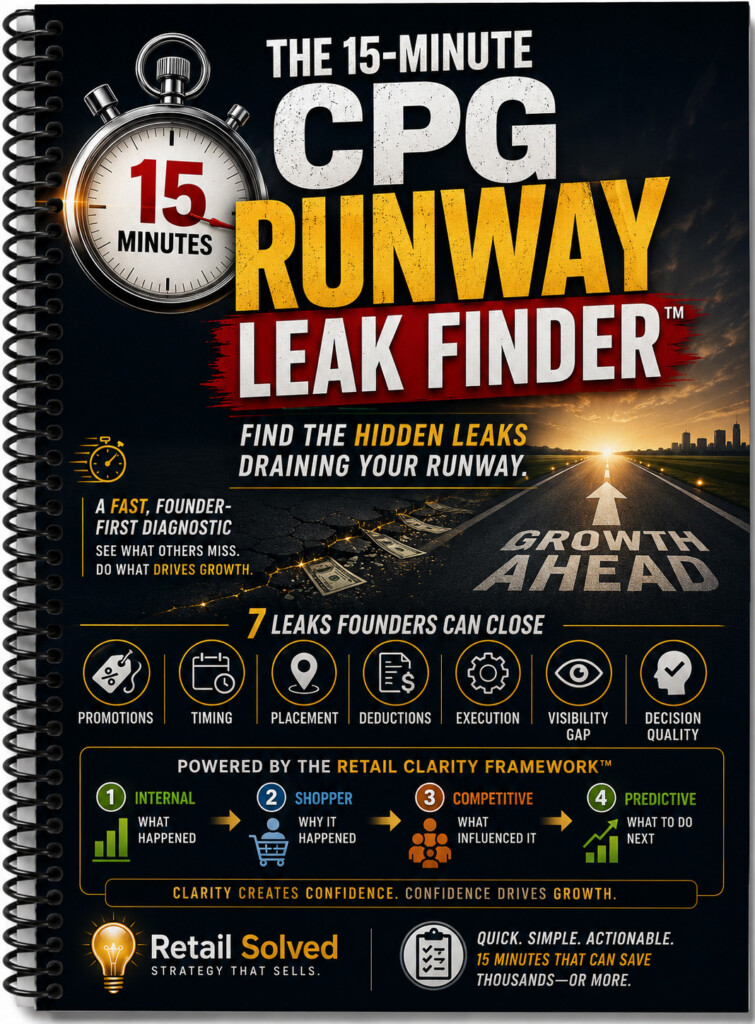
Start here: Find where your CPG brand is losing cash, margin, and runway.
In about 15 minutes, identify the leak creating the most pressure so you know where to look first.
No friction, no email required.
Retail Operating System™
The complete 11-module framework for protecting margin, optimizing trade spend, and scaling distribution with confidence.
Retailers run on systems.
Most brands run on hustle.
That gap is expensive.
The Retail Operating System™ is the only structured, data-driven retail growth framework built by a Certified Professional Strategic Advisor who has sat both in the founder seat and across the table from retailers.
It gives emerging CPG brands the same operational discipline, trade strategy, and category leverage that big brands use — simplified and systemized to protect margin, optimize trade spend, and extend runway while scaling distribution.
This is not education.
It’s infrastructure.
Image is the property of CMS4CPG LLC, distribution or reproduction is expressively prohibited.