Getting into retail can be one of the most expensive yeses your brand ever receives.
Most founders are taught how to pitch investors: founder story, product, traction, market opportunity, growth, and the ask.
Retail buyers are making a very different decision.
They want to know where the product belongs, who buys it, what it does for the shopper and category, what the retailer gains, what risk they are taking, and what happens after they say yes.
In this episode, I share why a motivated shopper once spent roughly 20 minutes trying to find a newly launched product that was already authorized and in the store — and why that story eventually helped inspire the New Item Essential System.
I also walk through the five questions every brand should pressure-test before its next retailer presentation:
- Where exactly does the product belong?
- Who is the shopper, and why does that shopper matter to this retailer?
- What can you show the retailer that they do not already know?
- What does the retailer gain if they say yes?
- What happens after they do?
You will also hear why I believe the brand must continue to own its strategy even when working with great brokers, distributors, data providers, agencies, and software partners.
The goal is not to become a retail expert overnight.
It is to build your retail muscle one skill, one item, one retailer, and one better decision at a time.
Listen where you get your podcast








Like what you’ve heard?
Please leave a review and comment on iTunes
Let me know your most pressing question, I’ll do my best to answer it on a future episode.
Episode 335 CPG Pitch Deck: What Retail Buyers Need to See Before They Say Yes Getting into retail can be one of the most expensive yeses your brand ever receives. That probably sounds strange. Founders work incredibly hard to get the meeting, get the buyer interested, get the authorization, and finally get the product onto the shelf. But getting the yes is only the beginning. Years ago, an avid podcast listener told me about a product launch she was excited to support. She went into the store specifically looking for the product. She could not find it. She asked a store employee. Then another. They searched for roughly 20 minutes before finally finding the product in a completely different part of the store. Think about everything that had already gone right. The brand created a product someone wanted. They got the retailer to say yes. They got the product into the store. They spent money trying to drive shoppers in to buy it. A motivated shopper actually showed up. And the sale was almost lost because nobody had made one of the most basic things clear enough. Where does this product belong? That story is one of the reasons I originally created my New Item Essential System. And it is why today's episode is not really about building a prettier pitch deck. It is about becoming more useful than the brands you are competing against. Welcome to Bulletproof Your CPG Brand. I'm Dan Lohman, founder of Retail Solved. Now, Let’s roll up our sleeves and get started. If you have been listening to the last few episodes, there is a thread running through all of them. In Episode 332, we talked about why a promotion can increase sales and still make cash tighter. In Episode 333, we talked about why the best product does not automatically win. The product that solves the right shopper problem has the advantage. Last week, in Episode 334, we talked about what happens when the promotion is approved but the shelf does not look anything like the plan. Today I want to move one step upstream. If you're building a CPG pitch deck for a retailer, the question is not whether it looks impressive. The question is whether it makes the retailer's decision easier. Before the retailer says yes, what are you giving them that actually makes their decision easier? Because most founders are trained to do something very different. The industry spends a tremendous amount of time teaching founders how to pitch investors and they then use the same pitch with retailers. Here is the founder. Here is the product. Here is the mission. Here is the market opportunity. Here is our traction. Here is how fast we are growing. Here is why we are different. Here is what we need. There is nothing inherently wrong with that information. But an investor and a retailer are making two very different decisions. An investor is asking, if I put money into this company, what could it become and what will my return be? A retailer is asking, if I give this item scarce space on my shelf, what happens next? Can I trust what the brand is telling me? Where do I put it? Who buys it? What does it replace or sit beside? How does it help my shopper? What does it do for my category? What does it do for my basket? What risk am I taking? Can this brand support the business after I say yes? That is a very different conversation. And yet I have sat through more new-item preparation meetings than I can count where the team was getting ready to walk into a 45-minute retailer meeting with 60 or more slides. Sometimes it felt like the salesperson was preparing to carry a phone book into the meeting. The frustrating part was that some of the best shopper and category work we had done never even made it into the presentation. Instead, the deck became a long version of: Here is who we are. Here is why our product is great. Here is how big the market is. Here is how fast we are growing. Here is a pie chart showing you something you probably already know. Here is a bar chart focused on what I think your priorities should be. Here is what we want from you. Again, that does not mean every one of those slides is useless. It means the presentation is usually built around the brand's story instead of the retailer's decision and most retailers already know far more about their category than your presentation gives them credit for. That is the problem. Think about the last time you needed a favor from someone. Would you begin by telling them everything you wanted from them? I need more space. I need another item. I need a display. I need a lower fee. I need more distribution. I need you to take a chance on me. Probably not. And yet, when I sat on the retailer side of the desk, that was essentially what I heard from brand after brand. I know this well because I lived it. Brands would come to me and tell me what they needed while I was responsible for the assortment, inventory, merchandising, and the decision that could have a very real impact on whether their product succeeded. Almost nobody started by asking what mattered to me. Almost nobody tried to make my job easier. After you hear enough versions of the same pitch, you start tuning them out. That does not mean the brands were lazy or bad at what they did. Most were doing exactly what the industry had taught them to do. The lightbulb came on for me later when the roles reversed and I became the brand. I was determined not to become one of the suppliers I had tuned out. Early on, I was given one of the weakest DSD routes in the company selling salty snacks. These were some of the poorest-performing stores, and a lot of the retailer relationships were not particularly warm. That is the polite way of putting it. Some of the stores had been neglected by us. So I started with something incredibly simple. I tried to help the retailers get what they wanted with as few headaches as possible. I learned what mattered to them. I listened. I followed through. I made recommendations easy to understand. I made the work as turnkey as I could. I did what I said I was going to do and I committed to always overdelivering. It did not change overnight, but the relationships changed. The skeptical retailers started trusting me. Many became friends and business allies. Within a few months, that weak route became the highest-grossing route in the company. As a commission sales person, I literally doubled my paycheck. There was no magic sales trick. I simply stopped thinking first about what I needed from the retailer and started thinking about how I could help the retailer win. That lesson has followed me throughout my entire career. And it is one of the biggest opportunities I see for challenger brands today. You do not have to outspend the biggest brand. You do not need their headcount. You do not need every expensive piece of software they own. You can create an enormous advantage by being more prepared, more useful, and easier to work with. Here is one of my favorite examples. One of the first things a retailer needs to understand about a new item is incredibly basic. Where does it go? Not just which store. Not just which department. What category? What segment? Where on the shelf? What should it sit beside? Why would the shopper look for it there? There is sophisticated planogram software that can cost many thousands of dollars a year. Those tools can be extremely useful if you need them. But you do not need a huge software subscription to answer a simple question. Take a picture of the shelf. Put it into your PowerPoint sales deck. Drop an image of your product into the place where you believe it belongs. Then explain why. That is it. Now put yourself in the retailer's chair. Instead of forcing the buyer to imagine what you mean, you are showing them, exactly specifically and you are supporting your recommendations with facts. Here is the category. Here is the segment. Here is the shelf. Here is where the item fits. Here is what it should sit beside. Here is why the shopper will look for it there. Here is what role it plays. You just removed work from the retailer's decision. A picture really can be worth a thousand words. In this case, one simple picture can do more work than 20 slides of generic information. And if you do not make placement recommendations clear, the retailer may make the decision for you. That is how a good product winds up in the wrong place. Then several months later, someone looks at the sales report and concludes the item did not work. The report may be completely accurate. It may also be telling you the result of a mistake that happened before the first shopper ever saw the product. That is an execution leak. That is why the fundamentals matter. So before your next retailer presentation, I want you to pressure-test five things. First, where exactly does the product belong? Can the buyer see the shelf in their mind? What category? What segment? What products sit beside it? Why does your shopper expect to find it there? If the retailer has to figure that out for you, you are adding work and adding risk. Second, who is the shopper and why does that shopper matter to this retailer? Do not stop at a generic demographic. "Millennial moms who care about wellness" does not tell the retailer very much. What problem is the shopper trying to solve? How do they use the product? What do they buy with it? What makes them choose it again? What else is in their basket? Why is that shopper valuable to this retailer? Our product appeals to busy on-the-go moms searching for a easy quick to prepare meal solution. Our customers frequently also purchase organic milk, organic snacks, and organic bread when they purchase this item. Their basket it 15% higher as a result. This is exactly why I keep talking about listening to real shoppers. The company can explain what it makes. The shopper can explain why it matters. Your job is to turn both into a retailer story the buyer can use. Your job is to help the retailer easily connect the dots between your items and the other things your customers frequently purchase. Third, what can you show the retailer that they do not already know? This is especially important if you are already selling in their stores. The retailer already knows how your item is performing. They have the numbers. They do not need you to spend half the meeting reading their own report back to them. Show them something useful. A shopper signal. A category gap. A placement problem. A market opportunity. A competitive weakness. A new use occasion. A basket opportunity. A reason your shopper makes the category more valuable. For example, maybe you discover plant-based sales are growing more slowly at this retailer than at a key competitor, even though this retailer's shoppers strongly align with your product. Now you have something worth investigating. That is how you stop being another brand asking for something and start becoming a resource. Fourth, what does the retailer gain if they say yes? Most brands can explain exactly what the brand gains. More doors. More volume. More awareness. More credibility. More distribution. But the retailer is responsible for their business. What do they gain? Does your product bring a valuable shopper? Does it fill a real assortment gap? Does it improve the category? Does it help the basket? Does it create a new occasion? Does it make the shelf easier to shop? Does it help the retailer stand for something important to its customers? Does it reduce a risk or solve a problem? Your product does not need to do all of those things. It just needs to some of those things a little better than some of the other brands the retailer sells. But you should know which one matters. Fifth, what happens after the retailer says yes? This is where a lot of brands get into trouble. Who owns the setup? Who verifies the item landed correctly? Who checks the shelf? Who watches inventory? What does the broker need to know? What is the promotion supposed to accomplish? What does the distributor need? How are you going to measure success? What happens when the first problem shows up? What happens if the item is in the wrong place? What happens if inventory is sitting in the distributor warehouse? What happens if the promotion is approved and the shelf is empty? Getting the authorization is not the win. The next sale, and the sales that come after it, matter even more. Authorization is permission to prove that you deserve the shelf. The deck is not the strategy. It should be evidence that you understand the strategy. And this is where another story becomes important. Years ago, I interviewed the founder of Bubba's Fine Foods on the podcast. His company had started small and focused. For the first couple of years, they were profitable. They sold directly online and then began shipping directly to stores that were asking for the product. The demand was pulling them into retail. Then they decided they wanted to grow faster. They hired an experienced master broker. The founder wanted to start carefully in the western United States where the company could support the business. The advice he got was essentially, why limit yourself? Go national. Very quickly, the product was pushed into distributor DC’s from the West Coast to the East Coast. The problem was that the brand had not yet built the infrastructure to support that footprint. They learned about free fills. Chargebacks. Distributor costs. The cost of supporting velocity. And the simple truth that getting product into a distribution center does not mean a retailer has committed to it, and getting onto a shelf does not mean the product will move. This is where fees, chargebacks, deductions and cash pressure can start compounding. The founder described adding roughly a thousand stores during that period. Sales activity looked like growth. Cash told a different story. Eventually, he ended the master-broker relationship, focused on the markets the company could actually support, and let some of the other distribution go. I am not telling you that story because brokers are bad. They are not. Good brokers can create enormous value. The lesson is much bigger. Do not hand the keys of your brand to anyone. Your broker should help execute the strategy. Your distributor should help move product. Your software should help support a process. Your data should help answer a specific question. Your agency should help bring expertise. But the brand still has to own the strategy. You need enough understanding to ask whether the recommendation actually makes sense for your business. Can we grow profitably in these new retailers, regions and channels? And if we do, can we actually support that growth financially and operationally? You need enough retail muscle to know what questions to ask, what good looks like, where the risks are, and when something does not make sense. That is the distinction. The easy button comes after the fundamentals. The tool can help you move faster. It cannot decide where you should be going. And that is why I have become so focused on what I call building your retail muscle. Think about any great athlete. They do not become great because they discovered one secret trick. They practice the fundamentals over and over until those fundamentals become automatic. Retail works the same way. One retailer meeting. One better shelf recommendation. One shopper question. One clearer broker assignment. One promotion with a specific job. One piece of data bought to answer a specific question. One scorecard that makes ownership visible. One better decision. Then do it again while striving to be a little better the next time. At first, you have to think about every move. Over time, those moves become retail muscle memory. They get baked into your brand's DNA. And that is when a challenger brand starts becoming very difficult to compete against. Not because you suddenly have the biggest budget. Because you are more prepared. You ask better questions. You make fewer preventable mistakes. You make the retailer's job easier. You learn faster. You waste less money solving the wrong problem. And you become more useful every time you sit across the table from a retailer. That is the advantage. If you're building a CPG brand and want practical help competing at retail without wasting money on the wrong fix, subscribe. That's what we work on here every week. And before your next retailer meeting, I want you to do one thing. Do not begin by opening your current pitch deck. Open a blank sheet of paper and write this question at the top: How can I make this retailer's decision easier? Then answer the five questions we just covered. Where exactly does the product belong? Who is the shopper and why do they matter here? What can I show the retailer that they do not already know? What does the retailer gain if they say yes? And what happens after they say yes? If your current presentation cannot answer those questions clearly, do not add another 20 slides. Fix the fundamentals first. I created a free resource to help you do that. It is called the New Item Essential System. It walks you through the retail fundamentals behind a stronger new-item plan, including the story, placement, shopper, trade, data, assortment, broker, merchandising, and execution questions that can determine what happens before and after the retailer says yes. The goal is not to become a retail expert overnight. Start with one question: Which retail fundamental is costing you the most right now? Then build that muscle first. You can get the New Item Essential System free at: RetailSolved.com/guide13 Again, that's RetailSolved.com/guide13. One skill. One item. One retailer. One better result. Then build the next muscle. Because retailers do not need more brand promises. They need brands that help them win. I'm Dan Lohman. This is Bulletproof Your CPG Brand podcast. Thanks for listening.
Enter your name and email address below and I'll send you periodic brand building advice, tips and strategies.
Sign up to receive email updates
FREE Trade Promotion ROI Calculator:
Click Here To Maximize Sales And Profits
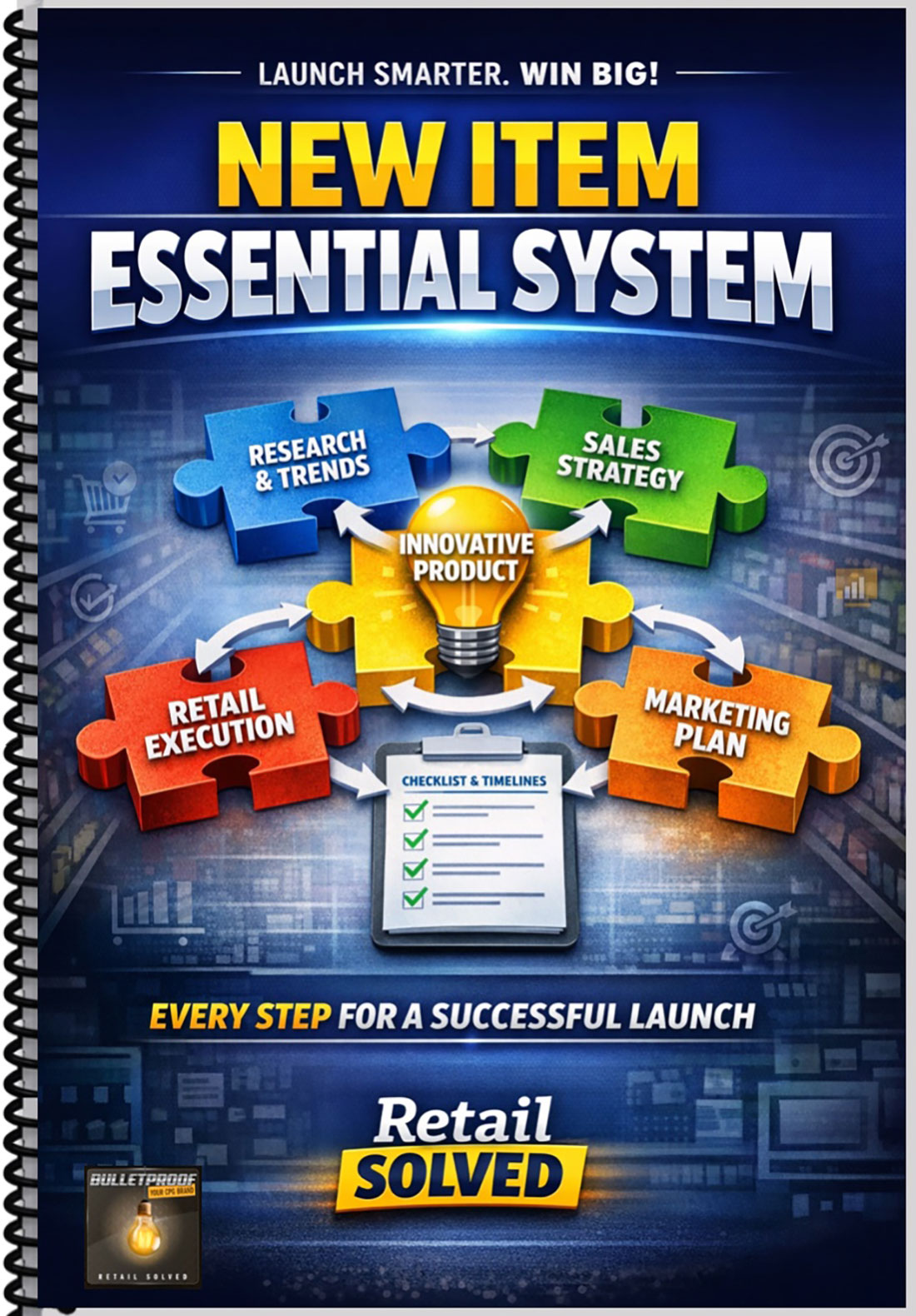
Most new items do not fail. They never had a real chance.
Pressure-test the shopper, placement, retailer value, execution, economics, and support behind the launch.
Retail Operating System™
The complete 11-module framework for protecting margin, optimizing trade spend, and scaling distribution with confidence.
Retailers run on systems.
Most brands run on hustle.
That gap is expensive.
The Retail Operating System™ is the only structured, data-driven retail growth framework built by a Certified Professional Strategic Advisor who has sat both in the founder seat and across the table from retailers.
It gives emerging CPG brands the same operational discipline, trade strategy, and category leverage that big brands use — simplified and systemized to protect margin, optimize trade spend, and extend runway while scaling distribution.
This is not education.
It’s infrastructure.
Image is the property of CMS4CPG LLC, distribution or reproduction is expressively prohibited.