I found a roughly $15 million growth opportunity gap inside a brand that was already in the stores.
They did not need another retailer.
They needed the right products in the retailers they already had.
The brand had 16 SKUs, growing distribution, brokers, promotions, and plenty of reasons to believe things were moving in the right direction. But store by store, the assortment told a very different story.
Retailers were carrying the brand — but often not the core products shoppers in the category looked for first.
That created three expensive problems at once:
- weaker competitive positioning
- harder-to-build velocity
- trade promotions being forced to work much harder than they should
In this episode of Bulletproof Your CPG Brand, I show you how I identified the gap and the simple four-part system I used to turn the problem into a much clearer retail strategy.
You’ll learn:
- why more distribution is not always better distribution
- how to identify the products that should form your core assortment
- why specialty items should expand the brand after the core is protected
- how the wrong assortment can weaken promotion ROI
- why a retailer can carry your brand while your existing distribution quietly becomes less secure
- how to find productive whitespace in stores you already have
- the four questions to pressure-test before chasing the next retailer
The lesson is simple:
Sometimes the fastest growth opportunity is not the retailer you have not landed yet. Sometimes the money is hiding in the stores you already have.
Want help finding the retail problem sitting in front of you?
The free Build Your Retail Muscle Founder Problem Finder gives you three podcast conversations to start with, one practical action, and the next resource if you want to go deeper.
No email required.
RetailSolved.com/guide33
Show notes and resources: RetailSolved.com/session336
Chapters
These are based on the actual finished recording:
00:00 — The $15M growth gap hiding inside existing distribution
00:45 — What looked like retail progress was actually a warning
01:20 — The products shoppers look for first
02:04 — Three expensive problems caused by the wrong assortment
02:39 — When trade marketing subsidizes a weak assortment
03:01 — How I exposed the productive whitespace
03:56 — Protect the core assortment before adding more SKUs
04:45 — Why fixing the shelf makes promotions work harder
05:30 — When weak velocity puts existing distribution at risk
06:24 — Distribution vs. productive distribution
06:48 — The four-part productive distribution check
07:27 — Why door count is the wrong growth scorecard
07:53 — Finding money in the stores you already have
08:26 — The free Founder Problem Finder
09:20 — The question to ask before chasing more stores
Listen where you get your podcast








Like what you’ve heard?
Please leave a review and comment on iTunes
Let me know your most pressing question, I’ll do my best to answer it on a future episode.
336 More Retail Doors Won't Fix the Wrong Assortment I found a $15 million growth gap inside a brand that was already in the stores. They did not need another retailer. They needed the right products in the retailers they already had. And here is the painful part. The wrong assortment was not only leaving distribution on the table. It was making their promotions weaker, hurting velocity, and putting some of the distribution they had already earned at risk. If your brand is chasing more doors before fixing this, you may be paying to scale the problem. Ready to hear more? Let me show you what we found — because I see versions of this mistake all the time. Even with big brands. This was an energy-bar brand with 16 SKUs. They were growing and shoppers loved the brand. They had retailers. They had brokers. They were running promotions. From thirty thousand feet, this looked like progress. But when I looked store by store sales, I saw something very different. The brand had effectively allowed retailers and brokers to decide which flavors each store would carry. So one store might have five of the brand's products and still be missing several of the products shoppers in that category looked for first. Think about how a shopper enters a category. In energy bars, there are familiar flavor platforms shoppers already understand — things like chocolate, peanut butter, vanilla, cookies and cream. Those are entry points. A shopper may love cashew, raspberry, pecan, or another specialty flavor. Those products can absolutely make the brand distinctive. But if the shopper comes to the shelf looking for a familiar peanut-butter or chocolate option and your brand does not offer that choice at that store, you can lose consideration before the shopper ever discovers what makes your specialty items interesting. That was the problem. The brand technically had distribution. But the distribution was inconsistent enough that the brand could look incomplete from store to store. And that creates three expensive problems at once. First, it weakens your competitive posture. Second, it makes velocity harder to build. Third, and this is the part most brands miss — it makes your trade promotions work much harder than they should. Imagine paying for a promotion when the store does not carry the products shoppers are most likely to use to enter your brand. You are now asking the promotion to do two jobs. It has to convince the shopper to try the brand. And it may also have to convince the shopper to try an unfamiliar flavor at the same time. That is a much harder sale. Trade marketing can amplify a strong assortment. It can also subsidize a weak one. And if the core assortment is inconsistent, the promotion can create awareness the shelf is not prepared to convert. That is one reason a promotion can increase shipments or even increase sales and still fail to build the business the way you expected. The problem may have started before the promotion ever ran. So I built a very simple view. First, identify the products shoppers in the category buy most consistently. Then identify the brand's strongest products that align with those shopper entry points. Then overlay the brand's actual distribution — store by store and retailer by retailer. Now the whitespace becomes visible. Not theoretical whitespace. Not "we should be in more stores" whitespace. Productive whitespace. Where are we already doing business, but failing to give the shopper the core choices they expect from us? In this case, the gap was roughly $15 million. Again, that was an identified opportunity gap — not a claim that $15 million automatically fell into the bank account. But it changed the decision. The first growth priority was no longer: "How do we get more doors?" It became: "How do we make the doors we already have work harder?" That is a much better retail question. This is product distribution. The KPI strategy I recommended was straightforward. Before we keep layering in specialty items, make sure the retailer carries the brand's priority core assortment first. The exact number will vary by brand and category. In this case, think of it as a core group of roughly five priority items. Those items earned first position in the selling story. Then the specialty flavors became the next layer — the products that expanded choice, created discovery, and made the brand unique after the core was protected. That gave the sales team and broker a much clearer assignment. Instead of: "Get as many of our 16 items in as you can." The assignment became: "Protect these core items first. Close these gaps. Then earn the right to expand the rest of the assortment." That is a strategy somebody can actually execute today. And notice what happens to the promotion once you fix the shelf. Now when you invest trade dollars, the promotion reaches more shoppers with products they already understand. A shopper may enter the brand through the familiar flavor. If the product delivers, that trial gives the specialty assortment a better chance on the next trip. So the core items do more than generate their own sales. They become a trial mechanism for the rest of the brand. That is what I mean when I say one SKU can work harder than the number printed on its own sales report suggests. Its job may be to recruit the shopper. Its job may be to establish the brand in the category. Its job may be to make the retailer's assortment easier to shop. Its job may be to make the promotion work harder. This is why I get nervous when somebody wants to cut or swap an item simply because one metric makes it look weaker. The metric may be accurate. The decision can still be incomplete. There was another warning sign in this case. Before I started working with the brand, I could see distribution beginning to erode. Some retailers were at risk because the brand was not consistently meeting the velocity threshold required to justify the shelf space. Think about how dangerous that is. Think about how costly that could be - the loss of a retailer and their shoppers. The team is celebrating new doors while existing doors are becoming less secure. They are spending money to expand while the core is quietly weakening. That is not growth. That is complexity wearing a growth costume. And I have seen this pattern at much larger businesses too. New items are exciting. Innovation gets attention. Retailers want something new. Sales teams want another reason to call the buyer. But if the new item replaces one of the core products shoppers buy first, you can make the assortment more interesting and the business weaker at the same time. This is why I separate distribution from productive distribution. Distribution tells me you got the yes. Productive distribution tells me the shopper can find the right product, the assortment makes sense, the retailer benefits, the economics work, the promotion has something solid to amplify, and the brand can support the business well enough to repeat it. More doors are useful only when the system underneath them can carry the weight. So before you chase your next retailer, I want you to run a very simple four-part check. First, identify the category entry points. What are shoppers most likely to look for first when they enter your category? Second, identify your core brand items. Which of your products best meet those familiar needs and recruit shoppers into the brand and category? Third, overlay the actual distribution. Which stores are missing the core even though they already carry your brand? And fourth, pressure-test your trade plan. Are you spending promotional dollars in stores where the shelf is prepared to convert the demand you are paying to create? That is the work. Not glamorous. Not complicated. But it can be worth a lot of money. And this is where I want to challenge the way this industry talks about growth. We celebrate the retailer win. We celebrate the distributor. We celebrate the new geography. We post the store count. But the brand does not get paid for collecting doors. The brand gets paid when the right shopper buys the right product often enough at economics the business can support. That is a very different scoreboard. Sometimes the fastest growth opportunity is not the retailer you have not landed yet. Sometimes the money is hiding in the stores you already have. It is in the missing core SKU. The shelf placement nobody checked. The promotion running against the wrong assortment. The distribution gap your dashboard averaged away. The deduction everyone accepted as a cost of doing business. The broker assignment nobody made clear. Those are the retail equivalent of finding free money in the couch cushions. Except the couch cushions can be worth tens of thousands — or, in the right situation, millions. That is also why I built the Build Your Retail Muscle Founder Problem Finder. After more than 335 episodes, you should not have to search an archive and guess which conversation might help. Hear from top CEO’s and industry thought leaders. Scott Jensen of Rhythm superfoods said “Listening to a half a dozen of your podcasts with the breadth of them being as many as they are, you can listen to half of those and get an MBA in entrepreneurship” Start with the problem sitting in front of you. Maybe it is: "I got the yes. Now what?" Maybe: "My promotions are not paying back." Maybe: "My product is not moving at shelf." Or: "I have the reports. I still do not know what to do." Pick the problem and I will point you to three conversations to start with, one practical action, and the next resource if you want to go deeper. It is free. No email required. Go to RetailSolved.com/guide33. Here is the thought I want you to leave with. If you are trying to grow distribution, do not begin by asking: "How many more stores can we get?" Ask: "Are we making the stores we already have productive enough to deserve the next ones?" Protect the core. Make the shelf easier to shop. Give the promotion the right products to amplify. Use the specialty items to expand the relationship after the shopper has a reason to trust the brand. Then grow. One skill. One item. One retailer. One better result. Then build the next muscle. If this episode change the way you think about doors vs profitable distribution, share it with a founder looking for an edge. Thanks for listening to the Bulletproof your CPG Brand podcast. You can download this weeks free guide and the show notes at retailsolved.com/session336
Enter your name and email address below and I'll send you periodic brand building advice, tips and strategies.
I'm Daniel Lohman. This is *Bulletproof Your CPG Brand*.
There is always a free guide at the end of every episode to help you go deeper in the topics we cover.
Now, lets roll up or sleeves and get started.
Sign up to receive email updates
FREE Trade Promotion ROI Calculator:
Click Here To Maximize Sales And Profits
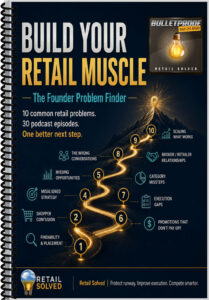
335+ podcast episodes. Start with the problem in front of you.
Choose the retail problem you are facing and get three conversations, one practical action, and the next resource to help you build that muscle.
Retail Operating System™
The complete 11-module framework for protecting margin, optimizing trade spend, and scaling distribution with confidence.
Retailers run on systems.
Most brands run on hustle.
That gap is expensive.
The Retail Operating System™ is the only structured, data-driven retail growth framework built by a Certified Professional Strategic Advisor who has sat both in the founder seat and across the table from retailers.
It gives emerging CPG brands the same operational discipline, trade strategy, and category leverage that big brands use — simplified and systemized to protect margin, optimize trade spend, and extend runway while scaling distribution.
This is not education.
It’s infrastructure.
Image is the property of CMS4CPG LLC, distribution or reproduction is expressively prohibited.