What makes one shopper willingly pay more while another keeps chasing the lowest price?
It is not always the product.
It is whether the product solves a problem the shopper recognizes and whether the brand communicates that value in a way the shopper and retailer can understand.
In this episode, Daniel Lohman talks with Marise May, co-founder of Cha’s Organics, about the values, relationships, and operating choices behind a mission-driven organic brand that has spent 20 years building trust with shoppers, farmers, suppliers, and retailers.
Marise shares how authenticity, simplicity, organic agriculture, Fairtrade, and long-term partnerships have shaped the brand.
The conversation also reveals a larger commercial opportunity.
The people already buying your product can help explain:
• what problem your product solves
• which parts of your story resonate
• what shoppers value beyond price
• what creates trial, loyalty, and advocacy
• how to improve products, packaging, and communication
• how to build a stronger retailer story
• what your broker needs to understand before representing the brand
Your email list and customer community should not be used only for coupons and announcements.
They can become a two-way Shopper Signal System that helps the brand listen, validate ideas, improve decisions, and bring real shopper language into retailer conversations.
You will also hear why generic consumer research can miss the specific people buying your product and how strong supplier and community relationships can create resilience when costs, logistics, and markets become difficult.
Learn more about Cha’s Organics: https://chasorganics.com
The free Shopper Signal Flywheel™ helps you listen: RetailSolved.com/guide31
The free guide Simple Solutions To Maximize Broker/Distributor Effectiveness helps you translate what you learn into a clearer broker and retailer strategy: RetailSolved.com/guide11
Simple Solutions To Maximize Broker Effectiveness helps you apply that strategy to one broker, one retailer, and one immediate priority: RetailSolved.com/BrokerStrategies
Listen where you get your podcast








Like what you’ve heard?
Please leave a review and comment on iTunes
Let me know your most pressing question, I’ll do my best to answer it on a future episode.
That's very true.
Enter your name and email address below and I'll send you periodic brand building advice, tips and strategies.
I think a lot of people, um, don't
have that platform to express, you know, what they really
want, what they want from their food, what's important to them.
And it is valuable information.
Like you said, you don't have to go out and pay for it from a data set.
I think that's why we used to really like early on.
We felt we benefited a lot also from doing demos and doing consumer
shows because you would have that live interaction and I found that very valuable.
It wasn't just about selling the product.
It was finding out what's resonating with this person in front of me.
What does this person in front of me really care about?
You know, when I'm describing the product, do certain things
kind of fall flat, I know there's certain things where you just see them light up.
A mission driven brand does not become more valuable, simply
because the founder believes deeply in the mission.
It becomes more valuable, when shoppers understand
that mission, see themselves in it, and want to carry it forward.
Later in this episode, you will hear
how a founder can turn an occasional customer and a loyal evangelist
by creating a more personal relationship with the people who
are already by your product.
It begins simply by listening instead of simply promoting
ask useful questions.
Learn the words your shoppers use, invite them deeper
into the values behind your brand.
Then use what you learned, improve your products, packaging
communication, retailer story, and repeat purchase.
I call this the shopper signal flywheel.
Maurice has spent 20 years building chire organics,
around authenticity, organic agriculture, fair trade,
and a deeply personal commitment to making good food while
creating a positive impact.
Her story shows why the relationship between the
founder, the mission, and the shopper matters so much.
Are you ready to hear more?
Welcome to the bullproof your CPG brand podcast.
I'm Dan Loman, founder of retail salt.
I help CPG founders protect runway, improve
execution, and compete smarter.
Today I'm talking with Maurice, the co-founder of Triorganics.
Now, let's roll up our sleeves and get started.
Medice, thank you for coming on today.
Can you please tell me about yourself and your journey to where you're at today?
Sure, thanks so much, Dan.
I'm really excited to be here.
Um, well, my name is Maurice May, and I'm the
co-founder of Chas Organics.
We are in our 20th year now out of Montreal and Canada.
And we are widely known as Canada's favorite organic
coconut milk.
We also carry a wide variety of other products, coconut based
mostly, but also spices, some really nice snacks,
coconut rolls, and some heirloom rice.
Our products are sourced in Sri Lanka.
And we work with some really cool, fair trade
organic, regenerative farmers over there.
So we're just all about good food, making good things happen in the world and
trying to make the world a better place for everyone while eating well.
Well, I appreciate you coming on, and Matt was on the on
the podcast before.
He works for you, and he did an amazing job, and the
thing that impressed me most...
is how you are doing it right and what I say doing it right.
The fair trade, the organic, the regenerative organic, and
how you're giving back to the community.
Let's start by talking about that commitment that you've made.
Not only to your brand, to your consumers, Because that's
important, but more important, not more importantly, but.
If they understand or appreciate why that matters, that's
going to help you help them.
Yeah, um, thank you for, uh, starting
with that because that's really at the heart of what we do.
Um, I would say that we came to business a little bit,
uh, unconventionally.
My background is in nutritional science and my partner, Chanaka, is actually
from Sri Lanka.
I have been vegetarian since birth and often
on vegan my whole life.
Always had a real deep care for animals and the environment.
I always wanted to make the world a better place.
And I think when I was growing up, as a lot of young people do,
I saw a lot of problems in the world, which could seem insurmountable.
Um, and sometimes my young 20s,
when I was graduating from my nutrition degree, I realized that there
was only so far I could go through academia or
through those conventional channels, if I really wanted to have an impact.
I mean, I really didn't want to just be one person,
you know, giving one person advice or really limited in that way.
I just felt like I wanted to have an impact.
Like I wanted to make a difference in the world.
And I started to realize that even though I wasn't really from
a business background, let's say, I was really looking at more
like the scientific side and the nutrition, you
know, environment whatnot.
I started to realize that really business, um,
is so important because most people in the end are influenced through marketing.
So I was of that mindset when I traveled to Japan after
my finishing my bachelor degree in nutritional science and I met Chana,
my partner, um, who was living in Japan and I
guess say we hit it off and, uh, We
quickly realized that there was something pretty cool between the synergy
of where he comes from and these really
nice, you know, products, like, I
don't want to call them products, but, you know, crops,
foods, like coconut, like turmeric.
There were things I was really interested at the time, having recently discovered
Ayurveda, and the healing benefits of spices, especially
turmeric, and I was really onto coconut at the time in the early 2000s
for like so many reasons, the healthy fats, the versatility.
And as a vegan, you know, who had always avoided dairy.
I was really into this like bringing these products to market in Canada.
Um, And he is very entrepreneurial,
I would say, and really like of the people that understands, you know,
the reality of the people in Sri Lanka, the farmers, he really gets it.
So we realized we had this cool synergy between the 2 of us and
I guess that was the foundation of where we ended up building our
business out of was this, this really like heartfelt
commitment to doing good for people, like doing
good for consumers, helping them eat better, helping them be
able to have impact as well, you know, bringing that impact
into the hands of consumers.
And then also making sure that what we do, we do it right.
Like you said, you know, so we work with the right partners, we get to know them.
We know what they're doing, how they're growing, how the
environment is impacted, how their people are benefited.
And so that's just what we've been doing.
And now, yeah, we just celebrated our 20th year in business.
So still going strong and I just got back from Sri
Lanka, actually, and, uh, it's always just so inspiring
to go there and really see on the ground, you know, what we're involved in.
It's pretty cool.
Well, I personally really appreciate what you're doing, and I appreciate
the commitment that you're making.
And also I love the fact that you've given a bigger voice to this.
And so kind of a funny story.
There was a, there's so much noise in the industry
about what you should eat what you shouldn't eat.
And there was someone at one
of the local retailers, the big retailer here.
Had a nutritionist that put out a ranking of all
the different products, and they took a vegan,
Spaghetti, I forget exactly.
I think it was made out of broccoli or something like that.
I forget what it was.
But anyway, that was less healthy than the
stuff that has carbs and white flour in terms of their ranking.
My point is, you're giving a bigger voice to a
problem, and you're doing it more consistently
with more people, and I don't, you don't
have the, um, because of your authenticity.
I'm not getting your bias.
Let me put it that way.
Can you go into that a little bit more?
Like, sorry, just if you could just back up for a minute.
So, um, basically, what is what you're saying,
like, that we just sort of present the product transparency without
transparently without trying to, like, impose a bias or.
No, no, thank you.
I appreciate it.
Sorry, I'll try to be more clear.
So I go to one store.
I'm told this is the way I shoot it.
I go to another store.
This is the one I should eat.
I listen to one nutritious, here's what I should do.
The point being is that your brand promise.
is consistent with everyone you talk to,
the way you present it, the way you communicate it.
The way I experience it when I take it home.
That matters.
Because it's not only a brand promise in terms of how you give
back and all that other stuff, we'll get to that in a minute.
But the fact that it's consistently good for
me, it's regentive, I mean, it's got the things that I need.
Can you dig into that a little bit more?
Yeah, actually, great point.
Thank you.
Um, I think that this speaks to being
uncomplicated, and that's something that I have always valued as a person.
Um, I like simplicity.
I like truth.
I like to kind of cut through the noise and get to the heart of it.
Actually, that's why I study nutritional science.
Um, as a, as a teenager, I had been
really into plant-based foods.
I was discovering veganism.
And at the time, you know, there was like zines and things going around and
they would tell you things, but I was like, how can I really trust this piece
of paper as someone photocopy it and staple together that
I got in my like humanities class at school?
I don't know, you know?
So I really wanted to like dig deeper and I guess I've
always been a truth seeker.
Um, so I like to cut through the noise and
find the essence.
And that's what really excited me about coconut, I would say, early on
and still excites me now is I think that that is one of those, I don't want to say products.
Coconut is just one of those incredible miracle foods that,
um, I think has longevity because it's
just been around for so long and these trees are
so ancient and so incredible and everything we
get from that tree is just fascinating in so many ways,
including the coconut milk, the coconut water, the coconut
water, you know, like all the things that come out of it are just really good.
And I think they've stood the test of time.
We're not so much into, you know, trends and fads.
It's like, here's something that has really healthy
fats that your body needs.
You know, the short and medium chain fatty acids.
You have your loric acid and all of those really
nice fatty acids that actually nourish the gut, the brain cells,
nervous system, um, the gut bacteria, and
so many tissues in the body and just support health.
So this seems to be something that despite what some people will
tell you because I believe there is some misinformation going around,
even in nutritional science around coconut because not all of the research has
been done on high quality coconut.
I do believe coconut is one of those products that will stand the test of time that
will be proven to be healthy.
So many people just enjoy it for the taste and as a dairy alternative
or for cooking, but really it goes beyond that.
So we look for these products like coconut, and most of our products
are coconut or turmeric or chew cinnamon, that really
people have been using for 1000s of years.
And they're simple and they're uncomplicated, and then we don't complicate them.
So we don't add glyphosate into the ground.
We don't add chemical fertilizer into the ground.
We don't spray them with antifungals or pesticides.
We don't add all kinds of other chemicals in the processing.
We don't add any gums, any fillers, you know, so we try
to keep things pure, simple, and uncomplicated, and
we try to only really, um, present
our customers or our consumers with products
that we truly believe in, that we can stand behind.
And I think that might be what differentiates us as almost like
more of an ingredient company, I would say, even though we have snacks,
is that we don't try to reinvent everything and make
some kind of crazy new fad product that, you know.
I won't say anything because I don't know a lot of people out
there, but sometimes I see things that they're kind of like borderline ridiculous,
and I just like to keep things simple and uncomplicated,
and I think that's how we, um, have maintained our
brand integrity over 20 years and will continue to do so,
is with that that promise of simplicity and authenticity
and just keeping things uncomplicated.
I appreciate you sharing that.
I'm going to pick on myself a little bit.
So, years ago, I remember learning
that the leading serial company, the
guy that started it, took a grain of cereal, busted
it apart and put in a bunch of vitamins and nutrients.
I thought wow, that's pretty brilliant.
And I thought, wow, that's really cool that you could do that,
thinking that that was a good idea.
And then when I work for mega food, I'm working, uh,
talking to Trina, low dog, and, and Dr. Wild.
Um, I was learning about the nutrients and how things don't
metabolize in the body, and the point being where I'm going with this, is
that our parents ate organic because that's all there was.
One and two, if you give your body what it needs.
Then it doesn't need all that other stuff.
And three, a lot of the stuff that's processed
or a lot of the stuff that's manufactured doesn't
metabolize in the body.
So,
From my perspective, the reason that we have such a health
crisis in this country, the US, is because of
all the processed foods, and the point being is that...
If you take something and process it, then you either bake
out the nutrients or you do something to
compromise them, where to your point, if
I what nature gave me, then that's what matters well.
So the way that I frame this is this.
If I eat the generic bread, I'm hungry before I finish eating it.
If I eat the best mainstream bread, I may
be satiated longer.
But I'm still, I'll still get hungry and I
still won't, it won't give my body everything it needs.
However, if I spend the extra, say, ¢50 more
for the organic bread.
Then the organic bread's gonna give me what I need.
Therefore, at a higher price point, it's
actually less expensive, because I'm giving my body what
it needs, and I'm satisfying my body completely.
And I was remember I was talking to Matt Goldberg.
Not Matt, uh, excuse me, um, thank Matt.
Anyhow, he, yeah, Max, thank you.
Yeah, so he went full, completely organic, lost a
lot of weight, got really super healthy.
And the point being is that if you're eating healthy,
then you don't need all that other stuff, you eat less
of it, and that's better for you better for your skin
better for anything else.
And then we get to the environment, to the animals, to the planet, et cetera.
Can you can you add on to that?
Yeah, I mean, I think what you're saying is spot on and I think
also it gets lost in a lot of people is there's the processing
and there's the ultra process and that's true.
Minimal processing could include cooking.
You know, that's a form of processing.
So not necessarily all processing is bad.
If you if you bake something, you know, with no added oils
and it's super healthy and it's all organic, that that might not be a bad thing.
But on the other hand, like when you're going into ultra
processing and ultra refining into your point of adding in, the
vitamins and minerals, so you're like stripping the grain of everything,
nutrient dense, and then trying to add them back in synthetically
and artificially, and then,
So there's all kinds of junk going back in there that our bodies don't really know how to handle.
So to your point about organic and organic bread, I mean, I
think one of the biggest issues around wheat and around bread is that here in Canada
anyways, in the United States, we're actually, um, I don't
want to say we, like aren't farmers, are using glyphosate
to desiccate wheat and legumes and grains,
you know, oats, wheat, lentils, chickpeas, pre-harvest.
So this is off-label use.
It's not being used as a pesticide, which it's registered for.
Um, It's actually being used as
a desiccant, which means that, you know, the farmers pass the field, spray
the field with glyphosate, harvest the grain.
That gets ground up, put into flour, and that's the bread when you
when you mention eating non-organic bread.
you know, this is this is what people are consuming.
So yeah, obviously, you're going to have less nutrients,
but you're also going to be hungry because now, Your body's
not working properly.
Like you can't, you can no longer metabolize nutrients properly.
The gut is losing, you know, vital bacteria and it's
changing the bacterial composition.
And now you're not maybe producing the right amount
of vitamins and also neurotransmitters, right?
Because gut bacteria produced serotonin and neurotransmitters.
So just imagine by eating that non-organic slice of bread.
you know, where this leads to and versus.
So when you're choosing the organic grain, now you're feeding
your body, not only nutrient dense food, but
you're not putting into your body these, these toxins,
you know, that are actually just wrecking havoc on our health.
And it does remind me what you're saying about our organic rice because
I just got back from Sri Lanka.
So I was visiting a lot of our organic heirloom rice patty fields.
And, um, This is just, To
me, it's an incredible experience to go and to be there and to witness,
you know, the difference that we're making that are, that our
customers, our consumers, our family here are helping us make
by choosing to buy our organic heirloom
rice, which is available in Canada right now, um, which is, and also
though it goes into our organic coconut rolls, which are available in the United States as well.
So the heirloom rice is grown in such an incredible way.
Um, I was just visiting our farm and there was actually a PhD
student there, so she was, I think, a master's student in agriculture.
So she was really breaking it down, explaining some really cool stuff.
You know, if you don't contaminate the
soil, and I will say, contaminate with nitrogen-based,
fossil fuel-based, chemical fertilizer, this
is the 1st this is the 1st step in the soil health
and soil balance going off is just when you fertilize.
If you don't put that stuff in the ground, and you plant this
heirloom seed, which is perfectly suited to the environment,
to the climate, and you give it enough space to grow, and
you give it enough nutrients, compost, you know, just natural
things, and you just let the soil be, it
grows these incredibly strong plants that are so resilient
that you don't even need to apply pesticides.
So this woman was there in the field and she was observing and she was observing all the insect species.
And they're are insect species in the field that
would decimate these conventional crops that are being
applied, you know, where you're applying the fertilizer and the pesticide and the glyphosate.
And they're not harming our crop.
So the reason for that is that the plant itself has its own built-in
resilience has its own built-in immune system, really.
And when you don't over fertilize, it creates
stronger roots, now the roots are going deeper into the ground.
And when you leave the soil microme and
the balance of nature take care of, you know, that that
plant, it develops these really strong synergies
between the soil microbiome and the plant and the root systems
and the fungi, and then they have these species like dragonfly
and spiders that are natural predators.
And the whole system works.
Like it just works if you just let it be.
And they have these beautiful plants growing that are, you know,
after 6 weeks, they're massive and they've got root balls like this.
And I'm thinking, geez, there's people saying you can't grow rice in
Sri Lanka without fertilizer.
This is crazy, right?
But fertilizer is the 1st thing they do to weaken the plant.
So it's just amazing.
It just reminded me of what you were talking about because like everything that,
you know, that applies in us in our gut, really, you can apply that to the
soil and the plants growing there.
It's true.
In fact, actually, I've had a lot of people on the podcast who've,
Not gotten, we haven't gotten into the weeds, which this is important, but the point is,
There's so much misinformation.
And for example, organic India.
They made a, the way that they
helped the farmers get off organic.
I get off the pesticides in the herbicides and the fertilizers and stuff like that.
Lotus foods.
What it does.
Jeff Moyer from the Rodeale Institute.
Actually, this is before they had the certification.
Uh, the, the, the, the regenerative certification he came
on and was sharing a lot of the same thing about how
the,
When you leave, when you protect the ground that
we're growing stuff in, it makes a tremendous impact.
So thank you for sharing all that.
So, as far as how this relates to your
product, the point being is that the brand promise
is really strong.
And the consistency and the
way that you deliver it.
Can you talk a little bit about how you connect what
you just shared to the consumer that buys your stuff, buys your products.
Well, 1st of all, you know, platforms like this are so important for us
because as you can see, There's a
lot behind our brand, you know, we're more than just a one hit wonder.
We're more than just like a catchy slogan or a cute package.
I mean, there really is a lot of substance there.
And so having an opportunity like this to share
these details to really like, um, elaborate
a little more on, you know, what really goes into
our products, the ethos behind what we do,
our values, how the plants are grown.
All of this, I think, is really what reaches a lot of our core consumers.
And one way that we've been able to build this, you know,
really organically over the past 20 years is, you know, my
partner and I, Chanaka, Maddie, who we've had on the show, our
core team, just getting out there and really speaking to people.
So, like, hitting up all the independent health food stores early on,
you know, door to door, speaking to the store managers, speaking
to even the cashiers, the natural past, getting them familiar
with our brands that they can be our brand ambassadors at the retail level,
was a huge way that we grew our brand early on, doing a
lot of demos ourselves in person speaking again.
Um, you know, showing people that authenticity, communicating who we are.
So they see, okay, this is this is who we are.
I'm the person who goes and sees the farmer.
And I know why I'm buying that product, and I'm the person who's
promising you a product you can trust, you know?
I think that goes a long way that we're not, we're dealing with a lot of middlemen.
you know, we're quite direct and Shanika being Sri Lankan.
We really are direct.
You know, we know some of these farmers personally, we visit them.
Um, and I think that authenticity and
the care and the passion behind what we do.
We just always have to find ways to communicate that.
So it could be through consumer shows, demos, and then,
you know, as went on through the years, obviously social media is
a big part of communicating, being on podcasts, having
any opportunity to give presentations, I always welcome any opportunity
to get in front of a crowd and speak.
Because I think that we have a lot there in
our brand story and actually sometimes too much.
You know, it's hard to pack it in and she was like, okay, what are we focusing on?
But I find depending on who, who I'm speaking with,
you know, there might be a different interest, it might go to more of the
social impact of what we do, how we're helping people,
women, children, communities, the animal rights, animal protection.
We do donate one% of our, um, coconut
milk proceeds to the uh, elephant conservation in
Sri Lanka with a few projects there.
Our product's not picked by monkeys.
You know, they're all plant-based.
So we have like different avenues, different people we reach, I think, with our values and our messaging.
And then it's just, um, I
guess, like it's also a question I have for you, you know?
How can we do it better because I think my biggest challenge
is finding how to reach that consumer who's just shopping for
groceries at the grocery store, you know, who's not on your podcasts
or not on our social media and having a product that
really speaks to them, you know?
And I think that is where our challenge is.
I don't really have an answer for that.
You know, people have QR codes, shelf talkers, uh, all kinds
of stuff, but at the end of the day, the product has to speak for itself too,
you know, and you have a very limited space.
So then, then we just go down to product appearance
and product integrity, product taste and the promise of,
you know, a great product that everyone can trust, I guess.
But I would love to hear your input on how we reach
that consumer at the grocery store, just shopping for their
groceries with all of the brand story and
messaging and impact that goes into our brand.
I'm glad you asked that.
So let me let me back way up and let's talk about the underlying problem.
The underlying problem is that in this industry,
the myth is that if I lower the price, people will buy stuff.
And the, I hate that because it's,
It's assuming that we're all stupid as consumers, and if
you lower the price on a bad product, I'm going to go out and buy it.
Okay?
It doesn't consider value.
And so 2 things.
One, we need to help consumers
understand and appreciate the value that you bring.
That's in your brand story, that's in the care
that you put in the product, that's in the your brand
promise in terms of how you deliver the product, where it comes from
the authenticity, all that other stuff, okay?
That's critically important.
We need to not, as an industry, not
allow ourselves to be.
Misled by the notion that price
is the only thing.
So back to the bread story.
If I'm a retailer, here's how you need to communicate
that, just pick it on the bread story.
So if I'm the cheap generic bread, that customer that buys that,
Probably does not spend a lot in that store.
Their market basket is really small.
If I'm the mainstream bread buyer.
The top of the line mainstream bread, I'm going
to spend more, but I'm still going to go from
store to store to store, et cetera.
And granted, you run into that, especially now this unpredictable environment,
but if I'm an organic customer,
I'm going to buy more organic things across the store.
So my basket is dramatically higher as a result.
So in 2016, I was given a privilege of
putting together, actually wrote a feature article for the
progressive grocer.
And Nielsen gave me access to all their data.
store level at a certain level.
And I was able to prove with that, that
the stuff that we're talking about are the key drivers.
And so the Cliff notes version is,
That in the dairy category, sales are up like one%.
But an organic dairy was up 12%.
organic dairy represents just a small fraction of that category.
If you strip organic out of that out of that entire
category, cells are declining, and I found the
same thing throughout the store, especially when you get into plant-based, into
gluten-free, into all of the stuff that we care about.
Organic particularly, and my point is that...
This is what we need to help the retailers appreciate
so that they can build bigger baskets, keep
their customers in the store and build more loyalty with
that customer while they're there.
So the point being is that, and this is where all my content is
focused, is that,
If I can help you help our
community better communicate to the retailer,
the value that we bring in terms of the consumer that
we drive into the store,
That's the win.
Your thoughts?
I think that's spot on.
I think that's absolutely true.
Um, I agree, because I know that the consumer who looks for
our product, they care about their health, they care about their family's health.
They're willing to spend maybe that dollar more, to get premium quality,
you know, gum free or like the gluten-free vegan organic
snack for their kids, whatever the case may be.
That shopper, um, I know because I'm that shopper.
I know how much my basket, you know, can often be worth.
It can be a little, you know, we spend a
lot of our income on food because food's what matters and at the end of the
day, health is wealth, right?
So, um, yeah, that resonates with me because
like it will draw in a customer who will look for
those higher value products and seek them out.
So if we can bring that customer into the story.
I agree, I think that is a win.
And, and but then again, how do,
so one thing is we, us bringing the customer in.
So that means that's a customer who might have seen us at a trade show,
a consumer show, followed us on social media or someone told them about our brand.
So somehow they became aware of our brand and we draw that customer
in and I love that as a key message to
deliver to the retail buyer or manager.
How, though, do we communicate with a customer who's just walking
the aisles at a store, shopping for, you know, they they
want to pick up some coconut milk to go home and make their curry?
There's 5 different brands.
I know our look is different.
It's exciting.
You know, we have a premium product and a lot of people have tried it and
they know it, but a lot of people haven't.
And my curiosity is always in, in how to,
reach that customer.
You know, what is it in the product itself that can
stand out and acquire that customer when all
they're doing is just scanning the aisle and they don't have time to go
on social media and like look at our latest podcast and what is
this brand all about, you know?
I'm just curious your thoughts on that.
That's another good question.
So.
This is not meant to be a commercial for mega food.
I'm not, you know, I no longer work for them, obviously, as a comfort,
self form, but the point being, what I wanted to share.
Is that if I go into the store and I buy a $5 bottle
of vitamin C, 1000 milligrams, that
sounds pretty impressive, right?
Big bottle, right?
Anyhow, that's just expensive urine.
If I spend 20, 30 bucks, whatever it is to buy their
stuff, the way they make it, et cetera, because.
And by the way, in terms of processing, heat, they don't
put it together with heat, the way that other brands do.
So audio, all the nutrients, et cetera, are in that product.
So the point being, the value, okay?
One, the the 1000 milligrams,
not going to solve my problem as a customer.
To your point, it's going to create other issues with all the other stuff.
I'm putting in my body.
Yeah.
So when you talk about your product specifically.
One, how do we communicate that?
So, building awareness and whatnot.
But the other thing I want to challenge you to do is,
let me ask you, If I sign up to your list, what do you do with my name?
What do you, how do you?
If I give you my email address?
What happens next?
Well, we should have a welcome flow, um, of emails.
However, I will say that we're
currently revamping our entire website and newsletter because
it's been kind of unloved recently.
We've just been so busy that we haven't given it the attention it needs, but
that would be a great way to educate more and
to really, I guess, gain people's loyalty is to have
a great welcome flow of emails where they really get engaged and
learn about our brand, I guess.
No, I'm want so and this is where I'm going.
We're not we're not doing that part that great, I'll be honest.
the newsletter right now.
We really have to.
We're in the process of revamping the whole thing, so it will be great soon.
We're going to change it.
So thank you for sharing that.
So I came up with something called the the Shopper Signal Flywheel.
And the point is this.
If I get onto your list, I'm interested in your product, you can
have a conversation with me.
So instead of using it as a couponing device like
most brands do.
Have a conversation with me one on one.
And start asking me questions.
How do I use a product?
What do I like about it?
Let's say that you wanted to come up with a new product, chocolate or banana.
Which one do you like?
Well, Dan?
Which one do you prefer?
And I'll say chocolate, okay?
And then you say, well, you know, most everyone said chocolate.
So here's the product and a generic looking wrapper.
What do you think about it?
Before you go into production, before you start sourcing,
before you start spending money.
My point being is that,
I can help co-create your products.
One, two.
As you're listening to me, and this is the most important thing.
You're getting valuable insights.
You're learning from me in my voice how
I use the product.
You can then take that to the retailer and say, here's a real customer.
Three, you're pre-selling the stuff.
Your products, so you can go to the retail.
Look, we've got people lined up for this.
You just need to put it on your shelf.
For by communicating like this,
I'm, you're creating a ecosystem
outside of retail so that, let's
say, something happens to the store and you get kicked
off all the shelves, Sally, if those things kind of happen, you
future proof your brand.
So there are a lot of advantages to that.
So anyhow, the point being is that.
There are ways to communicate better with that consumer.
And as you communicate with me, and
help convert me, you know, up your value ladder, from just
a curious consumer to a loyal evangelist
that appreciates and understands everything that you said.
Now I'm going to start evangelizing to my community.
That's how we build this.
Make sense?
Mhm.
Yeah.
Yeah.
I like that actually, and that's good.
Very good feedback, uh, as we're sort of revamping that
whole side of our, uh, our website and our e-com and our newsletter,
um, to use that two-way communication, you know,
not we're not just feeding information.
We're actually getting information that can help us on new
launches and yeah, even pack design and everything.
Very good.
Let me pause here because this is the opportunity I
want every founder to hear your sales report can tell
you what happened.
It cannot tell you why a shopper chose your product.
What they almost purchased instead.
What message mattered most?
What disappointed them or what might turn an occasional
purchase into a habit.
Your email list should not be used only to distribute coupons
and brown announcements.
It can become a two way sharper signal system.
Ask one useful question.
Listen to the language your real customers use.
Learn what they value, what they need next,
and what you could do to make the product easier to understand,
choose and recommend.
Then use those signals to improve your product, packaging,
promotion, retailer conversations, and rep- purchase strategy.
I call this the Shopper Signal Fly Will.
I created a free guide to help you begin using this strategy
with shoppers that you already have.
You can download it instantly, retail solved.com
forward slash guide 31.
You can also download the guide and review the show notes and
find everything mentioned in this episode at retailsov.com
forward slash session 333.
Now, let's get back to Maurice, and how chire organics
turns its values into relationships.
Sharpers can understand and support.
Thank you.
There's so much more.
I mean, trademark, there's so many other things you can do with it.
And the point being, and thank you for saying it, is that, so the big brands, they talk at us.
Um, big brand, bias because we're good.
Why?
Because we're good.
Why?
Because we're fantastic.
Why?
Because you need to buy us.
Why?
It's always about them.
So now you're going to change the messaging.
So you're talking to me as an individual.
I feel hurt.
I feel seen.
I feel part of your community.
And now I'm going to help support your brand.
Yeah, fascinating.
That's very true.
I think a lot of people, um, don't
have that platform to express, you know, what they really want,
what they want from their food, what's important to them.
And it is valuable information, like you said, you don't have to go out
and pay for it from a data set.
You can.
I think that's why we used to really like early on.
We felt we benefited a lot also from doing demos and doing consumer
shows because you would have that live interaction.
And I found that very valuable.
It wasn't just about selling the product.
It was finding out what's resonating with this person in front of me.
What does this person in front of me really care about.
You know, when I'm describing the product, do certain
things kind of fall flat, and are there certain things where you just see
them light up, you know?
I found early on that often when I would just kind of
like talk at people, like I did before with the whole nutritional science thing,
you'd see like their eyes glaze over and be like, no, it's really high in lower acid and
na, na, na, and they'd be like, like get me out of here, you know?
But you say something with um, heart,
you know, something with impact.
Um, we'd explain how, you know, we're helping to save wild
elephants in Sri Lanka, and that would just resonate with people.
They'd be like, oh, wild elephants, you know, that awakens
something inside of me and I feel like, wow, that's really cool.
I want to support that, you know, so I noticed that early on.
And, um, I realize, okay, like as a brand,
I like to geek out and like talk about these things, but
this isn't where we go with our messaging, you know, like we don't market on technical
fact-based, you know, that's not what we do.
We really, we try to reach people with their values, with their
emotions and create that emotional connection with people because really,
I think most decisions are made emotionally.
And, um, Sadly, in food, I think
a lot of brands manipulate that and they
create, you know, this false sense of excitement over really
things that are actually bad for people.
Um, we try to do the opposite.
You know, we try to create genuine excitement because now people realize,
oh, I can have a lasting impact through my actions through my small purchase.
I can make a difference.
And I think people value that.
People want to do the right thing and we give them that opportunity.
But that's something I learned really on one-on-one interactions.
Okay, what works, what doesn't work?
So, yeah, leveraging that on a bigger
scale with 1000s of people in a newsletter is a cool idea too.
Well, thank you for saying that.
And I will include that as this week's free guide.
I always include a free guide in every episode, so thank you.
And let me go one step further.
So when you're talking to the retailer, 1st of all,
Most brands, they use panel groups.
And I cannot tell you how many products
I've seen where the brand group has said, hey, our
product scores really, really high and it fails.
And the problem is, the panels that they're talking to to get the
consumer advice aren't the consumers
that are buying your stuff.
Okay?
They're more generic.
And sometimes they just tell you what they want to say.
I'm not going to say they lie, but the stuff can be very mistaken.
not reliable.
Exactly.
So when you think about it, where I'm going with this, the retailer needs 3 things.
They want a product that they know can earn a profit
in their category, whose contribution.
So base sales increasing natural contribution.
what they take the bank.
One, two.
They want a competitive advantage in their market, meaning that you're
doing something to help them grow and gain more market share.
And three, they want more traffic in their store.
So with that said,
If you can develop a story for the retailer,
that talks about your consumer in your consumer's
voice, again, the market has got all that stuff.
That's something they don't have access to.
So while the big brands are going to come and say, well, this is what consumers think.
Well, that's a generic consumer and you know, I don't know
if I trust it, but if you can say, here's what you can do.
Where I'm going with this is that, I met a brand,
don't want to mention the name, but they were actually popular
bar brand at this point, but they started an entirely different category.
But,
They they had an organic product, and it was authentic.
And they were scattered throughout the store in several different apartments.
And I put together a very informal Facebook
survey for them, and we used their
customers feedback, and they went to the retailer
plus some other data, et cetera, and they got into all 1600
Safeway stores in the produce section, and they grew
from sub 200,000 over 3 million, et cetera.
And the point being is that,
If you can speak to the retailer and
tell them about what their consumer is looking for, that's
the opportunity.
Makes sense?
Yeah.
Yeah, that makes a lot of sense.
And I think when we mention that, it's funny, we've never used panels,
you know, we've, Maybe it's not as we should have, you know, every once in
a while you launch a product, you know, actually, what were we thinking?
that one's not gonna work, but most of them have been successful.
I would say that like, you know, probably over 80% of
what we've launched, maybe 90%.
I think we've had success.
And, um, you know, I think a lot of it comes down
to also really being in touch with the consumer, um,
as we we really are that consumer too.
You know, we build products that we believe in because it's what we would want to.
Use for our family.
Um, I know for myself as a parent, you know, I'm a mom.
I have 2 kids.
Uh, my partner, Chanaka, he's my husband, so he has 2 kids too.
We have 2 daughters.
They're great.
They're amazing, they're athletic, they're busy.
They're always on the go, you know, and they are totally
plant-based in the sense of vegetarian.
Uh, dairy free, strictly gluten free,
you know, for dietary intolerance reasons, and we try to get as much
high quality organic food that's low in any
kind of like added sugars and additives and all that.
So, I really resonate with that consumer.
And I think that consumer resonates with our products.
And so it's not a stretch for me to think, okay,
how will I communicate with, you know, the mom who's looking for a healthy
snack she can trust for her kids.
When, you know, for just, for example, for our coconut rolls, which are,
uh, which are, by the way, really taking off in the states right now, which is exciting.
So something about our coconut rolls is really resonating with the folks down there, which is really great.
Um, I think it's just that and we didn't put
a lot of marketing activity, I'll say, into these products.
They've just kind of taken off on their own, which is which is very exciting.
Um, and I think with our coconut
rolls, what's really reaching people on top of like the cute visuals
and the animals, which is something I'm proud of because I also
say I designed it, but I really co-designed it with my family and, you know, Chanika has some input.
He wanted that Hawaiian look and then the kids really helped me a lot with the colors and the animals.
So I'd say we kind of co-created that as a family.
Um, but something really resonates and I think it's, you know, beyond just acute packaging.
It's this clean, simple ingredient.
You have no idea how many people, because I do our social media.
I see people just literally put our ingredients on social media
and say, this is a great product, you know, just from the ingredients.
So it's like clean, it's just organic heirloom rice, organic
coconut milk, very minimal sugar and coconut
sugar, and then you've got like pure ingredients, there's no additives,
there's no seed oils.
And so it's like, but then you taste it and it's like, okay, it's
gluten free, it's organic, it's vegan, it's all
these things, but they taste really good, you know, like the conventional consumer loves them.
So I think that, that kind of product, like, I
understand how exciting it is as a parent,
to be able to give something to my kids, that checks all the boxes, but doesn't
taste like just some kind of dry generic cardboard.
You know it actually tastes good.
Um, and then figuring out like how to communicate with that consumer
or the kid or whatever.
It's not so much of a stretch because we have a family.
We are that consumer.
We understand the pain points, we understand, you know, things like,
I'll have messaging on my social media, like, uh, you know,
as I'm traveling and having trouble, finding food
that my kids can eat because everywhere you go, it's like, is it gluten free?
No.
Do you have anything vegetarian?
No, you know, is it this?
And then you literally have to walk out of places, like feeling that frustration as
a parent, but then being able to go on my social media and say
like, hey, don't get stuck hungry on a trip, make sure you pack
a couple bags of coconut rolls so you and your, you know, your family can snack on
the beach or whatever because it's true, you might not find something like that wherever you're going.
So like, I think I understand the consumer, understand the pain points,
and it's easier for us to communicate and to understand their preferences.
Um, although I think we can always do better.
So.
Always welcome.
We always welcome advice on how to, how to message those things.
Um, but yeah, I think relating to the consumer is so important.
That's what we try to do.
Fantastic.
Well, now you've got homework.
I mean, not literally homework, but I mean, leverage this.
Anyhow, it's...
That strategy is going to help maximize what you're doing.
So I'm excited that you're doing that.
Thank you for sharing all that.
And one of the cool things about what we're
talking about is our is your ability to give back to
consumers too, and to, to different programs that resonate.
Let's talk about that because as you're putting together
your new strategy,
That needs to be in there.
The personal side of you, because that's going to resonate.
When I'm buying a product.
I don't want to know that it's a faceless brand.
I want to appreciate and understand you because that's where
the authenticity comes from.
So can you talk a little bit about how you
give back and then how you communicate those values as well.
Um, well, one of the important ways that we give back as a as
a brand is through fair trade.
We've been a fair trade brand since we started, and we're
actually Canada's 1st and only fair trade certified coconut milk.
Because our volume of coconut milk is so high, it really is our
bestseller by far, most of our fair trade impact comes from coconut,
but it's not only coconut.
We also have fair trade spices.
We have fair trade tea with our masala chai black tea,
and those are very important products to our line because we know the communities who they
support are important, and we know what the alternatives look like, especially in tea.
So we're proud of those products as well.
And even with our products that aren't fair trade certified,
we do work with partners overseas in Sri
Lanka, who are very on the ground, very involved with
the communities who grow their products, who package the products, and
we always make sure that everyone along the line is being respected
and only respected, but their lives are actually being enriched, you know, that we're giving back.
And that's part of our sort of more regenerative business philosophy is
that we're not only sustainable.
We always want to give back.
So we don't sustain, we regenerate, we actually build the
way that you build soil health, you're over here with compost, with green manure,
with, you know, roots on the ground.
We build community.
We build even the people within our team, you know,
we just, we have that philosophy of continually improving
and continually growing, growing together.
So with fair trade, one of the nice things is that there's a
set standard minimum price, but there's
also a fair trade premium that goes along with the fair trade promise.
And what's really nice about the premium is that this
is actually a pool of funds that goes outside of the actual product.
So the farmer grows and sells the product, or it
could be some, in some cases on a coconut orchard, they could
be workers, but workers that are either treated sort of as
independent farmers.
They're still in a farmer's association.
And so they come and they work on the orchard, as if it's their land,
or they could be workers there or workers on someone else's land.
Bottom line is everyone's getting a fair price, everyone's getting
fair treatment, and they're receiving and their
communities are receiving these fair trade premiums.
What's exciting about the premiums is that actually, it really
helps to build communities.
So it's not only the farmers, but it's the whole farmer's community normally can benefit.
We've seen fair trade premiums go towards things like getting
more access to fresh water in a community that's
way up in the mountains in rural Sri Lanka or having a
footbridge to cross, you know, a little stream, but that's
difficult for children or elderly people to cross.
That could be as simple as that for the whole community.
It could be building a community center
or a daycare, so that all the children in the
community have access and paying for the salary of a teacher, so
that everyone, all the families in the community have access and that helps helps
the whole family, or it could be things like farming
tools, seedlings, organic fertilizer inputs,
training, sometimes, um, some fair trade
premiums will go towards, um, women's empowerment projects.
So, like, helping with either teaching
skills or having equipment like sewing machines.
We've seen like in a small rural town in Sri Lanka where they're
growing spices, a little shop setup where women are selling clothing to the neighborhood.
So people can buy clothes, but they're also making extra money.
So these are always through fair trade that we can empower communities.
And, um, we also have handmade packaging with our spice boxes
where the women making these products are actually, um,
living in rural Sri Lanka where there's not much employment opportunity.
And, you know, often they're at home with a family.
So this gives them an avenue to make money, uh,
in a fair and respectful, equitable way with their hands and
actually handmake these boxes using all eco-friendly materials.
Um, it's cute packaging for our products.
We love them.
It avoids having an import, like, you know, another packaging
product from China, for example, or just from somewhere where it's
just a, it's just packaging at the end of the day, it doesn't have impact, right?
So this is a way that we can leverage the fact that we have packaging to create impact.
And these women are actually working from home with their hands,
making income that's reliable, that is giving back
to their community and it's like win-win.
So we look for these win-win opportunities where it's like, okay, how can
we, you know, we're in this situation.
How can we now use the fact that we have packaging to
make that a positive, you know, create positive impact for someone else?
We didn't have to do it.
You know, sometimes it's complicated because we have to then, you
know, how many boxes do we have overseas and did they count them right and
we go to order them ahead and it can be a little more complex.
But at the end of the day, we know that that matters.
And actually, when we were in Sri Lanka in 2021,
When the whole country had just shut down, we went right after
we reopened the country, which is a really interesting time to be there with the whole transition
that was happening with organic and everything.
It was it was quite interesting.
I could talk a whole hour about that.
But when we visited these women, what we found out that was
that because they also make, um, handicraft products for
tourists, like, you know, little ceramic elephants and stuff
like that and because there had been no tourists, our packaging
was their only source of income for that entire time.
You know?
So you just, you don't always think about those things.
And I remember at the time thinking, wow, because we're
paying so much on container prices.
You know, our container prices had skyrocketed.
At one point we're just breaking even that year.
Like we just couldn't even make profit because all the shipping costs
was so high and everything was complicated, but then I'd stop and think,
but wow, like we've still had so much impact, you know?
And that in itself is a win, I think, to be able to provide
that for other people.
I mean, for us, that matters anyways.
Good for you.
so thank you for doing that.
I mean, that's that's great that you get back and the other thing is...
Because you do that, those non-employees
are going to act like part of your family, they're going to
have been over backwards or treat you well.
Yes, we have this long-term part.
Thank you.
No, we have these long-term partnerships that, um, it's one of these things that
you you see and and I say it all the time as we
experience it, you know, fair trade and and this kind of regenerative
relationship that we build with our partners, it goes both ways, you know?
Sometimes in times of shortage or challenge or scarcity,
you want to make sure that you have a solid partner.
And I think companies who kind of use extractive policies
and don't look for that long-term partnership, they're
going to lose in the end because it's not getting any easier,
let's face it, you know, with climate change and global
insecurity and all these crazy things happening all the time and trade wars
and and, you know, petrol prices and shipping on and on.
There's always some kind of challenge.
And we have found that by having that respectful
and regenerative and long-term relationship that
we build with our partners, um, from, from shipping
to packaging, to, you know, raw
material sourcing, all along the supply chain, right down to the retailer,
is that those relationships actually matter.
And, you know, I know for a fact that sometimes our
shipment will make it onto a container whereas, you know, someone had
to choose and ours will get on because we've built those solid
partnerships where people.
We're like family.
It's true.
Every step on the way were like family and we all treat each other that way, which is, which is nice.
And I appreciate the fact that you share those values.
So thank you.
So now you're going to, you're going to, um,
turn your consumer base into regenerative, however
you want to put that, but you're going to use that, that, that mindset with him.
I think that's fantastic.
And the other cool thing about this industry, the reason I love it, is
because those relationships, even back at home, you
know people in the industry that can help or you know where
their resources are.
And so,
The thing I love about working on, quote unquote, this side of the fence,
meaning natural, small brands, organic, et cetera,
as opposed to big brands, is over there.
When I was working for Unilever right out of college, we're not out of college.
when I was younger.
We used to joke about the only way that we were going to get promoted is
we figured out a way to knock off our boss.
Obviously, we wouldn't do that.
But my point is,
It, it, it was such a different mindset.
Then I went to work for Kimberly, Kimberly Clark.
And we weren't the pretty kids on the block.
So, you know, like, like you see in a lot of companies, but, you know,
everyone worked together in that same mindset, that's here.
Now I'm not saying that company's like that today, but back then it was.
But the point being is that in this industry, there
are always people to reach out to to help to get help from,
if you've got a problem, et cetera.
I love the community.
I really do love the health food community.
It's the best industry.
It's great.
Is there anything that we haven't covered that you want to cover?
Um, gosh, we really covered a lot, but, um...
Well, we just, uh, we'll be announcing a cool, uh,
update soon.
So if anyone uh, is in Canada, especially in Ontario.
I've got something really cool coming up with Costco that we are about to announce.
I think a lot of people are going to get excited about this.
So stay tuned for that announcement and,
um, and we are launching 3 new
flavors of coconut rolls in the Northeast United States
in the next, uh, 3 months, I would say.
So this fall, they'll be rolling out.
We're really excited about these flavors.
We have a passion fruit that's actually made with pure organic
passionfruit puree.
And one of the cool things about passion fruit is you can grow it intercropping
with coconut in an agroforestry model.
So that's one of those crops that's kind of exciting to be
able to offer because we're able to like maximize some
agricultural space and create more income for farmers
while giving this great product.
So no flavors added.
It's pure passion, puree.
I love that one.
We've got a salted caramel that's actually made with pure
sea salt and caramelized, Fairchured organic cane sugar.
So there's no flavor at it again, no seed oils, no garbage.
It's so delicious.
And the probably the most exciting one is the
chocolate filled because this is a chocolate filled wafer
roll that is to die for and it's vegan, it's organic,
it's gluten free, but you would never think,
I mean, like anyone will fall in love with this and it's like a really rich,
just like delicious chocolate.
So we're super excited about those 3 skews.
If anyone's in the northeast, like that whole New York area and
around, you'll be finding those rolling out soon.
So we're excited for that launch.
And they are also coming to Canada.
I know you have a lot of listeners in Canada.
Over the next few months, stay tuned and they'll be coming into
stores in your area probably sometime in October.
So yeah, I'm very excited about that.
Thank you for sharing that.
That sounds exciting.
In fact, I will put a link to you, to your brand, to your website,
et cetera, so people can fall along and join your newsletter.
Yes, yes, and I promise to send more.
We definitely don't span people.
I'll promise you that.
It'll be like, I signed up for this newsletter.
Not getting many messages.
But we're going to change that soon.
We're gonna, we're gonna have great newsletter content.
Well, I'm so thrilled that you came on, so thank you so much for your time.
I'm glad.
And I'm glad and thank you for sharing what you shared about
your trip to Sri Lanka.
That was pretty cool on LinkedIn.
Yeah, and and and we have more coming.
I did just get back, but I'm still posting.
We've got some cool, if you're on Instagram, definitely follow us.
We have some cool video content there,
reels, and I highlight everything in our Instagram highlights.
You can actually watch like all the stories we've shared because we're so busy there.
Sometimes I just share a quick story.
But LinkedIn as well.
I love to bring people along as much as possible over there.
And yeah, thank you so much.
I have really enjoyed this conversation and I know we could talk
forever as we have in the past, so.
Yeah.
Well, thank you.
I appreciate it.
Thank you.
And appreciate all the advice.
Thanks so much.
Thank you.
Manice, thank you for sharing your story and for the work that
you and your team are doing the lessons.
I hope you take away from this conversation is that authenticity
is not a slogan.
It is the consistency between what the founder believes how
the product is made with the sharper experiences and how
the brand communicates.
Maurice and char organics have spent 20 years building that consistency
into their business.
The next opportunity for every mission driven brand is
to stay equally close to the people who buy their product.
Listen to them.
learn their language, invite them deeper into the story.
Then use those signals to make better products, marketing,
retail and growth decisions.
You can learn more about Mauritian China organics,
through the links in the show notes.
You can download the free shopper signal flywheel, and
review everything mentioned in this episode at retailsov.com
forward slash session 333.
Thank you for listening to the Bulletproof Your CPG brand podcast.
I look forward to seeing you in the next show.
Sign up to receive email updates
FREE Trade Promotion ROI Calculator:
Click Here To Maximize Sales And Profits
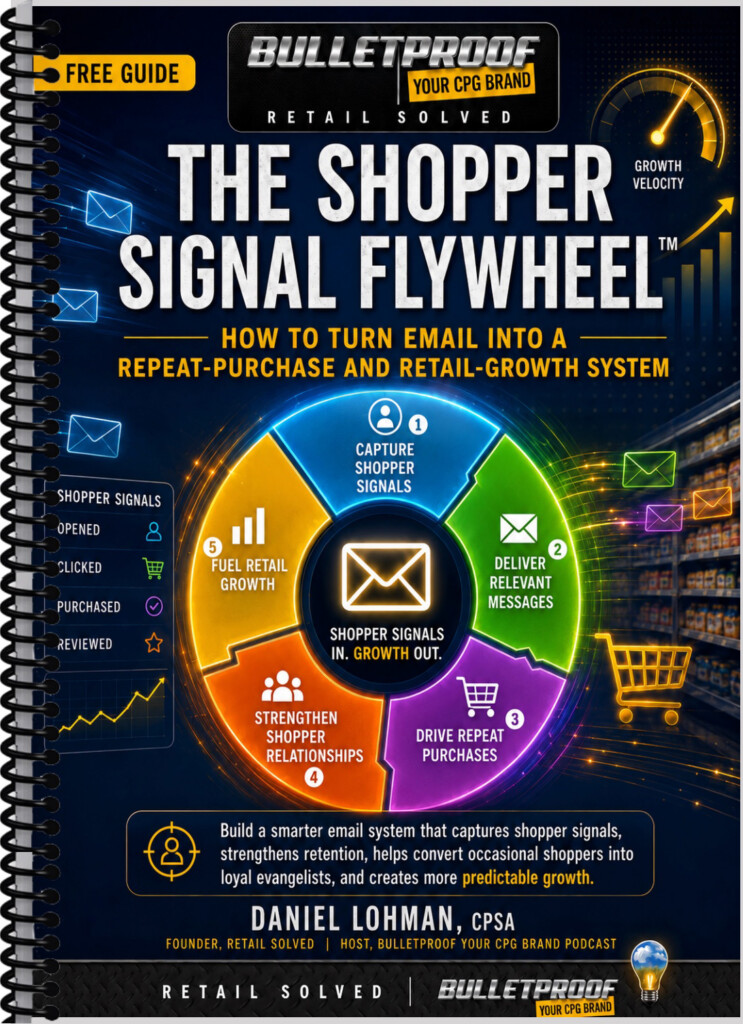
Your shoppers may know what your sales report cannot tell you.
Use your email list to capture real shopper language, validate ideas, strengthen repeat purchase, and build retailer-ready proof.
Your email list can become more than a marketing channel.

If your broker is not delivering, something may be missing upstream.
Create clearer priorities, stronger retailer assignments, better accountability, and the structure your broker needs to perform.
Retail Operating System™
The complete 11-module framework for protecting margin, optimizing trade spend, and scaling distribution with confidence.
Retailers run on systems.
Most brands run on hustle.
That gap is expensive.
The Retail Operating System™ is the only structured, data-driven retail growth framework built by a Certified Professional Strategic Advisor who has sat both in the founder seat and across the table from retailers.
It gives emerging CPG brands the same operational discipline, trade strategy, and category leverage that big brands use — simplified and systemized to protect margin, optimize trade spend, and extend runway while scaling distribution.
This is not education.
It’s infrastructure.
Image is the property of CMS4CPG LLC, distribution or reproduction is expressively prohibited.